
On this page
Start here
Quick answer
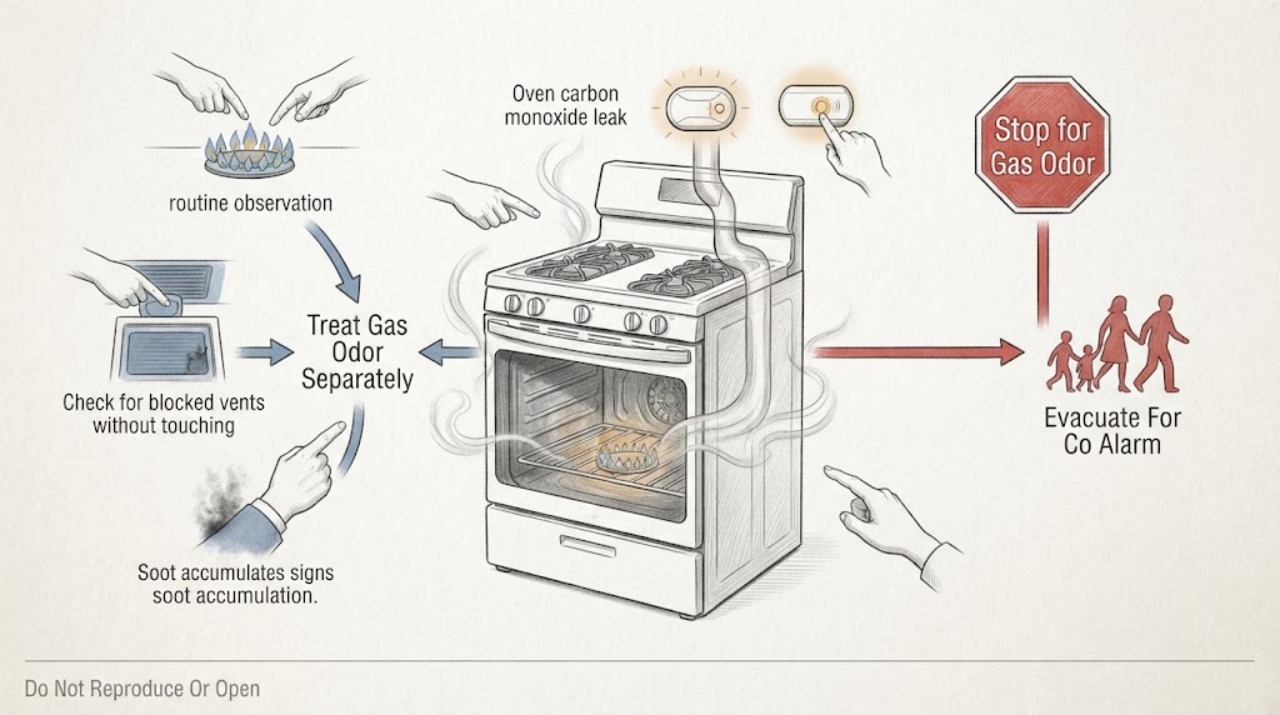
Treat a carbon-monoxide alarm, CO symptoms, or suspected combustion problem as an emergency rather than an oven repair test. Leave the home immediately for fresh air, call 911 or emergency services from outside, and seek medical attention for headache, dizziness, nausea, shortness of breath, confusion or loss of coordination. Do not run the GE oven to see whether the alarm sounds again, open panels, adjust a burner, or re-enter to troubleshoot. GE says unburned gas odor is not normal and directs people not to touch electrical switches and to call the gas supplier from outside; CPSC says hidden appliance damage or combustion problems require a trained service technician. Only after emergency responders or the gas utility say the home is safe should a qualified appliance/HVAC or gas professional identify the exact model, fuel type and venting conditions.
Work through in order
Diagnostic checks
Use only checks that match the exact appliance or system and its official guide.
-
Check 1
If a CO alarm sounds, anyone has CO-like symptoms, or a professional has raised a CO concern, leave the home immediately and get fresh air. Take people and pets if possible without delaying exit; do not stop to run the oven, silence the alarm by troubleshooting, or search for the source.
Expected result: A CO alarm or symptoms such as headache, fatigue, shortness of breath, nausea, dizziness, confusion or loss of coordination are present; or none is present.
Next step: From outside or a neighbor's location, call 911/emergency services and seek immediate medical attention for symptoms. Do not re-enter until the fire department or other qualified responders say it is safe.
Why this matters
Why: CPSC says CO is odorless and colorless, symptoms can resemble flu, and suspected exposure can become fatal if occupants remain. The presence or absence of odor cannot clear a CO hazard.
-
Check 2
If there is a rotten-egg or other unburned-gas odor, leave without touching electrical switches or flames. Do not turn the oven on, attempt to locate the leak, or use a phone inside the home.
Expected result: Unburned-gas odor is present, or the only report is a CO alarm/symptom with no odor.
Next step: From outside, call the gas supplier or 911 as appropriate. Keep the oven off and follow emergency instructions; do not return to compare odors or restart the appliance.
Why this matters
Why: GE says an unusual startup odor from combustion may occur briefly, but unburned gas odor is not normal and requires an outside call to the gas supplier. CO itself has no smell, so no odor does not rule it out.
-
Check 3
After evacuation, do not reproduce the event by running the oven, opening the cabinet, adjusting a burner, changing a vent connection, or trying to make the alarm sound again. Preserve the alarm display/history if it can be recorded without re-entry, and tell responders what happened.
Expected result: The alarm has reset, the oven appears normal, or the suspected event remains unexplained.
Next step: Keep the oven out of service and wait for professional assessment and clearance. Do not substitute a reset, ventilation fan or a short test cycle for inspection.
Why this matters
Why: A normal-looking oven or cleared alarm does not rule out hidden appliance damage, burner adjustment or blockage. CPSC says only a trained technician can detect and correct those hidden conditions.
-
Check 4
Only after responders declare the area safe, provide the technician with any safe, visible information about the installation: exact model, gas/electric/dual-fuel type, alarm time, whether the oven was operating, and any visible soot, rust/water streaking or blocked external vent. Do not remove covers or change the vent path.
Expected result: The exact model/fuel type is known or unknown, and visible soot, moisture, rust/streaking or vent damage is present or absent.
Next step: Keep the oven off and give these observations to qualified appliance/gas service. If the model is unknown, use the exact GE owner-support/manual route after the home is cleared; do not borrow another model's combustion procedure.
Why this matters
Why: CPSC identifies improper connections, visible cracks, rust/stains, sooting and vent or appliance damage as clues, while hidden problems require trained service. GE warns that covering gas-oven passages can block airflow and cause CO poisoning.
-
Check 5
Arrange qualified GE appliance or gas service after the emergency response. Provide the model, fuel type, alarm/symptom history and any responder findings. Do not authorize a user-level burner adjustment, vent alteration or internal repair based on a generic code or symptom.
Expected result: The CO alarm or symptoms occurred, the oven has soot/odor/vent concerns, or the cause remains unresolved after emergency clearance.
Next step: Keep the oven out of service until qualified service and the relevant authority clear it. Seek medical follow-up when exposure or symptoms occurred.
Why this matters
Why: CO risk involves combustion, venting and hidden conditions that the available evidence cannot distinguish. CPSC requires trained service boundaries for hidden combustion problems.
Use your observations
Decision map
Find the observation that best matches what you see, then follow the next safe action.
-
PATH 01Next step
What you see
A CO alarm sounds or anyone has compatible symptoms.
Do this next
Leave immediately, get fresh air, call 911/emergency services from outside and obtain medical attention. Re-enter only after professional clearance.
Why this path and its safety boundary
Why it matters: Treat this as a potential CO exposure; the oven is not safe to test or diagnose from inside.
-
PATH 02Next step
What you see
A rotten-egg/unburned-gas odor is present near the oven or in the home.
Do this next
Leave without touching switches or flames and call the gas supplier or 911 from outside. Keep the oven off.
Why this path and its safety boundary
Why it matters: GE says unburned gas odor is not normal; this is a gas-safety event separate from the fact that CO itself has no odor.
-
PATH 03Next step
What you see
There is no alarm or symptom, but the oven has soot, abnormal combustion, visible vent damage, or a professional has identified a CO concern.
Do this next
Do not run a confirmation cycle or alter the appliance. Arrange qualified combustion-appliance service and keep it off until cleared.
Why this path and its safety boundary
Why it matters: Visible clues can indicate improper operation or venting, while hidden causes remain unresolved.
-
PATH 04Next step
What you see
The oven is confirmed electric-only and there is no separate fuel-burning appliance or external CO source.
Do this next
Follow emergency responder guidance, keep the suspect appliance off, and have qualified professionals identify the actual CO source before use.
Why this path and its safety boundary
Why it matters: The gas-oven combustion branch is not established, but a CO alarm still requires emergency handling and source investigation.
Helpful context
Understand the symptom
Treat CO as an emergency, not an oven troubleshooting symptom
CPSC says CO is colorless and odorless and lists headache, fatigue, shortness of breath, nausea and dizziness among early symptoms. If an alarm sounds or symptoms occur, leave for fresh air, call emergency services from outside and seek medical attention. Do not run the oven to reproduce the event.
Separate unburned gas odor from CO
GE says a brief odor at gas-oven startup can come from combustion, but unburned gas has a different rotten-egg odor and is not normal. Leave without touching electrical switches or flames and call the gas supplier from outside. CO itself cannot be detected by smell.
Preserve airflow and use trained service
GE warns that covering gas-oven passages or an entire rack with foil can block airflow and cause CO poisoning. CPSC identifies hidden appliance damage, burner adjustment and vent blockage as trained-technician conditions. Keep the oven off and do not open, adjust or alter it.
When checks do not resolve it
Need a professional?
For any CO alarm, CO-like symptoms or suspected exposure, leave immediately, call 911/emergency services from outside, seek medical attention and do not re-enter until professional clearance. For gas odor, call the gas supplier or 911 from outside without touching switches or flames. After clearance, use qualified GE appliance/gas service; do not run the oven to reproduce the alarm or perform burner, vent or internal repairs.
Common questions
FAQ
Can I run the GE oven again to see if the CO alarm returns?
No. A cleared alarm or normal-looking oven does not establish safety. Leave the appliance off and wait for emergency responders and qualified service to identify and clear the source.
Can I smell carbon monoxide from a GE oven?
No. CPSC says CO is colorless and odorless. A rotten-egg odor points to unburned gas instead; GE says that odor is not normal and directs an outside call to the gas supplier without touching electrical switches.
Could foil in a gas GE oven cause a CO problem?
GE warns never to cover gas-oven slots, holes, passages or an entire rack with foil because blocked airflow may cause carbon monoxide poisoning and a fire hazard. Do not remove or replace a liner until the exact manual and qualified service address the condition.
Read the exact guide
Official sources
- Gas Range - Gas OdorsGE Appliances · Official GE support guidance distinguishing brief startup combustion odor from unburned gas odor and directing an outside gas-supplier call.
- The Invisible Killer: Carbon Monoxide SafetyU.S. Consumer Product Safety Commission · CPSC safety poster covering evacuation, medical attention, re-entry clearance, hidden appliance/vent problems and trained-service boundary.
- Range & Wall Oven - Using Aluminum Foil or Silicone LinersGE Appliances · Official GE safety guidance for gas-oven airflow passages and foil/liner use.
- Protect Your Family from Carbon Monoxide PoisoningU.S. Consumer Product Safety Commission · Federal CO safety guidance covering gas ranges/ovens, alarms, symptoms and exposure risk.
Community feedback
Share a repair observation
Share a plain-text repair observation. Accepted observations are published automatically; this page may take a moment to update.