
On this page
Start here
Quick answer
Do not use a Samsung NX58H5600SS gas oven again to see whether carbon monoxide is present or to reproduce a suspected leak. Carbon monoxide is colorless and odorless, and an alarm, symptoms such as headache, dizziness, weakness, nausea, chest pain, or confusion, or a credible concern about combustion requires everyone, including children and pets, to leave for fresh air and contact emergency or fuel-gas professionals from a safe location. Do not delay leaving to ventilate, operate switches, adjust burners, relight the oven, remove panels, or treat a household alarm as a substitute for professional assessment. Do not re-enter or resume baking until responders or a qualified gas-appliance professional has evaluated the home and appliance and explicitly cleared them.
Before you begin
Safety first
- Do not use the oven to reproduce the concern, adjust burners or air shutters, relight it, dismantle panels, sample combustion gases yourself, bypass safety controls, or perform live electrical or gas tests. A CO alarm, symptoms, gas odor, hissing, smoke, or fire requires leaving and emergency or fuel-gas response. Keep the appliance out of service until a qualified professional has assessed the home and exact range and has given a clear return-to-use decision.
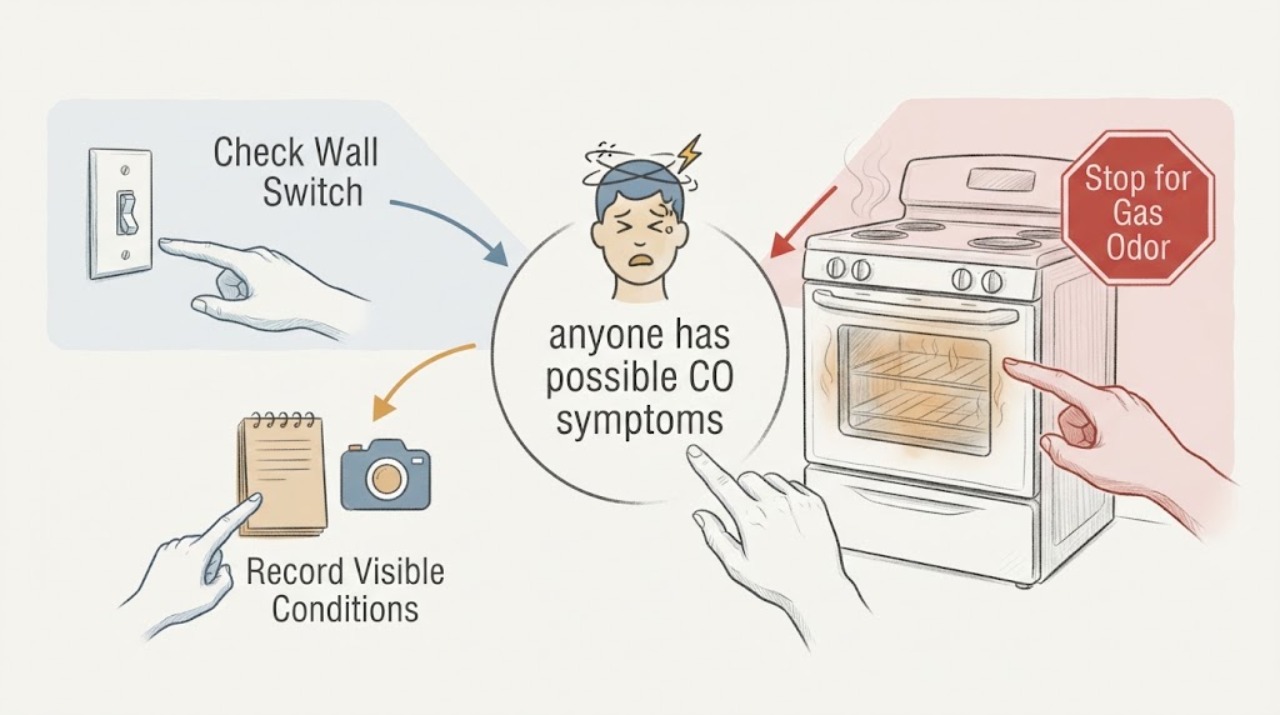
Work through in order
Diagnostic checks
Use only checks that match the exact appliance or system and its official guide.
-
Check 1
If a CO alarm is sounding, anyone has possible CO symptoms, or there is a credible concern about combustion, stop using the oven and leave the home immediately with people and pets. Move to fresh air and contact emergency services from outside or another safe location.
Expected result: The alarm sounds, a person has headache, dizziness, weakness, nausea, vomiting, chest pain, confusion, or unusual drowsiness, or the concern arose during or after using the gas oven.
Next step: Tell responders that a gas range/oven may be involved and follow their evacuation and medical instructions. Do not re-enter until responders authorize it.
Stop if: Do not stay inside to collect readings, open windows as a preliminary test, silence the alarm, finish cooking, or return for belongings.
Why this matters
Why: This is an immediate life-safety event, not a normal oven-fan symptom. CO exposure can become serious without a smell, so the absence of an odor does not make continued occupancy or testing safe.
-
Check 2
If there is a gas odor, hissing, or another suspected fuel-gas leak without a CO alarm, leave without operating appliance controls, electrical switches, plugs, flames, or ignition sources. Call the fuel-gas utility or emergency responders from a safe location.
Expected result: A sulfur-like gas odor or hissing is present, the odor is absent but a CO alarm or symptoms occurred, or no immediate warning is present but the oven is still suspected of producing combustion gases.
Next step: Remain out of the hazard area and give the utility or responders the appliance location and the event sequence. Let them decide whether gas isolation, ventilation, or additional evacuation is required.
Stop if: Do not adjust a burner, relight a pilot or igniter, close or reopen a valve while inside the hazard area, or operate a switch or electronic device in the suspected-gas area.
Why this matters
Why: Natural-gas odor and carbon monoxide are different hazards: CO itself is odorless, while an odor or hissing can indicate unburned fuel. Either condition makes an in-home bake test unsafe; no odor does not clear the oven.
-
Check 3
From a safe location and without re-entering a potentially contaminated home, preserve the event details for responders: whether the oven was baking or broiling, when the alarm or symptoms began, whether other gas appliances were operating, and the exact display or alarm behavior. Use an existing photo or the model record rather than going back inside to retrieve a label.
Expected result: The model can be confirmed as NX58H5600SS from a record or safe photo, the full regional suffix is known, or the suffix and appliance identity remain uncertain.
Next step: Give responders and the service provider the exact model and market only if already known, together with the time, mode, alarm/symptom pattern, and any prior installation or service history.
Stop if: Do not re-enter to photograph a rating plate, inspect a burner, sample exhaust, or retrieve a manual after an alarm, symptoms, or suspected gas release.
Why this matters
Why: Samsung's support page confirms the NX58H5600SS family and its model-specific documents, but the opened official record is a regional /AC variant. A missing suffix limits manual-specific conclusions and does not justify borrowing a combustion or adjustment procedure from another range.
-
Check 4
After emergency responders have assessed the residence, arrange a qualified gas-appliance service visit for the exact Samsung model. Ask the provider to assess combustion, burner operation, installation and venting, adjacent fuel-burning appliances, and any evidence that could explain the reported event; do not request a part based only on the suspicion or an alarm.
Expected result: Responders or the qualified provider identify an unsafe condition, identify another fuel-burning source, find no confirmed source yet, or explicitly clear the appliance after their assessment.
Next step: Keep the range out of service until the responsible professional documents what was assessed and gives a clear return-to-use decision. If the source remains unresolved, request further qualified gas and indoor-air evaluation rather than testing the oven yourself.
Stop if: Do not adjust air shutters or burners, remove panels, bypass ignition or safety controls, use a consumer sensor as proof of clearance, or authorize a replacement part without a model-specific diagnosis.
Why this matters
Why: An alarm or symptom establishes a safety response, not the failed component or the source. A professional finding is needed to distinguish the oven from another appliance, installation/venting issue, or an alarm event with no confirmed source.
-
Check 5
Only after the home and range are cleared, verify that CO alarms are installed and maintained according to their manufacturer instructions, especially near sleeping areas, and keep the Samsung installation and user guide available for the service provider. Do not use alarm testing to justify a bake cycle.
Expected result: A working alarm system and exact model documentation are available, or alarms are missing, expired, misplaced, or not functioning as instructed.
Next step: Correct alarm placement or maintenance only after the immediate hazard is resolved, and follow the qualified provider's written return-to-use conditions for the range.
Stop if: Do not regard a silent alarm, an open window, or one symptom-free test as proof that the oven is safe.
Why this matters
Why: Alarms provide an important warning layer, while the exact Samsung documents identify the appliance and installation requirements; neither replaces a professional combustion assessment after a suspected event.
Use your observations
Decision map
Find the observation that best matches what you see, then follow the next safe action.
-
PATH 01Next step
What you see
A CO alarm sounds or anyone develops possible CO symptoms during or after use of the Samsung gas oven.
Do this next
Leave immediately, get to fresh air, contact emergency services from a safe location, and do not re-enter until responders inspect and authorize it.
Why this path and its safety boundary
Why it matters: The occupants may be exposed to a life-threatening hazard, and the oven cannot be treated as a routine appliance fault or safely tested to identify the source.
-
PATH 02Next step
What you see
There is a gas odor or hissing but no CO alarm, or there is no odor but the oven remains suspected of producing combustion gases.
Do this next
Leave, avoid switches/flames and appliance controls in the hazard area, and contact the fuel-gas utility or emergency responders. Keep the oven off pending professional assessment.
Why this path and its safety boundary
Why it matters: A gas release and a CO concern cannot be ruled out by the absence of the other warning; CO is odorless and an unburned-fuel odor is a separate emergency signal.
-
PATH 03Next step
What you see
There was no alarm or symptom, but a user wants to run another bake cycle, inspect the burner, or use a household detector to decide whether the suspicion is real.
Do this next
Do not test or dismantle the range. Arrange qualified gas-appliance and, when appropriate, indoor-air evaluation for the exact model and installation.
Why this path and its safety boundary
Why it matters: A repeat test or visual check cannot safely establish combustion performance or clear the appliance; an absent warning does not prove that no CO was produced.
-
PATH 04Next step
What you see
Responders and a qualified provider have assessed the home and explicitly cleared the range, or they have found an unresolved source.
Do this next
Follow the written clearance and service conditions exactly; if unresolved, keep the oven out of service and obtain the next qualified gas/air-safety evaluation rather than substituting a part or repeating a bake test.
Why this path and its safety boundary
Why it matters: Only the responsible professional can set the return-to-use boundary. An unresolved source means the suspected hazard remains open even if the Samsung oven was not proven to be the cause.
Helpful context
Understand the symptom
The exact NX58H5600SS is a Samsung gas range, but the model identity alone does not prove that the oven is producing carbon monoxide. That distinction must not delay the safety response: carbon monoxide has no smell or color, and a gas smell is a separate warning that also requires leaving and contacting fuel-gas professionals. The normal convection-fan baseline for this Samsung family does not cover a suspected combustion hazard, so do not treat this as a noise diagnosis or run a bake cycle to investigate.
A residential CO alarm is an emergency warning, not a diagnostic instrument for locating a leak. The safe handoff is from the occupants to emergency responders or a qualified fuel-gas and appliance professional who can assess the home, venting, combustion, and other fuel-burning sources with appropriate instruments. The oven must remain out of service until the responsible professional gives a clear, model-appropriate return-to-use decision.
When checks do not resolve it
Need a professional?
Call emergency services from a safe location for a sounding CO alarm, suspected exposure, symptoms, active fire, or an immediate gas hazard. Contact the fuel-gas utility or emergency responders for gas odor or hissing. Arrange a qualified Samsung gas-appliance technician and any required indoor-air or fuel-gas professional evaluation for any suspected CO event, even if the alarm is silent and no symptom is present.
Safety scope: Do not use the oven to reproduce the concern, adjust burners or air shutters, relight it, dismantle panels, sample combustion gases yourself, bypass safety controls, or perform live electrical or gas tests. A CO alarm, symptoms, gas odor, hissing, smoke, or fire requires leaving and emergency or fuel-gas response. Keep the appliance out of service until a qualified professional has assessed the home and exact range and has given a clear return-to-use decision.
Have this ready
- Provide the exact model NX58H5600SS, complete regional suffix or market if already known, the baking mode and timing, alarm or symptom sequence, gas odor or hissing observations, other fuel-burning appliances operating, installation or service history, and any existing safe photo or record. Do not re-enter to collect information.
Common questions
FAQ
Can I keep baking if the Samsung NX58H5600SS has not triggered the CO alarm?
No. A silent alarm does not prove that the gas oven is safe. Do not run another bake cycle or try to reproduce the concern; arrange qualified assessment of the home and exact range before use.
Does carbon monoxide smell like natural gas?
No. CDC describes carbon monoxide as odorless and colorless. A gas odor or hissing is a separate fuel-gas warning, while an odorless CO concern still requires the same immediate caution and professional response.
Can a household CO detector tell me whether the oven needs a new burner or sensor?
No. An alarm can warn of a potentially dangerous condition but cannot identify the source, failed component, installation cause, or safe return-to-use status. Leave and obtain emergency or qualified gas-appliance help as appropriate; do not choose or replace a part from the alarm alone.
Read the exact guide
Official sources
- Responding to Residential Carbon Monoxide Incidents - Guidelines for Fire and Other Emergency Response PersonnelU.S. Consumer Product Safety Commission · Official CPSC emergency-response guidance used only for the resident-facing evacuation and re-entry boundary, not as a DIY measurement or appliance-repair procedure.
- Carbon Monoxide Poisoning BasicsCenters for Disease Control and Prevention · Government health guidance applicable to suspected CO exposure around a gas range; it does not diagnose this Samsung model or identify a failed part.
- Carbon MonoxideU.S. Consumer Product Safety Commission · Regulator guidance applicable to the emergency response to a suspected CO event; it does not establish a Samsung oven cause or repair.
- NX58H5600SS Gas Range, 5.8 cu.ft | Samsung Support CASamsung · Official Samsung support page opened for the exact NX58H5600SS model family; the page is a Canadian /AC regional variant and is used for identity and model-document routing, not to transfer unverified market-specific combustion instructions.
Community feedback
Share a repair observation
Share a plain-text repair observation. Accepted observations are published automatically; this page may take a moment to update.