
On this page
Start here
Quick answer
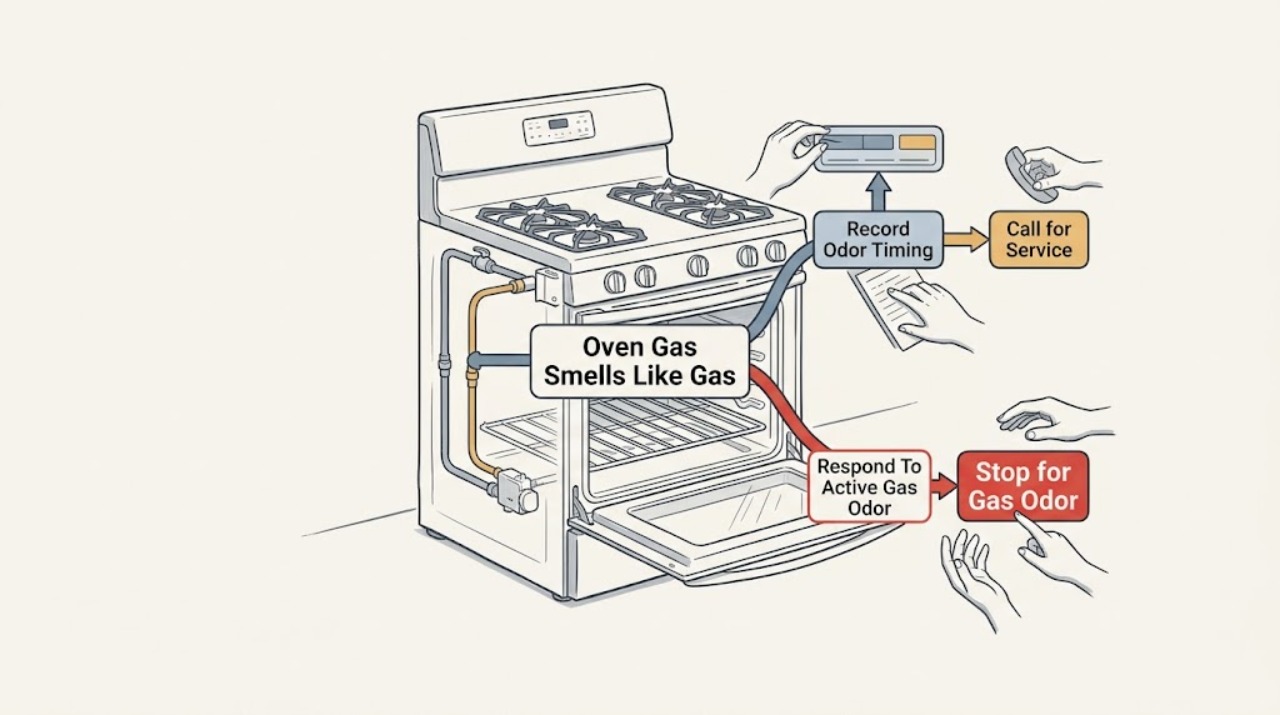
Treat a gas smell from a Samsung gas oven as a possible gas leak until its timing and source are safely understood. If the smell is present now, is strong or persistent, occurs when the oven is off, or comes with a hissing sound, do not light anything, operate switches or appliances, use a phone inside, or try another ignition. Leave the home immediately and contact the gas supplier or emergency services from outside. Samsung says a faint gas-like odor can occur during first use because of packaging and protective oil, and that smoke or unusual odor during self-cleaning can be expected; those explanations do not make an unexplained or continuing gas smell safe. After there is no active gas odor and the oven is cool, note whether the smell occurred only during first use, self-cleaning, normal cooking, or after a spill. Samsung advises ventilating for unusual odor during normal use, inspecting the cool cavity for spills, and requesting service if a clean oven still smells. Do not move the range to inspect its connector, open the burner or gas manifold, test for leaks with a flame, or adjust gas parts. Arrange qualified Samsung appliance or gas service for any recurring odor, ignition problem, abnormal flame, or uncertain source.
Before you begin
Safety first
- Do not operate a suspect gas appliance, use flame to test for leaks, move the range, disconnect gas tubing, or open gas or electrical panels.
Work through in order
Diagnostic checks
Use only checks that match the exact appliance or system and its official guide.
-
Check 1
If you smell gas now, hear hissing, see an unexplained flame, or cannot tell whether the odor is gas, do not light a match, touch a light switch, operate the oven controls, use a phone inside, or start an appliance. Leave the home immediately using a safe exit and contact the gas supplier or emergency services from outside.
Expected result: The odor is active, strong, persistent, present while the oven is off, accompanied by hissing, or absent after everyone is outside and the area has been ventilated by natural circumstances.
Next step: Remain outside and follow the gas supplier or emergency responder's direction. Do not re-enter to inspect, reset, relight, or move the Samsung range until qualified personnel say it is safe.
Stop if: Stop immediately and evacuate for gas odor, hissing, fire, smoke, dizziness, or any need to operate an electrical switch or phone inside.
Why this matters
Why: An active or unexplained gas odor must be treated as a possible leak, not as a routine cooking smell. A later absence of odor does not identify the cause or clear the appliance for use.
-
Check 2
Only after there is no active gas odor and the appliance is safe to approach, record when the smell occurred: the first use of a new oven, a self-cleaning cycle, normal cooking, immediately after a spill, while the oven was off, or with no clear trigger. Do not reproduce the odor to collect a better sample.
Expected result: The odor was faint and limited to first use, occurred during self-cleaning, followed a visible cooking spill, occurred during ordinary cooking without a spill, or has no clear timing pattern.
Next step: Keep the oven off until the timing is matched to the exact Samsung manual or qualified service advice. Never use the first-use or self-clean explanation to dismiss a strong or persistent odor.
Stop if: Stop if the odor returns, becomes stronger, is accompanied by a hiss or flame problem, or cannot be distinguished from escaping gas.
Why this matters
Why: Samsung identifies faint gas-like odor during first use, smoke or odor during self-cleaning, and burning residue during normal cooking as different possibilities. An odor during ordinary use without a spill, an odor while off, or an unexplained recurring odor needs service and cannot be cleared by timing alone.
-
Check 3
When there is no gas odor and the oven is cool, verify visually that the oven and cooktop controls are in their normal off positions. Do not turn a knob to test ignition, relight a burner, or touch controls while gas odor is present.
Expected result: A control is visibly not off, all controls are off, a knob is damaged or loose, or the control status cannot be confirmed without approaching an odor.
Next step: If any control status is uncertain or the smell returns, leave the area and obtain gas or appliance service. Do not turn controls on and off repeatedly to test the oven.
Stop if: Do not operate controls, switches, or ignition when gas odor is present or when the knob or valve is damaged.
Why this matters
Why: A control that is not off can explain unburned gas only if it was safely identified and no active leak remains, but it does not prove the appliance is safe. Controls that are damaged, loose, or uncertain need professional inspection.
-
Check 4
If the odor occurred during ordinary cooking, the oven is off and cool, and there is no gas odor, inspect the accessible oven cavity for a food spill or residue that could burn. Wipe only accessible cooled surfaces according to the Samsung manual; do not remove panels, reach around a burner, or start self-cleaning to mask an unexplained gas smell.
Expected result: A spill or residue is visible, the cavity is clean, residue is heavy or inaccessible, or the odor returns after safe cleaning.
Next step: Follow the model's ordinary cleaning instructions only for a confirmed cooled spill. If the cavity is clean or the odor returns, keep the oven off and request qualified Samsung service.
Stop if: Stop for gas odor, smoke, flame abnormality, damaged insulation, wet controls, or any need to remove a cover or reach behind the cavity liner.
Why this matters
Why: Samsung says spilled material can produce smoke or unusual odor during normal use. A clean cavity, inaccessible residue, or recurring odor keeps a gas-path, burner, venting, or control fault in consideration and should not be treated as a cleaning issue.
-
Check 5
Do not create a test flame. If the oven has already been used safely and no gas odor is present, record only what was observed during normal operation: delayed ignition, repeated failed ignition, flame going out, unusual flame color or shape, soot, smoke, or an odor that appears from a clean cavity. Do not remove the bottom panel or burner parts.
Expected result: Ignition was normal, ignition was delayed or failed, a flame went out, the flame looked abnormal, soot or smoke appeared, or the odor came from a clean oven.
Next step: Stop using the oven and give the exact observation to qualified Samsung appliance or gas service. Do not move the range or inspect its gas connector yourself.
Stop if: Stop for any gas odor, flame rollout, smoke, soot, repeated ignition attempt, or symptom that requires opening a panel or moving the appliance.
Why this matters
Why: Abnormal ignition, flame behavior, soot, or odor from a clean oven points beyond a simple food spill and can involve gas delivery, ignition, burner, venting, or control components. A single normal cycle does not rule out an intermittent leak.
-
Check 6
From an ordinary-access label or paperwork, record the Samsung model and whether the appliance is a gas range or wall oven. Note the odor timing, whether the oven was on or off, control positions observed without gas odor, spill or residue findings, ignition or flame symptoms, and whether anyone had to evacuate. Do not move the appliance to find a connector label.
Expected result: The odor recurs, the source is uncertain, the oven is clean, ignition or flame behavior is abnormal, or the model and installation history are unavailable.
Next step: Keep the oven off, contact qualified Samsung appliance or gas service, and provide the model and safe observations. If gas odor returns before service, evacuate and contact the gas supplier or emergency services from outside.
Stop if: Do not move the appliance, disconnect the gas line, open the rear panel, or operate the oven to reproduce the odor.
Why this matters
Why: A recurring or unexplained odor requires qualified diagnosis even if it disappears between uses. CPSC warns that moving an appliance to inspect its connector can cause a weakened connector to fail; the model and observations are more useful than a risky inspection.
Use your observations
Decision map
Find the observation that best matches what you see, then follow the next safe action.
-
PATH 01Next step
What you see
The smell is strong, persistent, present while the oven is off, accompanied by hissing, or not safely distinguishable from gas.
Do this next
Leave immediately without operating switches, phones, or appliances inside and contact the gas supplier or emergency services from outside. Do not re-enter or move the range until cleared by qualified personnel.
Why this path and its safety boundary
Why it matters: A possible gas leak takes priority over all appliance troubleshooting, regardless of the oven's age or recent use.
-
PATH 02Next step
What you see
The oven is new, the odor is faint, and it occurs only during first use with no active gas odor or other abnormal symptom.
Do this next
Follow the exact Samsung model's first-use and ventilation instructions only when there is no gas-leak concern. Stop and seek service if the odor persists or changes.
Why this path and its safety boundary
Why it matters: Samsung identifies packaging and protective oil as a possible first-use explanation, but this does not apply to a strong, recurring, or unexplained gas smell.
-
PATH 03Next step
What you see
The odor or smoke occurs during self-cleaning or follows a visible cooking spill, with no gas odor while the appliance is off.
Do this next
Let the oven cool and follow only the model's cleaning guidance for confirmed residue. Do not use self-cleaning to test or conceal a gas smell.
Why this path and its safety boundary
Why it matters: Burning residue can explain an odor in these specific contexts, but a clean cavity, gas-like smell while off, or repeated odor outside those contexts needs service.
-
PATH 04Next step
What you see
The odor occurs during normal cooking without a visible spill, returns after cleaning, or comes from a clean oven.
Do this next
Keep the oven off, do not reproduce the symptom, and arrange qualified Samsung appliance or gas service with the model and timing recorded.
Why this path and its safety boundary
Why it matters: Samsung's spill explanation is less likely; a gas supply, ignition, burner, venting, or control issue needs professional diagnosis.
-
PATH 05Safety boundary
What you see
Diagnosis would require moving the range, opening a panel, checking a connector, or testing a gas valve or burner.
Do this next
Stop user inspection and have qualified gas or appliance service inspect the installation and components.
Why this path and its safety boundary
Why it matters: The task has crossed into gas-appliance service work. CPSC warns that moving an appliance can cause a weakened connector to fail.
Safety stop: Do not move the range, disconnect gas tubing, open a panel, use a flame for leak testing, or operate a suspect gas appliance.
Helpful context
Understand the symptom
Safety comes before deciding whether an odor is normal
A faint odor during a documented first use or self-cleaning cycle is different from a gas smell that is strong, persistent, unexplained, or present while the oven is off. Do not test that distinction by relighting the oven. If gas may be escaping, leave without operating lights or electronics and contact the gas supplier or emergency services from outside.
Samsung's odor categories are timing clues, not a diagnosis
Samsung describes first-use packaging and protective oil, self-cleaning residue, and spills during normal cooking as possible odor sources. Use the timing only to report what happened: a new oven, self-cleaning, or a cooking spill. A clean oven with recurring odor needs service, and no timing pattern should be treated as proof that gas is safe.
Keep gas connections and ignition work professional
The accessible checks are limited to safe observation, ordinary controls when there is no gas odor, and a cool-cavity visual check for spills. Do not move the range to inspect its connector, remove panels, open a burner manifold, test with a flame, or adjust a regulator or valve. The CPSC warns that moving an appliance can damage certain gas connectors; qualified service should inspect any suspected gas-path fault.
Only after diagnosis
Potential parts
- Samsung oven igniter or ignition assembly
Consider only after qualified diagnosis confirms delayed or failed ignition rather than an active gas leak or supply fault.
Ignition parts are model-specific; confirm the complete Samsung model and service documentation before selection. - Samsung oven burner or gas valve assembly
Consider only when a qualified technician confirms abnormal burner or valve behavior after the gas path is made safe.
Gas components require model-specific fit and professional installation; do not order or install from an odor symptom alone. - Gas appliance connector or supply component
Consider only when the gas supplier or qualified technician identifies the connector or supply as the source; never move the appliance to inspect it.
Connector and supply work must follow local requirements and qualified-service guidance; compatibility cannot be inferred from the Samsung model alone.
When checks do not resolve it
Need a professional?
Call qualified Samsung appliance or gas service for any recurring, unexplained, or clean-oven gas odor, delayed ignition, failed ignition, abnormal flame, soot, or suspected connector or valve problem.
Safety scope: Do not operate a suspect gas appliance, use flame to test for leaks, move the range, disconnect gas tubing, or open gas or electrical panels.
Common questions
FAQ
Is a faint gas-like smell from a new Samsung oven normal?
Samsung says a faint gas-like odor can occur during first use because of packaging and protective oil. That explanation does not apply to a strong, persistent, unexplained odor, a smell while the oven is off, or hissing; treat those as possible gas leaks and leave immediately.
What should I do if my Samsung oven smells like gas right now?
Do not light anything, operate switches or appliances, use a phone inside, or try to ignite the oven. Leave the home immediately and contact the gas supplier or emergency services from outside. Do not re-enter or move the range until qualified personnel clear it.
Can a cooking spill make a Samsung oven smell like gas?
Samsung says a spill or residue can produce smoke or unusual odor during normal cooking. Inspect for a spill only after the oven is off, cool, and free of active gas odor; a clean oven or recurring odor needs qualified service rather than another cleaning cycle.
Should I move my Samsung gas range to inspect the connector?
No. The CPSC warns that moving an appliance, even slightly, can cause certain weakened connectors to fail and says only a qualified professional should check them. Do not pull the range out or disconnect gas tubing yourself.
When does a Samsung oven gas smell require service?
Arrange qualified gas or appliance service for any recurring or unexplained odor, odor from a clean oven, delayed or failed ignition, flame abnormality, soot, or a smell that occurs while the oven is off. Evacuate first for an active gas smell or hissing.
Read the exact guide
Official sources
- CPSC Warns of Generator, Carbon Monoxide and Fire Hazards Ahead of Hurricane SeasonU.S. Consumer Product Safety Commission · CPSC gas-leak evacuation and no-electronics guidance
- Certain Older Gas Connectors May Be DangerousU.S. Consumer Product Safety Commission · Gas-appliance connector safety and response to suspected gas leaks
- Odor or smoke from Samsung ovenSamsung Support US · Samsung oven odor distinctions for first use, self-cleaning, and normal cooking
- Install your Samsung gas or electric rangeSamsung Support US · Samsung gas-range model-specific installation and gas-supply boundary
Community feedback
Share a repair observation
Share a plain-text repair observation. Accepted observations are published automatically; this page may take a moment to update.