
On this page
Start here
Quick answer
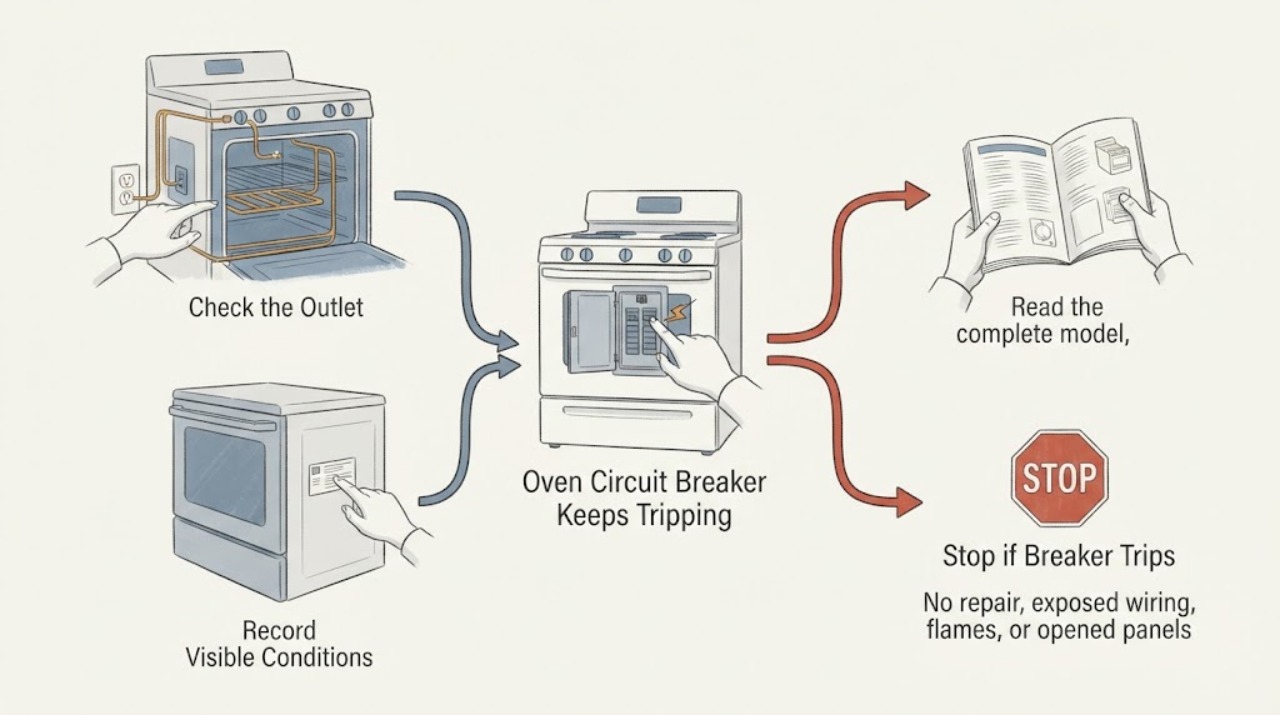
Stop using the GE oven when its circuit breaker trips, especially if there is smoke, sparking, a burning smell, heat at the receptacle or panel, damaged wiring, or water near electrical parts. GE's circuit-breaker guidance says to confirm the appliance's correctly sized breaker from its installation instructions; for electric ranges, cooktops, and wall ovens it permits only a power-off visual check for holes or breaks in visible bake, broil, or surface elements. If the breaker trips immediately when reset, GE says the house wiring or breaker box typically needs an electrician. If it stays on until the oven operates and then trips again, the appliance needs qualified diagnosis. Do not keep resetting the breaker, remove a hardwired oven, open the panel, bypass protection, or perform live measurements.
Before you begin
Safety first
- Do not repeatedly reset a tripping breaker, install a larger breaker, open the breaker panel or oven cabinet, pull out a hardwired oven, bypass electrical protection, or perform live measurements. Keep the oven off for any smoke, sparking, burning smell, heat damage, water, or repeated trip.
Work through in order
Diagnostic checks
Use only checks that match the exact appliance or system and its official guide.
-
Check 1
Stop using the GE oven and keep the breaker off if there is smoke, sparking, a burning smell, heat or discoloration at the outlet or breaker, damaged wiring, water near electrical parts, or an oven fire.
Expected result: Any of those warning signs is present, or the breaker trips repeatedly without a visible warning.
Next step: Move away from an active hazard. Isolate power only from a safe location and arrange qualified electrical or GE appliance service; if flames leave the oven, leave the home and call emergency services.
Why this matters
Why: The event may involve fire, shock, or supply-circuit hazards; repeated resets can keep energizing a fault and do not diagnose an oven part.
-
Check 2
Record when the breaker trips: immediately after a single safe reset, when Bake or Broil is selected, during preheating, after another load starts, or only after the oven has been running.
Expected result: The breaker trips immediately after reset, or it stays on until the oven or another household load is used.
Next step: For an immediate trip, leave the breaker off and call an electrician. For a use-related trip, leave the oven off and arrange qualified appliance diagnosis after the circuit is confirmed safe. Do not repeat the event to collect more data.
Why this matters
Why: GE says an immediate trip after reset typically points to house wiring or the fuse/breaker box, while a breaker that stays on until the appliance operates typically requires appliance diagnosis. The timing is a routing clue, not a component diagnosis.
-
Check 3
Read the complete GE model information and its installation instructions, then compare the required circuit and connection with the installed setup without opening the panel or changing wiring.
Expected result: The installed breaker or connection does not match the model instructions, the appliance is hardwired and its connection is inaccessible, or the setup appears to match.
Next step: Do not replace the breaker with a larger rating or alter the connection. Give the model and installation information to an electrician; use appliance service as well if the circuit is confirmed correct but the oven trips during operation.
Why this matters
Why: GE states that a correctly sized breaker or fuse is determined from the appliance's installation instructions. A mismatch is an installation/electrical issue; a visual match does not clear a repeated trip.
-
Check 4
Only after power is safely isolated, inspect accessible bake and broil elements on an electric GE range or wall oven for a clearly visible hole, crack, or break; do not remove covers or touch the element.
Expected result: A visible element break or hole is present, or no visible element damage is found.
Next step: Keep the oven off and provide the model and photographs to qualified appliance service. If no visible damage is found, do not keep resetting the breaker; service must diagnose the appliance after the electrical path is safe.
Why this matters
Why: GE identifies visible holes or breaks in these elements as a reason for replacement, but no visible damage does not rule out an appliance fault and does not authorize live testing.
-
Check 5
Prepare a service record with the GE model, breaker type and rating from the installation instructions, exact trip timing, selected mode, other loads on the circuit, visible element or cord damage, odors, smoke, and any recent installation or wiring work.
Expected result: The breaker continues to trip, the circuit setup is uncertain, or the oven has a visible or safety-related abnormality.
Next step: Keep the oven out of service and give the record to an electrician and/or qualified GE appliance technician. Do not open the cabinet, replace a breaker with a larger one, bypass protection, or perform live measurements.
Why this matters
Why: The unresolved cause may be house wiring, the breaker box, installation, or an oven-side fault; the symptom alone cannot identify a safe replacement part.
Use your observations
Decision map
Find the observation that best matches what you see, then follow the next safe action.
-
PATH 01Next step
What you see
The breaker trips immediately when reset, before the GE oven is selected or used.
Do this next
Leave the breaker off and arrange qualified electrical diagnosis. Do not keep resetting it or change the breaker rating.
Why this path and its safety boundary
Why it matters: GE says this timing typically points to house wiring or the fuse/breaker box rather than proving an oven component failure.
-
PATH 02Next step
What you see
The breaker holds until Bake, Broil, preheat, or another oven load is used, then trips.
Do this next
Stop operating the oven and arrange qualified appliance service after an electrician confirms the circuit and breaker installation.
Why this path and its safety boundary
Why it matters: The circuit may be correct but the oven-side load or fault still needs diagnosis; timing alone does not prove a bake element, control, or wire is bad.
-
PATH 03Next step
What you see
A visible bake or broil element hole or break is found with power safely isolated.
Do this next
Leave power off and have the exact GE model and element confirmed by qualified appliance service; do not touch or test the element.
Why this path and its safety boundary
Why it matters: GE identifies visible element damage as a serviceable cause for an electric range or wall oven, but the correct replacement still depends on the model.
-
PATH 04Next step
What you see
The oven has smoke, sparking, a burning odor, charred wiring, a hot receptacle, water near electrical parts, or an oven fire.
Do this next
Stop operating the oven and move away from the hazard. For flames escaping the oven, leave and call 911; otherwise arrange qualified electrical/appliance service without opening the unit.
Why this path and its safety boundary
Why it matters: This is an immediate electrical or fire-safety event, not a routine breaker-reset problem.
Helpful context
Understand the symptom
A tripping breaker does not identify a particular GE oven part. The useful first distinction is timing: does the breaker trip as soon as it is reset, or only when the oven is selected, preheats, or runs? That timing helps separate a supply or breaker-box concern from an oven-side fault without asking you to test live wiring.
Make the electrical situation safe first
Leave the oven off if the cord, receptacle, breaker area, controls, or wiring is hot, wet, charred, loose, sparking, or smells burned. Do not touch a sparking or wet connection. If an oven fire escapes the appliance, leave the home and call emergency services; do not open the oven to investigate flames.
Use the GE installation instructions for the breaker requirement
GE says the appliance must be on the correctly sized breaker or fuse and directs owners to the installation instructions for the specific appliance. Do not substitute a larger breaker, add an extension cord, alter a hardwired connection, or assume that a breaker that looks on is fully reset on a 220/240-volt double-breaker circuit.
Do only the visible, power-off checks supported for your model
If the oven is an electric range or wall oven and power has been safely isolated, GE's guidance allows looking for visible holes or breaks in bake or broil elements. Do not remove panels, pull out a hardwired oven, test resistance with the circuit energized, or touch the element. If you cannot isolate power safely, skip the inspection and use service.
When checks do not resolve it
Need a professional?
Call an electrician when the breaker trips immediately after reset, the breaker rating or wiring is uncertain, or the circuit shows heat or damage. Call qualified GE appliance service when the breaker trips only while the oven operates, an element is visibly damaged, the oven remains unsafe, or the fault persists after the circuit is cleared.
Safety scope: Do not repeatedly reset a tripping breaker, install a larger breaker, open the breaker panel or oven cabinet, pull out a hardwired oven, bypass electrical protection, or perform live measurements. Keep the oven off for any smoke, sparking, burning smell, heat damage, water, or repeated trip.
Have this ready
- Complete GE model, installation instructions, breaker type/rating, trip timing, selected oven mode, other loads, visible element or cord damage, recent wiring work, and any smell, smoke, heat, or water event.
Common questions
FAQ
Why does my GE oven keep tripping the breaker?
The timing matters. GE says an immediate trip after reset typically points to house wiring or the breaker box, while a trip that occurs when the oven operates typically needs appliance diagnosis. Neither timing proves a specific part is bad.
Can I keep resetting the breaker to finish cooking?
No. Repeated resets can re-energize a fault. Leave the oven off and route an immediate trip to an electrician or a use-related trip to qualified appliance service after the circuit is confirmed safe.
Can I replace the GE oven breaker with a larger one?
No. GE says the required breaker or fuse size comes from the exact appliance installation instructions. Do not change the rating or wiring; have an electrician verify the installation.
What if I see a hole or break in the bake element?
Keep power isolated and do not touch or test the element. GE identifies visible holes or breaks as a reason for replacement on electric ranges and wall ovens, but the exact model and safe repair should be confirmed by qualified appliance service.
Read the exact guide
Official sources
- GE Appliance - Circuit Breaker TripsGE Appliances · Official GE guidance used for breaker timing, correct breaker sizing from installation instructions, limited power-off visual checks of electric oven elements, electrician routing, and appliance-service routing. It does not identify a part for an unidentified GE oven.
- Cooking Fire Safety PictographsU.S. Fire Administration · Government cooking-fire source used for the response to an oven fire, including keeping the oven closed while flames are inside and evacuating/calling 911 if flames escape. It does not diagnose a GE breaker trip.
- Appliance and Electrical Fire SafetyU.S. Fire Administration · Government safety source used for damaged-cord, outlet, overload, and direct-connection boundaries; it is not a GE oven diagnostic or breaker-sizing source.
- GE Appliance - Resetting Your Circuit BreakerGE Appliances · Official GE guidance used only for the single reset distinction and service boundary; it does not authorize repeated resets or live electrical testing.
Community feedback
Share a repair observation
Share a plain-text repair observation. Accepted observations are published automatically; this page may take a moment to update.