
On this page
Start here
Quick answer
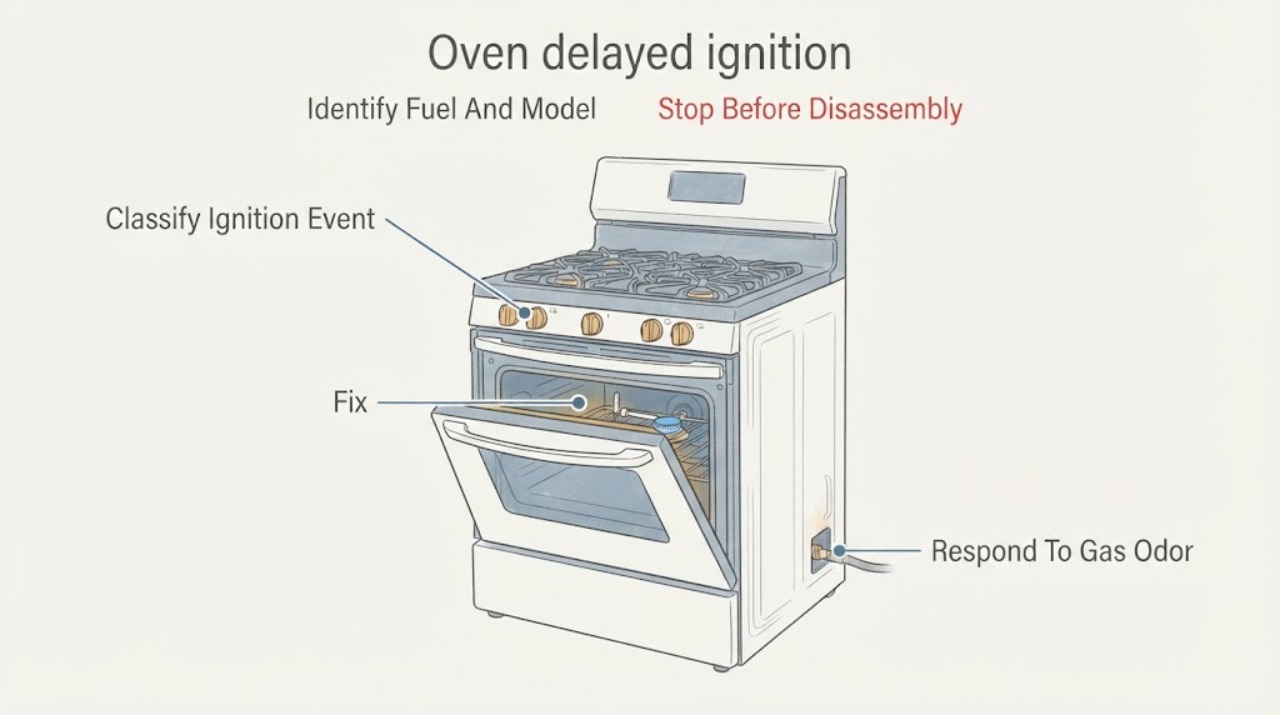
Treat a boom, door movement or ignition that takes longer than GE’s stated 2–3 seconds as a gas-safety fault, not a normal preheat delay. Stop using the gas oven, keep clear of the burner and do not repeatedly relight or disassemble it. If you smell unburned gas, open windows if safe, do not touch electrical switches or open flames, leave the area and call the gas supplier from outside. The exact model is needed to distinguish an electronic Glo-Bar system from a standing pilot and to follow any model-specific service path; GE’s pilot instructions apply only to listed models and are not a general DIY procedure. A qualified gas-appliance technician should diagnose delayed ignition, airflow, gas pressure and ignition components.
Work through in order
Diagnostic checks
Use only checks that match the exact appliance or system and its official guide.
-
Check 1
Without restarting the oven, record whether the event was a boom, forceful pop, door movement, visible late flame, or only a slow rise to temperature. Record whether the appliance is gas or electric from the label and whether the symptom occurred on Bake, Broil or both.
Expected result: There was a boom/door movement or ignition took longer than the GE 2–3 second expectation; there was only slow preheat; or the fuel/system is unknown.
Next step: For a boom, door movement or late gas ignition, stop using the oven and arrange gas-appliance service. For slow preheat without ignition symptoms, use the exact model support path; if fuel is unknown, identify the model without operating the oven.
Why this matters
Why: GE treats a boom or door blow-open as delayed ignition requiring service. Slow preheat alone is a different symptom, while unknown fuel/system prevents safe ignition diagnosis.
-
Check 2
If a rotten-egg-like or otherwise unburned-gas odor is present, do not touch switches, thermostats, plugs or flames. If safe, open windows, leave the home and call the gas supplier from outside; use emergency services according to local instructions if the odor is strong or anyone feels unwell.
Expected result: The odor clears after ventilation, persists, or its source is uncertain.
Next step: Do not re-enter to test the oven until the gas supplier or qualified responder says it is safe. After any gas incident, arrange qualified appliance inspection before use.
Why this matters
Why: GE says unburned gas odor is not normal and must not be investigated by operating electrical controls or open flames. A combustion odor at initial start is a different, short-lived condition, but a delayed-ignition event still requires service.
-
Check 3
Read the appliance rating label and owner documentation while the oven is off to identify the complete model, gas versus electric fuel and electronic versus standing-pilot ignition. Do not remove the oven bottom, door, burner cover or control panel to find the system.
Expected result: The label identifies a GE gas range/wall oven with an electronic igniter, one of GE’s listed standing-pilot models, an electric oven, or an unidentified appliance.
Next step: Give the complete model and fuel type to GE or a qualified technician. If it is electric or unidentified, clarify the symptom rather than applying gas ignition instructions.
Why this matters
Why: GE’s ignition and pilot instructions are model/fuel specific. The listed pilot procedure applies only to the specified model group; an electric oven has no gas ignition path.
-
Check 4
From outside the oven and without another ignition attempt, note whether the door moved, whether the event occurred during Bake or Broil, whether the appliance was recently serviced or converted to LP, and whether the gas shutoff or power supply has an obvious external issue. Do not adjust the shutoff, gas pressure or wiring.
Expected result: The event is repeatable on one function, followed a recent installation/conversion, or there is no safe visible context beyond the delayed ignition itself.
Next step: Keep the oven off and provide the observations and model label to qualified gas-appliance service. Do not attempt a pilot adjustment, burner cleaning or air-shutter adjustment without model-specific professional instructions.
Why this matters
Why: These details help a technician separate model-specific ignition, fuel-supply and installation questions, but none proves an igniter, valve, airflow or pressure fault.
-
Check 5
If the control display shows Delay Start, Delay Bake or a similar scheduled feature, confirm its presence from the exact owner manual without starting the oven. Treat any boom, door movement or gas odor as a separate ignition safety issue.
Expected result: Only a programmed start time is present; or a scheduled start is accompanied by a late ignition event or gas odor.
Next step: Follow the model manual only for cancelling a schedule. If ignition is abnormal or gas is smelled, leave the oven off and follow the gas-safety/service branch.
Why this matters
Why: GE documents Delay Start as a scheduling feature, not as delayed burner ignition. A scheduling setting does not explain an abnormal gas ignition event.
Use your observations
Decision map
Find the observation that best matches what you see, then follow the next safe action.
-
PATH 01Next step
What you see
The oven makes a boom/forceful pop, the door blows open or moves, or the gas flame lights later than the GE 2–3 second expectation.
Do this next
Stop using the gas oven and arrange qualified gas-appliance service. Do not repeat the ignition attempt or adjust burner, valve or airflow parts.
Why this path and its safety boundary
Why it matters: GE identifies this as delayed ignition and says it should be referred to repair service.
-
PATH 02Next step
What you see
A rotten-egg-like or persistent unburned-gas odor is present after an ignition attempt.
Do this next
Open windows if safe, avoid electrical switches and flames, leave the area and call the gas supplier from outside. Do not return to test the oven until cleared.
Why this path and its safety boundary
Why it matters: GE says unburned gas odor is not normal and requires immediate gas-safety action.
-
PATH 03Next step
What you see
The appliance is electric, or the model/fuel system cannot be confirmed from the label and manual.
Do this next
Keep the appliance off and clarify the actual heating symptom with the full model number; use model-specific service rather than a gas ignition procedure.
Why this path and its safety boundary
Why it matters: A gas delayed-ignition diagnosis cannot be transferred to an electric or unidentified oven.
-
PATH 04Next step
What you see
Only a scheduled Delay Start/Delay Bake feature is shown and there was no abnormal gas ignition, boom, door movement or gas odor.
Do this next
Use the exact owner manual to cancel or change the schedule. If a late ignition event occurs, return to the gas-safety/service branch.
Why this path and its safety boundary
Why it matters: GE treats Delay Start as a programming feature, not a burner ignition fault.
Helpful context
Understand the symptom
Recognize delayed ignition rather than normal preheating
A slow preheat is different from a gas burner that waits and then lights with a boom, forceful pop or door movement. GE says an oven should light in 2–3 seconds and identifies a boom or door blow-open as delayed ignition requiring service. Do not keep cycling Bake or Broil to measure the delay; each attempt can expose the appliance to another abnormal ignition event.
Treat gas odor as an immediate safety event
GE distinguishes the short-lived combustion odor that can occur when a gas oven first starts from the rotten-egg-like odor of unburned gas. If unburned gas is suspected, do not operate switches, create a flame or continue testing. Open windows if safe, leave the area and call the gas supplier from a phone outside the home.
Confirm the appliance and ignition family without opening it
The task does not include a model or fuel type. Confirm from the rating label and installation information whether this is a GE gas range, gas wall oven or an electric oven. GE’s gas-oven support distinguishes an electronic Glo-Bar igniter from standing-pilot models, and its pilot article is limited to specific model numbers. An electric oven does not have a gas ignition system, so an “ignition” description would need to be clarified rather than mapped to a gas part.
Leave gas controls and ignition adjustments to service
GE’s gas-oven page lists controls, power, gas supply and model-specific igniter observations, but a delayed ignition symptom is already a service boundary. Do not adjust burner air shutters, gas pressure, safety valves or igniter wiring, and do not remove oven panels. A technician needs the full model, fuel type, ignition timing, sound, flame/door behavior and whether any gas odor remained after the attempt.
Do not confuse the feature called Delay Start with delayed ignition
GE uses Delay Start or Delay Bake for a programmed time before cooking begins. That scheduling feature is unrelated to a gas burner that lights late. If the display shows a delay setting but the gas burner also produces a boom, door movement or gas odor, treat the ignition behavior as the urgent issue and stop using the oven.
When checks do not resolve it
Need a professional?
Call the gas supplier from outside immediately for suspected unburned gas. Arrange qualified gas-appliance service before further use for any boom, door movement, ignition later than the documented 2–3 seconds, repeated late ignition, pilot/igniter concern, abnormal flame or a symptom following installation or fuel conversion. Do not open the oven, adjust gas pressure/airflow, bypass safety controls or perform live electrical tests.
Common questions
FAQ
Is a short gas smell when a GE oven starts always delayed ignition?
No. GE says a combustion odor at initial start can be normal and should go away within minutes, while unburned gas smells like rotten eggs and is not normal. A boom, door movement or ignition later than 2–3 seconds is delayed ignition and needs service regardless of the odor description.
Can I clean or adjust the GE oven igniter myself?
Do not adjust gas pressure, burner airflow, safety valves or igniter wiring from a model-free article. GE’s general gas-oven page gives model-dependent checks and directs service if the oven will not operate; delayed ignition itself is a service condition.
Does Delay Start explain a late ignition?
No. GE documents Delay Start/Delay Bake as a programmed start-time feature. It does not explain a gas burner that lights with a boom, door movement or an abnormal delay.
Read the exact guide
Official sources
- Gas Range - Oven Will Not Turn On - Pilot Light ModelsGE Appliances · Used to show pilot procedures are model-limited; article does not reproduce the lighting procedure.
- Range & Wall Oven - Delay Start of CookingGE Appliances · Scheduling feature only; used to distinguish programmed delay from delayed gas ignition.
- Gas Range - Gas OdorsGE Appliances · Official gas-odor safety guidance; unburned-gas response only.
- Gas Range & Wall Oven - Oven Will Not Come OnGE Appliances · Gas-oven format, model-dependent power/gas/control/igniter checks and service boundary.
- Gas Range - What is Normal Operation vs What Requires ServiceGE Appliances · Official gas-appliance safety page; delayed-ignition timing and service/gas-safety boundaries.
Community feedback
Share a repair observation
Share a plain-text repair observation. Accepted observations are published automatically; this page may take a moment to update.