
On this page
Start here
Quick answer
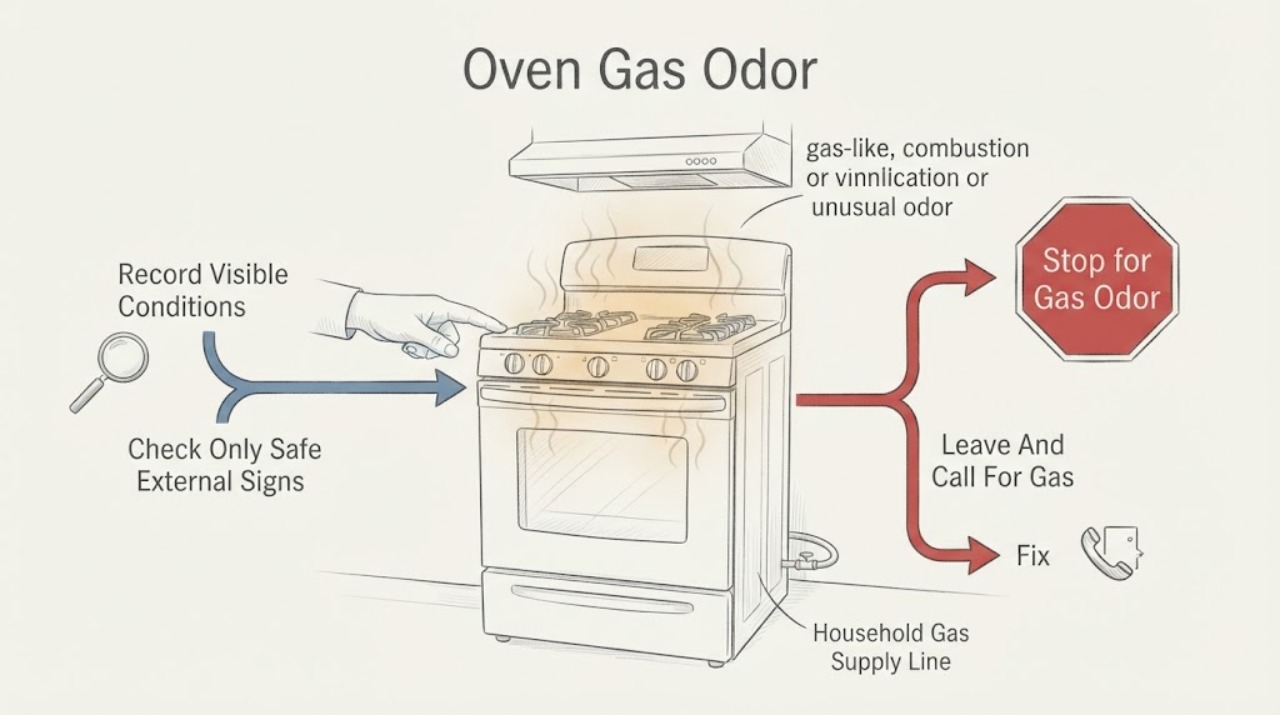
Treat a rotten-egg or unburned-gas smell as an emergency, not as a cleaning problem. GE says to open windows or doors if safe, avoid electrical switches and phones inside, extinguish open flames, clear everyone from the area and call the gas supplier or servicer from outside; call the fire department if the supplier cannot be reached. GE also distinguishes a brief unusual odor at initial ignition, which may be combustion odor that goes away within minutes on a gas range, from unburned gas, delayed ignition, a boom, a door pushed open, abnormal flames or an odor that persists. Do not relight the oven, turn knobs repeatedly, adjust the burner or regulator, open panels or restart it to reproduce the smell. Keep the GE oven out of service until the gas supplier or a qualified appliance/gas professional says it is safe.
Work through in order
Diagnostic checks
Use only checks that match the exact appliance or system and its official guide.
-
Check 1
If the odor resembles unburned gas or rotten eggs, stop using the oven and, only from a safe position, open a door or window, avoid electrical switches and phones inside, extinguish open flames if safe, and clear people and pets from the area.
Expected result: The gas-like odor is present, smoke or flame is visible, or the area cannot be cleared without approaching the appliance.
Next step: Call the gas supplier or servicer from outside or a neighbor's phone. If the supplier cannot be reached or there is fire, call the fire department/emergency services. Do not return to test the oven until cleared.
Why this matters
Why: GE treats unburned-gas odor as abnormal and gives an outside-call evacuation response; this is not a user troubleshooting branch.
-
Check 2
After the area is safe and without turning the oven back on, record whether the odor began while the oven was off, at initial ignition, after cycling, during broil/bake, or after a failed ignition; note any smoke, flame, popping, boom or door movement.
Expected result: The odor was present while off, occurred only briefly at initial ignition, persisted after heating, or followed a delayed-ignition sound/door movement.
Next step: Keep the oven off for persistent, gas-like or delayed-ignition symptoms. Give the timing and observed signs to the gas supplier or qualified service professional.
Why this matters
Why: GE describes a brief initial combustion odor as a possible normal gas-range characteristic, but persistent odor, gas-like odor, boom or door blow-open is a service/gas-professional condition. The record helps service without a hazardous repeat test.
-
Check 3
From a safe distance and only when there is no active gas odor, record visible flame color during ordinary operation only if the exact manual and the gas professional have said the appliance is safe to operate; do not remove panels, reach into the burner area or adjust air shutters/regulators.
Expected result: A flame is completely yellow/orange after LP conversion, controls are hard to turn, or no abnormal flame/control sign is available because the oven remains out of service.
Next step: Stop use and arrange qualified service for any abnormal flame or control. Do not attempt a gas adjustment or internal ignition test.
Why this matters
Why: GE sends completely yellow/orange flames after proper LP conversion and hard-to-turn controls to service or a gas professional. Absence of a visible sign does not clear a reported gas odor.
-
Check 4
If the appliance is new, tell the service professional whether the odor was a mild non-gas smell during the first uses or a gas-like/rotten-egg smell; do not use the new-oven guidance to dismiss a suspected gas leak.
Expected result: The odor was mild, non-gas and limited to first use, or it was gas-like, strong, persistent or accompanied by smoke/abnormal ignition.
Next step: For gas-like, persistent or hazardous odor, remain in the stop-use/outside-call branch. For a mild first-use non-gas odor, follow only the exact model owner's manual and stop if the odor changes or intensifies.
Why this matters
Why: GE's new-oven page covers smoke/odor from new parts or insulation in gas and electric ovens, while its gas-odor pages separately classify unburned gas as abnormal. The smell description and hazard signs determine the safe branch.
-
Check 5
For the gas supplier or qualified service professional, record the complete GE model and serial number, natural-gas or LP setup if known, whether the odor occurred with the oven on or off, and any delayed ignition, flame or control symptoms.
Expected result: The model/fuel information and symptom timing are available, or the exact model and fuel conversion remain unknown.
Next step: Provide the record to the gas supplier or qualified GE service professional. Do not order or adjust a regulator, igniter, burner or valve based only on the odor.
Why this matters
Why: GE's guidance is written for gas ranges and model-specific owner manuals; the missing model/fuel details prevent a user from safely selecting a burner or ignition procedure.
Use your observations
Decision map
Find the observation that best matches what you see, then follow the next safe action.
-
PATH 01Next step
What you see
The odor is rotten-egg-like or otherwise suggests unburned gas, especially while the oven is off, or anyone has symptoms from the gas exposure.
Do this next
Leave the area, avoid switches/phones and flames, open doors/windows only if safe, and call the gas supplier or emergency services from outside or a neighbor's phone.
Why this path and its safety boundary
Why it matters: GE says unburned gas is not normal in the home and requires the gas-safety response rather than appliance troubleshooting.
-
PATH 02Next step
What you see
The odor occurred only briefly when a gas-range oven first started, is not gas-like, and there was no smoke, boom, door movement, abnormal flame or recurring smell.
Do this next
Do not intentionally repeat the ignition just to verify it. Record the model and follow the exact owner manual; obtain service if the odor returns, persists or becomes gas-like.
Why this path and its safety boundary
Why it matters: GE describes a short initial combustion odor as a possible normal operating characteristic, but the exact model manual still controls operation.
-
PATH 03Next step
What you see
The oven makes a boom, the door blows open, ignition is delayed, the controls are hard to turn, or the flame is completely yellow/orange after LP conversion.
Do this next
Keep the oven off and arrange qualified service. Do not adjust air shutters, gas pressure, burner parts or ignition components.
Why this path and its safety boundary
Why it matters: GE lists these as conditions for repair service or a gas professional; the symptom does not prove which gas component is at fault.
-
PATH 04Next step
What you see
The oven is new and the odor is mild, non-gas and limited to the first few uses, with no smoke or abnormal ignition sign.
Do this next
Use the exact model owner manual for any first-use care and stop immediately if the odor becomes gas-like, strong, smoky or recurrent.
Why this path and its safety boundary
Why it matters: GE says new parts, insulation or shipping tape can produce temporary smoke or odor in a new oven; that guidance does not cover unburned gas.
Helpful context
Understand the symptom
Separate combustion odor from unburned gas
GE says an unusual odor can occur when a gas oven first starts because gas is burning at the burner, and that this should go away within a few minutes. GE separately describes unburned gas as a different, often rotten-egg-like smell that is not normal in the home. Because smelling gas can precede a dangerous concentration, do not stay near the oven to perform a smell comparison or turn it back on to see whether the odor clears.
Gas odor changes the first action
A gas-like odor takes priority over troubleshooting. From a safe position, avoid electrical switches and phones inside, extinguish open flames only if doing so does not delay leaving, open doors or windows if safe, clear the area and make the outside call. Do not use the oven, light a burner, relight a pilot or investigate behind the range while the odor is present.
Delayed ignition and abnormal flame signs need service
GE lists a boom or door blow-open as delayed ignition and sends that condition to service. It also sends completely yellow or orange flames after proper LP conversion, hard-to-turn controls and persistent gas symptoms to a service technician or gas professional. Those signs do not identify a particular burner, igniter, regulator or valve for an unknown GE model, so do not adjust gas components yourself.
When checks do not resolve it
Need a professional?
Leave the area and call the gas supplier or emergency services from outside for a gas-like or rotten-egg odor. Arrange qualified GE appliance or gas-professional service for persistent odor, delayed ignition, a boom, door movement, abnormal flames, hard controls or any recurring symptom.
Have this ready
- complete GE model and serial number
- natural gas or LP setup if known
- whether the smell occurred while the oven was off or only at ignition
- whether the odor was rotten-egg/gas-like or a brief non-gas combustion odor
- any boom, delayed ignition, door movement, abnormal flame or hard-to-turn control
Common questions
FAQ
Is a smell at startup always a gas leak?
GE says a brief unusual odor at initial startup can come from gas combustion and should go away within minutes, but it separately says unburned gas or a rotten-egg smell is not normal in the home. Do not remain near the oven to compare smells or restart it to test; use the outside-call gas-safety response when gas is suspected.
What should I do if I smell gas while the GE oven is off?
Leave the area, avoid electrical switches and phones inside, extinguish open flames if safe, open doors or windows if safe, and call the gas supplier or servicer from outside or a neighbor's phone. Call the fire department if the supplier cannot be reached.
Can I adjust the air shutter or regulator to remove the odor?
No. GE routes abnormal flames, delayed ignition and persistent gas symptoms to a repair service or gas professional. The model, fuel conversion and gas components must be evaluated by qualified personnel.
Does a new-oven smell make a gas-like odor safe?
No. GE's new-oven guidance covers temporary smoke or non-gas odor from new parts or insulation. It does not override GE's separate warning that unburned gas or a rotten-egg odor is abnormal and requires the gas-safety response.
Read the exact guide
Official sources
- Gas Range - Gas OdorsGE Appliances · Official GE appliance support page for gas ranges; used narrowly for the gas-odor distinction and emergency response, with exact model/fuel configuration still controlling.
- Gas Range - What is Normal Operation vs What Requires ServiceGE Appliances · Official GE gas-cooking support page; supports delayed-ignition, abnormal-flame, hard-control and gas-smell escalation without identifying an internal part for an unknown model.
- Range & Wall Oven - Smoke and Odor from a New OvenGE Appliances · Official GE support page for new gas and electric ovens; used only to distinguish mild first-use non-gas odor from suspected unburned gas and to defer to the exact owner manual.
- If You Smell Gas in Your HomeGE Appliances · Official GE safety page used only for evacuation, ventilation, no-switch/no-flame and outside-call instructions.
Community feedback
Share a repair observation
Share a plain-text repair observation. Accepted observations are published automatically; this page may take a moment to update.