
On this page
Start here
Quick answer
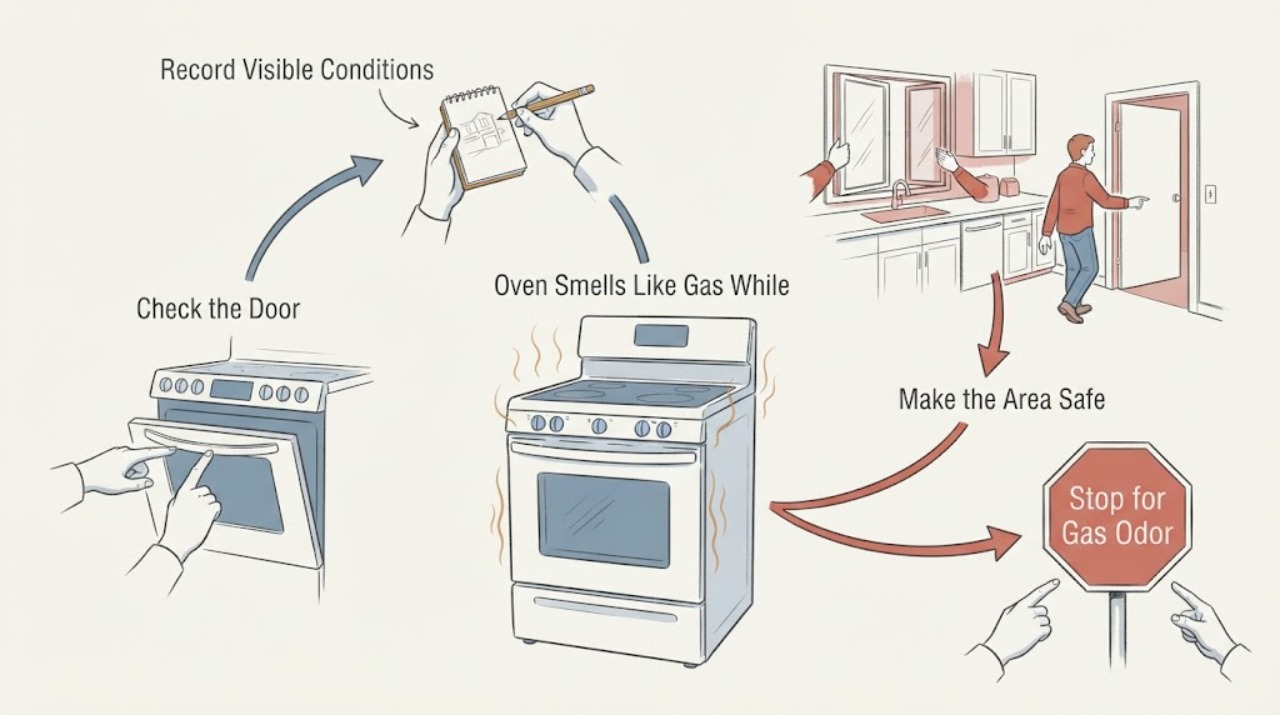
If you smell rotten-egg or unburned gas now, stop using the GE range, do not light or restart the oven, operate electrical switches, or search for the leak with a flame. If it is safe without operating equipment, open a door or window, extinguish an open flame, leave everyone out of the area, and call the gas supplier or emergency service from outside. GE says a brief unusual odor at the first start can come from combustion and may go away within a few minutes, but an odor that persists, returns while baking, appears when the oven is off, follows a delayed ignition or boom, or occurs with an abnormal flame needs the gas supplier or qualified gas-appliance service. A CO alarm or headache, dizziness, nausea, weakness, confusion, or breathing trouble is an evacuation and medical-emergency path because carbon monoxide itself has no odor.
Before you begin
Safety first
- Owner checks are limited to evacuation and emergency reporting when gas or CO is suspected, recording the odor timing after the area is cleared, and safe external observation from the normal user position. Do not use a flame to find a leak, repeat ignition tests, open panels, disconnect the gas connector, adjust gas pressure or air shutters, alter conversion parts, or touch the igniter, safety valve, regulator, burner, or control wiring.
Work through in order
Diagnostic checks
Use only checks that match the exact appliance or system and its official guide.
-
Check 1
If the odor is present now, especially if it smells like rotten eggs, is strong or spreading, appears with the oven off, or anyone feels unwell, stop using the range without touching electrical switches or the oven controls. If safe without operating equipment, open a door or window and extinguish an open flame, then leave the home or affected area and call the gas supplier or emergency service from outside or a neighbor's phone.
Expected result: The odor clears after leaving, remains strong or returns, a CO alarm sounds, or anyone has headache, dizziness, weakness, nausea, vomiting, chest pain, confusion, shortness of breath, or loss of coordination.
Next step: Keep everyone out, follow the gas supplier or emergency responder's instructions, and obtain medical help for possible CO exposure. Do not restart the range until the area and appliance have been declared safe.
Stop if: Do not light the oven, operate a switch, use a phone inside, test for a leak with a flame, or return to inspect the appliance while an unburned-gas or CO concern remains.
Why this matters
Why: GE treats unburned or rotten-egg gas odor in the home as abnormal and directs occupants to ventilate, avoid switches and flames, leave, and call from outside. CPSC identifies CO as odorless and potentially deadly, so a CO alarm or compatible symptoms cannot be evaluated by smelling the oven.
-
Check 2
Only after the gas supplier or emergency service says the area is safe, write down exactly when the odor occurred: only during the first start, on every ignition attempt, during steady baking, when the burner cycles off, after the oven is turned off, or after a recent installation, move, or fuel conversion. Do not repeat a bake cycle to reproduce the smell.
Expected result: The odor was brief and limited to the first start, disappears within a few minutes with normal operation, or persists, returns during baking, follows burner cycling, or appears while the oven is off.
Next step: Keep the oven off for a persistent or recurring odor and report the timing to a qualified GE gas-appliance technician or the gas supplier. Use the exact owner documentation for any model-specific control information.
Stop if: Do not keep cycling the oven, turn gas controls repeatedly, or attempt to purge a suspected gas path yourself.
Why this matters
Why: GE says an unusual odor caused by combustion can occur when a gas oven first starts and should go away within a few minutes. Persistence, recurrence, or odor while off is not the same observation and does not establish a harmless startup condition.
-
Check 3
From the normal user position and only after the area is cleared safe, note whether the oven ignites promptly and whether there was a boom, delayed ignition, persistent popping, or movement of the oven door. Do not reach into the burner area or remove a panel to watch an igniter, burner, regulator, or safety valve.
Expected result: The oven lights without a boom and the odor is absent after the brief first-start period, or ignition is delayed, the oven makes a boom or abnormal pop, the door moves, or the gas odor remains after the burner should be lit.
Next step: Stop using the oven and arrange qualified gas-appliance service for delayed ignition, persistent popping, a door movement, failed ignition, or recurring odor. Provide the exact model and the observed timing instead of naming a part.
Stop if: Do not adjust gas pressure, air shutters, pilot settings, burner components, igniter wiring, or the safety valve, and do not repeat an ignition test.
Why this matters
Why: GE says a boom or door blowing open indicates delayed ignition and that the oven should ignite in 2 to 3 seconds; it directs this condition to repair service. Residual odor after an ignition attempt is not a safe reason to keep trying.
-
Check 4
If a flame is visible from the normal safe viewing position after a professional has cleared the immediate gas concern, record whether it is the expected pattern for the installed fuel and whether it is completely yellow or orange, unstable, lifting, or accompanied by soot or odor. Do not remove burner parts or attempt a fuel-conversion adjustment.
Expected result: The flame is stable for the correctly configured fuel and the odor does not recur, or the flame is completely yellow or orange after LP conversion, unstable, accompanied by soot, or paired with gas odor.
Next step: Keep the oven out of service and arrange qualified gas-appliance evaluation for abnormal flame, soot, or any returning odor. Give the provider the fuel type and any recent conversion or installation history.
Stop if: Do not adjust the regulator, air shutter, burner orifice, gas pressure, or burner assembly yourself.
Why this matters
Why: GE says completely yellow or orange flames after proper LP conversion can reflect airflow, gas pressure, or bad gas and should be referred to service or a gas professional. Flame color alone does not identify an igniter, valve, regulator, or burner fault.
-
Check 5
Separate a possible gas odor from a new-oven or overheated-material odor only by safe external history: note whether the appliance is newly installed or first used, whether the smell is chemical, oily, or smoky rather than rotten-egg-like, and whether it occurs with visible smoke or grease. Do not run a heating or self-clean cycle to burn off an uncertain smell.
Expected result: The odor is limited to the first few uses and is consistent with new materials, or it is gas-like, recurrent, smoky with grease, or still uncertain after the appliance has cooled.
Next step: Follow the exact owner manual only after the gas concern has been cleared; otherwise keep the oven off and arrange qualified service. Treat smoke, flame, or combustible buildup as a separate fire-safety reason to stop.
Stop if: Do not use an oven cleaner, burn-off cycle, open flame, or improvised ventilation test to identify the odor.
Why this matters
Why: GE documents that new ovens can produce a temporary smoke or material odor, but that is not a safe way to clear an odor described as gas. Uncertainty, grease smoke, or a gas-like recurrence keeps the appliance in the professional-assessment path.
-
Check 6
Before service, record the complete GE model JGBP86SEM1SS, serial information, natural-gas or LP configuration, whether surface burners work, the odor description and timing, any ignition sound or flame symptom, recent installation or conversion work, and whether the gas supplier has already checked the supply. Do not order an igniter, safety valve, regulator, or control from the symptom alone.
Expected result: The full identity and fuel configuration are available, or the model, market, conversion status, and source of gas are uncertain.
Next step: Give the identity and symptom log to the gas supplier or qualified GE gas-appliance servicer, and keep the oven off until that professional confirms the repair boundary and safe return to operation.
Stop if: Do not remove the range, disconnect the gas connector, open the control or burner compartment, or alter conversion components.
Why this matters
Why: GE's exact-model support route identifies JGBP86SEM1SS as a 30-inch free-standing gas range and provides its owner-manual path. Gas-train and ignition behavior can depend on installation and fuel configuration, so a generic part or near-model instruction is not a diagnosis.
Use your observations
Decision map
Find the observation that best matches what you see, then follow the next safe action.
-
PATH 01Next step
What you see
A rotten-egg or unburned-gas odor is strong, spreading, persistent, present while the oven is off, or accompanied by a CO alarm or illness symptoms.
Do this next
Leave the area, avoid switches, flames, phones, and appliance controls inside, call emergency services or the gas supplier from outside, and obtain medical help for possible CO exposure. Do not return or operate the range until professionals clear it.
Why this path and its safety boundary
Why it matters: This is an immediate gas or combustion-safety path, not a homeowner ignition diagnosis. CO is odorless, so the absence of a rotten-egg smell cannot clear a sounding CO alarm or compatible symptoms.
-
PATH 02Next step
What you see
The odor occurs only at the first start, is a brief combustion odor, disappears within a few minutes, and there is no delayed ignition, abnormal flame, smoke, warming control, or recurrence.
Do this next
Use the exact owner manual and monitor without deliberately reproducing the odor. Stop and request service if it returns, lasts longer, or gains any ignition, flame, or gas-leak symptom.
Why this path and its safety boundary
Why it matters: This matches GE's described first-start combustion odor more closely than unburned gas, but the observation does not authorize repeated testing or override a local gas professional's instruction.
-
PATH 03Next step
What you see
The oven makes a boom or door movement, ignition takes longer than GE's stated 2 to 3 seconds, popping persists after the burner cycles, or the gas smell remains after an ignition attempt.
Do this next
Stop using the oven, keep gas controls off, and arrange a qualified gas professional or GE appliance service. Do not repeat the bake cycle or adjust the gas train.
Why this path and its safety boundary
Why it matters: The pattern is consistent with delayed ignition or residual/unburned gas and requires qualified gas-appliance evaluation; it is not evidence for a particular igniter, valve, or regulator failure.
-
PATH 04Next step
What you see
The flame is completely yellow or orange after a proper LP conversion, unstable, sooty, or accompanied by recurrent odor, while the appliance otherwise appears to ignite.
Do this next
Keep the oven out of service and have a qualified gas professional check fuel configuration, combustion, and the appliance installation. Do not adjust air shutters, pressure, or burner parts.
Why this path and its safety boundary
Why it matters: GE identifies airflow, gas pressure, or fuel quality as possible professional-service concerns in this situation, but flame appearance cannot identify the failed component.
-
PATH 05Next step
What you see
The smell is recurring or unexplained during baking, the model or fuel configuration is uncertain, or safe external observations do not match the exact owner documentation.
Do this next
Keep the oven off, provide the full model and timing log to the gas supplier or qualified GE servicer, and do not resume cooking until the gas path and combustion are professionally assessed.
Why this path and its safety boundary
Why it matters: The opened sources support a safety and service boundary but cannot safely normalize an unresolved gas odor or identify a component on JGBP86SEM1SS from smell alone.
Helpful context
Understand the symptom
A gas smell while this GE oven is baking is not diagnosed by replacing an igniter or valve. The first decision is safety: distinguish a brief combustion odor at first start from unburned gas, then stop for any odor that persists, returns, or is paired with delayed ignition, a boom, an abnormal flame, or an oven that fails to light. The exact JGBP86SEM1SS model is identified in GE's parts and support routing, but gas-path work remains a qualified-service task.
Carbon monoxide cannot be smelled. If a CO alarm sounds or anyone develops headache, dizziness, weakness, nausea, vomiting, chest pain, confusion, shortness of breath, or loss of coordination while the oven is operating, leave immediately for fresh air and call emergency services; do not stay to inspect the range. Do not return the oven to use until the responsible professionals have cleared the appliance.
When checks do not resolve it
Need a professional?
Use the gas supplier or emergency service first for an active or strong gas odor, an odor while off, a CO alarm, or illness symptoms. Use qualified GE gas-appliance service for any recurring baking odor, delayed ignition, boom, door movement, abnormal flame, failed ignition, smoke, soot, or unresolved model/fuel configuration.
Safety scope: Owner checks are limited to evacuation and emergency reporting when gas or CO is suspected, recording the odor timing after the area is cleared, and safe external observation from the normal user position. Do not use a flame to find a leak, repeat ignition tests, open panels, disconnect the gas connector, adjust gas pressure or air shutters, alter conversion parts, or touch the igniter, safety valve, regulator, burner, or control wiring.
Have this ready
- Provide the complete model JGBP86SEM1SS, serial information, market, fuel type and conversion history, odor description, exact timing, ignition delay or sound, flame observations, whether surface burners work, recent installation or movement, photographs from a safe position, and any gas-supplier or emergency-responder findings.
Common questions
FAQ
Is a gas smell normal when this GE oven starts?
GE says a brief unusual odor at the first start can come from combustion and should go away within a few minutes. A rotten-egg or unburned-gas odor, a smell that persists or returns while baking, or an odor while the oven is off is not a normal reason to continue operating the range; leave and contact the gas supplier or qualified service.
What does a boom or popping sound with gas odor mean?
GE says a boom or door blowing open indicates delayed ignition and that the oven should ignite in 2 to 3 seconds. Persistent popping or odor after the burner cycles also needs a qualified gas-appliance assessment. Do not repeat the ignition test or adjust the gas train yourself.
Can I smell carbon monoxide from the oven?
No. CPSC says carbon monoxide is colorless and odorless. If a CO alarm sounds or anyone has headache, dizziness, weakness, nausea, vomiting, chest pain, confusion, shortness of breath, or loss of coordination, leave for fresh air and call emergency services; do not stay to locate the source or operate the range.
Should I replace the igniter or safety valve because the oven smells like gas?
No. Gas odor, delayed ignition, and abnormal flame can involve the supply, installation, fuel conversion, ignition, burner, safety controls, or another condition. Keep the oven off and let a qualified gas-appliance professional identify the cause against the complete JGBP86SEM1SS documentation before any part decision.
Read the exact guide
Official sources
- Model Search | JGBP86SEM1SSGE Appliances / GE Appliance Parts · The opened GE model page identifies JGBP86SEM1SS and links product specifications, owner's manual, and installation instructions. It establishes the exact model identity and documentation route, not a universal repair or gas-adjustment procedure.
- Gas Range - Gas OdorsGE Appliances · Supports the distinction between a brief first-start combustion odor and unburned or rotten-egg gas odor for a GE gas range. It does not authorize operation or repair of an unresolved JGBP86SEM1SS gas condition.
- Gas Range - What is Normal Operation vs What Requires ServiceGE Appliances · Supports the gas-odor, delayed-ignition, abnormal-flame, and professional-boundary branches for GE gas ranges. Specific control and fuel-conversion details still require the exact JGBP86SEM1SS documentation.
- Carbon Monoxide Fact SheetU.S. Consumer Product Safety Commission · Supports the CO-specific safety branch for a gas oven in a home. It does not diagnose this GE range or determine the source of an alarm.
Community feedback
Share a repair observation
Share a plain-text repair observation. Accepted observations are published automatically; this page may take a moment to update.