
On this page
Start here
Quick answer
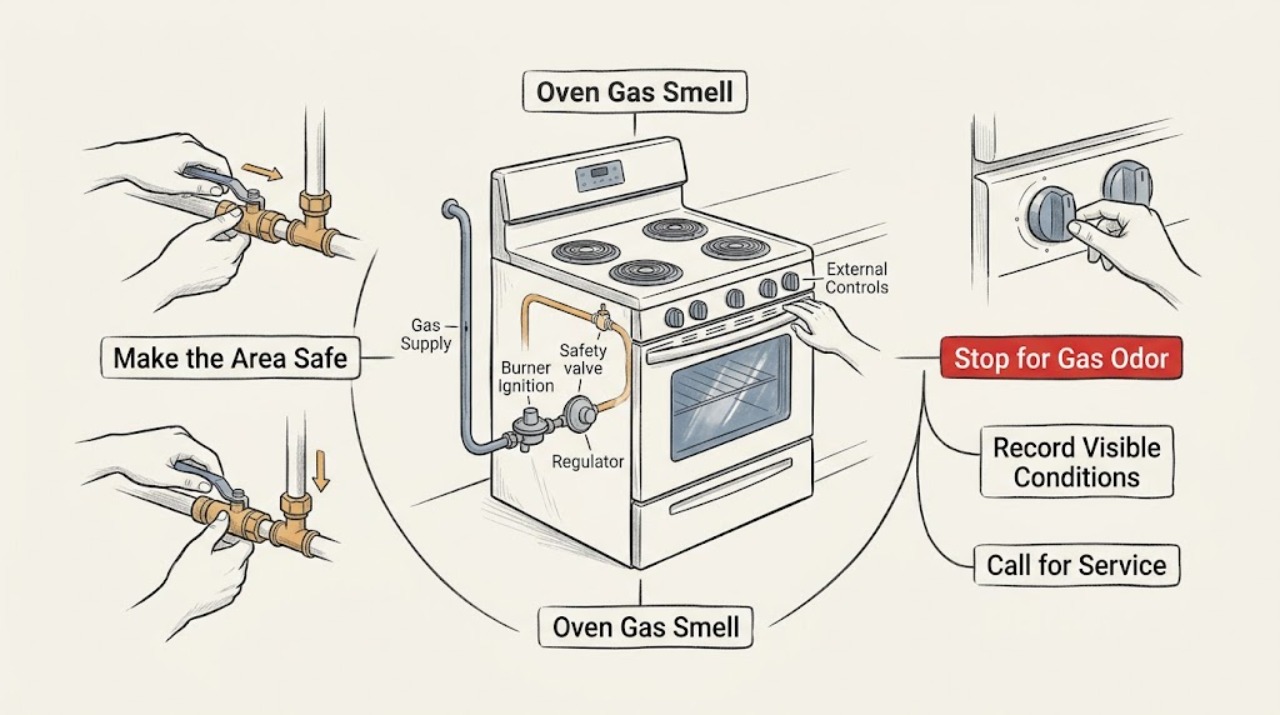
Treat an unexplained or rotten-egg gas odor as an emergency, not a troubleshooting opportunity. Do not light the oven, operate switches or appliances, use a phone inside, or search for the leak with a flame. If it is safe without operating electrical equipment, open a door or window, extinguish an open flame, leave the area, and call the gas supplier or emergency service from outside or a neighbor's phone. GE says a brief unusual odor when a gas oven first starts can come from combustion, but unburned gas in the home is not normal. Only after the area is declared safe should you document whether the odor was limited to startup, accompanied by ignition trouble, or returned while the oven was off. Never relight repeatedly or work on the gas train yourself.
Work through in order
Diagnostic checks
Use only checks that match the exact appliance or system and its official guide.
-
Check 1
If you smell gas now, stop using the oven and do not touch electrical switches, thermostats, appliance controls, or a phone inside the home; if safe without operating equipment, open a door or window, extinguish an open flame, and leave with everyone in the area.
Expected result: A strong, spreading, or persistent odor, an odor present while the oven is off, or any person feeling unwell means the area must remain empty; do not return to inspect the appliance.
Next step: From outside or a neighbor's phone, call the gas supplier or emergency service and follow its instructions. Do not restart the oven until the area and appliance have been declared safe.
Why this matters
Why: GE states that unburned gas or a rotten-egg odor in the home is not normal and requires ventilation, avoiding switches and flames, clearing the area, and contacting the gas supplier or emergency service from outside.
-
Check 2
After the gas supplier or emergency service says it is safe to assess the appliance, record when the odor occurred: only at the first startup, during each ignition attempt, while baking, after the flame cycles off, or with the oven completely off.
Expected result: A brief odor limited to a first startup is different from an odor that persists, returns during operation, or occurs while the oven is off. A gas odor paired with a delayed ignition, popping, or door movement is not a normal startup observation.
Next step: Do not repeat an ignition test to confirm the pattern. Give the timing, odor description, and any sound or flame symptom to the gas supplier or qualified servicer.
Why this matters
Why: GE says a first-start unusual odor can come from combustion, while residual or unburned gas and delayed ignition require a repair service or gas professional.
-
Check 3
If the issue is an oven that does not ignite while the surface burners work, leave the gas controls off and use only the model owner's manual to identify the normal control state; do not access the regulator, igniter, safety valve, or burner assembly.
Expected result: A working cooktop with a non-igniting oven can reflect a model-specific control, regulator, igniter, or gas-path fault; a smell during repeated failed ignition is a stop signal, not a reason to keep trying.
Next step: Arrange qualified gas appliance service, especially if the oven was recently installed or moved. Do not remove panels or attempt a regulator or burner adjustment.
Why this matters
Why: GE's gas-range guidance lists correct controls, the regulator position on some new installations, and the igniter as possible causes when the oven does not heat, while directing unresolved faults to service.
-
Check 4
Do not use a flame, leak-detection experiment, or repeated start cycle to locate the odor; instead, after the area is cleared and safe, note any visible ignition behavior from the normal user position without reaching into the oven.
Expected result: A boom, delayed ignition, door movement, persistent popping, or a flame that is completely yellow or orange after an appropriate fuel conversion needs professional evaluation; no visible symptom does not prove the gas path is safe.
Next step: Stop using the range and report the exact sound, flame, and odor pattern. Do not adjust air shutters, gas pressure, pilot settings, or burner components.
Why this matters
Why: GE identifies delayed ignition and abnormal flame color as conditions for a qualified service technician or gas professional and specifically warns against using an open flame to find a leak.
-
Check 5
Check only the surrounding conditions after a professional has cleared the gas concern: make sure the oven area is free of spilled grease or combustible items and that no cleaning product, plastic, or packaging is heating near the vent or burner.
Expected result: An odor that is chemical, smoky, or oily rather than gas-like may have a different source, but odor plus gas symptoms, flame irregularity, or a control fault must still be treated as unsafe until evaluated.
Next step: Do not run a heating cycle to burn off an uncertain odor. Use the owner's manual and qualified service to identify the source before operating the oven again.
Why this matters
Why: GE distinguishes new-oven smoke or material odor from gas odor and warns that grease or combustible buildup can ignite. Smell alone is not a safe method for clearing an appliance.
-
Check 6
Before service, write down the exact GE model, fuel type, whether the burners work, when the odor appears, any display or ignition behavior, recent installation or conversion work, and whether the gas supplier has inspected the supply.
Expected result: A complete symptom history lets the gas supplier or servicer distinguish a house-side supply issue, a new-installation condition, and an appliance ignition or safety-control fault without repeated homeowner tests.
Next step: Keep the oven off until the responsible gas or appliance professional confirms the repair boundary and safe return to operation.
Why this matters
Why: GE directs owners to model-specific manuals and qualified service for unresolved gas-range faults; ignition and gas-path work should not be improvised from a generic procedure.
Use your observations
Decision map
Find the observation that best matches what you see, then follow the next safe action.
-
PATH 01Next step
What you see
The odor is present now, resembles unburned gas, persists with the oven off, or is spreading through the home.
Do this next
Do not troubleshoot. Avoid switches, phones, flames, and appliances inside; leave, call the gas supplier or emergency service from outside, and follow its instructions.
-
PATH 02Next step
What you see
A brief unusual odor occurs only when a gas oven first starts and then disappears, with no residual odor or ignition symptom.
Do this next
Treat it as the limited startup behavior GE describes, but stop and report it if it becomes persistent, returns while off, or changes to an unburned-gas smell.
-
PATH 03Next step
What you see
The oven fails to ignite, produces a boom or persistent popping, or the door moves unexpectedly.
Do this next
Turn the oven off, do not attempt another ignition, and arrange qualified gas appliance service after the area is safe.
-
PATH 04Next step
What you see
The burners work but the oven does not heat or ignite, especially after installation or moving.
Do this next
Use only the model manual to confirm settings, then request qualified service for the regulator, igniter, safety valve, or gas path; do not open the appliance.
-
PATH 05Next step
What you see
Flames are completely yellow or orange after the correct fuel conversion, or the smell returns after a professional clearance.
Do this next
Stop using the oven and call a qualified gas professional or appliance servicer. Do not adjust gas pressure or airflow yourself.
Helpful context
Understand the symptom
Gas odor is a safety decision before it is an appliance diagnosis. A new gas oven can have a brief startup odor as the burner operates, but an odor that resembles unburned gas, persists after the oven is off, or appears with ignition trouble must be handled as a gas emergency.
Do not test a suspected leak with a match, lighter, or any other flame. Do not remove the oven bottom, access the regulator, adjust burner air, or open the gas train. The gas supplier or a qualified gas appliance professional determines whether the supply or appliance is safe.
Safety boundary
Stop conditions
- Stop immediately and leave the area if you smell unburned gas, a rotten-egg odor, or gas that persists while the oven is off. Call the gas supplier or emergency service from outside.
- Do not touch electrical switches, use a phone inside, light a match, search with a flame, turn on an appliance, or repeatedly attempt ignition during a suspected gas leak.
- Stop using the oven for a boom, delayed ignition, door movement, persistent popping, abnormal flame color, melting controls, or any gas odor that returns after startup.
- Do not remove panels, adjust a regulator, change gas pressure or burner airflow, relight a pilot, or service the igniter, safety valve, or gas train yourself.
Only after diagnosis
Potential parts
- oven igniter
Consider this only after qualified diagnosis confirms an igniter fault; odor or a no-heat symptom alone does not establish part failure.
Confirm the exact GE model and manufacturer fit information before ordering or installing any gas-oven part. - oven safety valve
Consider this only after a qualified gas-appliance diagnosis identifies a failed valve rather than a supply, control, or ignition issue.
Gas safety valves require exact model verification and qualified installation; never bypass the valve. - oven door gasket
Consider this only when the exact model's gasket is visibly damaged and service confirms it contributes to heat or odor leakage; a gas odor is not a gasket diagnosis.
Confirm the exact model and installation procedure before ordering or fitting a gasket.
When checks do not resolve it
Need a professional?
Call the gas supplier or emergency service immediately for an unburned-gas or rotten-egg odor in the home. After the area is safe, call qualified GE gas-appliance service for delayed ignition, a non-igniting oven, abnormal flame color, recurrent odor, control or regulator concerns, or any repair requiring access to the gas train or electrical ignition system.
Common questions
FAQ
Is it normal for a GE gas oven to smell when it first starts?
GE says a brief unusual odor at first startup can come from gas combustion and should not be confused with unburned gas. A rotten-egg or persistent odor, odor while the oven is off, or odor with ignition trouble requires leaving the area and contacting the gas supplier or qualified service.
What should I do if I smell gas from my GE oven?
Do not operate switches, phones, flames, or appliances inside. If safe, open a door or window, leave the area, and call the gas supplier or emergency service from outside or a neighbor's phone. Do not return until it is declared safe.
Can I adjust the GE oven regulator or igniter myself?
No. Regulator, igniter, safety-valve, gas-pressure, and burner-air adjustments are qualified-service work. Give the gas supplier or appliance servicer the exact model and symptom history instead of repeating ignition tests.
Read the exact guide
Official sources
- Range & Wall Oven - Smoke and Odor from a New OvenGE Appliances · GE new-oven material odor and smoke distinction from gas odor
- Gas Range - What is Normal Operation vs What Requires ServiceGE Appliances · GE gas-range normal startup odor, unburned-gas warning signs, ignition symptoms, and service boundary
- Important Safety InstructionsGE Appliances · GE gas-range safety instructions, open-flame prohibition, and qualified service boundary
- Gas Range Air in Gas LineGE Appliances · GE first-start gas-line behavior and oven flame appearance
- Gas Range - Oven Does Not Heat, But The Burners HeatGE Appliances · GE gas-range oven ignition, regulator, controls, and qualified service guidance
- If You Smell Gas in Your HomeGE Appliances · GE emergency response when gas is smelled in the home
Community feedback
Share a repair observation
Share a plain-text repair observation. Accepted observations are published automatically; this page may take a moment to update.