
On this page
Start here
Quick answer
If the middle pane or any other glass in the GE JB630RF1SS oven door shattered during Self Clean, turn the oven off, keep people and pets away, and let the range cool completely. Do not use the oven, start another cleaning cycle, sweep fragments into the door vents, remove the door, or try to replace the glass yourself. GE says not to cook on a product with broken glass because cuts, fire, or shock may occur, and its support guidance does not recommend using a range when an oven-door window is broken or cracked. Once the range is cold and safe to approach, photograph the damage without disturbing it and record the exact model and serial information for GE or the authorized service provider. Ask for an inspection and written warranty-coverage decision; a photo and service request do not promise that GE will pay for the repair.
Work through in order
Diagnostic checks
Use only checks that match the exact appliance or system and its official guide.
-
Check 1
Turn the oven off from the controls if they respond, keep the oven door closed, keep people and pets away, and let the range cool fully. If there is active smoke or fire, follow the emergency response for the home and do not open the Self Clean door to introduce air.
Expected result: The pane is shattered or cracked, fragments are visible on the floor or in the door, the oven is still hot or locked, or smoke, flame, burning odor, sparks, or a breaker trip occurred.
Next step: Leave the oven unused and allow natural cooling. For continuing smoke, flames, or an electrical hazard, keep clear and obtain appropriate emergency or qualified appliance/electrical help; do not restart the range.
Stop if: Do not force the door, touch fragments, vacuum or sweep through door vents, pour water into the hot oven, or restore power to test it.
Why this matters
Why: Broken glass creates a cut, fire, shock, and door-safety concern; heat and a Self Clean lock can make the door and fragments hazardous to handle. A smoke or electrical event is more urgent than determining why the glass failed.
-
Check 2
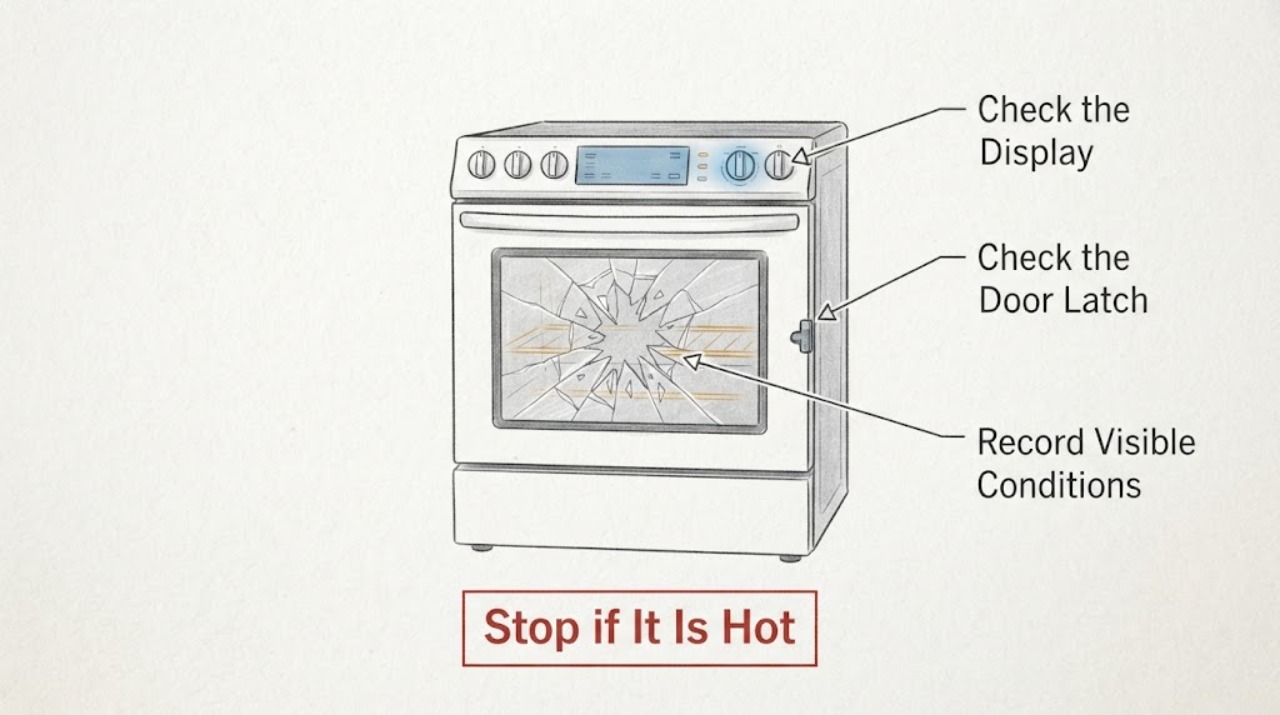
When the range is cold and safe to approach, take wide and close photographs of the door from the outside without touching the glass, gasket, latch, or fragments. Record whether the middle pane alone appears broken, whether other panes or the frame are damaged, and whether pieces fell into the room.
Expected result: Only a pane appears damaged, multiple panes or the frame are damaged, the gasket is displaced, fragments are loose, or the extent cannot be seen without opening the door.
Next step: Keep the door closed and provide the photos to GE or a qualified service provider. If the extent is unclear, let the technician inspect it rather than opening or dismantling the door.
Stop if: Do not remove the door, unscrew the inner panel, pick glass from the gasket, or clean inside the door assembly.
Why this matters
Why: The visible pattern helps service identify a door-assembly safety issue, but it cannot establish the cause or authorize a user glass replacement. Unseen fragments and a damaged frame make continued use especially unsafe.
-
Check 3
Read the rating plate or paperwork without moving the range and record the exact model suffix, serial number, purchase or installation date, and market. Confirm that the label says JB630RF1SS rather than a similar JB630 or another GE range.
Expected result: The label clearly shows JB630RF1SS, shows a different suffix, or cannot be read without moving the range or disturbing the damaged door.
Next step: Send the exact identity, photos, receipt or delivery record, and a description of the Self Clean event to GE or an authorized service channel. If the model cannot be confirmed safely, report that uncertainty rather than ordering glass.
Stop if: Do not pull the range out, remove the storage drawer or door to find a label, or rely on a third-party parts listing to select a replacement pane.
Why this matters
Why: GE uses model-specific door assemblies, manuals, and warranty terms. A JB630-series document is useful safety context, but the exact suffix controls the service parts and coverage review.
-
Check 4
From outside the cold range, note whether the controls are normal, whether the oven light or display is still powered, whether the door remains locked, and whether any breaker or fuse operated. Do not operate a heating or Self Clean function to reproduce the failure.
Expected result: The control is dead, the lock remains engaged, the range is otherwise powered, a breaker tripped, or the display and door appear normal despite broken glass.
Next step: Keep the oven out of service and tell the technician every observed state. If the controls remain powered and there is no hazard, do not repeatedly cycle them; let service determine whether power isolation is needed.
Stop if: Do not bypass the door lock, reset a tripped breaker repeatedly, probe wiring, or open the control console.
Why this matters
Why: A powered range or an engaged lock does not make the damaged door safe. A trip or dead control may indicate an associated electrical fault, while normal controls do not remove the glass and heat-exposure risk.
-
Check 5
Prepare the service and warranty request with the exact model and serial, photos, receipt or delivery date, Self Clean setting and timing, whether all racks and loose items had been removed, the cooling/lock state, and any smoke, odor, spark, or breaker detail. Ask for a written inspection and coverage decision.
Expected result: The event is documented with intact identifying information, or the identity, cause, or coverage facts remain uncertain.
Next step: Leave the oven unused until qualified service confirms the door and related safety components are repaired. Keep all broken pieces only if they can be retained without touching sharp fragments; otherwise do not handle them.
Stop if: Do not authorize glass replacement from a photo alone, clean the door by disassembly, or operate the oven while any door glass is broken or cracked.
Why this matters
Why: A complete record lets GE or its servicer assess the whole door assembly and the cleaning event without requiring another hazardous run. Timing alone does not prove a defect or promise reimbursement.
Use your observations
Decision map
Find the observation that best matches what you see, then follow the next safe action.
-
PATH 01Next step
What you see
Any oven-door pane is broken or cracked after Self Clean, regardless of whether the cooktop and display still work.
Do this next
Keep the oven off and door closed, allow it to cool, and arrange qualified GE appliance service. Do not clean, dismantle, or replace the glass as an owner procedure.
Why this path and its safety boundary
Why it matters: GE treats broken door glass as a safety issue and does not recommend oven use; the remaining glass may be exposed to more heat and fragments may create cut or electrical hazards.
-
PATH 02Next step
What you see
Smoke, flames, burning or electrical odor, sparks, a breaker trip, or unexpected heating accompanied the breakage.
Do this next
Stop using the range, keep clear, isolate power only from a safe accessible disconnect if appropriate, and obtain emergency or qualified appliance/electrical service.
Why this path and its safety boundary
Why it matters: This is an immediate fire or electrical safety event, not merely a broken-window repair. Restarting Self Clean or cooking could worsen the hazard.
-
PATH 03Next step
What you see
The range is cold, no active hazard remains, but the door is locked, fragments are loose, the frame or gasket is damaged, or the damage cannot be assessed without opening the door.
Do this next
Keep the door closed and request a qualified inspection. Provide photographs and the exact model/serial rather than trying to release the latch or remove the door.
Why this path and its safety boundary
Why it matters: The door assembly remains structurally unsafe to handle and may have hidden fragments or latch damage; a cold exterior does not make user disassembly safe.
-
PATH 04Next step
What you see
Photos and the exact JB630RF1SS identity are available, but the owner wants GE to cover the replacement.
Do this next
Submit the photos, serial, proof of purchase, and Self Clean history through GE or an authorized service provider and request the coverage decision in writing. Leave the range unused until cleared.
Why this path and its safety boundary
Why it matters: Documentation supports a warranty or service review, not a guaranteed outcome. GE's manual states that warranty terms and exclusions apply, and the cause still requires inspection.
Helpful context
Understand the symptom
Treat the shattered pane as a safety failure
The middle pane is part of the oven-door assembly, not loose trim. After glass breaks at Self Clean temperatures, fragments may be inside the door or around its vents, and the remaining panes can be exposed to abnormal heat. GE's guidance is to stop using the oven when the door window is broken or cracked. Do not keep the range powered for a closer look or run another cycle to see whether the door still seals.
Document first; do not negotiate from a guessed cause
A Self Clean event establishes timing, not responsibility or the failed piece. Preserve a clear photo from a safe distance, the full model and serial label, the date and stage of the cleaning cycle, whether the door was locked, and any smoke, sparks, odor, or breaker event. Give that record to GE or an authorized service provider and ask them to inspect the complete door assembly and the self-clean event. Warranty or reimbursement decisions depend on the actual terms and inspection; this article cannot promise coverage.
When checks do not resolve it
Need a professional?
Qualified GE appliance service is required for any broken or cracked oven-door glass, displaced gasket or frame, retained fragments, a locked door after the event, or any associated smoke, electrical, or heating symptom. The door assembly, glass retainers, hinges, latch, and Self Clean-related safety checks should be matched to the exact JB630RF1SS identity; do not select or install a component from the breakage description alone.
Common questions
FAQ
Can I use the cooktop while the oven-door glass is broken?
GE's support guidance says surface burners on a range may be safe when the oven window is broken or cracked, but the damaged door remains a safety concern. Keep the range away from the oven function and follow the technician's instructions before using any part of the appliance if fragments, heat, smoke, or electrical damage are present.
Should I vacuum or wipe up the broken glass?
Do not clean inside the door, sweep through its vents, or handle sharp fragments while the range is hot or powered. Photograph the damage from a safe distance, keep people away, and let qualified service decide how the door assembly and fragments should be handled.
Will GE automatically cover a pane that broke during Self Clean?
No automatic coverage should be assumed. Provide the exact model and serial, proof of purchase, photos, and Self Clean history, then request a written warranty or service decision. The timing of the break does not by itself establish a defect or reimbursement obligation.
Read the exact guide
Official sources
- Range & Wall Oven - Operation of Oven If Door Window Is Broken or CrackedGE Appliances · Official GE safety guidance opened for the exact symptom; it states not to use the oven when the inner or outer door window is broken or cracked.
- 30" Free-Standing Range Owner's ManualGE Appliances · Official GE owner's manual opened through GE's model support page; the cover includes the JB630 series and the safety section applies to the covered electric ranges.
- Range & Wall Oven - Tips for Self CleanGE Appliances · Official GE Self Clean guidance opened for the event condition; it supports cooling, lock, smoke, and no-repeat-operation boundaries but does not diagnose why glass shattered.
- Assembly View for CONTROL PANEL | JB630RF1SSGE Appliances Parts · Official GE Appliances parts diagram opened to verify the exact JB630RF1SS model identity; it is not used to select a replacement pane or promise compatibility.
Community feedback
Share a repair observation
Share a plain-text repair observation. Accepted observations are published automatically; this page may take a moment to update.