
On this page
Start here
Quick answer
Treat a suspected GE oven gas leak as an emergency. Do not turn the oven or another appliance on, touch electrical switches, use a phone inside, light a match, or try to find the leak. Extinguish an open flame only if it can be done immediately without delaying escape, leave the building or area with everyone else, and call the gas supplier or emergency services from outside or a neighbor's phone. GE says unburned gas odor is not normal; do not return, relight, test, or restart the oven until the gas supplier, fire department, or qualified service provider has declared the area safe.
Before you begin
Safety first
- This page is limited to emergency evacuation and communication. Do not operate electrical switches or phones inside, light a match, turn on an appliance, try a flame test, manipulate gas fittings or valves, remove panels, or perform internal repair.
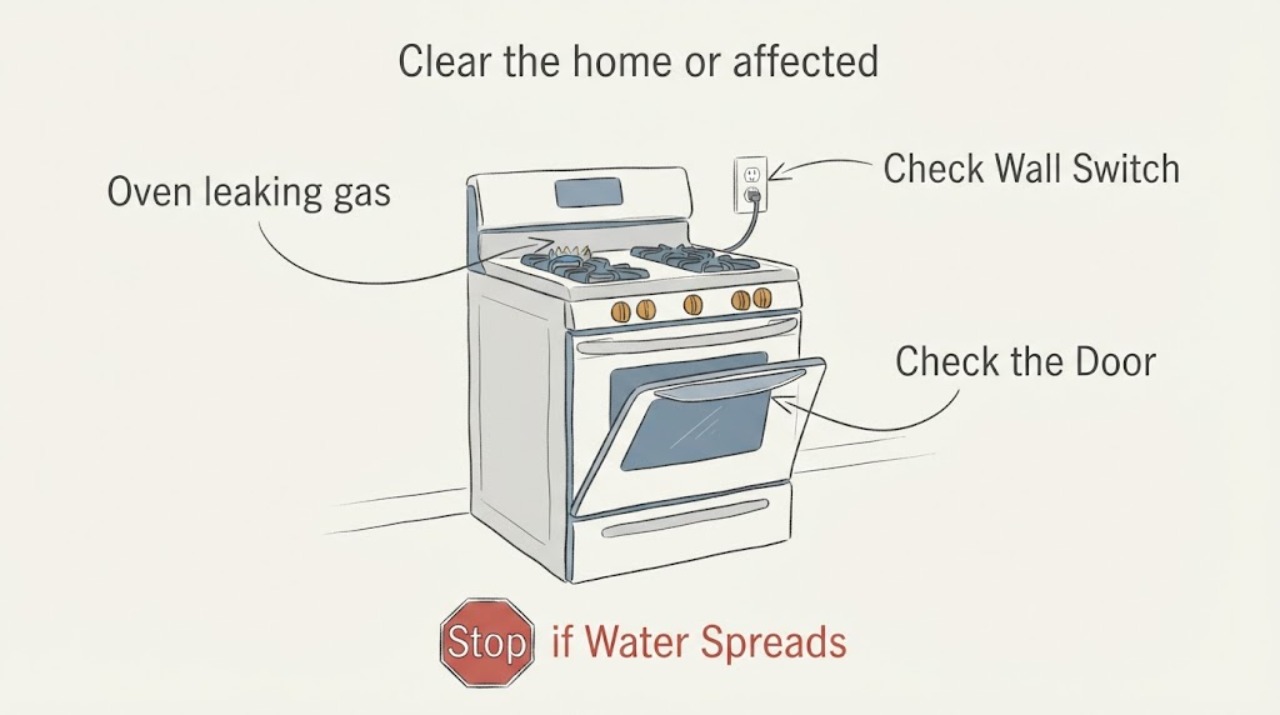
Work through in order
Diagnostic checks
Use only checks that match the exact appliance or system and its official guide.
-
Check 1
If gas odor is present now, stop using the GE oven and do not touch appliance controls, electrical switches, plugs, thermostats, or phones inside the home.
Expected result: The odor is present, stronger near the oven, accompanied by hissing, or uncertain but cannot be safely ruled out.
Next step: Leave immediately with everyone in the area. Do not stay to identify the leak or collect belongings.
Stop if: If the odor is gone, do not restart the oven to see whether it returns; document what happened from a safe location and arrange qualified evaluation.
Why this matters
Why: GE treats unburned gas odor as abnormal and warns that switches, phones, flames, and appliances can create an ignition source.
-
Check 2
From the safest available position, extinguish an open flame only if doing so does not delay escape, then open a door or window only while leaving if it can be done without entering or remaining in the contaminated area.
Expected result: A flame is present, ventilation can be opened on the exit path without delay, or neither action can be done safely.
Next step: Prioritize evacuation over ventilation or flame control when there is any doubt or strong odor.
Stop if: Exit without touching anything else; do not use a switch, fan, appliance, or phone inside.
Why this matters
Why: GE's gas guidance calls for extinguishing open flames and opening windows or doors, but these steps never justify staying inside to investigate a leak.
-
Check 3
Clear the home or affected area and call the gas supplier or local emergency service from outside or from a neighbor's phone.
Expected result: The gas supplier can be reached, or the supplier cannot be reached and emergency services are needed.
Next step: Describe the suspected GE oven gas odor, your location, whether anyone is exposed, and any fire or medical emergency. Follow the responder's instructions.
Stop if: Do not re-enter or attempt an appliance repair while seeking help; use the local emergency channel from a safe location.
Why this matters
Why: GE directs occupants to call from outside and to contact the fire department if the gas supplier cannot be reached; this is the appropriate path for an unconfirmed or confirmed gas emergency.
-
Check 4
Do not turn the oven back on, relight a pilot, operate a burner, turn a gas valve, use a leak-detection flame, or open the appliance after evacuation.
Expected result: The odor has stopped, or a responder has not yet declared the appliance and area safe.
Next step: Keep the appliance out of service until the gas supplier, fire department, or qualified service professional gives a safe return-to-use decision.
Stop if: Do not treat the absence of current odor as permission to test the oven.
Why this matters
Why: An odor stopping does not prove that the source is repaired or that residual gas is absent. Re-ignition or internal access could create the hazard the safety guidance is intended to prevent.
-
Check 5
After the area is cleared by the appropriate responder, provide the exact GE model number and the timing, location, and character of the odor to qualified appliance service; do not select a replacement part from the symptom alone.
Expected result: The responder confirms an appliance inspection is needed, or the odor was traced to another gas appliance or building gas system.
Next step: Use qualified service for the identified appliance or gas system and follow the model-specific installation and service documentation.
Stop if: Keep the GE oven out of service until the responsible gas professional provides a clear safe-use decision.
Why this matters
Why: The public sources support emergency isolation and escalation, not a model-independent diagnosis of a valve, regulator, hose, igniter, or control.
Use your observations
Decision map
Find the observation that best matches what you see, then follow the next safe action.
-
PATH 01Next step
What you see
A rotten-egg or unburned-gas odor is present now, or the source cannot be ruled out
Do this next
Do not operate switches, phones, flames, or appliances inside. Leave the area and call the gas supplier or fire department from outside or a neighbor's phone.
Why this path and its safety boundary
Why it matters: GE identifies unburned gas as abnormal and treats the situation as a gas-safety emergency.
-
PATH 02Next step
What you see
A brief odor occurred only at first ignition and disappeared as the gas oven heated, with no continuing unburned-gas odor
Do this next
Do not reproduce the odor. Record the model and have qualified service evaluate any repeated, strong, or unexplained odor before further use.
Why this path and its safety boundary
Why it matters: GE says a short-lived combustion odor can occur when an oven first starts, but this distinction does not validate a suspected leak or authorize repeated testing.
-
PATH 03Next step
What you see
The odor stops after the occupants leave, but no gas professional has cleared the oven or building
Do this next
Do not return to operate or inspect the oven; wait for the gas supplier, fire department, or qualified service provider.
Why this path and its safety boundary
Why it matters: The absence of odor is not proof that a leak was repaired or that the area is safe.
-
PATH 04Next step
What you see
Smoke, fire, illness, dizziness, or another immediate emergency accompanies the gas concern
Do this next
Move to safety and contact local emergency services from outside; do not re-enter or attempt to shut down the appliance from inside.
Why this path and its safety boundary
Why it matters: This is an emergency response situation beyond appliance troubleshooting.
Helpful context
Understand the symptom
“Leaking gas” is a safety report, not a normal oven troubleshooting symptom. GE notes that a new gas oven can have a brief combustion odor when it first starts, but it also states that unburned gas in the home is not normal. Because the source and concentration cannot be established safely from the appliance controls, treat the report as a gas emergency until the gas supplier, fire department, or qualified service provider clears the area.
This page does not identify a burner valve, regulator, hose, igniter, or control fault. It gives only the immediate public-safety response for a GE oven or range with a suspected gas odor. Do not test for leaks with a flame, operate the oven to reproduce the smell, or open a panel.
When checks do not resolve it
Need a professional?
Use the gas supplier or fire department for the immediate suspected leak; after emergency clearance, use qualified appliance/gas service for the GE oven and any identified appliance-side fault.
Safety scope: This page is limited to emergency evacuation and communication. Do not operate electrical switches or phones inside, light a match, turn on an appliance, try a flame test, manipulate gas fittings or valves, remove panels, or perform internal repair.
Common questions
FAQ
Is a gas smell from a GE oven always normal when it starts?
GE distinguishes a brief combustion odor when a gas oven first starts from unburned gas. It says unburned gas odor in the home is not normal. Do not keep operating or restart the oven to decide which it is; leave and call from outside if the smell is strong, persistent, or uncertain.
Can I test the GE oven for a gas leak with a flame or soapy water?
Do not test a suspected leak yourself. GE's emergency guidance says not to light a match or turn on an appliance. Leave the area and have the gas supplier, fire department, or qualified gas professional determine whether the area is safe.
Should I turn off the oven or gas valve before leaving?
Do not remain inside to manipulate controls, switches, or fittings. Leave immediately and follow the gas supplier or emergency responder's instructions from a safe location.
Can I use the oven again after the smell disappears?
No. The odor stopping does not prove that the source is safe. Keep the GE oven out of service until the responsible gas professional or emergency responder clears it and qualified appliance service addresses any appliance fault.
Read the exact guide
Official sources
- If You Smell Gas in Your HomeGE Appliances · Immediate evacuation and emergency communication boundary for suspected gas odor; not an appliance-part diagnosis
- Gas Range - Gas OdorsGE Appliances · Family-level distinction between brief combustion odor and unburned gas, plus immediate no-switch/no-flame/call-from-outside guidance
Community feedback
Share a repair observation
Share a plain-text repair observation. Accepted observations are published automatically; this page may take a moment to update.