
On this page
Start here
Quick answer
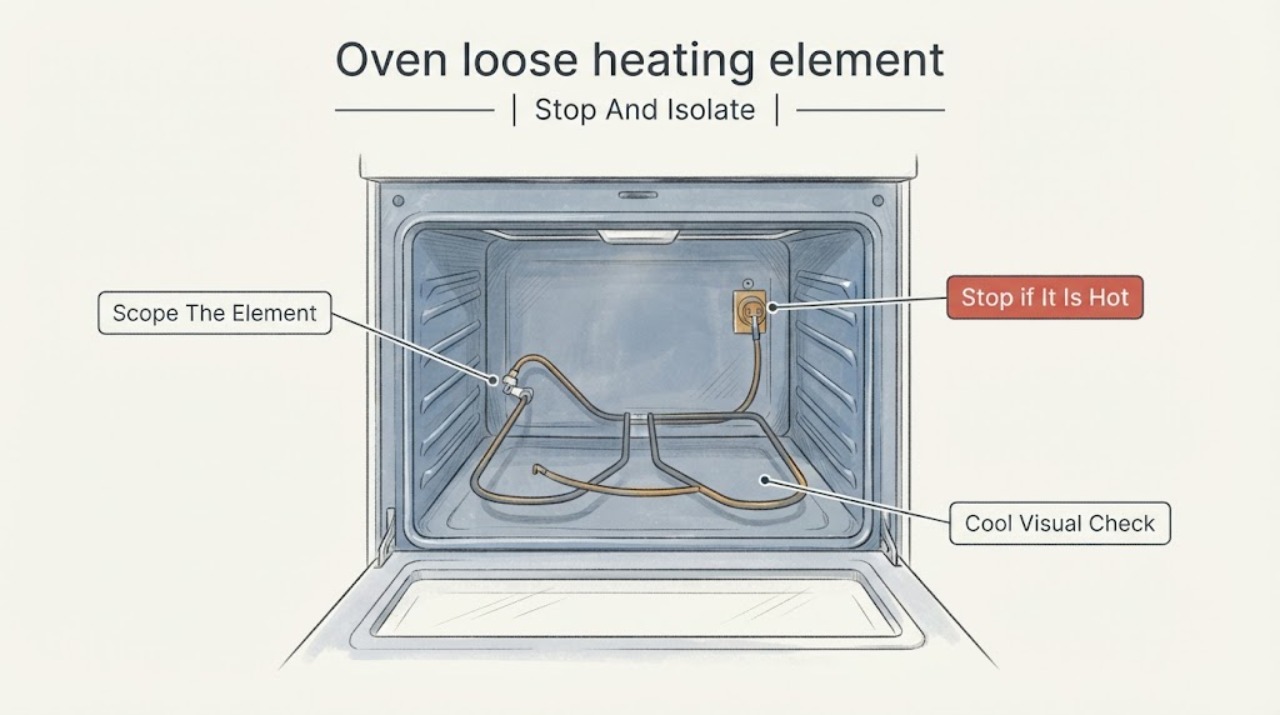
Do not use a GE oven if a bake or broil element is loose, visibly damaged, sparking, tripping the breaker, or producing a burning-plastic smell. GE says a failed element can rupture and spark, trip household protection, and stop heating, and recommends not using the oven when a bake or broil element fails. Turn the oven off, keep hands and tools away from the element and wiring, and arrange model-specific service. Once the appliance is completely cool and power is safely removed, a user may only look for visible cracking, breakage, or a shifted element; do not touch, straighten, remove, open panels, or run a heating test.
Work through in order
Diagnostic checks
Use only checks that match the exact appliance or system and its official guide.
-
Check 1
Stop the oven and leave it out of use when the element is loose or there has been sparking, smoke, a burning-plastic odor, or a breaker trip. If it is safe to do so without approaching a hazard, switch off the appliance circuit; do not re-energize it to test.
Expected result: The event includes active smoke/flame, strong burning odor, visible arcing, repeated protection trips, or only a loose-looking element.
Next step: Leave the oven off, keep hands and tools away, and use emergency response for an active fire/smoke hazard or qualified appliance service for the appliance.
Why this matters
Why: GE identifies rupture, sparks, tripped household protection and burning-plastic odor as possible element-failure symptoms and recommends not using the oven when a bake or broil element fails.
-
Check 2
Find the full GE model number and use its Owner's Manual to identify whether the concern is the bake element, broil element, or a hidden/model-specific assembly.
Expected result: The model documentation identifies a visible bake/broil element, a hidden element, or a different oven type than assumed.
Next step: Keep the article path and symptom identity, but follow only that model's manual and service route; do not transfer another model's mounting or part instructions.
Why this matters
Why: GE documents model-dependent bake/broil behavior; a visible element and a hidden or gas-oven arrangement do not share the same user checks or access path.
-
Check 3
When the oven is completely cool and power is safely removed, look through the normal oven opening for a crack, break, sag, detached support, exposed connection, or burn mark; do not touch or move anything.
Expected result: The element is visibly deformed or disconnected, or it looks intact and the only complaint is that it did not glow on one observation.
Next step: For any visible damage or looseness, keep the oven out of use and arrange model-specific service. For an intact-looking element, record the cycle and symptoms rather than performing a heating test.
Why this matters
Why: GE says power must be removed before inspecting an electric bake element for cracks or breaks; its documented cycling means one non-glowing observation does not establish a fault.
-
Check 4
Write down the cycle, timing, and safety signs: Bake or Broil, preheat or cooking, breaker trip, spark, odor, smoke, unusual heat, or visible movement.
Expected result: The concern is repeatable only in one cycle, or it is accompanied by an electrical or thermal warning.
Next step: Give the record and model number to GE or qualified appliance service. Do not infer a terminal, relay, wire, or control-board failure from the symptom.
Why this matters
Why: Bake and broil elements can be engaged differently by model and cycle; sparks, odor, and protection trips raise the service priority beyond a cooking-performance complaint.
-
Check 5
Arrange GE or qualified appliance service for a loose, damaged, shifted, or inaccessible element and provide the model and observations.
Expected result: The element remains loose/damaged, the mounting or connection is not visible from the normal opening, or the oven still has a safety symptom.
Next step: Keep the oven out of use until inspected. Do not open panels, handle wiring, straighten or remove the element, or install an unverified part.
Why this matters
Why: The safe next step depends on model-specific parts, supports, terminals, access and electrical isolation; the report does not prove which internal component failed.
Use your observations
Decision map
Find the observation that best matches what you see, then follow the next safe action.
-
PATH 01Next step
What you see
The element sparks, smokes, smells like burning plastic, or trips the household protection.
Do this next
Keep the oven off and arrange qualified service; respond to any active fire or smoke as an emergency.
Why this path and its safety boundary
Why it matters: GE describes these as possible consequences of an element shorting or rupturing, and says not to use the oven when the bake or broil element fails.
-
PATH 02Next step
What you see
With the oven cool and power removed, the bake or broil element is visibly loose, sagging, cracked, broken, or detached.
Do this next
Do not touch or reposition it. Record the model and arrange model-specific repair.
Why this path and its safety boundary
Why it matters: The visible condition is consistent with a failed or unsupported element, but it does not identify the exact mounting, terminal, or wiring cause.
-
PATH 03Next step
What you see
The element looks intact, and the only observation is that it did not glow during one bake or broil check.
Do this next
Do not run another test solely to watch the element. Use the exact manual and service route if heating remains abnormal.
Why this path and its safety boundary
Why it matters: GE documents cycling and model-dependent behavior; a broil element may be on without glowing orange in some conditions.
-
PATH 04Next step
What you see
The model is unknown, the element is hidden, or the appliance is not confirmed to be an electric GE oven.
Do this next
Keep the appliance out of use if it is physically loose or damaged, obtain the model number, and request model-specific service.
Why this path and its safety boundary
Why it matters: The mounting, element type and safe access path are unresolved; another model or gas-oven procedure cannot establish compatibility.
Helpful context
Understand the symptom
Stop using the oven when the element is loose
Treat a visibly loose, sagging, cracked, or shifted bake or broil element as a service condition. GE says an element can short against its sheath, rupture, spark, trip a household fuse or breaker, and create a burning-plastic odor; its guidance says not to use the oven if a bake or broil element fails. Turn the oven off and keep people away from the hot cavity. If there is active smoke, flame, a strong burning smell, or an electrical event, leave the area and use the appropriate emergency or electrical service response rather than testing the oven again.
Confirm which element and oven type you have
A GE electric range or wall oven can have bake and broil elements that operate separately or together. During baking, the broil element may cycle and may not glow orange on every model, so lack of glow by itself does not prove that the element is loose or failed. Find the model label and use the matching GE Owner's Manual to identify whether the reported part is a visible bake element, broil element, or a hidden/model-specific assembly. Do not substitute a gas-oven or another GE model's instructions.
Make only a cool, power-removed visual check
After the oven is fully cool, and only if power can be disconnected without approaching heat, smoke, or damaged wiring, look at the element from the normal oven opening. GE's troubleshooting guidance calls for removing power before inspecting an electric bake element for cracks or breaks. For this loose-element problem, stop at visual observation: do not touch the element, straighten it, push it back into a support, remove fasteners, handle terminals, open a rear or control panel, or make an electrical measurement.
Use the observation to choose the safe next step
A visible crack, break, sag, detached support, exposed connection, or evidence of arcing supports leaving the oven out of service and arranging model-specific repair. If the element looks normal but the concern is that it does not glow, remember that GE documents normal cycling and model-dependent element behavior; do not diagnose a part from one heating observation. Record whether the symptom occurred during Bake, Broil, or preheat, and whether there was a trip, spark, odor, or smoke.
Give the technician the model and symptom history
Before requesting service, record the full GE model number, element location, whether the oven is a range or wall oven, and what was seen while the appliance was off and cool. Include any breaker trip, spark, burning-plastic smell, smoke, or visible distortion. The exact model is needed to select the correct manual and determine the proper element, support, terminal, and access method; do not order or fit a part based only on the phrase “heating element.”
When checks do not resolve it
Need a professional?
Arrange GE or qualified appliance service for any loose, sagging, cracked, broken, shifted or inaccessible heating element, or after sparks, smoke, burning-plastic odor, or a breaker trip. The exact model is required before selecting an element, support, terminal or access method.
Common questions
FAQ
Can I push a loose GE oven element back into place?
No. Do not touch or reposition it. GE routes a failed or damaged bake/broil element to non-use and service; the correct support and electrical connection depend on the model.
Does an element that does not glow always mean it is broken?
No. GE says elements cycle, and a broil element may be heating without glowing orange in some models or phases. A loose, cracked, sparking, or shifted element is a separate stop-use condition.
What should I give GE service?
Give the full model number, element location, Bake/Broil or preheat context, and any spark, breaker-trip, odor, smoke, or visible movement. Do not choose a replacement element from the symptom alone.
Read the exact guide
Official sources
- FAQs | Ranges & OvensGE Appliances · Official GE range/oven FAQ with electric bake-element inspection after disconnecting power and model-specific Owner's Manual routing.
- Range & Wall Oven - Oven Temperature Is Not CorrectGE Appliances · Official GE support article covering normal cycling, electric bake-element observation after power removal, visible cracks/breaks and service routing.
- Electric Range & Wall Oven - Bake and Broil Element OperationGE Appliances · Official GE operation article distinguishing bake and broil element engagement and normal non-glowing/cycling behavior.
- Range & Wall Oven - Oven Will Not Come OnGE Appliances · Official GE support article instructing power isolation before inspecting a bake element and directing unresolved cases to repair.
- Range & Wall Oven - Oven Heating Element FailureGE Appliances · Official GE support article for range and wall oven bake/broil element failure, including rupture, sparks, tripped protection, odor and service boundary.
Community feedback
Share a repair observation
Share a plain-text repair observation. Accepted observations are published automatically; this page may take a moment to update.