
On this page
Start here
Quick answer
Before calling a GE oven defective, separate a browning problem from a temperature or recipe problem. GE says pale cookies can result from a sided pan or two pans restricting airflow, while general baking results depend on full preheating, pan size and finish, rack position, spacing, and limited door opening. Preheat to the selected temperature, use the recipe's recommended rack and pan, leave room around the pan, and avoid covering a rack with foil. If the food is still pale while a consistent biscuit test also shows poor heating, check the exact model's temperature guidance and, for an electric oven, inspect a visible bake element only after power is disconnected. A cracked element, a gas oven that does not ignite its bake burner, repeated under-temperature results, or a persistent problem after the user-level checks needs qualified GE service; do not adjust gas or work inside a powered oven.
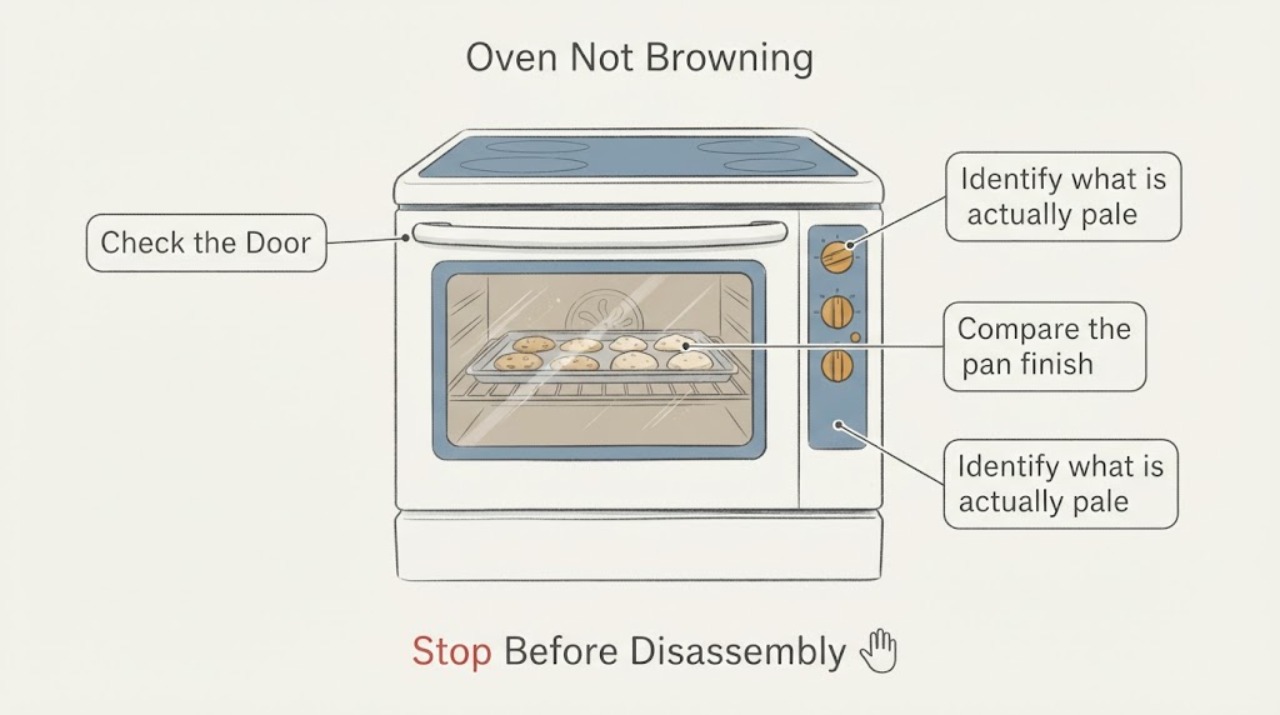
Work through in order
Diagnostic checks
Use only checks that match the exact appliance or system and its official guide.
-
Check 1
Identify what is actually pale or uneven, then use one recipe or package test with a single pan; note the pan material, whether it has sides, the rack position, and whether the result is pale everywhere or only at the center, edges, top, or bottom.
Expected result: The problem changes with the pan, recipe, load, or position, or the same food is pale despite the same controlled setup.
Next step: Use the matching GE pan, rack and spacing guidance before inspecting the appliance. Keep the recipe and pan constant for the next check.
Why this matters
Why: A change with cookware or placement points to baking conditions rather than proving an oven fault. A repeatable result under controlled conditions justifies checking heat and temperature next.
-
Check 2
Preheat the GE oven in the intended Bake or convection mode to the recipe temperature until the model's preheat signal indicates readiness; place the pan on the manual's recommended rack with space from the walls and other pans, then avoid opening the door before the minimum time.
Expected result: Browning improves when the oven is fully preheated, the load is less crowded, the rack is changed, or the door stays closed, or the food remains pale under the controlled setup.
Next step: Keep the improved arrangement for normal baking. If the controlled setup still fails, run a repeatable biscuit or package test and check the exact model manual.
Why this matters
Why: Improvement supports heat-loss, airflow, rack or preheat effects. Persistence under a controlled setup makes a temperature or heating issue more plausible but still does not identify a failed part.
-
Check 3
Compare the pan finish and size with the recipe and GE guidance: use a suitable pan, avoid a dark pan when it is causing the wrong result, and do not cover the rack with foil or crowd the oven.
Expected result: A shiny or correctly sized pan, better spacing, or removing full-rack foil changes the color or evenness, or the browning remains poor.
Next step: Use the pan and spacing that match the recipe and model manual. Do not compensate with arbitrary temperature increases, especially when the center is still undercooked.
Why this matters
Why: Pan finish and blocked circulation can change browning without an appliance failure. No improvement after controlling them leaves temperature, mode, element/burner operation, or heat loss for the next check.
-
Check 4
Run a consistent biscuit or package test, then record the model, mode, set temperature, preheat indication, time, rack, pan and result; do not rely on a single door-open thermometer reading.
Expected result: The repeatable test is normal, or it remains under-browned/under-cooked and the oven does not heat as expected.
Next step: If the test remains poor, use the exact manual's temperature guidance. For an electric oven, only after power is removed, a visible cracked bake element is a service clue; for gas, do not adjust the burner or gas system—arrange qualified service.
Why this matters
Why: A normal repeatable test points away from a general heating failure and toward recipe, pan or placement. A failed repeatable test supports service investigation but does not prove the thermostat, sensor, element or burner by itself.
-
Check 5
Stop using the oven if there is smoke, gas odor, sparking, a breaker trip, damaged wiring, a cracked heating element, or a burner that fails to ignite; isolate power or gas only from a safe location.
Expected result: A warning sign is present, or the only issue is a repeatable browning result without a safety warning.
Next step: Keep the oven out of service and obtain qualified appliance or electrical/gas help for a warning sign. Otherwise arrange service if the repeatable test remains poor after the documented external checks.
Why this matters
Why: A warning sign is a safety/service condition, not a browning adjustment. Without one, the appliance can remain in the controlled-test path, but internal diagnosis is still not a user-level step.
Use your observations
Decision map
Find the observation that best matches what you see, then follow the next safe action.
-
PATH 01Next step
What you see
Browning improves after full preheat, correct rack position, proper pan spacing, fewer door openings, or a different pan.
Do this next
Keep the successful setup and follow the exact recipe and GE manual; do not change the oven temperature further unless the recipe or model guidance calls for it.
Why this path and its safety boundary
Why it matters: The observed change supports a cooking-condition cause such as airflow, pan finish, rack position, or heat loss rather than proving a failed GE component.
-
PATH 02Next step
What you see
The same controlled biscuit or package test remains pale or under-cooked after proper preheat, rack, pan, spacing and mode checks.
Do this next
Use the complete model manual and arrange qualified GE service. If the oven is electric, a visibly cracked bake element may be documented only after power is removed; do not open the control area or adjust gas components.
Why this path and its safety boundary
Why it matters: A general heating, temperature, mode, or heat-loss problem is more plausible, but the result does not identify a thermostat, sensor, element, burner, or control-board failure.
-
PATH 03Next step
What you see
The result is specifically pale on top while the oven is a gas model using conventional Bake, or the user is comparing conventional and convection modes.
Do this next
Follow the exact model's baking and broiling guidance and use the correct mode for the desired browning. If heating remains abnormal, stop experimenting with gas settings and request service.
Why this path and its safety boundary
Why it matters: GE states that conventional gas Bake uses the bottom bake burner and no top heat in the general case, while top browning and fan behavior vary by model; mode expectations can explain color without proving a defect.
Helpful context
Understand the symptom
“Not browning” is an outcome, not a diagnosis. A pale cookie, a pale top on a casserole, and an undercooked center can have different causes. GE's baking guidance starts with preheat, pan choice, rack position, airflow and door-opening habits; a heating fault becomes more plausible only when those variables are controlled and the oven still fails a consistent test.
Control the pan and airflow first
For pale cookies, GE recommends a flat cookie sheet rather than a sided jelly-roll pan and warns that two sheets on different racks can restrict circulation. Do not use a pan so large that it approaches the oven walls or door. Leave the clearance required by the recipe and the GE manual, and never cover the entire rack with foil because it blocks heat circulation.
Confirm preheat, mode, and rack position
Preheat to the selected temperature until the model's preheat signal indicates readiness, then use the recipe's rack position. Keep the door closed until the minimum cooking time has passed. Convection and conventional modes do not behave identically: GE notes that gas convection uses a fan and automatic conversion on selected models, while conventional gas Bake uses the bottom bake burner and generally no top heat. Follow the exact manual instead of changing temperature or mode to chase color blindly.
Use a controlled temperature check
If the same recipe remains pale, run GE's biscuit test or another repeatable bake using the package temperature and time. Compare the result only after keeping pan, rack, preheat and door-opening conditions consistent. GE cautions that oven elements cycle on and off and that ordinary oven thermometers can mislead when the door is opened; do not use one fluctuating reading to declare a failed thermostat. Use the exact owner's manual for any temperature calibration feature.
Escalate only after the controlled checks
On an electric GE range or wall oven, a visible crack or break in the lower bake element after power is removed is a service/part decision, not a reason to keep cooking. On a gas oven, failure of the bake burner to ignite or a persistent lack of heat needs service; GE's gas guidance does not authorize adjusting gas components. If a repeatable test remains poor after the safe user-level checks, record the complete model and arrange qualified service rather than opening the appliance.
Common questions
FAQ
Why is my GE oven cooking food but not browning it?
Start with full preheat, the recipe's rack position, pan finish and size, airflow around the pan, and limited door openings. GE says these conditions affect browning and cooking time; a repeatable controlled test should come before diagnosing a component.
Should I turn the temperature up to make food brown faster?
Not as a first fix. Control preheat, pan and rack conditions first. A higher setting can brown the outside while leaving the center under-cooked, and GE directs owners to use the exact recipe and model guidance for temperature adjustment or calibration.
Can a broken bake element cause a GE oven not to brown?
It can be a service clue on an electric oven, but pale food alone does not prove it. GE says to remove power before inspecting a visible bake element and recommends service if the element is cracked or if controlled baking still performs poorly. Gas burner or internal electrical work should be left to qualified service.
Read the exact guide
Official sources
- Range & Wall Oven - Oven Temperature Is Not CorrectGE Appliances · GE's general temperature/performance guidance; model-specific calibration and element configuration remain conditional.
- Gas Range - Convection Baking and RoastingGE Appliances · GE gas-range guidance for selected convection systems; it supports explaining mode-dependent top-browning expectations, not gas adjustment or a universal burner diagnosis.
- Range & Wall Oven - Optimal Baking PerformanceGE Appliances · GE's general range/wall-oven performance page; it supports controlled baking setup and does not prove a fault in an unspecified model.
- FAQs | Ranges & OvensGE Appliances · GE's official range/oven FAQ; it supports model-specific manual use, power-off element inspection and service escalation without naming an unsupported component.
- Range & Wall Oven - Oven Will Not Come OnGE Appliances · GE's general oven-start page; only the external power/reset and power-off visible-element boundaries are used here, not a universal repair procedure.
- Range & Wall Oven - New Oven Not Cooking ProperlyGE Appliances · GE's guidance for a new oven or a comparison with an older appliance; it supports following recipe/manual settings and does not prove a defect.
- Range & Wall Oven - Common Biscuit and Cookie Baking Problems and SolutionsGE Appliances · GE's general baking guidance for cookies and related baking outcomes; it supports pan, airflow and preheat checks without diagnosing a specific oven component.
Community feedback
Share a repair observation
Share a plain-text repair observation. Accepted observations are published automatically; this page may take a moment to update.