
On this page
Start here
Quick answer
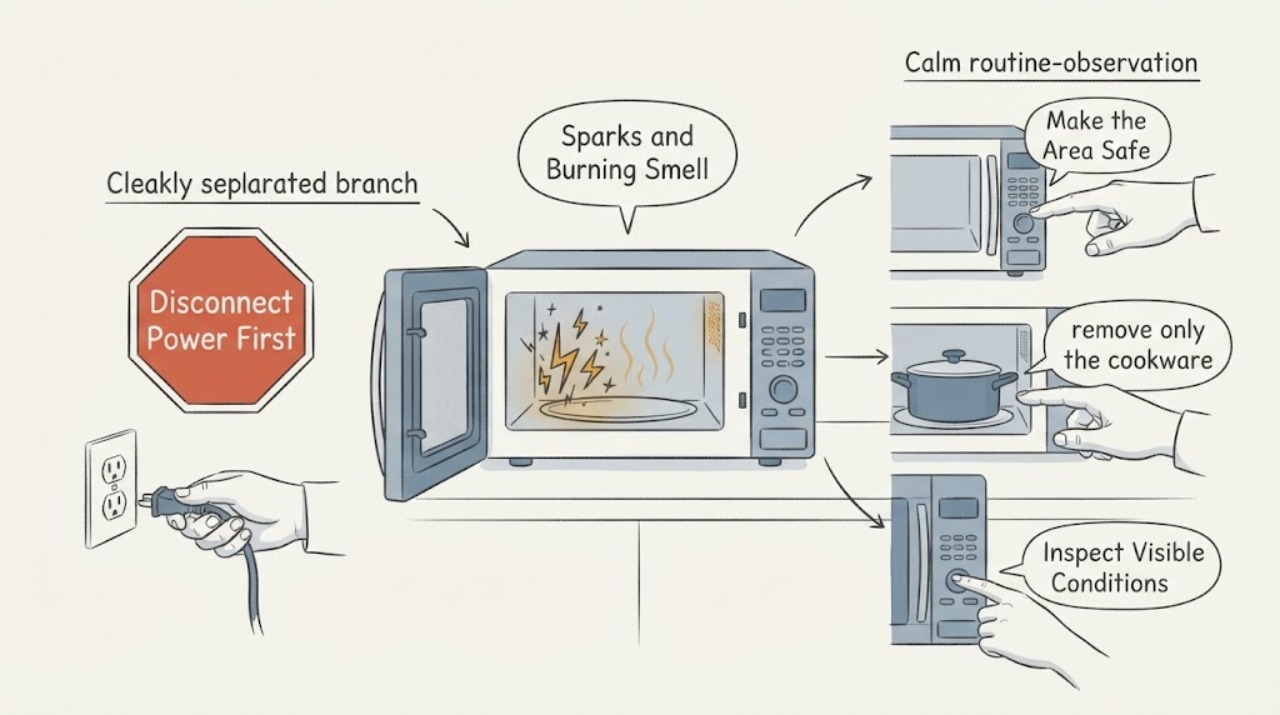
Stop the GE Advantium immediately when sparks appear along the cavity wall or a burning smell accompanies them. Press the normal Clear/Off control if it is safe to do so, disconnect power from a safe position, and do not run another test. After the oven is completely cool, inspect only the removable cookware and the visible cavity for metal or foil, food residue, scorch marks, peeling, a hole, or damage to the mica waveguide cover. GE says metal or foil can cause arcing, but a damaged cavity or missing waveguide cover requires the Advantium to remain out of service. Do not remove the cover, repaint the cavity, touch high-voltage parts, or test with metal or an empty cavity.
Work through in order
Diagnostic checks
Use only checks that match the exact appliance or system and its official guide.
-
Check 1
Stop the microwave function immediately. If the controls respond normally, press Clear/Off, keep the door closed while sparks or smoke are present, and disconnect power only from a safe position after the event has stopped. Do not restart the oven, run it empty, or use a metal object to reproduce the arc.
Expected result: There is smoke, a persistent burning or electrical odor, visible flame, a repeated arc, a damaged door, or heat that does not stop when the normal control is used.
Next step: Leave the appliance out of service. For smoke or fire, leave the area and use local emergency guidance; for a persistent odor or visible damage without an active fire, arrange qualified GE appliance service.
Stop if: Do not touch the cavity, open panels, or operate electrical controls during smoke, flame, shock, or an escalating odor.
Why this matters
Why: Those signs indicate an active safety or appliance-damage condition, not a cookware experiment. Even a single arc with a strong odor needs a no-restart boundary until the cavity has been inspected and the exact model guidance is available.
-
Check 2
When the Advantium is completely cool and power is isolated, remove only the cookware and removable tray or turntable that the exact manual identifies as user-removable. Inspect them and the cavity floor and side walls with ordinary lighting for foil, twist ties, metal trim, food splatter, grease, or a foreign object touching the wall.
Expected result: A metal item, foil edge, food residue, or foreign object is visibly present, or the cavity is clean with no obvious source.
Next step: Do not power the oven to see whether removing the visible item fixed it. Photograph the finding if safe, retain the exact model information, and use the service branch if the oven sparked with an odor or if no source was visible.
Stop if: Do not scrape, sand, pry, probe, or clean around an opening, burn mark, waveguide cover, or exposed material.
Why this matters
Why: GE identifies metal, foil touching the side, and some food or vegetable conditions as possible causes of arcing. A clean cavity with no visible source does not prove a failed component; it makes continued user testing less appropriate.
-
Check 3
Inspect the cooled cavity, door interior, and area under the turntable for a black spot, blistering, peeling, chipping, a hole, warped metal, or a scorched coating. Look at the mica waveguide cover near the top or side wall without touching or removing it.
Expected result: The cavity or door is scratched, chipped, peeling, burned, or perforated; the mica cover is missing, loose, or damaged; or all visible surfaces appear intact.
Next step: For any mark, hole, coating failure, or mica-cover problem, keep the oven disconnected and arrange service. If no damage is visible, still do not run another test because the reported event included sparking and odor and the full model is not confirmed.
Stop if: Do not repaint, patch, glue, replace, or remove the cavity finish or mica cover, and do not open the outer cabinet.
Why this matters
Why: GE says damaged or scratched Advantium interior surfaces, including the cavity or door, require discontinuing use; GE also says the mica cover protects the waveguide and must not be removed. An intact-looking surface still does not identify the internal cause of arcing with odor.
-
Check 4
Record the complete rating-label model number, the mode selected, what was inside the cavity, where the arc appeared, whether smoke or odor remained afterward, and any visible mark. Advantium 120 is not a complete model identifier for selecting a manual or part.
Expected result: The full model and serial information are available, or only the broad Advantium 120 series name is known.
Next step: Give the full label information and the no-restart inspection record to GE or an authorized appliance technician. If the full model cannot be found, request help identifying it before any further use.
Stop if: Do not order a magnetron, waveguide cover, cavity coating, switch, or control from the symptom alone.
Why this matters
Why: The exact manual determines the permitted tray, rack, cover, and cleaning instructions. A series name cannot establish a compatible waveguide cover, cavity treatment, or internal repair part.
Use your observations
Decision map
Find the observation that best matches what you see, then follow the next safe action.
-
PATH 01Next step
What you see
The arc coincided with visible foil, metal trim, a twist tie, or a foreign object touching the cavity wall, and no smoke, burn mark, coating damage, or persistent odor is visible after cooling.
Do this next
Keep the Advantium out of service and have the exact-model manual or qualified service confirm that the cavity and microwave shield are undamaged before normal use.
Why this path and its safety boundary
Why it matters: The visible item is a plausible arcing trigger, but the reported burning smell still means the event should not be treated as a successful DIY repair or reproduced test.
-
PATH 02Next step
What you see
A scorch mark, hole, peeling or chipped finish, damaged door area, or damaged/missing mica waveguide cover is visible.
Do this next
Keep power isolated, do not patch or remove the cover, and arrange qualified GE service.
Why this path and its safety boundary
Why it matters: The cavity or microwave-energy protection has been damaged; this is beyond a cookware correction and may worsen if energized.
-
PATH 03Next step
What you see
No visible metal, residue, or cavity damage explains the arc, or sparks and odor occurred with microwave-safe cookware.
Do this next
Do not repeat the event or open the cabinet; provide the exact model, timing, mode, and photos to qualified service.
Why this path and its safety boundary
Why it matters: An internal microwave, shielding, or control fault remains possible, but visible symptoms cannot identify a safe replacement part.
-
PATH 04Next step
What you see
Smoke, flame, a strong electrical or burning odor, repeated arcing, shock, or a wet/damaged electrical area is present.
Do this next
Leave the area if needed and follow local emergency guidance for fire or smoke. Otherwise keep the appliance disconnected and arrange professional service from a safe location.
Why this path and its safety boundary
Why it matters: This is an active hazard rather than a troubleshooting branch.
Helpful context
Understand the symptom
Advantium 120 is a series label rather than a complete model number, so the exact owner's manual still matters. The microwave-specific decision is safety first: a one-time arc caused by visible cookware or residue is different from an arc that leaves a mark, damages the cavity, or continues with no visible cause, but the reported spark plus odor is not a reason to reproduce the event.
Keep all inspection external and visible. The mica sheet or cardboard-looking cover near the cavity wall is part of the waveguide system and is not a user-removable shield. If it is missing, loose, burned, or visibly damaged, stop at that point and arrange qualified GE service.
When checks do not resolve it
Need a professional?
Stop using the Advantium and arrange qualified service for any arc accompanied by a persistent odor, smoke, scorch, chipping, peeling, a hole, door damage, a missing or damaged mica cover, repeated arcing, or an arc with no visible cookware cause. The technician needs the complete model/serial label and the recorded mode and event; the user should not access high-voltage components or the outer cabinet.
Common questions
FAQ
Can I run the Advantium empty to see whether the sparks return?
No. Do not repeat the event, run the cavity empty, or use metal as a test. A no-restart inspection and service handoff are safer after sparking with an odor.
Can I remove or repaint the cardboard-looking cover on the cavity wall?
No. GE identifies that cover as a mica waveguide cover and says it should not be removed. A missing or damaged cover requires service, not repainting or a patch.
Is Advantium 120 enough information to choose a replacement part?
No. Advantium 120 describes a series. Record the complete rating-label model and serial information; do not select a cover, magnetron, control, or other part from the symptom alone.
Read the exact guide
Official sources
- Microwave & Advantium - Interior FinishGE Appliances · Advantium stainless cavity and exact-model owner's manual routing
- Advantium Oven - How To Clean the InteriorGE Appliances · Cool-down cleaning of the Advantium cavity, turntable area, and mica sheet
- Advantium - Cardboard on Side of Cavity WallGE Appliances · Mica waveguide cover on the Advantium cavity wall
- Advantium - MicrowavingGE Appliances · Microwave cookware, trays, turntable support, and metal restrictions
- Advantium Interior DamagedGE Appliances · Cavity or door scratches, holes, and arcing damage
- Advantium Oven - Reasons for Sparking And ArcingGE Appliances · Sparking and arcing during Advantium microwave or speedcooking
Community feedback
Share a repair observation
Share a plain-text repair observation. Accepted observations are published automatically; this page may take a moment to update.