
On this page
Start here
Quick answer
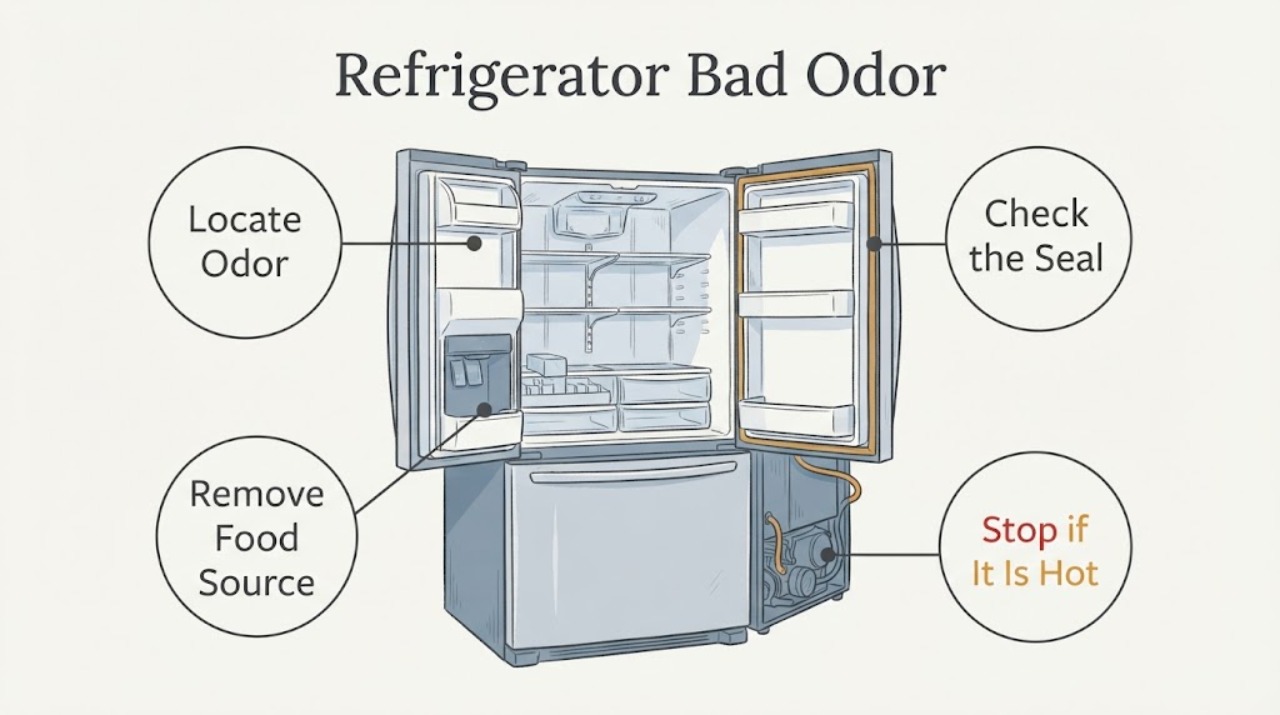
Start by locating whether the smell is in the fresh-food compartment, freezer, gasket, ice bin, dispenser water or around the outside of the refrigerator. GE says refrigerator odors commonly come from unwrapped food or spills, while the appliance's mechanical parts are not expected to create an odor or bad taste. Remove spoiled or moldy food, then follow the model's cleaning instructions; GE's general interior guidance uses a baking-soda solution, rinsing and drying, and warns against bleach, ammonia, abrasive cleaners and hot water on cold glass. If the odor smells electrical or burning, there is smoke, a leak near power, visible mold that cannot be cleaned, or the smell remains after the accessible compartments and food sources are addressed, stop using the affected function and arrange model-specific GE service rather than opening the sealed or electrical system.
Work through in order
Diagnostic checks
Use only checks that match the exact appliance or system and its official guide.
-
Check 1
With the doors closed between brief checks, identify where the odor is strongest: fresh-food compartment, freezer, door gasket, ice bin, dispenser water/ice, floor or cabinet exterior. Note whether it appears with a particular food, after dispensing water or ice, or only when the refrigerator runs.
Expected result: The smell is limited to food storage, the gasket/ice bin, the dispenser output, or the outside/cord area; or no location can be isolated.
Next step: Continue only with the matching external branch. If there is smoke, burning/electrical odor, heat or a leak near power, stop using the refrigerator and arrange qualified service; do not open the cabinet or repeatedly run it to reproduce the smell.
Why this matters
Why: A localized food, spill, mold or stale-water source supports an external cleaning branch. An odor at the cord/outlet, smoke, or an odor that appears with a hazardous electrical symptom is not a normal food-odor diagnosis. GE says the refrigerator's mechanical parts are not expected to produce an odor or bad taste.
-
Check 2
Remove expired, leaking or unwrapped food one item at a time, inspect containers and shelves, and discard any item with visible fuzzy mold, unusual slime or a clearly spoiled smell. Keep food that remains safe covered or sealed.
Expected result: A leaking or moldy item is found, the smell is on a shelf or container, or no food source is found.
Next step: Discard moldy food immediately, clean the affected interior surfaces, and continue to the full interior/gasket cleaning. Do not taste questionable food or keep moldy food while troubleshooting.
Why this matters
Why: GE identifies unwrapped food and spills as common odor sources and says mold can spread to refrigerator surfaces. Finding a source does not prove an internal appliance failure; no source means the gasket, ice/water path and full interior still need inspection.
-
Check 3
Follow the exact GE model manual for putting the refrigerator in a safe cleaning state; GE's general procedure is to turn the temperature control to OFF, unplug, mix one to two tablespoons of baking soda with one quart of water, wipe the walls and shelves, rinse and dry, and apply the same gentle process to the gasket, drawers, ice bin and other permitted parts.
Expected result: The odor decreases after the shelves, walls, drawers, gasket and permitted ice-bin surfaces are cleaned and dried, or it remains after all accessible surfaces are addressed.
Next step: If the smell remains, recheck hidden spills and the dispenser/ice branch, then use the model-specific support path. Do not use bleach, ammonia, abrasive/concentrated cleaners, lemon-scent products or hot water on cold glass.
Why this matters
Why: A reduction after cleaning supports a food, spill, mold or gasket-surface source. Persistence does not identify a compressor, fan, drain or control failure; it means the source has not been isolated or the model needs further support.
-
Check 4
If the odor is in ice or dispensed water, compare a clean glass of dispenser water with water from the household tap if safe, inspect the ice bin for old or spilled ice, and clean the bin only according to the matching GE manual. If the refrigerator was unused, GE recommends running three to four glasses of water from models with a dispenser to flush stale-water taste.
Expected result: Only ice/dispenser output smells, the tap also smells, the odor clears after a flush and fresh ice, or the odor persists in both compartments.
Next step: Use the exact model's water/filter and ice-bin instructions if the smell persists. Do not disconnect tubing, bypass a filter or replace a valve from odor alone; stop using the dispenser if water is discolored, contaminated or leaking.
Why this matters
Why: A dispenser-only smell can be in the stored ice, dispenser path or stale water; a household-tap smell is not established as a refrigerator fault. GE's storage guidance supports a limited post-absence flush but does not establish a universal filter, valve or tubing diagnosis.
-
Check 5
After the interior is clean, dry and free of suspect food, place an open box of baking soda in the fresh-food and freezer compartments and replace it according to the package. GE also describes activated charcoal in a shallow pan as an optional odor absorber; keep any absorber away from food and moving parts.
Expected result: The smell gradually decreases, or it remains strong despite cleaning and odor absorption.
Next step: If the odor remains strong, record its location, timing and any temperature, water or electrical symptom and contact GE support/service for the exact model. Do not mask a burning or chemical odor with fragrance or absorber.
Why this matters
Why: A gradual reduction supports a residual enclosed-space odor. Persistent strong odor after source removal and cleaning is not evidence that an internal part should be replaced.
-
Check 6
Stop and arrange qualified GE service or appliance support if the odor is burning/electrical/chemical, there is smoke, a leak near the cord or outlet, damaged wiring or insulation, visible mold in an inaccessible area, a temperature problem, or a strong odor persists after the accessible food, gasket, ice-bin and dispenser checks.
Expected result: The refrigerator has a hazardous smell or symptom, cannot be safely cleaned externally, or remains odorous after the documented cleaning path.
Next step: Keep the refrigerator and affected dispenser/ice maker off if safe to do so, protect perishable food using a safe alternative, and provide the exact model, odor location, timing and observations to qualified service. Do not open the electrical cabinet, sealed system or refrigerant circuit.
Why this matters
Why: The public GE odor and cleaning guidance supports food, spill, mold and surface-cleaning decisions but does not identify a universal internal repair for an unknown GE model. Continuing to run a refrigerator with a burning/electrical smell can add risk.
Use your observations
Decision map
Find the observation that best matches what you see, then follow the next safe action.
-
PATH 01Next step
What you see
The odor is strongest on a shelf, drawer, container or gasket and a leaking, unwrapped or moldy food item is found.
Do this next
Discard moldy or spoiled food, clean the entire affected area with the model-appropriate baking-soda solution, rinse and dry, then reassess without masking the smell.
Why this path and its safety boundary
Why it matters: The evidence supports a food, spill or surface contamination source rather than a proven mechanical failure.
-
PATH 02Next step
What you see
The odor appears only in ice or dispensed water, especially after the refrigerator was unused, while the household tap and compartments do not have the same odor.
Do this next
Follow the exact model's dispenser/filter and ice-bin instructions; for an absence, run the limited three-to-four-glass flush described by GE and stop if water is discolored, contaminated or leaking.
Why this path and its safety boundary
Why it matters: Stale water or stored ice is a plausible branch, but the symptom alone does not identify a filter, valve or tubing part.
-
PATH 03Next step
What you see
The odor is burning, electrical or chemical, is accompanied by smoke/heat, or is near the cord, outlet or a leak.
Do this next
Stop using the affected appliance/function, avoid opening the cabinet or repeating the test, and arrange qualified service. If there is active smoke or fire, leave the area and use local emergency procedures.
Why this path and its safety boundary
Why it matters: This is outside normal food-odor cleaning and may indicate a safety hazard; the smell does not prove which component is involved.
-
PATH 04Next step
What you see
The accessible food, interior, gasket, ice-bin and dispenser checks are complete but the odor remains strong or returns with a temperature, water or electrical symptom.
Do this next
Record the exact model, odor location, timing, food/water relationship and any temperature or leak observations and request model-specific GE service/support.
Why this path and its safety boundary
Why it matters: The general GE pages do not narrow this unknown-model combination to a safe user-level repair or compatible part.
Helpful context
Understand the symptom
Separate the odor source before cleaning
A bad smell can be caused by a spilled food item, an unwrapped container, mold, a dirty gasket or ice bin, stale dispenser water, or an odor outside the cabinet. These observations lead to different next steps. GE says mechanical parts are not expected to create an odor or bad taste, so do not treat the smell alone as proof that a compressor, fan, sealed system or control board has failed.
Use the model's cleaning instructions
GE's general interior procedure is model-sensitive at the power and temperature-control step: turn the temperature control off as directed for the model, unplug the refrigerator, clean with a baking-soda solution, rinse and wipe dry. Clean the gasket, drawers, shelves and ice bin only in a way the matching manual permits. Do not put refrigerator plastic or glass in a dishwasher and do not put cold glass under hot water.
Protect food and stop at the service boundary
Discard moldy food rather than trying to salvage it, and clean the surfaces that may have been exposed. If the smell is burning, electrical, chemical or accompanied by smoke, a leak near the cord or outlet, damaged insulation, or a temperature problem, stop using the affected function and arrange qualified service. This guide does not identify an internal component or authorize opening an electrical, refrigerant or sealed system.
When checks do not resolve it
Need a professional?
Request qualified GE service when the odor is burning, electrical or chemical; smoke, heat, a leak near power, damaged wiring or insulation is present; mold cannot be safely reached; the refrigerator has a temperature problem; or the odor persists after the documented external food, gasket, ice-bin and dispenser checks. Do not choose a filter, valve, fan, compressor or other part from odor alone.
Common questions
FAQ
What is the safest cleaner for a GE refrigerator bad odor?
GE's general guidance uses one to two tablespoons of baking soda per quart of water for the interior, followed by rinsing and drying. GE warns against bleach, ammonia, petroleum-distillate products, abrasive or concentrated cleaners, and lemon-scent products that may be absorbed by plastic.
Should I throw away food with mold in the refrigerator?
Yes. GE says to discard moldy food immediately and clean the entire interior if mold persists because mold can spread to refrigerator surfaces. Do not taste questionable food while investigating the odor.
Why does only the ice or dispenser water smell bad?
Stored ice, stale dispenser water or a water-path condition can be different from a compartment odor. GE recommends a three-to-four-glass flush after an absence for models with a dispenser, but the exact filter, ice-bin and water instructions depend on the model. Do not infer a failed valve or tubing from odor alone.
Can a refrigerator mechanical part cause a bad smell?
GE says its refrigerators and freezers do not contain mechanical parts expected to produce an odor or bad taste in food or ice. A burning/electrical odor, smoke or heat still requires stopping use and qualified service rather than assuming it is a food odor.
What if the smell remains after cleaning?
Recheck hidden spills, mold, the gasket, ice bin and dispenser output, then record the exact model and symptoms. If the smell remains strong or is accompanied by temperature, water or electrical symptoms, request model-specific GE support instead of opening the cabinet or replacing a guessed part.
Read the exact guide
Official sources
- Refrigerator Removing Mildew From InteriorGE Appliances Support · Official GE mildew-cleaning guidance for refrigerator interiors; it does not establish model-specific internal repair steps.
- Refrigerator - How to Clean the InteriorGE Appliances Support · Official GE general interior-cleaning guidance; the model owner manual controls the temperature-control and cleaning details for a specific refrigerator.
- Refrigerator, Freezer and Standalone Ice Maker - Care and Cleaning of Interior and GasketGE Appliances Support · Official GE care guidance for refrigerator/freezer/standalone-icemaker interiors and gaskets; it does not identify a universal internal repair.
- Refrigerator - Food MoldsGE Appliances Support · Official GE food-handling and refrigerator-surface guidance; it is used for food-safety and cleaning decisions, not for diagnosing internal refrigerator parts.
- Refrigerator - Vacation / Storage RecommendationsGE Appliances Support · Official GE storage guidance; the three-to-four-glass flush applies to models with a water dispenser after an absence and is not treated as a universal water-system repair.
- Refrigerator & Freezer - OdorsGE Appliances Support · Official GE general refrigerator/freezer guidance; exact owner manual controls model-specific cleaning details.
Community feedback
Share a repair observation
Share a plain-text repair observation. Accepted observations are published automatically; this page may take a moment to update.