
On this page
Start here
Quick answer
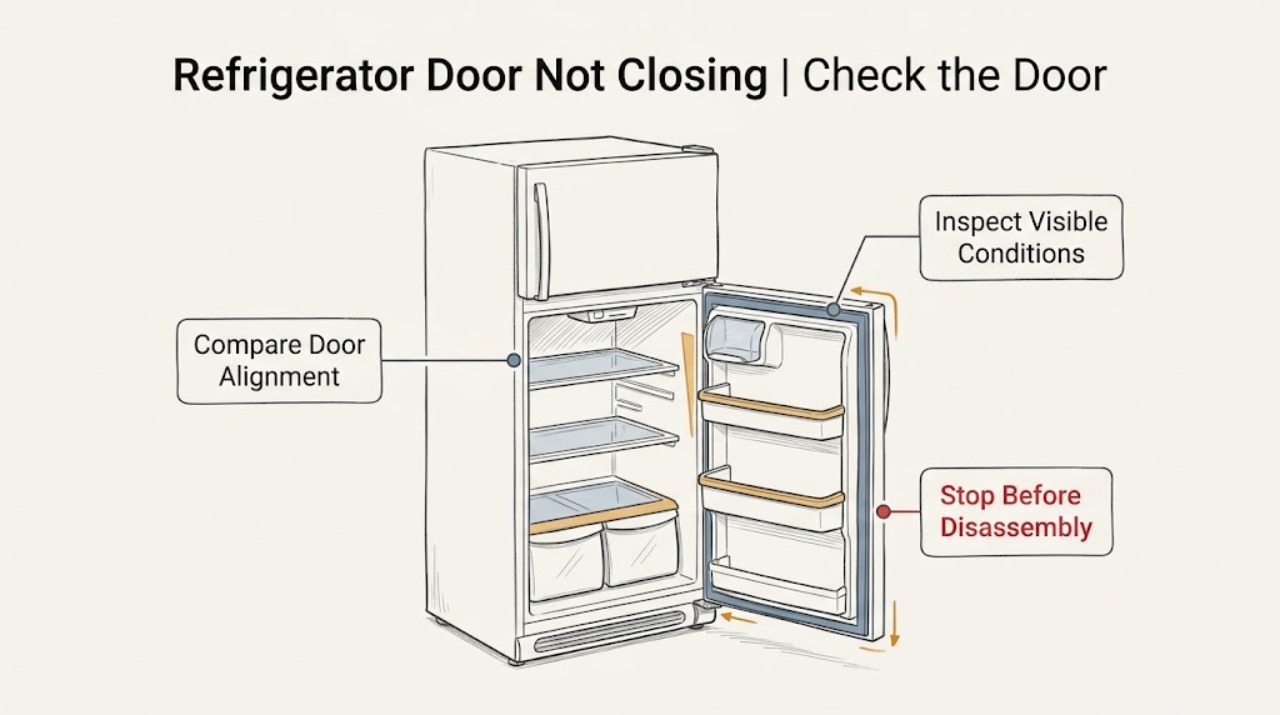
If a GE refrigerator door will not close, first remove anything physically blocking it: protruding food, an open bin, a heavy door item falling forward, an ice cube, shipping foam, or a freezer basket that is not seated. Then check whether the refrigerator is level, the doors are aligned, and the magnetic gasket touches the cabinet evenly without a tear or section pulled from its groove. Do not force the door, bend a hinge, or adjust hardware without the exact model instructions. If the hinge is broken, the door or cabinet is warped, the gasket cannot seal, frost or condensation is becoming more noticeable, or the door still will not close after safe external checks, arrange qualified refrigerator service. Keep perishable food cold while the door remains open and do not continue using a compartment that cannot seal.
Work through in order
Diagnostic checks
Use only checks that match the exact appliance or system and its official guide.
-
Check 1
Open the affected door or drawer only as far as needed and remove visible items that protrude into the closing path. Close every door bin and crisper, push racks and freezer baskets fully home, and check for pizza boxes, tall containers, heavy door items falling forward, an ice cube, or remaining shipping foam. Do not force the door against an obstruction.
Expected result: The door closes after one package, bin, basket, ice cube, or packing material is moved, or it still stops at the same point with the interior clear.
Next step: Leave the load arranged so it cannot contact the door and verify a full seal. If the door still cannot close with the compartment clear, continue with the level and gasket checks; do not push harder or bend parts.
Why this matters
Why: A physical obstruction or unseated storage component is more likely when the door closes after rearranging. A repeatable stop with a clear opening points toward leveling, alignment, seal, or hinge geometry.
-
Check 2
With the refrigerator on a stable floor, observe whether the cabinet rocks and whether the door closes by itself when opened less than 90 degrees. Check the visible front leveling legs or rollers and the top alignment of paired doors; use the exact model installation instructions before making any adjustment.
Expected result: The cabinet is not level, one door is visibly higher or lower, the door does not self-close, or the appliance is a built-in style for which the general roller procedure does not apply.
Next step: If the model instructions support owner leveling, make only the documented small adjustment and recheck closure. If the cabinet is built-in, the door remains uneven, or adjustment needs hinge removal, use a qualified installer or refrigerator servicer.
Why this matters
Why: GE links leveling and door alignment with reliable self-closing. A style-specific or built-in installation requires its own procedure, and incorrect adjustment can worsen the seal or stress the hinge.
-
Check 3
Inspect the magnetic gasket around the entire door perimeter. Look for cuts, tears, a section pulled from its retaining groove, wrinkles, hardened deformation, or a gap where the gasket does not touch the cabinet. Clean dirt from the gasket and mating surface with the model-approved mild cleaning method; do not apply unapproved heat, adhesive, or lubricant.
Expected result: The gasket is loose but intact, touches evenly after being pressed back into its groove, has visible damage, or remains uneven despite a clear closing path.
Next step: Reseat only a gasket that the exact model instructions identify as owner-adjustable. Arrange service for a torn, cut, distorted, incorrectly fitted, or persistently uneven gasket; do not leave the door held shut with tape or weight.
Why this matters
Why: A loose or displaced gasket can prevent closure and leak cold air; GE says torn or cut gaskets need replacement. Persistent uneven contact can result from door alignment, hinge, cabinet, or gasket-size issues.
-
Check 4
For a freezer drawer or French-door lower compartment, check that the lower basket is fully seated in its slides, no package touches the frame, the drawer gasket is in its groove, and the gasket touches the frame evenly at the top and bottom. For side-by-side doors, compare the top edges and use alignment instructions only for the exact model.
Expected result: The drawer or door sits crooked, the basket is out of its slides, the gasket has an uneven gap, or the door style is built-in or otherwise not covered by the accessible procedure.
Next step: Reseat only the accessible basket or gasket as the model instructions allow and recheck the seal. If the drawer remains crooked, the hinge or slide is damaged, or the model requires structural adjustment, arrange qualified service.
Why this matters
Why: GE identifies a mis-seated basket, package interference, gasket seating, and style-specific alignment as causes of a freezer drawer that does not seal. Built-in and hinge-related conditions need a service boundary rather than generic adjustment.
-
Check 5
After one external correction, close the door and inspect the seal with the room lights on and the compartment light off if the model allows safe observation. Watch for a continuous frost or condensation pattern, warm food, door alarms, or a gap that reappears after the door is opened. Do not pull the refrigerator out or remove hinge covers to investigate.
Expected result: The door closes and the gasket contacts evenly, or it still springs open, leaves a gap, produces more frost or condensation, or has a broken hinge, door, cabinet, or seal.
Next step: Move perishable food to a safe cold location if the compartment cannot seal. Keep the refrigerator door closed as much as possible and arrange qualified service for any persistent gap, frost, condensation, alarm, or damaged hardware.
Why this matters
Why: A stable even seal supports an obstruction, leveling, or gasket-seating cause. A recurring gap, frost, condensation, alarm, or broken hardware indicates that the compartment is not sealing and may need alignment or internal structural service.
-
Check 6
Record the refrigerator style, model number, affected door or drawer, obstruction found, leveling or alignment observations, gasket condition, and whether frost or condensation is becoming more noticeable. Do not continue operating a compartment that cannot remain sealed, and do not attempt hinge, slide, door-closer, or cabinet repair without model-specific instructions.
Expected result: The issue is isolated to one door, follows a recent move or installation, began after a gasket or shelf change, or persists with no visible external cause.
Next step: Use the exact installation or owner's manual for any permitted adjustment. Otherwise arrange a qualified refrigerator servicer and provide the recorded pattern rather than ordering a generic part.
Why this matters
Why: Recent installation or movement makes leveling and alignment more plausible; a new gasket or shelf can create a fit issue. A persistent unexplained problem raises the likelihood of hinge, slide, door, cabinet, or seal service.
Use your observations
Decision map
Find the observation that best matches what you see, then follow the next safe action.
-
PATH 01Next step
What you see
The door stops before the cabinet with food, bins, baskets, or shipping material inside.
Do this next
Rearrange or seat only the accessible item and verify the gasket seal. Escalate a repeatable stop with a clear compartment rather than forcing the door.
Why this path and its safety boundary
Why it matters: An obstruction is more likely when moving one item restores closure. A clear, repeatable stop points toward geometry, leveling, seal, or hinge conditions.
-
PATH 02Next step
What you see
The door closes only when pushed, springs back, or does not self-close.
Do this next
Follow the exact installation instructions for a permitted leveling check. Use a qualified installer or servicer for built-in units, uneven doors, or hinge adjustment.
Why this path and its safety boundary
Why it matters: Leveling or alignment is more likely than a simple obstruction, but the safe adjustment depends on the refrigerator style.
-
PATH 03Next step
What you see
The door reaches the cabinet but the gasket does not seal evenly.
Do this next
Reseat only as the model manual allows. Arrange service for damaged or persistently uneven seals; do not tape, glue, heat, or lubricate generically.
Why this path and its safety boundary
Why it matters: A gasket fit or damage issue is more likely than a storage obstruction, with alignment or hinge geometry possible when the gasket itself is intact.
-
PATH 04Next step
What you see
The door remains unsealed after external checks or the hinge, slide, door, or cabinet is damaged.
Do this next
Protect perishable food, keep the affected compartment closed, and arrange qualified refrigerator service. Do not remove structural hardware or continue using a door that cannot seal.
Why this path and its safety boundary
Why it matters: The compartment is not maintaining a seal and a hinge, slide, door, cabinet, or refrigeration-related consequence may be involved.
Helpful context
Understand the symptom
Start at the contact point, not the hinge
A door that stops a few inches short, springs back, or closes but leaves a gap can have different causes. Check the cabinet opening, shelves, bins, packages, ice, and drawer seating before changing alignment. A refrigerator door that cannot seal allows warm humid air in and can lead to frost or condensation, so avoid leaving it propped open while troubleshooting.
Leveling and alignment are style-dependent
GE says an improperly leveled refrigerator may not let the door shut on its own. Front rollers or leveling legs, side-by-side door alignment screws, French-door adjustments, and built-in models do not all use the same procedure. Use the exact installation instructions and make small, documented adjustments only if that model permits them; do not generalize one style's hardware to another.
A gasket can be reseated, but damage needs service
A magnetic gasket should sit fully in its retaining groove and contact the case evenly around the door. GE describes some modern gaskets as tool-free, but cuts, tears, or persistent deformation can require replacement. Do not use heat, lubricant, adhesive, or a replacement seal unless the exact model instructions call for it, and do not keep using the refrigerator when the gasket cannot seal.
When checks do not resolve it
Need a professional?
Arrange qualified refrigerator service if a GE door or drawer remains open with the compartment clear, the refrigerator is built-in, the hinge, slide, door, or cabinet is damaged, the gasket is torn or cannot seal, frost or condensation is becoming more noticeable, a door alarm persists, or the problem began after installation or movement and leveling does not resolve it. Keep perishable food safely cold while the door is unsealed. Do not force the door, remove structural hinge hardware, use tape or adhesive to hold it shut, or leave a compartment operating without a continuous gasket seal.
Common questions
FAQ
Why will my GE refrigerator door not close all the way?
Check for protruding food, open bins, heavy door items, an ice cube, a freezer basket that is not seated, or shipping foam. If the opening is clear, check leveling, door alignment, and the gasket around the full perimeter. A broken hinge, damaged door, or persistent gap needs qualified service.
Can a GE refrigerator gasket stop the door from closing?
Yes. A gasket pulled from its groove, wrinkled, cut, torn, or unevenly contacting the cabinet can prevent closure or leave a cold-air gap. GE describes model-dependent gasket seating and replacement; reseat only as the exact manual allows, and arrange service for damage or a seal that remains uneven.
How does leveling affect a GE refrigerator door?
GE says an improperly leveled refrigerator may not let the door shut on its own. Front rollers or legs and side-by-side alignment hardware vary by model, and built-in refrigerators may require a different procedure. Use the exact installation instructions and arrange service for structural or hinge adjustments.
Read the exact guide
Official sources
- Refrigerator - Condensation in Fresh Food CompartmentGE Appliances · GE refrigerator door seal, alignment, leveling, and moisture consequences
- Side-by-Side Refrigerator - How to Align DoorsGE Appliances · GE side-by-side door alignment scope and exact-model adjustment
- Refrigerator - Door Will Not CloseGE Appliances · GE refrigerator and freezer door obstruction, leveling, packing-material, and hinge checks
- Refrigerator - Frost in FreezerGE Appliances · GE refrigerator frost, door closure, gasket, alignment, and service boundary
- Refrigerator - Easy to Remove GasketGE Appliances · GE refrigerator gasket seating and model-specific replacement guidance
- Bottom Freezer Refrigerator - Freezer Drawer Not Sealing ProperlyGE Appliances · GE bottom-freezer drawer basket, package, gasket, and seal checks
- Top Freezer Refrigerator - Adjusting or Replacing the Door GasketsGE Appliances · GE top-freezer gasket seating, damage, and model-specific correction boundary
- Refrigerator - How to LevelGE Appliances · GE refrigerator leveling, rollers, legs, and self-closing behavior
Community feedback
Share a repair observation
Share a plain-text repair observation. Accepted observations are published automatically; this page may take a moment to update.