
On this page
Start here
Quick answer
Do not use a universal GE refrigerator error-code chart without first recording the exact model, display characters and whether the code is flashing or accompanied by beeps. GE says its published list contains only common codes for many refrigerators with electronic dispenser controls, not every possible code. Common examples are FF (freezer temperature rising), PF (power interruption), CI (check the icemaker), CC (check temperature controls), dE (defrost system has not operated properly) and uppercase DE (Demo mode, which disables cooling while lights and controls can work). Lowercase/uppercase appearance matters: tC and tF can be normal TurboCool and TurboFreeze indicators, not faults, and GE notes that some displays can make them look like other letters. Photograph the display, check the exact manual, protect food during a warm/freezer alert, and make only model-appropriate external checks. A brief power reset may clear some displays, but it does not repair a recurring code. Do not enter an undocumented diagnostic mode, remove panels, probe wiring, or work on the sealed system. Arrange qualified service for a recurring, unlisted or defrost code, warming food, water/electrical damage or any unsafe condition.
Before you begin
Safety first
- The owner may photograph the display, identify the model, observe temperatures/food, check safe external power and follow an exact manual's visible control or reset instruction. Qualified personnel must handle diagnostic modes, covers, defrost components, sensors, valves, boards, wiring, compressors and sealed-system work.
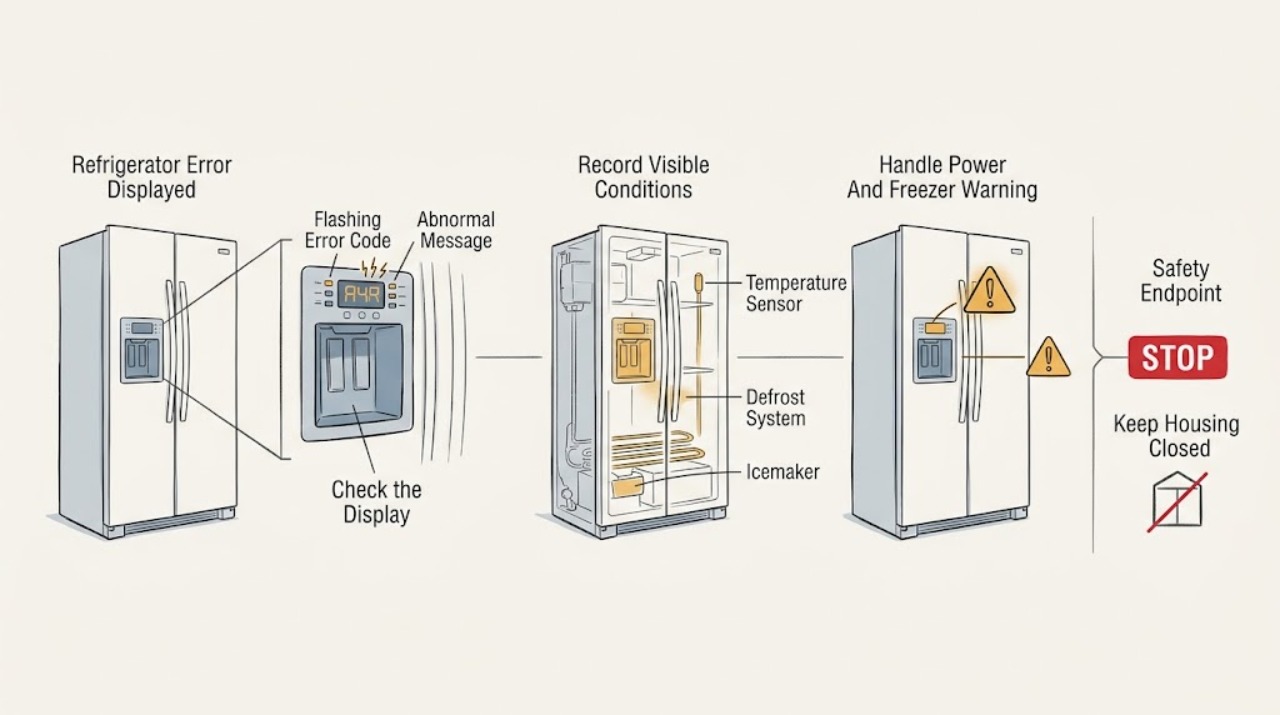
Work through in order
Diagnostic checks
Use only checks that match the exact appliance or system and its official guide.
-
Check 1
Photograph or transcribe the display exactly, including capitalization, flashing pattern, beeps, adjacent symbols and any temperature reading. Record the full model and serial number from the appliance label and whether it has an electronic dispenser/control panel.
Expected result: The code is clearly legible; it may be tC/tF, DE/dE, FF, PF, CI or CC; the display is ambiguous; or the model cannot be identified.
Next step: Use the exact model support/manual and compare the characters without guessing. Arrange service if the label is inaccessible without moving the refrigerator or removing a panel.
Stop if: Do not substitute a visually similar code, use a different model's diagnostic sequence, or publish/act on an unverified code meaning.
Why this matters
Why: GE says codes are model-dependent and some normal indicators resemble fault codes. The model and exact characters determine which manual and branch apply.
-
Check 2
If the display resembles tC, tF, EC, EF or another short pair, compare its exact case and the refrigerator's selected feature with the model manual. Check whether TurboCool or TurboFreeze was intentionally activated; do not change service settings just to make the text disappear.
Expected result: The display is tC or tF while the corresponding feature is active; the display is a flashing fault code with beeps; or the characters remain ambiguous.
Next step: Treat a verified tC/tF as a feature state and use the manual to end or understand that feature. Treat an unverified or flashing code as model-specific and continue recording conditions rather than guessing.
Stop if: Do not enter a hidden diagnostic mode, alter wiring or repeatedly disconnect power to suppress an unidentified display.
Why this matters
Why: GE says tC is a TurboCool indicator and tF is a TurboFreeze indicator, not an error. The display can look like other letters, so a visual guess can send the reader down the wrong repair path.
-
Check 3
For PF or FF, check the safe household power indication and the refrigerator's fresh-food/freezer temperature and food condition without unnecessary door opening. Note whether power was recently interrupted, frozen food is thawing, a door was held open, or the code returns.
Expected result: PF follows an outage; FF appears with thawing or rising freezer temperature; temperatures are normal and the code clears; or food is warming and the code persists.
Next step: Keep doors closed to retain cold, protect food according to applicable food-safety guidance, and use only the exact model's documented reset. Arrange service for persistent FF, warming food, power loss that does not resolve, or repeated breaker trips.
Stop if: Do not repeatedly reset a breaker, use a damaged cord/outlet, or remove panels to investigate a warm refrigerator.
Why this matters
Why: GE defines PF as interrupted refrigerator power and FF as a freezer-temperature warning. A cleared PF may be historical, while persistent FF or warming food indicates an operating/cooling problem, not merely a display problem.
-
Check 4
For CI, inspect only the accessible ice bin/ice-maker area for an obvious blockage and confirm the refrigerator's model-specific icemaker control and water status. For CC, read the temperature settings and actual compartment temperatures without entering an undocumented service test.
Expected result: CI appears with a stalled or blocked icemaker; CC appears with an incorrect temperature setting; both appear with normal operation; or the code returns after the model-approved correction.
Next step: Use the exact manual for the visible bin/control or temperature adjustment. Arrange service if CI/CC returns, the icemaker is inaccessible, cooling is poor, or the adjustment does not correct the condition.
Stop if: Do not force an icemaker rake, bypass a feeler arm, remove panels, disconnect tubing or test a valve/control live.
Why this matters
Why: GE defines CI as a prompt to check icemaker operation and CC as a prompt to check temperature controls. These labels do not identify a failed valve, motor, sensor or board by themselves.
-
Check 5
For DE or dE, preserve the exact capitalization and check the model's manual. Observe whether lights and controls work while cooling is disabled, or whether the code indicates a defrost issue and the compartments are warming. Do not force a defrost cycle or remove the rear cover.
Expected result: Uppercase DE matches Demo mode; lowercase dE returns as a defrost warning; the display case is uncertain; or cooling/food temperature is abnormal.
Next step: If and only if the exact manual confirms Demo mode, follow that model's documented exit method. For dE, warming compartments or an uncertain display, limit door openings and arrange qualified service.
Stop if: Do not use a generic demo exit, force defrost, access the heater/fan/wiring or continue operation with food warming and a recurring code.
Why this matters
Why: GE distinguishes uppercase DE Demo mode, which disables cooling while normal lights and controls can operate, from lowercase dE, meaning the defrost system has not operated properly in the last 24 hours. A persistent dE needs service diagnosis.
-
Check 6
Record the code before and after any exact-manual reset, the time it returns, temperatures, food condition, icemaker/dispenser status, door closure, recent outage, noises, water and electrical symptoms. Keep the refrigerator closed as much as practical while arranging help.
Expected result: The code clears and does not return with normal temperatures; it returns after the documented step; it is not listed for the model; or a hazard is present.
Next step: Give the technician the exact model, display photo, manual/reset used and operating observations. Stop using or isolate power safely for smoke, burning odor, water near electricity, hot wiring, damaged cord or repeated trips.
Stop if: Do not clear a code by disconnecting random harnesses, enter undocumented diagnostics, test sensors/boards live, or restore power to reproduce a hazard.
Why this matters
Why: A one-time PF or verified normal feature indicator can be informational. A recurring, unlisted or subsystem code is a service signal; a hazard takes priority over preserving the display.
Use your observations
Decision map
Find the observation that best matches what you see, then follow the next safe action.
-
PATH 01Next step
What you see
The display is verified as tC or tF and the matching TurboCool/TurboFreeze feature is active, with normal temperatures and no hazard.
Do this next
Use the exact manual to understand or end the feature and monitor temperatures. Escalate if the display differs, flashes as a fault or cooling changes.
Why this path and its safety boundary
Why it matters: GE identifies these as normal function indicators rather than faults; the apparent code may be a display-character confusion.
-
PATH 02Safety boundary
What you see
PF follows an outage, or FF appears while frozen food is thawing or the freezer temperature is rising.
Do this next
Keep doors closed, protect food, verify safe power and follow only the exact model's documented reset. Arrange service if the code or warming persists.
Why this path and its safety boundary
Why it matters: The code points first to an interruption or temperature condition, not a standalone control-display failure. Persistent warming can be a cooling, door, airflow or control problem.
Safety stop: Do not repeatedly reset power or open panels to chase a temperature code.
-
PATH 03Safety boundary
What you see
CI appears with an icemaker symptom, or CC appears with incorrect temperature settings or a temperature symptom, while the refrigerator otherwise has power.
Do this next
Make only the model-approved visible check or setting adjustment. If the code returns or cooling/ice production remains abnormal, arrange service.
Why this path and its safety boundary
Why it matters: GE uses CI and CC as prompts to check the icemaker and temperature controls; they do not name a replaceable part.
Safety stop: Do not force ice mechanisms, bypass sensors, disconnect water lines or perform live control tests.
-
PATH 04Safety boundary
What you see
Uppercase DE is confirmed with lights/controls but no cooling, or lowercase dE is displayed with a defrost or warming symptom.
Do this next
Use the exact manual's Demo exit only for a verified DE. For dE, warming food or uncertain capitalization, limit door openings and arrange qualified service.
Why this path and its safety boundary
Why it matters: Uppercase DE is Demo mode; lowercase dE signals defrost trouble. Treating them as interchangeable can leave a refrigerator warm or send the owner into an unsafe procedure.
Safety stop: Do not force defrost, remove covers or use a generic reset for an uncertain DE/dE display.
-
PATH 05Safety boundary
What you see
The code is not listed for the exact model, returns after the model-approved step, or occurs with smoke, electrical odor, water near electricity, abnormal heat, damaged wiring or repeated breaker trips.
Do this next
Stop using or isolate power only from a safe accessible point for a hazard, protect food, and arrange qualified refrigerator service with the display photo and model information.
Why this path and its safety boundary
Why it matters: GE's common list is intentionally incomplete; recurrence or a hazard needs model-specific professional diagnosis rather than a universal code interpretation.
Safety stop: Do not run undocumented diagnostics, remove panels, probe wiring or restore power to reproduce a hazard.
Helpful context
Understand the symptom
The characters and case are part of the diagnosis
A display that looks like EC, EF, an upside-down letter or a lowercase/uppercase pair may be a normal feature indicator or a different code. GE specifically distinguishes uppercase DE Demo mode from lowercase dE defrost trouble, and tC/tF from fault codes. Record the display exactly as shown rather than correcting it to the closest-looking code.
Codes are model-dependent signals, not a repair recipe
The same two characters cannot safely be treated as a complete diagnosis across every GE refrigerator. The official common-code article says it does not list every possible code because some require technician expertise. Use the model and serial number to reach the correct manual, then follow only its display and reset instructions.
Protect food and stop at safe external checks
FF, dE or a temperature-related warning can mean the refrigerator or freezer is not maintaining temperature. Limit door openings and move food only when safe and practical. A code that returns after the documented step, a refrigerator that is warming, or a code involving defrost, controls or wiring needs service; do not remove covers or perform live tests to identify it.
Safety boundary
Stop conditions
- Stop using the refrigerator and arrange qualified service for smoke, burning/electrical odor, water near electrical parts, a hot or damaged cord/outlet, exposed wiring, repeated breaker trips, severe overheating or a code with unsafe operation.
- Do not remove rear or dispenser covers, enter undocumented diagnostic modes, probe wiring or control boards, force defrost, bypass an icemaker/door sensor, or work on the sealed refrigeration system.
- Do not treat a visually similar code as confirmed. Preserve capitalization and the exact display, especially DE versus dE and tC/tF versus letters that look alike.
- If FF or dE accompanies warming food, limit door openings and protect food; a brief display reset does not establish that the refrigerator is cooling safely.
When checks do not resolve it
Need a professional?
Arrange qualified GE refrigerator service for any recurring or model-unlisted code, dE defrost indication, persistent FF/CC/CI condition, Demo mode that cannot be exited through the exact manual, warming compartments, or a code that returns after the documented reset. Stop immediately for smoke, burning/electrical odor, water near electricity, damaged power hardware, exposed wiring or repeated breaker trips. A verified PF or tC/tF indicator that clears with normal operation may be informational, but still use the model manual.
Safety scope: The owner may photograph the display, identify the model, observe temperatures/food, check safe external power and follow an exact manual's visible control or reset instruction. Qualified personnel must handle diagnostic modes, covers, defrost components, sensors, valves, boards, wiring, compressors and sealed-system work.
Common questions
FAQ
Are all GE refrigerator error codes covered by one list?
No. GE says its published list contains common codes for many refrigerators with electronic dispenser controls and does not include every possible code. Use the exact model and the exact display characters before deciding what a code means.
What does FF mean on a GE refrigerator?
GE defines FF as a prompt to check frozen food because the freezer temperature is rising too high. Limit door openings, check food condition and follow the exact model guidance; persistent warming or a returning code needs service.
What is the difference between DE and dE on a GE refrigerator?
Case matters. GE identifies uppercase DE as Demo mode, which can leave lights and controls working while cooling is disabled, and lowercase dE as a defrost-system problem in the last 24 hours. Confirm the exact display and use the model manual; do not force defrost.
Are tC and tF error codes?
GE says tC and tF can be normal TurboCool and TurboFreeze function indicators. They can look like other letters on some displays. Confirm the feature and model rather than treating every short code as a fault.
Can I reset a GE refrigerator error code by unplugging it?
GE notes that disconnecting power for a minute or two can sometimes reset the control and clear a code, but some conditions still require service. Use a reset only when the exact model guidance supports it; a recurring code, warming food or hazard is not fixed by clearing the display.
When should I stop using a GE refrigerator with a displayed code?
Stop and arrange service for smoke, burning/electrical odor, water near electricity, damaged or hot power hardware, exposed wiring, repeated breaker trips or severe overheating. For FF or dE with warming food, limit door openings and protect food while arranging qualified service.
Read the exact guide
Official sources
- Refrigerator and Freezer Troubleshooting and SupportGE Appliances · Brand support hub for locating exact model support and refrigerator troubleshooting/service pathways.
- Refrigerator - Error, Fault or Function CodesGE Appliances · General GE guidance for many electronic dispenser-control refrigerators; not a universal code table for every model.
Community feedback
Share a repair observation
Share a plain-text repair observation. Accepted observations are published automatically; this page may take a moment to update.