
On this page
Start here
Quick answer
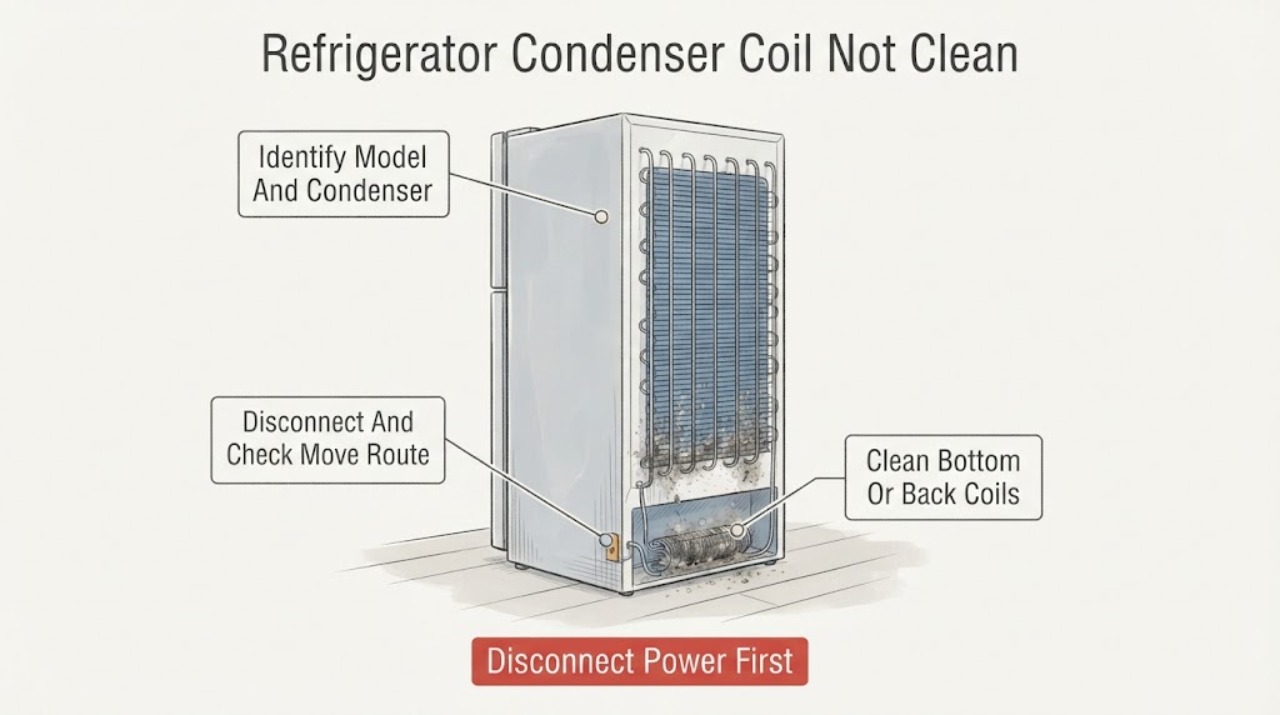
Do not assume every GE refrigerator has a user-cleanable condenser. GE says many models made since 2001 use a NeverClean condenser that is enclosed and does not require routine coil cleaning; other models may have coils under the base grille, on the back, or at the top. First identify the model and follow its owner manual. If the manual and visible design show accessible coils, unplug the refrigerator before cleaning, use the model-appropriate brush or vacuum method, and avoid sharp fins, the power cord and water tubing. If the condenser is enclosed, or the refrigerator remains warm after the documented cleaning, stop looking for a coil to scrub and arrange GE service rather than opening the compressor housing or diagnosing the sealed system.
Before you begin
Safety first
- Disconnect power before any documented condenser maintenance. Do not open a NeverClean compressor housing, pierce sealed-system tubing, add refrigerant, reach into an unknown machine compartment, or move the refrigerator if the cord or water line may be damaged.
Work through in order
Diagnostic checks
Use only checks that match the exact appliance or system and its official guide.
-
Check 1
Record the complete GE refrigerator model and serial information and read the model's owner manual or GE support page for the condenser design before removing a grille or moving the appliance.
Expected result: The manual identifies a NeverClean/enclosed condenser, an accessible bottom/back/top condenser, or does not identify the design.
Next step: For NeverClean or an unidentified design, do not open the compressor housing; use GE support/service. For an accessible design, continue only with the matching documented location and power-off method.
Why this matters
Why: The design determines whether there is a user-cleanable coil and which access route, if any, applies; no model or generic refrigerator picture can settle that question.
-
Check 2
Before maintenance on an accessible condenser, unplug the refrigerator; if it must be moved, use the model's installation instructions and move it straight, checking that the power cord and icemaker water line will not be pinched or rolled over.
Expected result: Power is disconnected and the appliance can be accessed without damaging flooring, cord, tubing or the water connection, or safe access is not available.
Next step: If access cannot be made safely, stop and arrange service. Do not pull sideways, drag across the floor, or clean around energized components.
Why this matters
Why: Power isolation reduces shock risk, while an unsafe move can create a separate electrical, water or appliance hazard; inability to access the condenser is not a reason to improvise.
-
Check 3
Only for a model whose manual identifies bottom or back coils, remove only the indicated grille if necessary and use a refrigerator condenser brush to loosen dust, pet hair and debris; vacuum or sweep the loosened soil without bending fins or contacting wiring and tubing.
Expected result: The coils are visibly accessible and dirty, or the area is enclosed, blocked, damaged or not the location described by the manual.
Next step: Replace the grille and keep the surrounding area clear after cleaning. If the coil is not the documented accessible design, stop and use GE support/service rather than opening covers.
Why this matters
Why: Accessible dirt can restrict heat removal, but an enclosed or mismatched location means this cleaning path does not apply and a damaged coil is not a normal cleaning task.
-
Check 4
Only for a model whose manual identifies a top condenser, disconnect power at the fuse box or breaker, wear long sleeves and gloves, and use a soft-bristle brush and vacuum on the specified fin area; do not reach into an unknown machine compartment.
Expected result: The model documentation confirms a top condenser and the fin area is accessible, or sharp fins, obstructed access, unfamiliar wiring or an unknown design is present.
Next step: For confirmed safe access, clean only the documented fin area and restore the grille before reconnecting power. Otherwise leave power off and arrange GE service.
Why this matters
Why: GE warns that top condenser fins are sharp and gives a specific access route; an unknown or obstructed compartment is outside a safe generic procedure.
-
Check 5
After an applicable documented cleaning and correct grille replacement, monitor whether the refrigerator returns to its expected temperature without opening covers or changing sealed-system parts; also note door sealing, interior airflow and installation clearance as model-specific observations.
Expected result: Cooling improves, the refrigerator remains warm/not cold enough, or the condenser was NeverClean/enclosed and no cleaning was performed.
Next step: Keep food-temperature safety in mind and schedule GE service for persistent poor cooling, abnormal operation or an unresolved NeverClean design. Do not add refrigerant or open the sealed system.
Why this matters
Why: Improvement supports airflow/heat-removal maintenance as a possible contributor but does not diagnose a part; persistent warmth means the coil hypothesis is incomplete or the cleaning path did not apply.
Use your observations
Decision map
Find the observation that best matches what you see, then follow the next safe action.
-
PATH 01Next step
What you see
The owner manual or GE support identifies a NeverClean condenser enclosed in the compressor housing.
Do this next
Do not remove the housing or search for the coils. Follow the manual for model-specific maintenance and use GE service if cooling is poor.
Why this path and its safety boundary
Why it matters: Routine user coil cleaning does not apply to that design; dust on the floor beneath the refrigerator is not the same as dirt on an accessible condenser.
-
PATH 02Next step
What you see
The model documentation confirms accessible bottom or back coils and they are visibly dusty or covered with pet hair.
Do this next
Disconnect power, clean only the accessible coils with the documented brush/vacuum path, restore the grille and cord/tubing position, then observe cooling.
Why this path and its safety boundary
Why it matters: The documented maintenance path is applicable, and debris may reduce heat-removal efficiency, but it does not by itself prove an internal component fault.
-
PATH 03Next step
What you see
The model documentation confirms a top condenser, but access is obstructed, fins are sharp, or the user cannot identify the specified compartment.
Do this next
Leave power disconnected and arrange GE or qualified refrigerator service rather than reaching into an unknown compartment or removing unrelated panels.
Why this path and its safety boundary
Why it matters: The official top-coil procedure has a physical injury and access boundary that a generic description cannot safely overcome.
-
PATH 04Next step
What you see
The correct accessible coils were cleaned, but the refrigerator remains warm or not cold enough.
Do this next
Check only model-supported external items such as settings, door gasket/closure and clearance, then schedule GE service. Do not open the sealed system or replace a compressor, fan or refrigerant based on this symptom alone.
Why this path and its safety boundary
Why it matters: Dirty coils are not a sufficient diagnosis; GE lists other temperature and airflow checks and recommends service when the problem remains.
-
PATH 05Next step
What you see
The model cannot be identified, or moving the refrigerator risks the floor, power cord, water line or electrical connection.
Do this next
Stop the cleaning attempt, obtain the model-specific manual or contact GE service, and do not drag or move the appliance sideways.
Why this path and its safety boundary
Why it matters: The cleaning route and physical access are unresolved, so generic coil instructions could create damage or a water/electrical hazard.
Helpful context
Understand the symptom
Identify the condenser design before touching it
GE describes NeverClean condensers as enclosed in the compressor housing and says they do not require routine cleaning. Other GE refrigerator designs place the condenser under the appliance, on the back, or at the top. The same brush-and-vacuum instruction therefore cannot be applied to every model. Use the model number and owner manual, then compare the manual's instructions with what is visibly accessible; do not remove a sealed housing to search for coils.
Clean only an accessible condenser with power disconnected
For a model whose manual identifies accessible coils, GE's support guidance starts with disconnecting power. The brush direction and grille access depend on whether the coils are under the base grille, on the back, or at the top. Use only the applicable path, keep the brush or vacuum outside electrical and tubing connections, and use gloves and long sleeves for top fins because GE warns that they are sharp.
Do not turn a coil-cleaning question into a sealed-system repair
If a NeverClean condenser is fitted, or if an accessible coil is clean but the refrigerator remains warm, the remaining cause is not established by this task. GE's cooling guidance also covers controls, door closure, airflow, installation temperature and other model-specific factors, then directs unresolved cooling problems to service. Do not open the compressor housing, pierce tubing, add refrigerant, or replace a fan or compressor based only on a dirty-coil assumption.
Only after diagnosis
Potential parts
- refrigerator condenser cleaning brush
Consider only when the exact GE model manual confirms an accessible condenser and the brush is appropriate for that location.
A brush does not apply to a NeverClean/enclosed condenser; confirm the model instructions before purchasing or using one.
When checks do not resolve it
Need a professional?
Use GE service when the model/manual does not identify a safe cleaning route, the condenser is enclosed but cooling remains poor, the refrigerator cannot be moved without risking the cord or water line, the top machine compartment cannot be accessed safely, or cleaning does not resolve the temperature problem. Keep food at safe temperatures while the refrigerator is not cooling properly.
Safety scope: Disconnect power before any documented condenser maintenance. Do not open a NeverClean compressor housing, pierce sealed-system tubing, add refrigerant, reach into an unknown machine compartment, or move the refrigerator if the cord or water line may be damaged.
Common questions
FAQ
Do all GE refrigerators need condenser-coil cleaning?
No. GE says many models made since 2001 use a NeverClean condenser enclosed in the compressor housing. Other models have accessible coils, so use the exact model manual rather than assuming a cleaning schedule.
Where are GE refrigerator condenser coils located?
GE documents designs with coils under the refrigerator, on the back or at the top, as well as NeverClean coils enclosed in the compressor housing. The model manual and visible design determine which path applies.
Can I vacuum the coils while the refrigerator is plugged in?
Do not. GE says to unplug before maintenance or cleaning. If the refrigerator must be moved, protect the power cord and any icemaker water line and stop if safe access is not available.
Will cleaning dirty coils fix a warm GE refrigerator?
It may improve heat removal when the model has accessible dirty coils, but it is not a diagnosis of every cooling problem. If the documented cleaning does not help, use GE's external troubleshooting and service route instead of opening the sealed system.
Read the exact guide
Official sources
- Refrigerator - Condenser TypesGE Appliances · GE family-level explanation of NeverClean, forced-air and natural-draft condenser arrangements; model documentation remains controlling.
- Refrigerators, Freezers and Icemakers Troubleshooting and SupportGE Appliances · GE refrigerator support entry point for identifying model-specific manuals and service.
- Refrigerator - NeverClean CondenserGE Appliances · GE refrigerator models equipped with an enclosed NeverClean condenser; it is not a universal statement about every GE refrigerator.
- Refrigerator - Cleaning Behind / Under the ApplianceGE Appliances · GE refrigerator external cleaning/movement guidance; installation instructions remain model-specific.
- Refrigerator - Cleaning Condenser CoilsGE Appliances · GE refrigerator family guidance with separate bottom, back and top procedures; exact model/manual determines whether the procedure applies.
- Refrigerator - Not Cooling EnoughGE Appliances · GE refrigerator family troubleshooting; model-specific clearances and cleaning instructions remain controlling.
- FAQs | RefrigeratorsGE Appliances · GE refrigerator support path for unresolved cooling or maintenance questions.
Community feedback
Share a repair observation
Share a plain-text repair observation. Accepted observations are published automatically; this page may take a moment to update.