
On this page
Start here
Quick answer
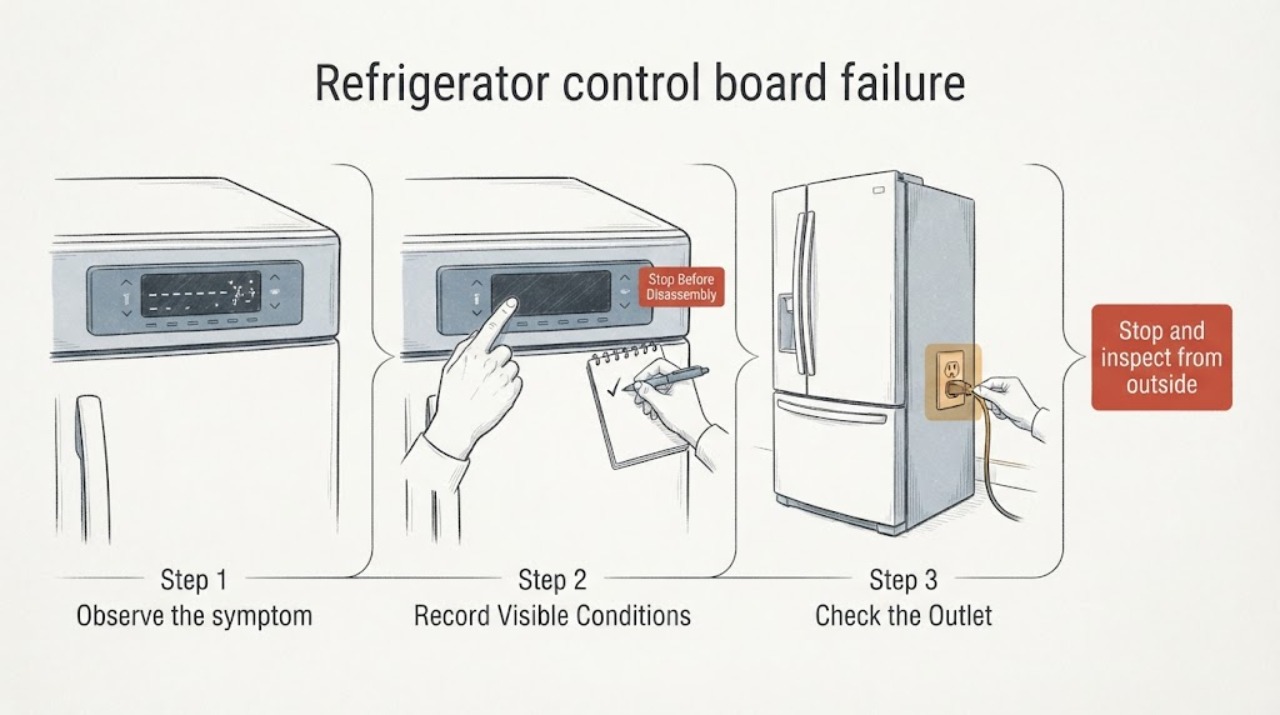
A dead display, no-cooling symptom, or fault code does not by itself prove that a GE refrigerator control board has failed. Start with safe external checks: confirm power at the outlet and a connected plug, verify that the controls are on and the panel is not locked, check for Demo Mode or a normal defrost or post-outage recovery period, and record the exact model and displayed code. GE documents a brief power reset for some nonresponsive panels, but button combinations and code meanings vary by model. Do not open the cabinet, test a live board, bypass a safety device, or order a generic board from a symptom alone. If the panel remains unavailable, cooling does not return, a code persists, or there is heat, odor, arcing, or breaker activity, stop and arrange GE or qualified appliance service.
Work through in order
Diagnostic checks
Use only checks that match the exact appliance or system and its official guide.
-
Check 1
Stop and inspect from outside for a burning odor, smoke, arcing, a hot plug or receptacle, water near electrical parts, or a breaker that trips again; if any is present, disconnect power only if it is safe to do so and keep the refrigerator out of service.
Expected result: There is a burning or electrical warning, repeated breaker activity, visible damage, or no immediate hazard.
Next step: For a safety warning, do not reset the breaker repeatedly, open the cabinet, or test the board; arrange qualified appliance or electrical service. Otherwise continue with the model and power checks.
Why this matters
Why: A safety event takes priority over diagnosing a control board, and repeated energizing can increase damage or shock and fire risk. No visible hazard means the external identification checks can continue.
-
Check 2
Record the full model number and the exact symptom before changing settings: check whether the fresh-food light works, whether the display is blank or only the dispenser panel is unresponsive, whether controls respond, and whether the refrigerator or freezer is warming.
Expected result: The interior light works, the panel is partly or fully responsive, a displayed code is present, or the entire appliance appears without power.
Next step: Keep the model number and the display wording for the matching owner manual or service request. Do not use a code or board procedure from another GE family.
Why this matters
Why: These observations separate an apparent control-panel problem from an outlet/power problem, a cooling problem, and a model-specific code; none alone identifies a failed board.
-
Check 3
Verify the refrigerator plug is firmly connected, the outlet is energized, and the temperature controls are on; check only the accessible plug and control settings, without removing panels or measuring live wiring.
Expected result: The outlet or plug is not supplying power, the controls are off, or power and settings are normal.
Next step: Correct only the accessible power or setting issue. If power is absent, use a qualified electrician; if power and settings are normal, continue to Demo Mode, defrost, and model-code checks.
Why this matters
Why: No power or an off control can mimic a dead control board. Normal external power and settings leave the symptom unresolved but still do not prove board failure.
-
Check 4
Check the exact model manual or GE's model-specific support for Demo Mode, panel lock, and any displayed code; if the issue is a nonresponsive panel and no electrical hazard is present, use only the documented brief power reset for that model.
Expected result: The display identifies Demo Mode, the panel is locked, a listed code is present, or the model-specific reset restores the panel; alternatively, no model-specific explanation is available.
Next step: Follow the matching manual for the displayed state. Do not reuse another model's button combination, repeatedly cycle power, or infer a board failure from an unchanged display.
Why this matters
Why: Demo Mode, a lock, and some fault or function codes are documented control states rather than proof of a failed board. A reset that helps is a symptom change, not a board test; an unlisted code needs model-specific service.
-
Check 5
If the panel responds but the refrigerator is not cooling, observe whether the unit is in a documented defrost or post-outage recovery period, whether doors and gaskets close, whether airflow is blocked, and whether the exact manual authorizes external condenser cleaning; do not diagnose the board from temperature alone.
Expected result: Cooling returns after the documented wait or external correction, or the refrigerator remains warm with normal power and controls.
Next step: If the refrigerator remains warm, protect perishable food and arrange GE or qualified service with the model and temperature timeline. Do not open the sealed system or control compartment.
Why this matters
Why: GE identifies defrost, compressor recovery, settings, door sealing, airflow, installation conditions, and model-dependent condenser access as possible explanations. Persistent warmth after those checks requires diagnosis beyond the visible controls.
Use your observations
Decision map
Find the observation that best matches what you see, then follow the next safe action.
-
PATH 01Next step
What you see
The interior light and refrigerator are both without power, or the outlet or plug fails the accessible power check.
Do this next
Stop using the outlet and arrange qualified electrical service if power cannot be restored safely; do not open the refrigerator to look for a board.
Why this path and its safety boundary
Why it matters: The immediate evidence points to the supply path or outlet, not a confirmed refrigerator control-board failure.
-
PATH 02Next step
What you see
The panel is blank or nonresponsive, but the interior light and outlet power are present and there is no burning, water, or breaker warning.
Do this next
Use the exact model manual for lock/Demo Mode and the supported brief reset. If the panel remains unavailable, arrange model-specific service without opening the cabinet.
Why this path and its safety boundary
Why it matters: A lock, Demo Mode, installation wiring condition, or control-panel issue remains possible; the observation does not prove the main control board has failed.
-
PATH 03Next step
What you see
The display shows a GE fault or function code, including a code that resembles a normal Turbo Cool or Turbo Freeze indication.
Do this next
Record the exact code and model, consult the matching manual, and arrange service if the code persists after the documented external step. Do not replace a board from the code alone.
Why this path and its safety boundary
Why it matters: GE says code meanings are model-dependent and that some display codes are normal functions rather than faults; an unfamiliar code cannot be decoded from the generic list.
-
PATH 04Next step
What you see
The refrigerator has normal external power and controls but remains warm after the documented defrost or recovery period and visible checks.
Do this next
Protect food, keep the symptom documented, and schedule GE or qualified refrigerator service. Do not perform live board tests, bypass sensors, or open the sealed system.
Why this path and its safety boundary
Why it matters: The cooling fault remains unresolved; GE's public guidance does not establish that the control board is the cause.
-
PATH 05Next step
What you see
There is smoke, burning odor, arcing, repeated breaker tripping, water at electrical parts, or visible wiring or cabinet damage.
Do this next
Keep the appliance de-energized from a safe location and arrange qualified appliance or electrical service; do not re-energize it for a diagnostic test.
Why this path and its safety boundary
Why it matters: This is a safety stop, not a user-level control diagnosis.
Helpful context
Understand the symptom
Why a symptom is not proof of a failed board
GE refrigerators can appear electronically dead when the outlet or plug has lost power, a control is off or locked, Demo Mode is active, the refrigerator is in defrost, or the compressor is waiting after a power interruption. GE also publishes separate guidance for a nonworking dispenser panel and for refrigerators that are not running or cooling. Those checks can narrow the symptom, but they do not identify a failed board without the exact model's diagnostic procedure.
Use model and code information before service
Record the complete model number, serial information if available, display wording, indicator behavior, whether the interior light works, and whether either compartment is actually warming. GE says its common-code list is not exhaustive and that a code can be a normal function indication, such as Turbo Cool or Turbo Freeze. A technician needs this identity and the symptom timeline to distinguish control, power, cooling, and display problems.
Keep board work inside the service boundary
A reset or an external setting check may restore a panel, but a temporary response does not prove the board is healthy and a failed reset does not prove the board is bad. Do not remove the rear cover, probe connectors, replace a board by visual appearance, or bypass a door, temperature, or other safety device. If supported external checks do not restore normal operation, use the exact model manual or arrange GE service.
When checks do not resolve it
Need a professional?
Arrange GE or qualified refrigerator service when the panel remains unresponsive after the model-specific external checks, a model-specific code persists, cooling does not return after the documented recovery or defrost conditions, or there is any burning odor, arcing, repeated breaker activity, water near electrical parts, or visible damage. Do not open the cabinet, probe a live control board, bypass a safety device, or order a board from symptoms alone.
Common questions
FAQ
Does a blank GE refrigerator display prove the control board failed?
No. Check accessible power, the plug and outlet, panel lock, Demo Mode, and the exact model's support instructions first. If the interior light and outlet power are normal but the panel remains blank, service can diagnose the control system without guessing a board from the symptom.
Can I reset the GE refrigerator before calling service?
GE documents a brief power reset for some nonresponsive panels and codes, but the correct buttons and behavior vary by model. Use the matching manual, do not repeatedly cycle power, and treat a successful reset as a change in symptom rather than proof that the board is good or bad.
Can a GE refrigerator stop cooling without a failed control board?
Yes. GE lists settings, door closure, blocked airflow, installation conditions, dirty coils on models that require cleaning, defrost, Demo Mode, and post-outage compressor recovery among the checks. Persistent warming after the model-supported checks needs service rather than a board diagnosis from temperature alone.
Read the exact guide
Official sources
- Refrigerator - Not Cooling EnoughGE Appliances · Opened GE's official cooling support page. It provides external and model-manual-conditioned checks and does not use warm temperatures to infer a failed control board.
- Refrigerator - Does Not Run or CoolGE Appliances · Opened GE's official general refrigerator support page. It supports external symptom triage and explicitly does not identify a control-board cause.
- Refrigerator - Not RunningGE Appliances · Opened GE's official general refrigerator support page. Demo Mode button sequences are presented as model-dependent examples and are not generalized to the unspecified task.
- Refrigerator - Dispenser Control Panel Not WorkingGE Appliances · Opened GE's official panel support page. It supports external panel checks only and does not authorize cabinet opening or board replacement.
- Refrigerator - Error, Fault or Function CodesGE Appliances · Opened GE's official code page. It states the common list is not exhaustive and distinguishes normal Turbo Cool/Turbo Freeze indicators from faults; no universal code or board diagnosis is assigned.
Community feedback
Share a repair observation
Share a plain-text repair observation. Accepted observations are published automatically; this page may take a moment to update.