
On this page
Start here
Quick answer
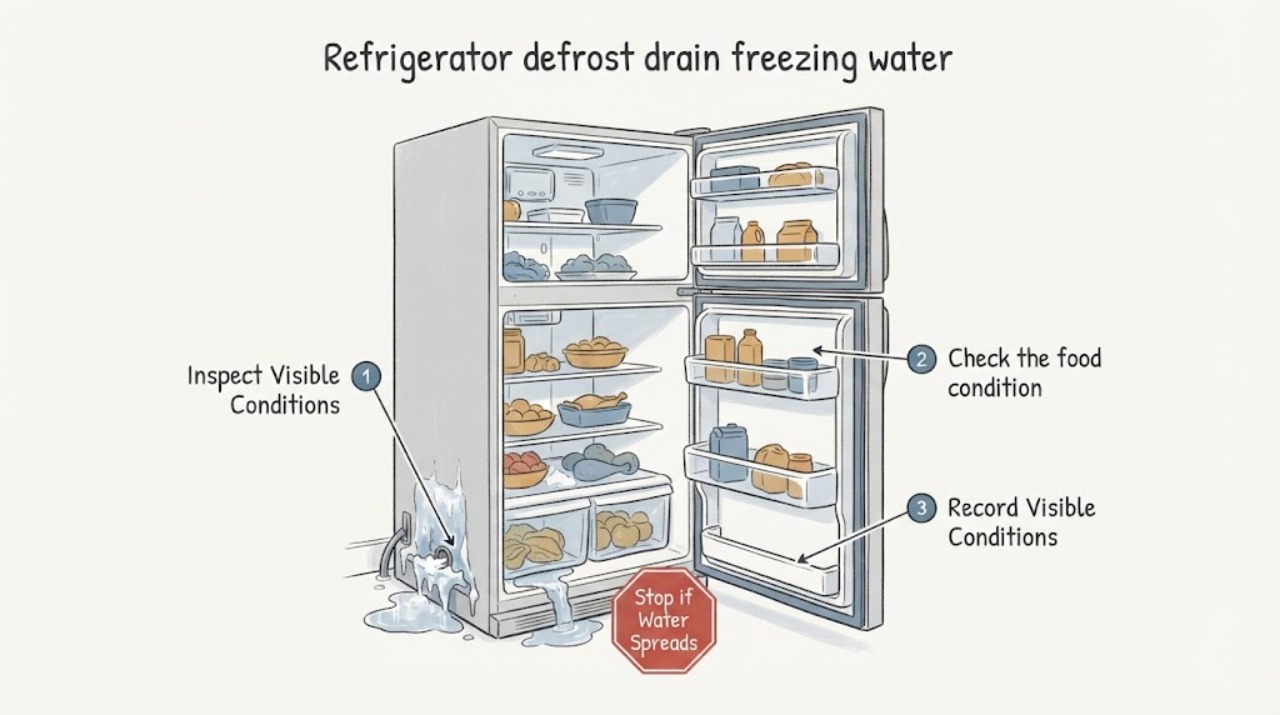
For a GE Profile PTI22MFMALBB with recurring ice in the defrost-drain area and water reaching the fresh-food compartment, first map the first wet point: freezer floor or rear wall, fresh-food rear wall or under the vegetable pans, door gasket, or rear water connection. GE identifies water down the fresh-food rear wall or under the vegetable pans as a possible clogged defrost-drain sign and says top-freezer models commonly need service to access that drain. Confirm the complete old-model identity and freezer layout in GE's manual finder; do not assume a nearby PTI22 variant shares the same access. Protect food, unplug before maintenance, and stop using the refrigerator for a wet electrical area or unsafe food temperatures. Do not chip ice with a sharp object, use a heat gun, remove the evaporator cover, or perform energized testing. A recurring freeze-up needs qualified service to find the cause, not repeated surface ice removal.
Work through in order
Diagnostic checks
Use only checks that match the exact appliance or system and its official guide.
-
Check 1
Read the complete rating-plate model, suffix, serial, and market without pulling or tilting the refrigerator. Confirm that every character is PTI22MFMALBB and record whether the freezer is physically above or beside the fresh-food compartment.
Expected result: The label matches PTI22MFMALBB and the layout is clear; a character or suffix differs; the model label is unreadable; or the freezer layout does not match the expected configuration.
Next step: Enter the complete model in GE's official manual finder and use only the matching manual. If the identity or layout is uncertain, arrange model-specific service instead of removing panels.
Stop if: Do not move the appliance or remove trim to read the label if doing so could stress water tubing or electrical connections.
Why this matters
Why: GE's drain instructions vary by refrigerator style, and an older model's access points cannot be safely inferred from a similar-looking PTI22 number.
-
Check 2
Dry the accessible floor and cabinet surfaces, then observe the first place that becomes wet during a safe observation: the freezer floor or rear wall, fresh-food rear wall, area under the vegetable pans, door gasket, or rear water connection. Do not run a long cycle to force a leak.
Expected result: Water tracks down the fresh-food rear wall or under the vegetable pans; ice or water is on the freezer floor; the rear valve or line is wet; water follows dispensing or icemaker fill; or the source is hidden.
Next step: Keep the unit and water supply safe while continuing only the matching location branch. Shut off the water for a water-system leak; arrange service when the source is hidden or returns.
Stop if: Stop if water reaches the outlet, cord, control area, or other electrical parts.
Why this matters
Why: GE identifies rear-wall/vegetable-pan water as a possible clogged defrost drain, while a wet valve, line, or fill tube supports a water-system path. A hidden source cannot be safely classified from the puddle alone.
-
Check 3
Check the food condition and the refrigerator's temperature indication without touching wet electrical parts. If food has been warm for an unknown period, move it to a known-safe cold appliance; unplug the refrigerator before any maintenance or cleaning only when the plug and floor are dry and safe.
Expected result: Food temperature is unknown or unsafe; water is near the outlet or cord; the area is dry and the refrigerator is maintaining temperature; or the unit has an active leak or damaged wiring.
Next step: Protect or discard affected food under applicable food-safety guidance. Leave the refrigerator off and arrange service for wet electrical areas, damaged wiring, active leaks, or loss of temperature control.
Stop if: Do not touch wet plugs, outlets, controls, or wiring; do not restore power from a wet location.
Why this matters
Why: A drain leak can damage food and floors, and GE states that water and electricity do not mix and that the appliance should be unplugged before maintenance. Food protection and electrical isolation take priority over diagnosing the drain.
-
Check 4
With water functions off, inspect the visible rear valve, household supply line, and icemaker fill line for wetness, splits, or a loose accessible connection. Do not disconnect tubing or move the refrigerator to chase a hidden leak.
Expected result: The valve or appliance line is wet; the household line is split or wet; the fill line is wet; all visible connections are dry; or water continues with the refrigerator supply closed.
Next step: Turn off the refrigerator water supply for any water-system leak. Use a plumber for a house-side line and qualified appliance service for a valve, internal line, or hidden source; if fittings are dry, continue with the location and recurrence branch.
Stop if: Do not patch tubing, disconnect a pressurized line, or work near wet electrical connections.
Why this matters
Why: GE lists a leaking valve, household line, and icemaker fill line as separate sources from a defrost drain. Dry fittings make a drain, condensation, internal tubing, or hidden source more likely but do not prove which one.
-
Check 5
Record whether the water appears after a defrost period, whether ice reforms in the same freezer or drain area, and whether the fresh-food leak returns under the pans or down the rear wall. Take photos of the ice pattern and water trail before it melts; do not chip, pierce, or force the ice.
Expected result: Ice and water recur at the same drain-related location after defrost; the leak appears without a defrost pattern; the door gasket has a visible gap or damage; or the source cannot be seen.
Next step: For a confirmed top-freezer configuration, use the exact GE manual or service path because GE says drain access commonly requires disassembly. Arrange service for recurrence; do not substitute a heat gun, sharp object, evaporator removal, or a generic drain-clearing procedure.
Stop if: Do not remove the evaporator cover, insert wire or a pointed object, apply a heat gun, or perform energized testing.
Why this matters
Why: A repeated defrost-timed overflow supports a restricted or freezing drain, while a gasket gap can admit humid air and create extra frost. A different timing or hidden source keeps water-system, condensation, or internal service causes open.
-
Check 6
After any model-approved external correction and only when the appliance is dry, verify the floor, fresh-food compartment, freezer floor, rear water connections, door gasket, and temperature over one normal operating interval. Do not repeatedly remove surface ice as a substitute for finding why the drain freezes.
Expected result: No water returns and temperatures remain safe; the same ice and fresh-food leak return; a rear water leak appears; or temperatures remain unsafe.
Next step: Shut off water for water-system leaks, protect food, leave the appliance off when temperatures are unsafe, and arrange qualified service for recurring or hidden problems.
Stop if: Do not restart after smoke, wet electrical parts, damaged wiring, an active leak, or an unsafe food-storage temperature.
Why this matters
Why: A dry interval supports only that the visible symptom did not recur during that observation. Repeated ice or leakage indicates an unresolved drain, gasket, water-system, or hidden cabinet problem; unsafe temperatures create a food-safety issue.
Use your observations
Decision map
Find the observation that best matches what you see, then follow the next safe action.
-
PATH 01Next step
What you see
The freezer layout is confirmed as top-freezer, and water repeatedly tracks down the fresh-food rear wall or collects under the vegetable pans after a defrost period.
Do this next
Use the exact PTI22MFMALBB manual if available and arrange service for drain access; GE says top-freezer drain access commonly requires disassembly. Protect food and floors while waiting.
Why this path and its safety boundary
Why it matters: This pattern matches GE's listed evidence for a clogged defrost drain. It does not establish whether the underlying recurrence is debris, ice, airflow, door sealing, or another internal condition.
-
PATH 02Next step
What you see
The freezer floor or fresh-food area is wet, but the refrigerator's visible valve, household line, and icemaker fill line are dry and the leak is not clearly tied to dispensing.
Do this next
Keep the icemaker and water supply off, document the ice and water trail, and arrange appliance service if the source is hidden or recurring. Do not remove the evaporator cover or probe the drain.
Why this path and its safety boundary
Why it matters: A defrost drain, condensation/door-seal issue, or hidden internal path is more likely than the visible water-supply branch, but the puddle does not prove a particular internal component.
-
PATH 03Next step
What you see
A rear valve, household line, or icemaker fill line is visibly wet, or water continues after the refrigerator water supply is closed.
Do this next
Keep the supply off. Use a plumber for a wet or split house-side line and qualified appliance service for a valve, internal line, or leak that remains unexplained.
Why this path and its safety boundary
Why it matters: The water-system or house-plumbing branch is more likely than a defrost drain alone; a continuing leak with the appliance supply closed may be on the house side or another internal source.
-
PATH 04Next step
What you see
Water reaches an outlet or cord, food has been at an unsafe temperature, there is an active uncontrolled leak, damaged wiring, smoke, or any need to use a sharp object, heat gun, evaporator-panel removal, or energized test.
Do this next
Protect or discard affected food, leave the refrigerator off, isolate water and power only from a dry safe location when appropriate, and obtain qualified appliance, electrical, or plumbing service.
Why this path and its safety boundary
Why it matters: This is a food-safety, water-damage, fire, cut, or electrical hazard, not a reason to continue owner-level drain work.
Helpful context
Understand the symptom
PTI22MFMALBB is an older GE Profile model. GE's official manual page requires the complete model number to retrieve the matching owner's manual, while the generic GE drain guidance branches by refrigerator configuration. Confirm every model character, suffix, serial, and whether the physical appliance is top-freezer before applying any drain-access instruction; do not use PTI22MFMLBB, PTI22MBMALBB, or another nearby variant as a substitute.
A fresh-food leak after a defrost event is compatible with a restricted or repeatedly freezing defrost drain, but location and timing still matter. GE also lists water valves, household lines, icemaker fill lines, exterior moisture, and leveling among leak possibilities. Water under the vegetable pans or down the fresh-food rear wall makes a drain branch more likely; a wet rear fitting or a leak that follows dispensing keeps the water-system branch open.
Move vulnerable food to a known-safe cold appliance if the refrigerator temperature is no longer controlled, and discard food according to local food-safety guidance when safe temperature history is unknown. GE warns that water and electricity do not mix and says to unplug before maintenance or cleaning. Keep the unit off for wet electrical parts, damaged wiring, an active leak, or any procedure that requires evaporator-panel or drain access beyond the exact manual.
When checks do not resolve it
Need a professional?
Have this ready
- Complete rating-plate model and serial, market and freezer layout, first wet location, timing relative to defrost or dispensing, photos of the ice and water trail, food-temperature history, whether the water supply and icemaker were shut off, and whether visible rear connections were dry.
Common questions
FAQ
Does water under the fresh-food vegetable pans prove the defrost drain is frozen?
No. GE lists water down the fresh-food rear wall or under the vegetable pans as evidence that a defrost drain may be clogged, but a door-seal, condensation, internal water path, or other hidden source can look similar. The first wet point and timing still matter.
Can I use a sharp object or heat gun to clear the ice?
Do not. A sharp object can damage tubing or the cabinet, and a heat gun can damage components or create a fire hazard. GE says top-freezer drain access commonly requires service; use the exact manual and qualified service path.
Should I turn off the water even if the leak seems like defrost water?
If the refrigerator has an icemaker or dispenser, turn off those functions and the refrigerator water supply when a rear valve, line, or fill tube could be involved. GE lists those sources separately from the defrost drain. Do not disconnect a pressurized line.
Is PTI22MFMALBB the same as another PTI22 model?
Do not assume that. GE's official manual finder requires the complete model number, and drain access depends on the refrigerator configuration. Confirm every character and use only the matching manual before any model-specific procedure.
What should I do if the leak keeps returning after the ice melts?
Repeated recurrence means the underlying drain, airflow, door seal, water system, or hidden cabinet path has not been established. Protect food and floors, keep water off if applicable, and arrange qualified service rather than repeatedly removing surface ice.
Read the exact guide
Official sources
- Owner's Manual & Installation InstructionsGE Appliances · The opened official GE page instructs users to enter the appliance model number, including PTI22MFMALBB, to retrieve owner's manuals, use-and-care manuals, installation information, and energy guides; the opened page itself does not confirm a matching document for this old model.
- Refrigerator - Icemaker Leaking or Dripping WaterGE Appliances · The opened GE support page lists water-line fittings, valves, fill-tube extension, defrost drain, exterior moisture, and leveling as distinct leak possibilities and directs users to shut off icemaker water for floor leaks.
- Refrigerator - Water on FloorGE Appliances · The opened GE support page covers refrigerator floor water, defrost-drain clues, water valves, household lines, icemaker fill lines, model-specific manual checks, and service escalation.
- Top Freezer Refrigerator - Drain TubeGE Appliances · The opened GE support page explains that automatic-defrost water travels through a drain tube and that water down the fresh-food rear wall or under vegetable pans may indicate a clogged drain; it warns that top-freezer access commonly requires disassembly and recommends service.
Community feedback
Share a repair observation
Share a plain-text repair observation. Accepted observations are published automatically; this page may take a moment to update.