
On this page
Start here
Quick answer
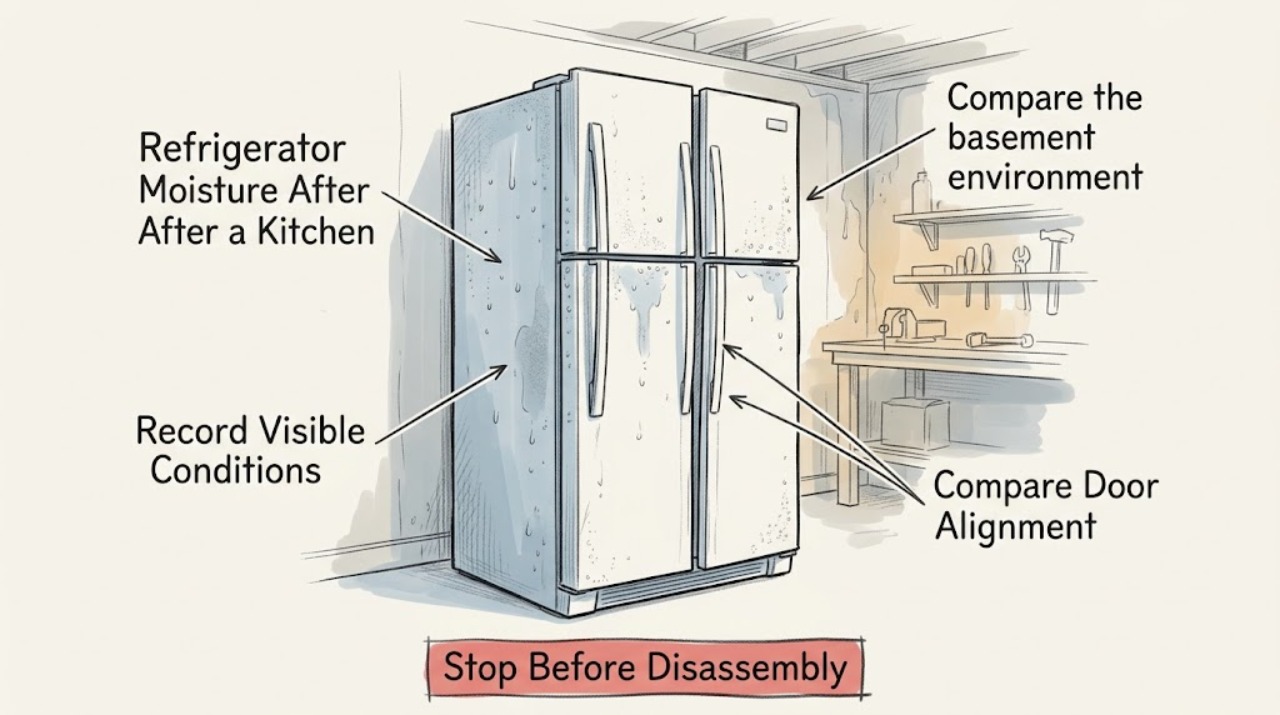
First identify where the moisture is: only on the outside cabinet, inside the fresh-food compartment, in the freezer, or pooled on the floor. A kitchen remodel can change basement humidity, nearby heat or air movement, and the refrigerator's clearances, so exterior condensation after relocation is not automatically a sealed-system leak. Dry the accessible surfaces, keep food covered, check that doors close and the gaskets meet the cabinet, and record whether the moisture follows a defrost cycle or returns after the room dries. GE says frequent door opening, a door left ajar, blocked closure, open containers, defrost, and high humidity can create moisture; a warm or wet rear area with proper clearance needs service. If food temperature is unsafe, move perishables to a known-cold refrigerator. As a tenant or occupant, do not pull out this heavy side-by-side refrigerator, remove panels, probe a defrost drain, touch refrigerant tubing, or work near wet electrical connections; report installation or building-humidity changes to the landlord, contractor, or property manager and arrange qualified GE service.
Work through in order
Diagnostic checks
Use only checks that match the exact appliance or system and its official guide.
-
Check 1
Dry the visible moisture and map its first appearance with photos: cabinet front or door seam, side or rear case, inside shelves or walls, freezer floor, under drawers, or the room floor. Record whether the water is clear, icy, or associated with a spill, and keep the refrigerator's doors closed while observing.
Expected result: Moisture returns only on an exterior surface, appears inside after door opening or defrost, forms a puddle under the refrigerator or freezer, or reaches an outlet or cord.
Next step: Keep the area dry and do not use or move the appliance if water is near electrical parts. For a recurring puddle, hidden source, or wet outlet/cord, notify the landlord or property manager and arrange qualified service; do not remove panels or continue testing a leak.
Why this matters
Why: GE treats exterior and interior condensation as different evidence paths. Moisture on a cold exterior surface can be humidity or clearance related; a pool, recurring freezer-floor water, or wet electrical area can indicate a drain, plumbing, or appliance problem rather than ordinary basement humidity.
-
Check 2
Compare the basement environment with the pre-remodel condition without moving the refrigerator. Note recent drywall, flooring, plumbing, HVAC, or dehumidifier changes; visible condensation on nearby walls or pipes; a new heat source; and whether the room feels unusually humid. A hygrometer can document the room trend, but do not infer a refrigerator defect from one humidity reading alone.
Expected result: Nearby walls, pipes, or the cabinet are also sweating, the basement became more humid after the remodel, or the room and surrounding surfaces are dry while the refrigerator alone is wet.
Next step: Photograph the room conditions and report any remodel-related ventilation, plumbing, or humidity change to the landlord or contractor. Do not place heaters against the refrigerator or seal ventilation openings; arrange service if the refrigerator remains wet after the room condition is corrected.
Why this matters
Why: A broad change affecting the room and other cold surfaces supports an environmental condensation contributor. Moisture isolated to the refrigerator, especially toward the rear with proper clearance, makes an appliance or installation issue more concerning.
-
Check 3
Check the fresh-food and freezer doors from the outside: look for a container blocking closure, a gasket gap, split, tear, or folded section, and whether the doors sit unevenly. Wipe an accessible gasket with a soft damp cloth only; do not remove it, add adhesive, or adjust hinges as a tenant.
Expected result: A door remains slightly open, a gasket has a gap or damage, containers interfere, or the doors close evenly and the gaskets contact the cabinet.
Next step: Remove only the visible food obstruction and clean the accessible seal. If a gasket is loose or torn, report it for a model-matched replacement; do not order or install a part without owner/service approval. If the closure is normal, continue to the defrost and floor-location branch.
Why this matters
Why: GE says warm humid air entering through frequent opening or incomplete sealing can produce interior moisture, while door alignment and leveling affect closure. A sound closure makes that explanation less likely for moisture that returns at the rear or under the unit.
-
Check 4
Inspect the inside without removing panels: note water on shelves or side walls, moisture under crispers, open uncovered containers, frost on freezer walls, and whether the wetness appears after a defrost period. Keep food covered and do not scrape ice or probe an opening with a tool.
Expected result: Moisture is on interior walls after humid door use, an open container is present, frost is heavy, or water pools under freezer baskets or inside the cabinet.
Next step: Cover containers, minimize door openings, and photograph frost or pooling. If water recurs under the freezer, the source is hidden, or frost blocks an air path, leave the appliance in place and arrange qualified service; do not clear a drain unless the exact PSCS5RGXCFSS manual explicitly provides an accessible procedure.
Why this matters
Why: GE lists warm humid air, open containers, and defrost as possible causes of interior moisture; pooled water under a freezer basket can instead support a defrost-drain path that requires model-specific instructions. Thick frost may also reduce normal airflow and needs the owner's manual or service rather than improvised probing.
-
Check 5
From a safe standing position, check that the remodel did not crowd the refrigerator against cabinets, a wall, or a new enclosure and that the floor still supports a level, self-closing door. Do not pull the refrigerator forward; photograph the visible side/top/rear clearance and ask the installer or property manager to verify the installation.
Expected result: A new cabinet or wall reduces clearance, the floor is uneven and a door does not self-close, or the visible installation appears unchanged and clear.
Next step: Keep the refrigerator where it is and have the installer or landlord correct any clearance or leveling issue according to the model installation instructions. If clearances are adequate but moisture persists, request appliance service.
Why this matters
Why: GE says improper air clearance can contribute to case moisture and that leveling helps doors close. A remodel-related clearance or leveling change is an installation issue, not proof of an internal refrigerator leak.
-
Check 6
Check food-safety impact separately: if an appliance thermometer shows the refrigerator is warm, transfer meat, seafood, dairy, eggs, leftovers, and other perishables to a known-cold refrigerator. Record the temperature and how long it may have been elevated; do not taste questionable food to decide whether it is safe.
Expected result: Food remains at a safe cold temperature, the refrigerator is warm, food has been above 40°F for more than two hours, or the duration is unknown.
Next step: Keep the doors closed, move or discard affected perishables according to FDA guidance, and report the measured temperature with the moisture photos. Do not keep running the appliance solely to preserve food that has an unsafe or unknown temperature history.
Why this matters
Why: Moisture can coexist with normal cooling, but a warm cabinet creates an independent food-safety decision. FDA says refrigerators should be at or below 40°F and advises discarding food that has been above 40°F for more than two hours or for an uncertain duration.
Use your observations
Decision map
Find the observation that best matches what you see, then follow the next safe action.
-
PATH 01Next step
What you see
Moisture is limited to the exterior cabinet or door area, nearby basement walls or pipes also show condensation, and the room became more humid after the remodel.
Do this next
Dry the cabinet, improve room humidity control or ventilation through the landlord/contractor, preserve clearances, and monitor whether the moisture returns. Do not cover vents or place heat against the appliance.
Why this path and its safety boundary
Why it matters: An environmental humidity or cold-surface condensation contributor is more likely than an internal water leak, although the refrigerator still needs monitoring for recurrence.
-
PATH 02Next step
What you see
Moisture is inside the fresh-food compartment and follows frequent opening, a door gap, blocked closure, open containers, or a recent restart after installation.
Do this next
Correct only the visible obstruction, keep containers covered, close the doors, and allow the appliance to stabilize. If moisture continues despite normal closure and use, request GE service through the owner or property manager.
Why this path and its safety boundary
Why it matters: Warm humid air entering the compartment or normal recovery after installation is more consistent with the pattern than a confirmed sealed-system defect.
-
PATH 03Next step
What you see
Water pools under the freezer, returns after a defrost period, appears at the rear of the case, or continues despite dry doors and a dry room.
Do this next
Keep the appliance in place, protect flooring, and arrange qualified GE service. Do not probe the drain, remove panels, or pour chemicals or hot water into an unidentified opening.
Why this path and its safety boundary
Why it matters: A defrost-drain, drip-pan, hidden leak, or appliance installation issue is more likely than exterior condensation alone. GE says the model manual determines whether a defrost drain can be cleared by the owner, and most freestanding models require service for this condition.
-
PATH 04Next step
What you see
A wet electrical area, visible mold-like growth on porous building material, food contamination, a warm refrigerator, or repeated moisture after the remodel is present.
Do this next
Stop using the affected area as appropriate, keep clear of wet electrical parts, move safe food, photograph without disturbing suspected mold, and notify the landlord/property manager for coordinated qualified appliance, electrical, or building service.
Why this path and its safety boundary
Why it matters: The issue has moved beyond a cosmetic condensation check and can involve electrical, property, indoor-air, or food-safety risk.
Helpful context
Understand the symptom
PSCS5RGXCFSS is a GE Profile refrigerator model with a model-specific owner's manual and installation instructions. The remodel and basement location are important because humidity, nearby heat, leveling, door alignment, and clearance can change even when the refrigerator itself was not repaired. The first decision is whether the water is condensation on a cold surface or water emerging from inside the appliance or a drain path.
Do not diagnose a sealed-system problem from dampness alone. Photograph the first wet point, dry it, note the room conditions and timing, and stop if water reaches the outlet, cord, controls, or any exposed connection. A tenant should preserve the installation and send the evidence to the landlord or property manager rather than moving or opening the refrigerator.
If mold-like growth is present, avoid disturbing it dry or spreading it through the room; contain the affected food and surfaces and ask the property manager about appropriate cleaning. Moisture that affects food, insulation, flooring, or electrical safety needs prompt attention even if the refrigerator still cools.
Only after diagnosis
Potential parts
- GE PSCS5RGXCFSS model-matched door gasket
Only if a qualified inspection confirms a torn, loose, or non-sealing gasket and verifies the exact model and door position.
When checks do not resolve it
Need a professional?
Contact the landlord or property manager and arrange qualified GE service when moisture returns after the visible door, room, and clearance checks; when water pools under the freezer or behind the case; when a gasket is damaged; or when the refrigerator is warm. Use a qualified electrician for water near an outlet, cord, or exposed connection, and follow appropriate building or mold professionals for visible growth on porous materials. Do not move this refrigerator, remove covers, probe a drain, handle refrigerant, test live circuits, or order a gasket, drain, fan, or sealed-system part from moisture alone.
Common questions
FAQ
Can a basement after a kitchen remodel make the GE refrigerator sweat?
Yes, a change in humidity, nearby cold surfaces, heat sources, or air clearances can contribute to exterior condensation. GE also lists door gaps and improper clearances, so first map where the moisture starts and compare the refrigerator with nearby walls or pipes.
How can I tell condensation from a clogged defrost drain?
Exterior dampness that matches humid room conditions points toward condensation. Water pooling under the freezer, recurring after a defrost period, or appearing at the rear is more consistent with a drain or hidden appliance path. The exact GE manual determines whether any drain step is owner-accessible; do not probe it on your own.
Should I keep food in the refrigerator while it is damp?
Dampness alone does not establish that food is unsafe, but verify the internal temperature with an appliance thermometer. FDA recommends 40°F or below; if food has been above 40°F for more than two hours or the duration is unknown, discard affected perishables rather than relying on smell or taste.
Read the exact guide
Official sources
- GE Refrigerator - Moisture on the ExteriorGE Appliances · Official GE support article opened for high-humidity, anti-sweat/Energy Saver, gasket, clearance, and rear-moisture service distinctions.
- GE Appliances Owner's Manual and Installation InstructionsGE Appliances · Official GE portal opened to confirm that manuals and installation instructions are retrieved by entering the exact model number; it does not itself provide a moisture diagnosis.
- GE Refrigerator - Condensation in Fresh Food CompartmentGE Appliances · Official GE support article opened for interior condensation, door closure, gasket, alignment, and leveling checks; it is not a model-specific repair procedure.
- GE Refrigerator and Freezer - Drain TubesGE Appliances · Official GE article opened to explain that self-defrost models route defrost water to a drain pan; it does not authorize a drain repair on this exact model.
- GE Refrigerator - Interior MoistureGE Appliances · Official GE support article opened for humidity, restart, door, defrost, open-container, frost, and service distinctions.
- Refrigerator Thermometers - Cold Facts About Food SafetyU.S. Food and Drug Administration · Official FDA page opened for the 40°F threshold, appliance thermometer use, closed-door strategy, and handling food with an uncertain warm history.
Community feedback
Share a repair observation
Share a plain-text repair observation. Accepted observations are published automatically; this page may take a moment to update.