
On this page
Start here
Quick answer
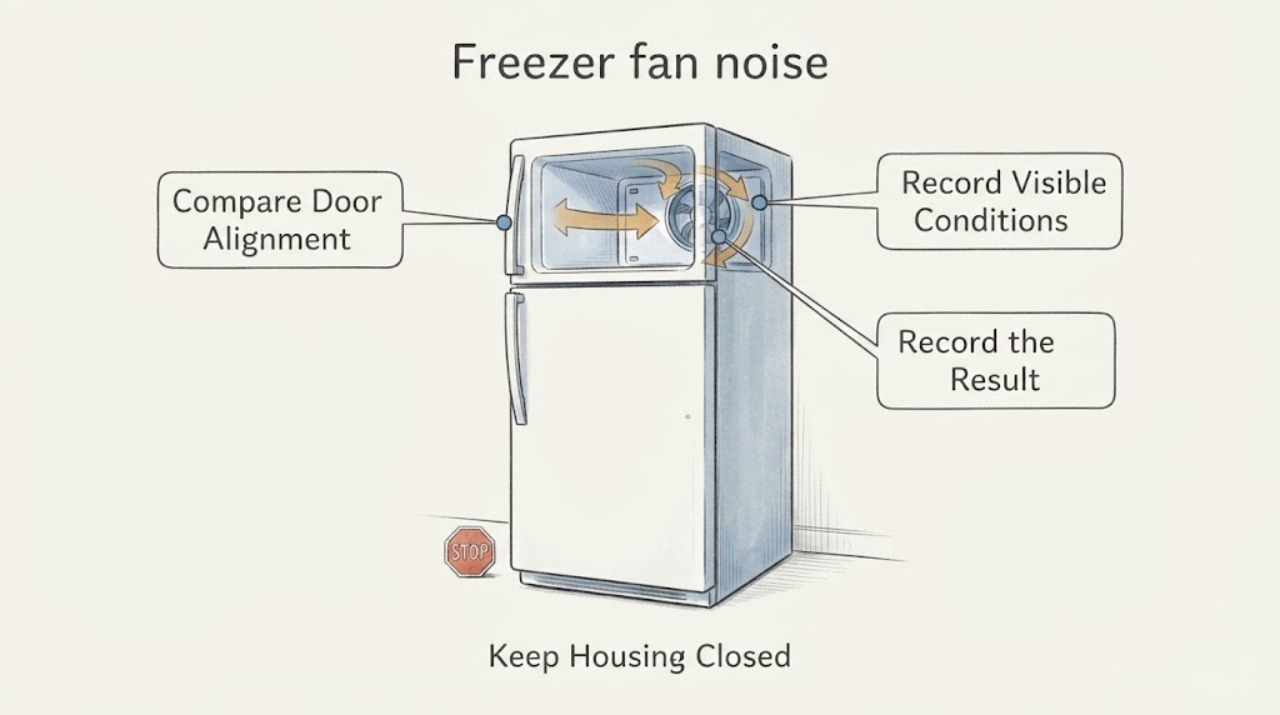
GE's parts-and-literature page identifies GWE19JSLNFSS as an 18.6 cu. ft. counter-depth French-door refrigerator and links its owner and installation documents. For a freezer noise, first record whether the sound changes with the freezer drawer/door, appears with frost, or follows a visible package touching the rear or air path. GE says a freezer sound like a fan blade hitting something is not normal, but that sound does not identify a fan motor. Keep the door closed as much as possible while checking whether the freezer is still holding temperature, and move vulnerable food to another working cold space if temperatures are rising. Do not put a hand or tool near a running fan, scrape or chip ice, use a hair dryer or heat gun, remove the freezer liner, or repeatedly run the appliance to reproduce the noise. If the noise is a persistent fan-strike sound, cooling is declining, frost returns, or there is water, odor, smoke, heat, or an electrical symptom, keep the refrigerator closed or off as appropriate and arrange qualified GE service.
Before you begin
Safety first
- Do not use a hair dryer, heat gun, knife, screwdriver, vacuum, or hot water to remove freezer ice. Do not remove the freezer liner or rear covers, touch a running fan, bypass a door switch, perform live electrical tests, or repeatedly reset a breaker. Isolate power only from a dry, safe position for an electrical or water hazard.
Work through in order
Diagnostic checks
Use only checks that match the exact appliance or system and its official guide.
-
Check 1
From outside, confirm the rating label reads GWE19JSLNFSS and record where the sound is loudest: inside the freezer drawer, at a door seal, under the cabinet, or near the rear. Note whether it is a steady airflow sound, a periodic click/gurgle, or a rhythmic scrape/strike. Do not open a rear cover or remove the freezer interior.
Expected result: The sound is clearly inside the freezer and resembles a blade strike; it changes when the freezer door/drawer is opened or closed; it is only a brief cooling/defrost sound; or the source cannot be localized.
Next step: Continue only with visible frost, door-seal, temperature, and package checks. If the sound is a persistent strike or cannot be safely distinguished from internal contact, keep panels closed and arrange GE refrigerator service.
Stop if: Do not touch a fan, insert a tool through a grille, pull out the refrigerator to reach the rear, or repeatedly cycle the appliance to make the sound recur.
Why this matters
Why: GE describes many normal cooling and defrost sounds, but specifically treats a freezer sound like a fan blade hitting something as abnormal. Location and timing narrow the safe next check but do not identify a fan motor, blade, ice buildup, or control as the cause.
-
Check 2
With the freezer stationary, inspect only the visible drawer/door seal and closure: look for a package preventing full closure, a gasket gap, a torn gasket, or an uneven drawer/door. Do not adjust hinges or remove the gasket. Close the freezer promptly after the observation.
Expected result: The door/drawer closes evenly and seals, or a package, gasket defect, misalignment, or obstruction is visible.
Next step: Remove only the package that visibly prevents closure and keep the seal path clear. For a torn gasket, uneven door, or recurring gap, stop trying to correct the freezer yourself and arrange model-specific service.
Stop if: Do not force the drawer, heat the gasket, apply unapproved lubricant, bend the door, or continue if the freezer cannot close and seal.
Why this matters
Why: GE says a door left ajar, a damaged gasket, poor alignment, or packages holding the door open can allow frost buildup. Frost can then interfere with the air path, but a visible seal issue does not prove that it caused the reported fan sound.
-
Check 3
Look through the open freezer only for loose packages or containers resting against the rear wall or visibly blocking an air opening. If the unit has a temperature display, record the freezer reading without changing settings repeatedly. Do not scrape, chip, vacuum, or probe frost and do not remove shelves or the interior liner to reach the fan.
Expected result: There is no frost; light frost is present near a package or door gap; ice is accumulating on the wall or air path; or the freezer temperature is rising or cannot be confirmed.
Next step: Move only a plainly contacting package and close the freezer. Do not attempt manual defrost with tools or heat. If frost remains, returns, blocks the air path, or the freezer is warming, keep food protected and arrange qualified GE service.
Stop if: Do not use a hair dryer, heat gun, knife, screwdriver, hot water, or any tool against ice; do not remove an evaporator cover or touch the fan.
Why this matters
Why: GE identifies packages against the rear wall, warm loads, frequent door openings, and poor sealing as frost contributors, and says ice on a frost-free freezer wall is not expected. Persistent ice or a rising temperature makes an internal airflow/defrost problem more likely, but it does not identify a fan motor or heater.
-
Check 4
Check the freezer temperature and food condition from outside the cabinet, then note whether the sound changes after a door opening or after the refrigerator has completed a defrost period. Keep doors closed while waiting; do not force a defrost, change wiring, or use the sound alone to choose a part.
Expected result: Temperature remains stable and the noise is brief or tied to a documented cooling/defrost event; temperature is rising while the noise persists; or the freezer has softened food, heavy frost, a leak, or a fan-strike sound.
Next step: For rising temperature or softened food, transfer perishable items to another working cold appliance and keep the doors closed. Arrange GE service for persistent noise, frost, cooling loss, or a leak; do not keep testing to obtain a clearer sound.
Stop if: Stop immediately for smoke, burning/electrical odor, sparks, abnormal heat, water near electrical parts, a hot or damaged cord/outlet, or a repeated breaker trip; isolate power only from a dry, safe position.
Why this matters
Why: Stable cooling and a short documented operating sound are more consistent with normal operation. A persistent freezer fan-like impact together with cooling loss or abnormal frost needs service, and food safety becomes more important than further noise testing.
-
Check 5
After the visible checks, do not remove any panel or run a prolonged observation. Record the model, exact sound description, location, timing, door/frost observations, temperature trend, and whether the noise changes with the freezer door or drawer. Give this sequence to the service provider rather than ordering a fan or motor from the sound.
Expected result: The fan-like sound remains, the source is hidden behind an interior panel, cooling is abnormal, or all visible checks are normal but the noise returns.
Next step: Keep the refrigerator operating only if cooling is stable and there is no hazard; otherwise keep it off and protect food. Arrange qualified GE service and request model-specific inspection before any component is selected.
Stop if: Do not open the freezer liner, touch a running fan, perform live electrical tests, bypass a door switch, or repeatedly reset a breaker.
Why this matters
Why: The remaining possibilities include an internal obstruction, airflow/defrost issue, fan assembly, control response, or another refrigerator fault. GE's public noise guidance routes an apparent freezer fan-blade impact to service rather than an owner-level component diagnosis.
Use your observations
Decision map
Find the observation that best matches what you see, then follow the next safe action.
-
PATH 01Next step
What you see
The freezer noise is a rhythmic scrape or impact that sounds like a fan blade hitting something, especially if it persists with the door closed.
Do this next
Keep the freezer interior closed and arrange qualified GE service. Do not remove the interior panel or touch the fan to confirm the source.
Why this path and its safety boundary
Why it matters: GE classifies this pattern as abnormal. Frost or a visible package may be involved, but the sound does not prove a failed fan motor or identify a safe part.
-
PATH 02Next step
What you see
Frost or ice is visible on the freezer wall/air path, the door or gasket does not seal, or a package is holding the door open or touching the rear wall.
Do this next
Remove only the contacting package, close the door, and leave the ice and panels alone. Do not use tools or heat to defrost; arrange service if frost persists, returns, or cooling changes.
Why this path and its safety boundary
Why it matters: A sealing, loading, or frost condition is more likely than a sound-only motor diagnosis. GE says ice accumulation is not expected in a frost-free freezer and directs service if the visible corrections do not resolve it.
-
PATH 03Next step
What you see
The freezer temperature is stable, the door seals, no frost or package contact is visible, and the noise is brief and tied to cooling or defrost rather than a blade strike.
Do this next
Monitor without opening panels. Arrange service if the sound becomes harsh, persistent, or is joined by frost, warming, leaks, or a control symptom.
Why this path and its safety boundary
Why it matters: The documented normal-sound explanations are more plausible, although an older or newly changing sound should not be declared normal from timing alone.
-
PATH 04Next step
What you see
The freezer warms, food begins to soften, the noise remains unexplained, or any smoke, odor, sparks, abnormal heat, water near electrics, or breaker event appears.
Do this next
Protect food in another working cold appliance and keep the refrigerator off when a hazard or unsafe temperature is present. Arrange qualified GE appliance service, plus qualified electrical help for an electrical hazard.
Why this path and its safety boundary
Why it matters: Cooling, electrical, water, or internal mechanical service is now more urgent than identifying the sound. The symptom does not establish a fan, compressor, control, or defrost component.
Helpful context
Understand the symptom
A freezer fan sound is a symptom, not a motor diagnosis
GE separates ordinary operating sounds from an apparent fan-blade impact. Refrigerant, defrost, and fan-speed changes can be normal, while a repeated freezer sound that resembles a blade hitting something is not. The safe decision is therefore to check the surrounding conditions—frost, door sealing, temperature, and visible package contact—without touching the fan or assuming that the fan motor is the failed part.
Keep the freezer cold while you observe
Open the freezer only long enough to read the temperature display if present and look at the visible drawer/door seal and packages. A frost-free freezer should not keep accumulating ice on its wall; GE says frequent or prolonged door openings, warm loads, packages against the rear wall, or packages holding the door open can contribute. If the freezer is warming or the noise continues, protect the food and leave internal panels closed for service.
When checks do not resolve it
Need a professional?
Arrange qualified GE refrigerator service for a persistent freezer fan-strike sound, recurring frost or ice, warming, softened food, a hidden obstruction, a damaged gasket or door that will not seal, or any noise that remains after the visible checks. Stop immediately for smoke, burning/electrical odor, sparks, abnormal heat, water near electrical parts, damaged power hardware, or repeated breaker trips.
Safety scope: Do not use a hair dryer, heat gun, knife, screwdriver, vacuum, or hot water to remove freezer ice. Do not remove the freezer liner or rear covers, touch a running fan, bypass a door switch, perform live electrical tests, or repeatedly reset a breaker. Isolate power only from a dry, safe position for an electrical or water hazard.
Have this ready
- Provide the complete model GWE19JSLNFSS, the sound location and description, whether it changes with the freezer door/drawer, frost and gasket observations, temperature trend, food condition, visible package contact, and any leak, odor, heat, power, or breaker symptom.
Common questions
FAQ
Does a freezer fan noise prove the fan motor has failed?
No. GE treats a blade-impact-like sound as abnormal, but the sound can be associated with an obstruction, frost, airflow condition, or another internal fault. Keep the fan and panels closed and arrange service rather than selecting a motor from sound alone.
Can I melt the freezer ice with a hair dryer or remove the fan cover?
No. Do not use tools or heat on the ice and do not remove the freezer liner. Check only visible door, gasket, package, frost, and temperature conditions; persistent ice or warming needs qualified service.
Read the exact guide
Official sources
- Refrigerator & Freezer - Ice on Freezer WallGE Appliances · Official GE support page opened for freezer-wall ice and electrical-safety boundary; it lists package/door causes, warns that wall ice is not expected in a frost-free unit, and routes persistent ice or a non-running fan to service.
- Model Search | GWE19JSLNFSSGE Appliances Parts · Exact GE model page opened for identity; it labels GWE19JSLNFSS as an 18.6 cu. ft. counter-depth French-door refrigerator and exposes links for the owner manual and installation instructions.
- Refrigerator - Frost in FreezerGE Appliances · Official GE freezer-frost guidance opened for visible door/gasket/leveling checks; it directs owners to the exact model manual for adjustments and service when the issue persists.
- Refrigerator - Normal Sounds and Noises MadeGE Appliances · Official GE support page opened to distinguish brief refrigerant, defrost, fan-speed, water-line, and icemaker sounds from an unexplained new or harsh freezer noise.
- Refrigerator - Unusual NoisesGE Appliances · Official GE refrigerator support page opened for symptom classification; it specifically states that a freezer sound like a fan blade hitting something is not normal and should receive service.
Community feedback
Share a repair observation
Share a plain-text repair observation. Accepted observations are published automatically; this page may take a moment to update.