
On this page
Start here
Quick answer
A GE refrigerator may have a condenser fan under or behind the unit, a freezer evaporator fan, or a model with a NeverClean or natural-draft condenser that has no owner-accessible condenser fan. Before calling it a failed fan, note where the sound or airflow is, whether cooling is normal, whether the freezer wall has ice, and whether the refrigerator may be in defrost. With power disconnected, keep exterior grilles and airflow clear only where the model manual permits; do not open the cabinet or test a fan circuit. A fan that remains stopped with poor cooling, ice buildup, or a new blade-rubbing sound needs service.
Before you begin
Safety first
- Disconnect power before any permitted exterior cleaning. Do not reach into a fan, remove internal panels, or perform live electrical tests.
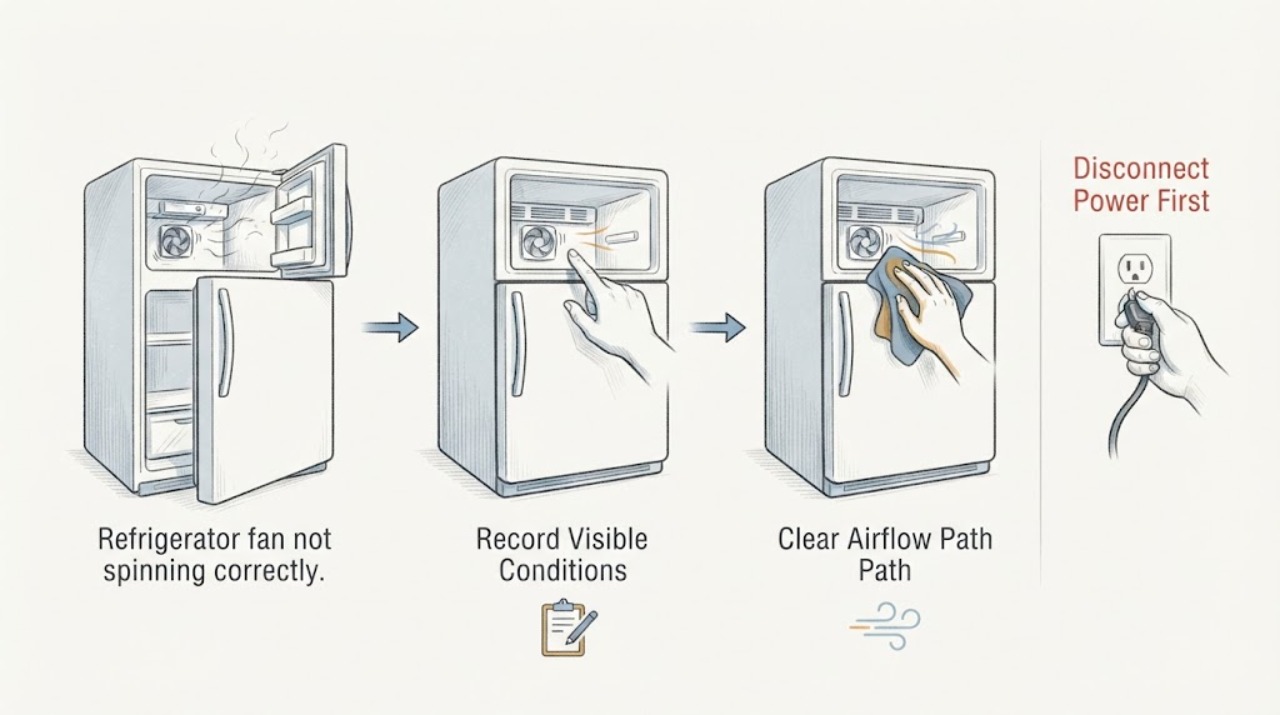
Work through in order
Diagnostic checks
Use only checks that match the exact appliance or system and its official guide.
-
Check 1
Record the exact GE model and identify where the observation occurs: under or behind the refrigerator, inside the freezer, or only as a change in sound or airflow.
Expected result: The noise or stopped airflow is localized to the freezer, the lower/rear condenser area, or cannot be localized.
Next step: Continue with the matching branch and exact owner manual.
Stop if: Do not name the part as a condenser or evaporator fan; use the model manual or service to identify it.
Why this matters
Why: GE uses different condenser designs and fan locations, and some models have no owner-accessible condenser fan; location is needed before a fan-specific conclusion.
-
Check 2
Check the food compartments and freezer temperature behavior, including whether the freezer rear wall has a new layer of ice or airflow is weak; do not remove an interior panel.
Expected result: The freezer wall is iced, cooling is worsening, or temperatures remain normal.
Next step: If ice is present or the freezer fan appears stopped, stop repeated testing and arrange service; do not chip ice or reach into the fan.
Stop if: Continue with normal-operation and external airflow checks.
Why this matters
Why: GE says ice on a freezer wall is not expected in a frost-free unit and lists a non-running freezer fan as a possible service condition; normal cooling does not prove a fan is defective.
-
Check 3
Consider whether the refrigerator has just had doors opened, a temperature change, or a defrost cycle; listen only from outside for normal cycling rather than trying to hold a fan on.
Expected result: Fan speed changes with door openings or the refrigerator is temporarily quiet during defrost, then resumes cooling normally.
Next step: Monitor temperatures and sound over the next normal cycle; do not replace a fan based on a temporary pause.
Stop if: Continue to the external condenser and airflow check.
Why this matters
Why: GE describes changing fan speed as normal response to temperature and door openings and notes that defrost temporarily stops normal operation.
-
Check 4
With power disconnected, inspect only the visible base grille, rear clearance, and floor area for dust, blocked airflow, or an obvious external obstruction; determine from the manual whether the model has serviceable coils or a NeverClean condenser.
Expected result: The model has accessible condenser coils with heavy dust, or it has a NeverClean/natural-draft design or no visible obstruction.
Next step: Clean only the accessible exterior coil/airflow area using the model's manual and keep the appliance unplugged during maintenance.
Stop if: Do not remove rear covers or enter the machine compartment to search for the fan; move to service if the symptom persists.
Why this matters
Why: GE says accessible coils may need cleaning, but NeverClean condensers normally do not; a natural-draft design has no condenser fan motor under the unit.
-
Check 5
Compare the symptom with GE's abnormal-noise guidance: a new freezer fan-blade rubbing sound or a persistent stopped fan with cooling trouble is different from ordinary hums, clicks, or fan-speed changes.
Expected result: The sound is newly scraping/rubbing, cooling is poor, or the fan remains stopped after normal cycling.
Next step: Stop repeated operation if cooling or safety is affected and arrange qualified GE appliance service with the model and location of the symptom.
Stop if: If cooling and temperatures are normal, continue monitoring and consult the manual before any maintenance.
Why this matters
Why: GE says a freezer fan blade hitting something is not normal and requires service; a new or unresolved fan concern cannot be assigned to a specific motor or blade without model-specific diagnosis.
Use your observations
Decision map
Find the observation that best matches what you see, then follow the next safe action.
-
PATH 01Next step
What you see
The observation is inside the freezer and the freezer wall has frost or ice
Do this next
Do not reach through ice or remove panels; protect food and arrange service if the fan remains stopped or cooling is affected.
Why this path and its safety boundary
Why it matters: GE treats freezer-wall ice as abnormal in a frost-free unit and lists a non-running freezer fan among the possible conditions.
-
PATH 02Next step
What you see
The observation is under the refrigerator but the model has a natural-draft or NeverClean condenser
Do this next
Verify the model in the owner manual and keep the exterior airflow area clear; do not install a fan or diagnose a missing one.
Why this path and its safety boundary
Why it matters: This design may not have the condenser fan the user expects, or it does not require routine coil cleaning.
-
PATH 03Next step
What you see
The model has accessible condenser coils and external dust is restricting airflow
Do this next
Clean only the visible coil/airflow area as GE's model guidance permits, then restore power and monitor cooling; do not open sealed compartments.
Why this path and its safety boundary
Why it matters: GE supports unplugged, model-appropriate coil cleaning for accessible-coil designs.
-
PATH 04Next step
What you see
A new scraping sound, poor cooling, or persistent non-running fan remains after normal-cycle and exterior checks
Do this next
Stop repeated testing and arrange qualified GE service; do not open the cabinet or perform live electrical measurements.
Why this path and its safety boundary
Why it matters: The public checks do not establish which fan, motor, control, or obstruction is responsible.
When checks do not resolve it
Need a professional?
Use qualified service for persistent stopped or noisy fan behavior, frost/ice with poor cooling, or any internal diagnosis.
Safety scope: Disconnect power before any permitted exterior cleaning. Do not reach into a fan, remove internal panels, or perform live electrical tests.
Common questions
FAQ
Does every GE refrigerator have a condenser fan under it?
No. GE describes forced-air, natural-draft, and NeverClean condenser designs. Natural-draft models do not have a fan motor under the refrigerator, and many newer models use a NeverClean condenser.
Can a GE refrigerator fan stop temporarily and still be normal?
Possibly. GE says fan speed can change with temperature and door openings, and a defrost cycle temporarily changes normal operation. A persistent stop with poor cooling, ice, or a new rubbing sound needs service.
Should I remove the back cover to see whether the fan is stuck?
Not without the exact model procedure. The article limits the check to visible exterior airflow and permitted coil cleaning; internal fan access and electrical diagnosis belong to qualified service.
Read the exact guide
Official sources
- Refrigerator - Cleaning Condenser CoilsGE Appliances · GE refrigerator condenser cleaning where the model permits owner access
- Refrigerator - Normal Sounds and Noises MadeGE Appliances · GE refrigerator normal fan-speed and operating sounds
- Refrigerator & Freezer - Ice on Freezer WallGE Appliances · GE freezer-wall ice and fan-not-running service condition
- Refrigerator - NeverClean CondenserGE Appliances · GE refrigerator NeverClean condenser design and external floor cleaning
- Refrigerator - Condenser TypesGE Appliances · GE refrigerator condenser and fan design types
- Refrigerator - Unusual NoisesGE Appliances · GE refrigerator sound observations and service boundary
- Refrigerator - Not RunningGE Appliances · GE refrigerator power, demo-mode, and defrost-cycle observations
Community feedback
Share a repair observation
Share a plain-text repair observation. Accepted observations are published automatically; this page may take a moment to update.