
On this page
Start here
Quick answer
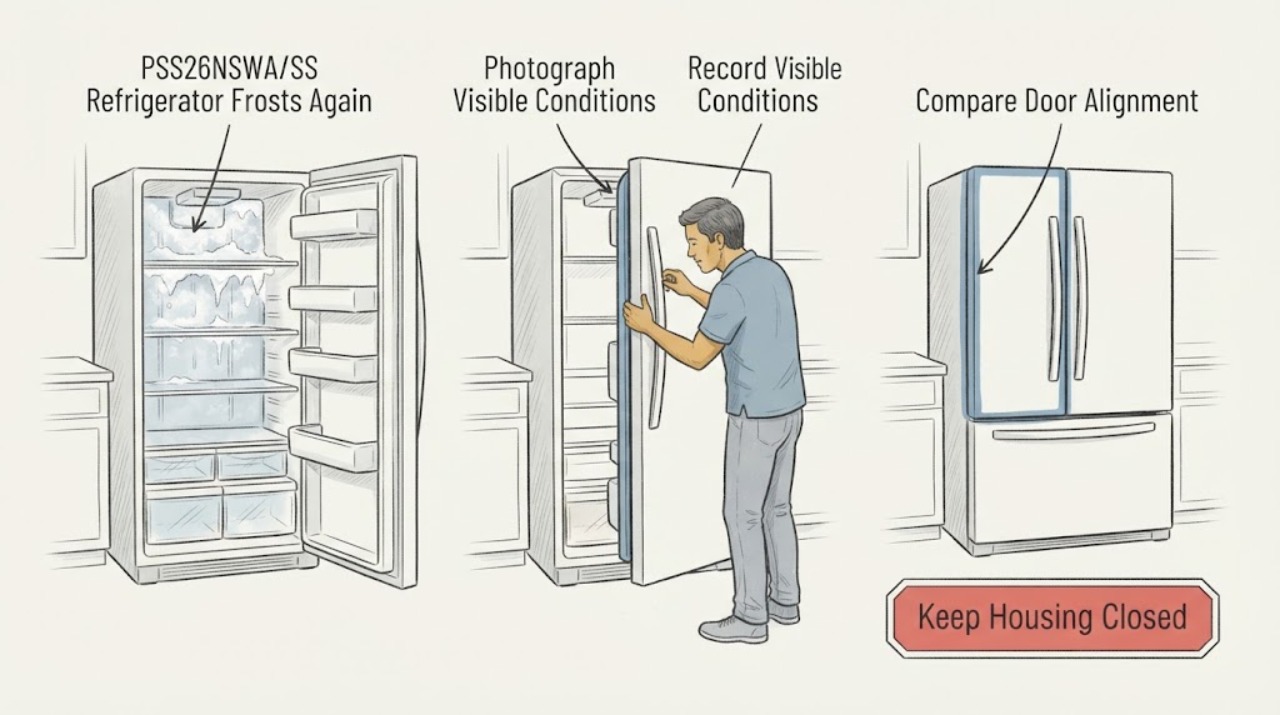
Recurring frost together with poor cooling on the GE PSS26NSWA/SS report does not prove that the defrost heater has failed again. First confirm the full rating-plate model: the opened GE product and support pages identify the closely related PSS26NSWSS, while the assigned label is written as PSS26NSWA/SS, so the exact suffix and manual must be checked before transferring a procedure. Photograph where the frost forms, record both compartment temperatures, and check the door seal, packages, and accessible air paths without removing a panel. If a sheet of frost returns on the same freezer wall, both compartments remain warm, the fan is obstructed, or the door cannot seal, protect the food and arrange qualified refrigerator service rather than repeatedly replacing a heater or melting ice with a heat source.
Work through in order
Diagnostic checks
Use only checks that match the exact appliance or system and its official guide.
-
Check 1
Without scraping the ice or moving the refrigerator, photograph the frost before changing anything. Note whether it is on packages, around the door edge or gasket, on the freezer rear wall, across the ceiling, around a vent, or in the fresh-food compartment. Record the freezer and refrigerator temperatures with suitable appliance thermometers if available, and note whether either door or drawer is blocked.
Expected result: Frost is limited to packages or the door edge, forms as a concentrated sheet on the same rear wall, is widespread, or is present in the fresh-food compartment; one or both compartments are also warm.
Next step: Keep the doors closed, protect perishable food, and use the frost-temperature pattern in the branches below. If ice blocks a vent, fan, drawer, or door, stop normal use and arrange service.
Stop if: Do not chip ice, force a drawer, remove an interior panel, or touch a fan blade.
Why this matters
Why: Package or edge frost favors warm humid air entry. A recurring rear-wall sheet combined with poor temperatures is a different branch from normal surface frost and is not enough evidence to call the heater the failed part without service testing.
-
Check 2
Read the complete rating plate inside the refrigerator compartment and record the model, serial number, and any other product identifiers. Compare it with the assigned PSS26NSWA/SS wording and use only a GE manual or support page that matches the full model and market; do not rely on a parts-site model list.
Expected result: The plate reads PSS26NSWASS/PSS26NSWA/SS, reads the different PSS26NSWSS, or is incomplete or unreadable.
Next step: Give a clear label photo to qualified service and ask for the exact owner or service documentation before ordering or replacing a defrost component. Do not move a large refrigerator alone to find another label.
Stop if: Do not remove doors, covers, trim, or wiring to identify the model.
Why this matters
Why: The opened GE product and support pages are for PSS26NSWSS, whereas the assigned string includes an A variant. That difference is a documentation boundary, not proof of compatibility or a reason to transfer a heater diagnosis.
-
Check 3
With both doors closed, check from outside that no package, bin, ice, or shipping material prevents the doors from meeting the frame. Inspect the visible gasket for a fold, tear, gap, or section that does not touch evenly. Move only an accessible package obstruction and do not bend the gasket or adjust hinges.
Expected result: A package holds a door open, the gasket is folded or damaged, the door is visibly misaligned, or both doors close evenly with no visible obstruction.
Next step: Correct only an accessible package obstruction. For a torn gasket, misalignment, or persistent gap, keep the refrigerator out of normal use as needed and arrange model-specific service.
Stop if: Do not use heat on the gasket, force the door, remove a gasket retainer, or alter hinges.
Why this matters
Why: An incomplete seal or warm-air path can repeatedly create frost without proving a heater failure. An even closure shifts attention toward load placement, airflow, the automatic defrost system, or another appliance-side issue if frost and warm temperatures persist.
-
Check 4
Move only accessible food or containers away from the freezer rear wall and documented air passages, keeping the load from touching the door or holding it open. Listen briefly for normal internal air circulation only as the model permits; do not press a door switch, remove a fan cover, or reach toward moving parts.
Expected result: A package blocks an air passage, the fan is absent or unusually noisy, ice contacts the fan, or the accessible load and airflow appear normal.
Next step: Remove only the package obstruction and monitor the documented temperatures without repeatedly opening the doors. If the fan is obstructed or frost returns with normal loading, arrange qualified service.
Stop if: Do not bypass a door switch, touch a fan, remove an interior cover, or operate with ice contacting a fan.
Why this matters
Why: A blocked path can create local frost and uneven temperatures. A missing or noisy fan, or frost that returns despite clear accessible airflow, makes an appliance-side diagnosis more likely but does not identify a fan, heater, sensor, or control part.
-
Check 5
Do not force a manual defrost with heat or tools. If the exact GE manual provides a safe owner defrost or cleaning procedure, follow only that procedure with power disconnected before cleaning; otherwise leave the iced refrigerator for qualified service. After an approved correction, record whether both compartments recover and whether frost returns in the same location.
Expected result: The appliance recovers and frost does not return after correcting a documented door or load issue, or temperatures stay poor and frost returns on the same wall or around the same airflow path.
Next step: Provide service with the frost photographs, both temperature records, the exact model identity, door and airflow results, and the prior heater or defrost repair history. Do not repeat forced defrosts or buy a part based on the frost alone.
Stop if: Never use a hair dryer, heat gun, torch, boiling water, knife, pick, or other heat or sharp tool, and do not remove interior panels.
Why this matters
Why: No recurrence after a verified warm-air correction supports a door, loading, or humidity cause. Recurrence in the same frost-free location with poor cooling is a system-level service branch; it cannot be reduced to another heater replacement from these observations alone.
Use your observations
Decision map
Find the observation that best matches what you see, then follow the next safe action.
-
PATH 01Next step
What you see
The exact model is confirmed, frost returns as a sheet on the same freezer wall, and the freezer and fresh-food temperatures remain warm after accessible door, load, and airflow checks.
Do this next
Keep the doors closed, protect food, and arrange qualified refrigerator diagnosis with the prior heater work, frost photos, temperature trend, and exact model/serial information. Do not authorize another heater solely from this pattern.
Why this path and its safety boundary
Why it matters: This is a recurring appliance-side pattern rather than ordinary frost on a package. A defrost, airflow, temperature-control, or sealed-system problem is possible, but the frost pattern does not prove the defrost heater is the failed part.
-
PATH 02Next step
What you see
Frost is limited to packages or the door edge, a package or gasket gap is found, and compartment temperatures remain normal.
Do this next
Remove the accessible obstruction, close the doors fully, reduce unnecessary openings, and monitor one normal cooling period. Call service if the seal remains damaged or frost spreads to the rear wall.
Why this path and its safety boundary
Why it matters: Warm humid air entry or a loading/closure event is more likely than a confirmed automatic-defrost failure. The GE manual lists an open door or frequent/long openings as causes of frost on frozen food.
-
PATH 03Next step
What you see
Packages block the air path, the freezer fan is absent or unusually noisy, or ice contacts the fan, while frost and temperature problems continue.
Do this next
Move only accessible packages. If the fan is obstructed or abnormal, leave the refrigerator out of normal use as needed and arrange qualified service; do not open the fan housing.
Why this path and its safety boundary
Why it matters: Restricted circulation or a fan-side fault is more likely, but these observations cannot distinguish a fan, defrost, sensor, or control part without model-specific service testing.
-
PATH 04Next step
What you see
The rating plate cannot be read or confirms a model other than the GE PSS26NSWSS documentation opened for this research, or frost is in the fresh-food compartment or blocks a door or vent.
Do this next
Protect perishable food, keep doors closed, photograph the condition, and ask qualified GE appliance service to identify the exact model and diagnose the defrost and cooling system. Do not remove panels or apply heat.
Why this path and its safety boundary
Why it matters: The exact procedure and component coverage are unverified, and the condition is interfering with food storage or airflow. A neighboring GE suffix cannot safely supply the missing diagnosis.
-
PATH 05Next step
What you see
There is smoke, a burning smell, melted plastic, damaged wiring or cord, water near electrical parts, an unusually hot cabinet, or repeated breaker operation.
Do this next
Stop using the refrigerator and keep clear. Arrange qualified appliance service, and use a qualified electrician for an outlet or building-wiring concern; follow local emergency guidance for smoke or fire.
Why this path and its safety boundary
Why it matters: The refrigerator has crossed an electrical or thermal safety boundary; frost and temperature checks are no longer appropriate owner troubleshooting.
Helpful context
Understand the symptom
There is an identity detail to resolve before using a manual. The task label is PSS26NSWA/SS, represented as PSS26NSWASS, but the opened GE product and support pages identify PSS26NSWSS. They are close enough to explain why the rating plate matters, not close enough to assume every part or procedure is interchangeable. Photograph the complete model and serial label inside the refrigerator compartment and use the matching GE document.
The GE manual treats frost on frozen food after a door is left open or opened frequently as a possible warm-air condition. It also describes a few degrees of freezer-air rise during a defrost cycle and defrost-related sizzling, popping, or an orange glow as normal on applicable models. Those observations do not show that the defrost heater is healthy, but they do show why a sound or glow alone is not a reason to replace it again.
The new decision in this repeat-failure report is whether the frost is a warm-air event or a recurring appliance-side pattern that is also preventing temperature recovery. A recurring sheet on the same freezer wall, warm readings in both sections, an obstructed fan, or a door that cannot seal should be documented for service. Do not use a hair dryer, heat gun, boiling water, knife, or panel removal to force a diagnosis.
When checks do not resolve it
Need a professional?
Arrange qualified refrigerator service when frost returns on the same freezer wall, either compartment stays warm, the freezer fan is abnormal or obstructed, the door or gasket cannot seal, frost enters the fresh-food compartment, the exact model cannot be confirmed, or the prior defrost-heater repair did not resolve the condition. Stop immediately for smoke, burning odor, melted plastic, damaged cord or wiring, water near electrical parts, an unusually hot cabinet, or repeated breaker operation; use a qualified electrician for a supply problem. Do not use heat or sharp tools to remove frost, remove interior panels, bypass a door switch, or select a defrost heater from the frost pattern alone.
Common questions
FAQ
Does frost coming back mean the defrost heater is bad again?
No. Frost location, door sealing, airflow, and actual compartment temperatures must be separated first. The GE manual lists warm-air and door-opening causes for frost and describes some defrost sounds or an orange glow as normal on applicable models. A recurring rear-wall sheet with poor cooling needs system diagnosis, not an automatic heater order.
Can I melt the ice with a hair dryer or heat gun?
No. Do not apply a hair dryer, heat gun, torch, boiling water, or another heat source to the liner, wiring, or sealed cooling parts. Use only an exact GE owner procedure if one is documented for the confirmed model; otherwise leave the iced refrigerator for qualified service.
Why does the model matter when the refrigerator looks like a GE side-by-side?
The opened GE product and support pages identify PSS26NSWSS, while the reported label is PSS26NSWA/SS/PSS26NSWASS. Similar names do not prove the same manual, wiring, or parts. Give service a clear rating-plate photo and use documentation that matches the complete model and market.
Read the exact guide
Official sources
- User Manual & Care for PSS26NSWSS | GE AppliancesGE Appliances · GE official owner-support and manual route for PSS26NSWSS; use only after confirming whether the assigned PSS26NSWA/SS (PSS26NSWASS) rating label is the same documented platform.
- GE Profile™ 25.5 Cu. Ft. Stainless Side-by-Side RefrigeratorGE Appliances · GE official product identity and feature page for PSS26NSWSS; used as a bounded model-family reference while the assigned PSS26NSWA/SS (PSS26NSWASS) rating-plate suffix remains to be confirmed.
- Owner's Manual and InstallationGE Appliances · This opened manual is linked from GE's PSS26NSWSS product page and covers a model family rather than explicitly printing the assigned PSS26NSWASS string. It supports frost, temperature, door, airflow, and safety observations, not an exact repeat-heater failure diagnosis.
Community feedback
Share a repair observation
Share a plain-text repair observation. Accepted observations are published automatically; this page may take a moment to update.