
On this page
Start here
Quick answer
Frost in a GE refrigerator freezer is often caused by warm humid air entering through frequent openings, a package or shelf preventing the door or drawer from sealing, or a warm or uncovered food load. Start by identifying where the frost is forming, clearing visible obstructions, checking the gasket and door alignment, and following the exact model manual for the temperature control and any defrost procedure. GE says ice on the wall of a frost-free model is not expected; if the frost remains after the visible causes are corrected, or the freezer fan is not running, service is required. Do not pry at ice, apply a heat source, remove an evaporator cover, or diagnose a defrost heater, thermostat, fan, or sealed system from frost alone.
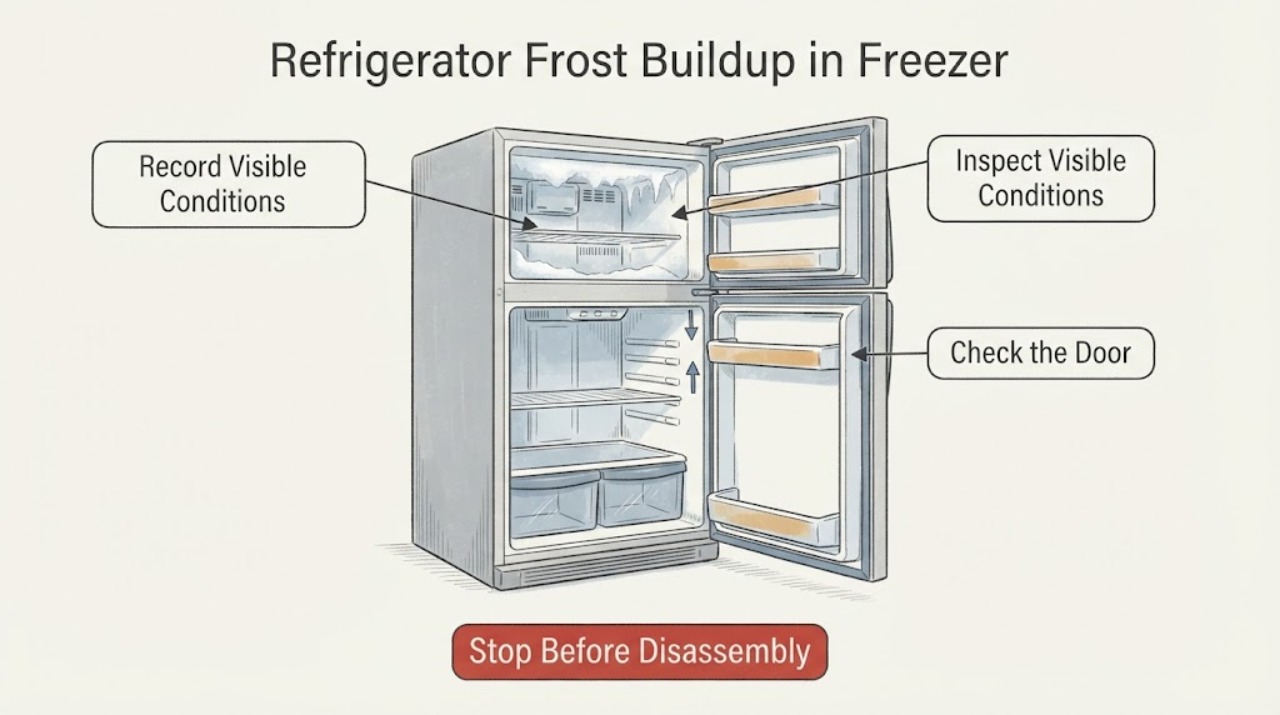
Work through in order
Diagnostic checks
Use only checks that match the exact appliance or system and its official guide.
-
Check 1
Record the model number and identify exactly where frost is forming: on the freezer wall, near the door or drawer opening, on packages, around the rear wall, or in a manual-defrost compartment.
Expected result: Frost is localized at the door/opening or packages, covers a wall in a frost-free model, or the refrigerator’s defrost style cannot be identified.
Next step: Use the exact owner manual for the model and proceed with the matching external branch. If the model or defrost style is unknown, do not start a model-specific defrost procedure.
Why this matters
Why: GE separates normal frost on food packages from frost caused by warm air entering at the door, and says wall ice is not expected in a frost-free model. The model determines which defrost instructions apply.
-
Check 2
Check the freezer door or drawer and the visible gasket without removing panels: make sure no package, shelf, basket, or bin prevents full closure, and look for a torn gasket, an uneven gap, or a door that does not sit squarely.
Expected result: A package or shelf blocks closure, the gasket is torn or split, the gasket does not contact evenly, or the door closes and seals normally.
Next step: Reposition only the visible obstruction and use the exact installation instructions for leveling or alignment. Do not force, heat, glue, or replace the gasket without model-specific instructions; persistent frost needs service.
Why this matters
Why: GE identifies incomplete closure, damaged gaskets, incorrect shelf/basket placement, and door alignment as direct frost checks. A normal-looking seal does not prove the defrost system is working.
-
Check 3
Review recent use for frequent door openings, high humidity, warm food, uncovered food, or packages pressed against the freezer rear wall, and keep the door opening and load conditions normal while observing the frost.
Expected result: One of these moisture or load conditions preceded the frost, or the frost continues despite normal loading and limited openings.
Next step: Correct the visible loading or usage condition and allow the freezer to stabilize. If heavy frost persists, do not keep scraping it away; use the exact manual or arrange service.
Why this matters
Why: GE says warm humid air, warm or uncovered food, high humidity, and packages against the rear wall can create temporary frost or ice. Continued heavy frost after those causes are corrected is outside the simple load explanation.
-
Check 4
Check the temperature control and door alignment only as described by the exact owner manual; if the model is frost-free, do not remove the evaporator cover or attempt to reach the defrost heater or fan.
Expected result: The control is set outside the model’s recommended range, the door needs model-authorized alignment, or no model-authorized external correction is found.
Next step: Apply only the manual’s external adjustment. If the freezer fan is not running, or the frost remains on a frost-free wall, keep the appliance in service-safe condition and schedule qualified service.
Why this matters
Why: GE directs owners to the owner manual for temperature adjustment, door adjustment, leveling, and maintenance. Frost alone cannot distinguish a door seal issue from an internal defrost or airflow issue.
-
Check 5
If cleaning or maintenance is needed, isolate power from a dry, safe position as directed by the exact manual and do not use sharp tools, heat, or electrical devices to melt ice. Record the model, frost location, and whether it returned after the visible corrections.
Expected result: The frost clears under the model-approved procedure and does not return, or it returns, remains behind a panel, or the fan is not running.
Next step: For recurring, hidden, or heavy frost, stop user troubleshooting and arrange qualified GE service. Do not replace a heater, thermostat, fan, sensor, or control based on the frost pattern alone.
Why this matters
Why: GE’s frost-wall guidance directs service when the external causes do not resolve the buildup or the freezer fan is not running. Recurrent or hidden frost has not been narrowed to a particular internal part.
Use your observations
Decision map
Find the observation that best matches what you see, then follow the next safe action.
-
PATH 01Next step
What you see
Frost is concentrated around the freezer opening, and a package, shelf, basket, or gasket is preventing the door or drawer from sealing.
Do this next
Clear only the visible obstruction and confirm normal gasket contact or model-authorized alignment; observe whether new frost stops over the next few days.
Why this path and its safety boundary
Why it matters: GE links warm humid air entering through incomplete closure with frost and ice at the opening.
-
PATH 02Next step
What you see
Frost is on food packages or followed frequent openings, high humidity, or warm uncovered food, while the door still seals.
Do this next
Improve package sealing and loading, reduce unnecessary openings, and monitor. Escalate if heavy frost continues or cooling is affected.
Why this path and its safety boundary
Why it matters: GE describes these as common moisture sources and says frost on packages can be a normal result of moisture freezing.
-
PATH 03Next step
What you see
A frost-free freezer has persistent ice on its wall after closure and loading checks are corrected.
Do this next
Keep the unit from further risky disassembly and arrange qualified service. Do not remove the evaporator cover or infer which defrost component failed.
Why this path and its safety boundary
Why it matters: GE says wall ice is not expected in a frost-free refrigerator and lists a non-running freezer fan or unresolved causes as service conditions.
-
PATH 04Next step
What you see
The exact manual identifies a manual- or cycle-defrost refrigerator, or the frost is a known normal feature of that design.
Do this next
Follow only that model’s manual, with power isolated as instructed. Do not transfer an automatic-defrost procedure or use sharp tools/heat.
Why this path and its safety boundary
Why it matters: GE says manual- or cycle-defrost refrigerators can normally accumulate frost and require the owner manual’s defrost instructions.
-
PATH 05Next step
What you see
Frost returns after visible causes are corrected, remains heavy or hidden, or the freezer fan is not running.
Do this next
Record the model and frost history and arrange qualified service. Keep the appliance safe and do not continue scraping, probing, or replacing parts.
Why this path and its safety boundary
Why it matters: GE directs these conditions to technician service; the frost pattern does not prove a heater, thermostat, fan, sensor, or sealed-system failure.
Helpful context
Understand the symptom
Find the air-leak or load condition before assuming a failed part
Freezer frost is moisture that has frozen, and its position matters. Frost around the door or drawer points first to closure, gasket, humidity, or a package obstruction; frost on a wall of a frost-free unit that persists after those checks needs service. Do not use tools or heat to attack the ice.
Automatic defrost is model-dependent
GE says full-sized frost-free refrigerators use automatic defrost, while manual- or cycle-defrost appliances follow a different owner-manual process. Because the task has no model, use the model and serial tag to select the correct manual before defrosting or cleaning.
When checks do not resolve it
Need a professional?
Arrange qualified service when frost continues after door, gasket, loading, humidity, and model-authorized checks; when ice is on the wall of a frost-free model; when the freezer fan is not running; or when the buildup is behind an inaccessible panel. Unplug only from a dry, safe position as directed by the manual. Do not chip ice, apply heat, use electrical devices to melt frost, remove evaporator panels, or replace defrost/cooling parts from frost alone.
Have this ready
- exact model and serial information
- frost location and thickness/extent
- whether the freezer is frost-free or manual-defrost
- door, gasket, shelf, and package observations
- whether the frost returned after correcting visible causes
Common questions
FAQ
Is frost on food packages always a refrigerator failure?
No. GE says frost or ice crystals on packages can result from moisture in the food or warm humid air entering when the freezer is opened. Frost on a frost-free freezer wall or heavy recurring frost is a different service concern.
Can I scrape the freezer wall or use heat to melt the frost?
Do not chip, pry, or apply an unapproved heat source. Use the exact owner manual for the refrigerator’s defrost design; if frost is heavy, hidden, or recurring, use qualified service rather than reaching internal components.
What does repeated frost on a GE frost-free freezer wall mean?
GE says wall ice is not expected in a frost-free model. Check visible door closure, gasket, shelves, baskets, bins, warm food, humidity, and rear-wall loading; if buildup persists or the freezer fan is not running, service is required.
Read the exact guide
Official sources
- Refrigerator & Freezer - Ice on Freezer WallGE Appliances · Official GE support article for ice accumulating on a freezer wall; used for frost-free expectation, humidity/load/closure causes, fan boundary, service recommendation, and power-isolation safety before maintenance.
- Refrigerator - Frost in FreezerGE Appliances · Official GE support article for frost buildup in a refrigerator freezer; used for temperature, door closure, gasket, alignment, leveling, and service checks. Exact model-specific instructions remain in the owner manual.
- Refrigerator - Automatic Defrost SystemGE Appliances · Official GE support article for automatic defrost operation; used to explain model-dependent automatic defrost and service boundary for heavy frost.
- Refrigerator - Frost or Ice Crystals on Food in FreezerGE Appliances · Official GE support article for frost on packages, walls, shelves, baskets, and door/drawer openings; used for normal package frost, warm-air entry, load placement, and service boundary.
Community feedback
Share a repair observation
Share a plain-text repair observation. Accepted observations are published automatically; this page may take a moment to update.