
On this page
Start here
Quick answer
Some frost can return on the evaporator as a frost-free refrigerator resumes cooling; GE explains that frost forms during normal cooling and is periodically melted by automatic defrost. On the GE PYE22PSKBSS, the first question is therefore not whether any frost exists, but whether the refrigerator is cooling normally and whether the frost is light and distributed rather than a heavy sheet, one-sided concentration, or ice that blocks airflow. Do not judge the replacement immediately during or just after defrost, and do not assume the repair caused the pattern. Photograph the pattern from a safe, de-energized position if the cover is already open, keep hands and tools away from the coil and wiring, and arrange qualified service if frost returns heavily, appears only on one area, contacts the fan, or the refrigerator cannot hold temperature.
Before you begin
Safety first
- Do not remove an energized panel, bypass a door switch, touch the fan, heater, wiring, or refrigerant tubing, scrape or chip frost, use improvised heat, or puncture the sealed system. Disconnect power before any model-permitted external cleaning and keep the appliance out of service if ice blocks airflow or food temperatures are unsafe.
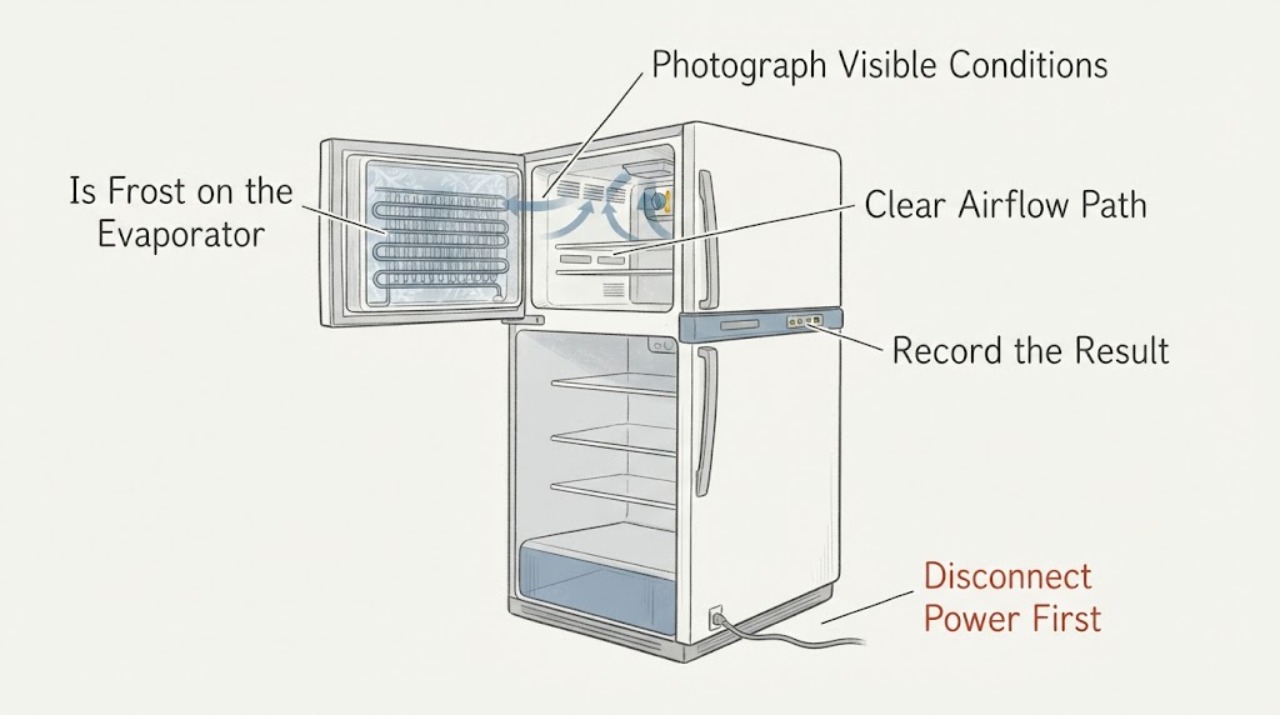
Work through in order
Diagnostic checks
Use only checks that match the exact appliance or system and its official guide.
-
Check 1
Record the complete PYE22PSKBSS model and serial information, when the fan was replaced, what was defrosted, whether the refrigerator was unplugged, and where the frost is visible. Photograph the pattern before removing anything. If an evaporator cover is already open, disconnect power from a safe dry position before looking; if it is closed, do not remove it just to inspect the coil.
Expected result: The frost is only a light distributed coating, a thick sheet, concentrated on one section, around a return-air path, or not actually on the evaporator at all; the refrigerator is cold normally or is warming.
Next step: Use the pattern branches below. Keep the refrigerator closed and protect food if temperatures are rising. Do not touch the coil, heater, fan, harness, or refrigerant tubing to improve the photograph.
Stop if: Do not open an energized panel, bypass a door switch, or use a sharp tool, heat source, or probe on the evaporator or tubing.
Why this matters
Why: A light returning coating can be consistent with the normal cooling side of an automatic-defrost cycle, while a heavy or one-sided pattern is a service clue. A photo taken after the intervention preserves evidence without turning a pattern into an unsupported diagnosis.
-
Check 2
Allow the refrigerator to return to normal cooling after the defrost rather than judging the coil while the defrost heater is active or immediately after it ends. From outside the appliance, note whether frozen food remains hard, whether the cabinet reaches its normal settings, and whether the evaporator-fan sound or airflow returns during a normal cooling period.
Expected result: The appliance is still recovering from defrost but holds temperature; it cools normally with a light frost return; or it remains warm, has no expected airflow, or develops a heavy ice layer before temperature stabilizes.
Next step: Do not repeatedly force defrost cycles or change settings to chase a photograph. If cooling or airflow does not return, stop and arrange service with the repair timeline and photographs.
Why this matters
Why: GE says the compressor and fans are off during defrost, and that the defrost process melts coil frost. Absence of fan sound during that interval is not proof of a bad replacement. Persistent warming, missing airflow during cooling, or heavy recurrence is different and needs diagnosis.
-
Check 3
Check the accessible causes of warm humid air and blocked circulation without moving the refrigerator or removing panels: confirm the French doors and freezer drawer close fully, no package holds a seal open, the gasket meets the frame evenly, and food does not block the documented air path. Do not use a generic GE adjustment procedure in place of the PYE22PSKBSS instructions.
Expected result: A package or drawer is preventing closure, the gasket is torn or uneven, the unit is visibly misaligned, a vent is blocked, or the doors and airflow path appear normal.
Next step: Remove only an accessible obstruction and close the doors normally. Arrange model-specific service for a torn gasket, damaged frame, persistent alignment problem, or frost that returns with a clear seal and airflow path.
Stop if: Do not force hinges, bend the door, remove a gasket retainer, or reach behind a fan cover.
Why this matters
Why: GE lists frequent or incomplete door closure, damaged gaskets, alignment, and leveling as frost contributors. If these external causes are absent, a recurring heavy pattern is less likely to be a simple loading event, but it still does not identify a particular replaced component.
-
Check 4
Compare the post-repair pattern with the time since the defrost and the location of the frost. If the unit is accessible only with a cover removed, leave the power disconnected and make observations without touching components; otherwise use only external temperature, door-seal, and airflow observations. Note whether frost returns evenly, remains on one side, contacts the fan, or blocks a vent.
Expected result: The pattern remains light and distributed while temperatures are normal; it becomes a thick layer or contacts the fan; it returns mainly on one wall; or there is little/no frost and the refrigerator is warm.
Next step: For a normal light pattern, monitor without repeated intervention. For a heavy, one-sided, obstructive, or warm condition, leave the appliance in a safe state and arrange qualified GE or refrigerator service rather than replacing another part by appearance.
Stop if: Do not scrape, chip, melt with a heat gun or hair dryer, short a fan or door switch, or probe live wiring.
Why this matters
Why: Light distributed frost with normal cooling is compatible with frost forming between defrost cycles. A heavy or one-sided pattern, ice contacting the fan, or no cooling is not a normal post-repair confirmation and can involve airflow, defrost, temperature control, wiring, component fit, or sealed-system work; the observation cannot choose among them.
-
Check 5
Prepare the service handoff if the abnormal pattern returns: provide the exact model and serial information, frost photographs before and after defrost, the date and scope of the fan replacement, the fan part or revision, whether any connector or harness was disturbed, cabinet temperatures, and whether the fan was observed during cooling or only during defrost.
Expected result: The technician has the repair history and pattern evidence, or the only proposed next step is another unverified fan, heater, sensor, control, or sealed-system replacement.
Next step: Request a model-specific diagnosis of airflow, fan installation and connector seating, defrost operation, temperature sensing, and sealed-system condition as appropriate. Keep the appliance out of normal use if ice blocks airflow or temperatures are unsafe.
Why this matters
Why: The same frost symptom can follow several paths, and GE's public guidance supports service for heavy or unusual frost rather than a symptom-only parts choice. The repair history helps the technician check installation and compatibility without treating timing as proof of fault.
Use your observations
Decision map
Find the observation that best matches what you see, then follow the next safe action.
-
PATH 01Next step
What you see
After the refrigerator resumes cooling, frost is light and distributed, temperatures are normal, airflow is not blocked, and the pattern does not rapidly build into an obstruction.
Do this next
Monitor without repeated defrosting or parts swapping. Record any change in temperature, airflow, or pattern and escalate if the frost becomes heavy or obstructive.
Why this path and its safety boundary
Why it matters: This is compatible with frost forming on the evaporator during normal cooling between automatic defrost cycles. It does not prove the replacement was perfect, but it is not by itself evidence of a failed fan.
-
PATH 02Next step
What you see
Frost forms as a heavy sheet, concentrates on one wall or one section while the opposite area stays bare, returns quickly after defrost, or blocks a vent, fan, drawer, or door seal.
Do this next
Stop repeated manual defrosting and arrange qualified appliance service with the photos and repair history. Keep food protected and do not operate if ice contacts the fan or prevents a door from sealing.
Why this path and its safety boundary
Why it matters: GE treats heavy accumulation and an unusual one-wall pattern as service conditions. Airflow, defrost, temperature control, installation, or sealed-system causes are possible, but the pattern does not identify which one or prove that the recent fan work caused it.
-
PATH 03Next step
What you see
Frost or moisture is concentrated at the French-door or freezer-drawer gasket, a package holds the door open, or a door is visibly uneven while the evaporator pattern is otherwise unclear.
Do this next
Remove only accessible obstructions and close the doors normally. Arrange service for a torn gasket, damaged frame, persistent gap, or alignment issue that the model instructions do not resolve.
Why this path and its safety boundary
Why it matters: Warm humid air entry or a closure problem is more likely than a conclusion about the replaced fan. GE lists door closure, gasket condition, alignment, and leveling among the first frost checks.
-
PATH 04Safety boundary
What you see
The refrigerator remains warm, the fan is absent or noisy during a normal cooling period, ice contacts the fan, or the abnormal frost returns after the fan replacement and a complete defrost.
Do this next
Leave panels and wiring alone and arrange qualified model-specific diagnosis. Give the provider the exact part information, connector history, temperature observations, and frost photographs.
Why this path and its safety boundary
Why it matters: A fan installation or connector issue, incompatible revision, defrost fault, sensor/control issue, or sealed-system problem may be involved. The timing after repair is useful evidence to report, not proof that the technician or part caused the failure.
Safety stop: Do not run the unit with ice contacting the fan or bypass a door switch to make the fan run.
Helpful context
Understand the symptom
A frost-free refrigerator is expected to make frost on its evaporator while it is cooling, then remove that frost during an automatic defrost cycle. After a fan replacement and manual defrost, a small amount of frost returning as the coil cools can therefore be compatible with normal operation. The useful distinction is the pattern, the refrigerator temperature, and whether ice is obstructing airflow—not the mere fact that the coil is no longer completely bare.
The PYE22PSKBSS is a specific GE Profile French-door platform. GE's general frost guidance does not provide a user-adjustable frost-thickness target for this exact model, so do not declare a fan, heater, sensor, control, or sealed-system part failed from one photograph. A heavy sheet, a one-sided pattern, rapid recurrence, a blocked fan or vent, or loss of temperature is the point to stop experimenting and give a qualified technician the model, repair history, photographs, and the replacement part information.
When checks do not resolve it
Need a professional?
Call qualified service for heavy or one-sided frost, rapid recurrence, blocked airflow, warming, a noisy or absent fan during cooling, uncertain fan compatibility or connector seating, damaged gasket or door alignment, or any need to access interior panels or sealed-system components.
Safety scope: Do not remove an energized panel, bypass a door switch, touch the fan, heater, wiring, or refrigerant tubing, scrape or chip frost, use improvised heat, or puncture the sealed system. Disconnect power before any model-permitted external cleaning and keep the appliance out of service if ice blocks airflow or food temperatures are unsafe.
Have this ready
- Provide GE PYE22PSKBSS and serial information, market, frost photographs and location, time since defrost, cabinet temperature observations, fan-replacement date and part/revision, connector or harness history, door/gasket findings, and whether the fan was observed during a normal cooling period.
Common questions
FAQ
Is any frost on the PYE22PSKBSS evaporator after defrost normal?
Some frost can form again while the evaporator is cooling because GE describes frost accumulation as part of normal frost-free operation. Judge the pattern together with cabinet temperature and airflow; heavy, one-sided, rapidly returning, or obstructive ice needs service.
How long should I wait after defrosting before deciding the replacement fan failed?
Do not judge while defrost is active or immediately after it ends. GE says the compressor and fans are off during automatic defrost; observe the appliance during a normal cooling period and use temperature, airflow, and frost recurrence rather than one immediate photograph.
Could the fan replacement have caused the frost?
The timing should be reported, but it does not prove causation. A technician should check the exact fan revision, connector and harness seating, airflow, defrost system, temperature control, and other causes indicated by the frost pattern.
Can I scrape the evaporator coil or use heat to remove the frost?
No. GE warns that scraping or chipping can puncture a refrigerant line. Do not use sharp tools, improvised heat, or an energized-panel inspection; arrange service for frost that blocks airflow or returns abnormally.
Read the exact guide
Official sources
- Model Search | PYE22PSKBSSGE Appliances · Exact model page used to confirm the GE Profile French-door refrigerator identity and the existence of model-specific owner and installation documents; it does not establish a universal frost pattern or part diagnosis.
- Refrigerator - Normal Sounds and Noises MadeGE Appliances · Used to avoid treating post-defrost cracking or popping and the absence of fan noise during defrost as an immediate fan failure; it is not a test of the replaced fan.
- Refrigerator - Frost in FreezerGE Appliances · General GE owner guidance used for door closure, gasket, alignment, leveling, and service escalation; it does not diagnose the replaced fan or the exact evaporator pattern.
- Refrigerator - Automatic Defrost SystemGE Appliances · General GE support guidance used for the frost-cycle distinction and service threshold; it is not a PYE22PSKBSS service manual or a part diagnosis.
- Refrigerator - Puncture in the Sealed SystemGE Appliances · Used only for the no-scraping/no-puncture safety boundary; it does not diagnose PYE22PSKBSS frost or authorize sealed-system work.
- Refrigerator and Freezer - Types of Defrost SystemsGE Appliances · General GE explanation used to distinguish automatic-defrost operation from manual-defrost models; it does not set a PYE22PSKBSS frost-thickness limit.
- Refrigerator - Manual DefrostingGE Appliances · Used narrowly for GE's unusual-pattern escalation and sharp-tool warning; the procedural steps are for manual-defrost refrigerators and are not applied as a PYE22PSKBSS defrost procedure.
Community feedback
Share a repair observation
Share a plain-text repair observation. Accepted observations are published automatically; this page may take a moment to update.