
On this page
Start here
Quick answer
Treat the leak and the loss of cooling as two linked but unproven faults. First record the full ZIS420DMD model and serial information, where the first water appeared, and separate refrigerator and freezer temperatures. Turn off the icemaker and the refrigerator water supply, and keep water away from electrical parts. GE's support guidance makes a wet tank or tubing, a clogged drain, a valve, a fill line, or a house-side line different diagnostic paths; its no-cooling guidance calls for external checks before service. A Reddit post about a 2004 ZIS420DMD reports a prior leak and later warming, but that user's pan and sealed-system account is not proof of the cause or of a replacement requirement. If replacement is considered, verify the new unit's opening, hinge and dispenser arrangement, panel thickness, and trim instructions; do not assume the old custom panels fit a replacement.
Work through in order
Diagnostic checks
Use only checks that match the exact appliance or system and its official guide.
-
Check 1
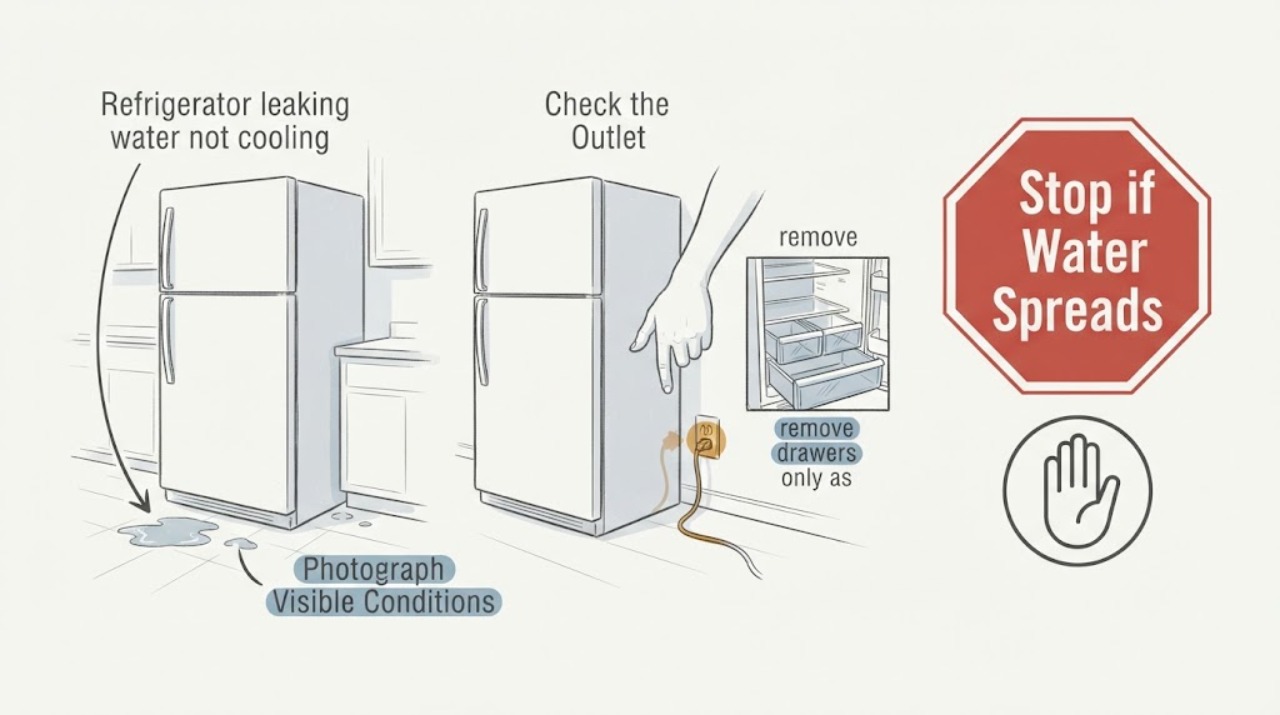
Photograph the full model and serial label, the first wet location, any visible water trail, and the current refrigerator and freezer temperatures. Record whether the leak began during dispensing, icemaker filling, defrost, or without an obvious trigger.
Expected result: The first wet point is at a rear connection, under fresh-food drawers, near the filter, in the freezer or ice bucket, or cannot be located; the freezer and refrigerator may be warm in different ways.
Next step: Keep the record for service and do not remove custom panels or internal covers just to find the source. Continue only with the external checks below if the floor and electrical area are dry.
Why this matters
Why: The location and timing separate the water valve, house line, tank or tubing, icemaker fill path, drain, and hidden sources. Separate temperature readings show whether one compartment or both are affected without proving a specific cooling part.
-
Check 2
Turn off the icemaker and close the refrigerator's water-supply shutoff. Wipe up standing water and inspect only dry, accessible rear fittings without disconnecting tubing; if water is near the outlet, cord, or controls, disconnect power only when it is safe to do so.
Expected result: The leak stops with the supply closed, a valve or line is wet, the shutoff leaks or will not close, or water remains near electrical parts or continues with the supply closed.
Next step: Leave the water off. Use appliance service for an internal valve, tank, tubing, drain, or recurring hidden leak and a plumber for the house-side line; stop immediately for wet electrical parts or a damaged cord.
Why this matters
Why: A wet appliance valve or fill line supports an appliance water-system path; a split house-side line belongs with plumbing. Continuing water, a failed shutoff, or wet electrical parts is outside a safe owner diagnostic.
-
Check 3
If water is under the fresh-food drawers, remove drawers only as the matching manual allows and dispense water into a glass while watching the accessible tank or tubing. Do not puncture, patch, or pull internal tubing.
Expected result: Water appears from the tank or tubing during dispensing, water is present without dispensing, or the tank and tubing remain dry.
Next step: Close the water supply and arrange appliance service for a wet tank, tubing, or hidden drain. Do not keep dispensing to reproduce the leak; if the area is dry, use the ice-bucket, filter, and rear-connection observations instead.
Why this matters
Why: A visible tank or tubing leak supports an internal water-system service call. GE notes that water under vegetable bins on Monogram models can also indicate a clogged drain, so a dry tank does not identify a different part by itself.
-
Check 4
With the water supply still off, perform only external no-cooling checks: confirm the controls are not off, doors close and seal, vents are not blocked, the interior light behaves normally, and the condenser and clearances are maintained as the exact manual permits. Note whether the compressor or fans are temporarily stopped during defrost.
Expected result: A door, loading, control, airflow, or power issue is visible; the unit is in a normal defrost pause; or the refrigerator remains warm after those checks.
Next step: Correct only a plainly visible condition allowed by the matching manual and record the temperature trend. If the refrigerator remains warm and dry, keep it plugged in for service when safe so the technician can observe the symptom; do not open the sealed system or perform live electrical tests.
Why this matters
Why: GE says defrost can temporarily stop the compressor and fans, while blocked airflow, door sealing, or control settings can affect temperature. A persistent warm refrigerator or freezer after external checks does not distinguish a sealed-system fault from a control, fan, defrost, or sensor problem.
-
Check 5
Ask the technician for a written diagnosis that lists the first water source, the cooling-system test result, the parts actually found failed, repair availability, and the replacement panel requirements. Give them the model label, temperature record, leak photos, and the date of the first failure.
Expected result: The diagnosis separates a repairable water-path fault from a cooling fault, confirms a sealed-system or compressor problem with testing, or cannot establish the source or exact fitment.
Next step: Use the written findings to decide repair versus replacement. For replacement, compare the exact installation documents and cabinet/panel measurements; do not order a model or panel based only on the old ZIS420DMD label or a generic Monogram family resemblance.
Why this matters
Why: A two-fault diagnosis supports comparing repair cost and downtime with replacement preference. A reported suspicion without a leak test or cooling-system test is not enough to claim a compressor failure or to choose a replacement model for panel reuse.
Use your observations
Decision map
Find the observation that best matches what you see, then follow the next safe action.
-
PATH 01Next step
What you see
The leak stops when the refrigerator water supply is closed and a rear valve, appliance line, or house-side line is visibly wet.
Do this next
Keep the water off; arrange appliance service for an appliance valve or fill line and a plumber for a house-side line. Continue no-cooling documentation only when the electrical area is dry.
Why this path and its safety boundary
Why it matters: The water system is a leading path, and the wet component determines appliance service versus plumbing. This does not explain the no-cooling symptom unless a separate cooling test links them.
-
PATH 02Next step
What you see
Water is under the fresh-food drawers, the reservoir or tubing is wet while dispensing, or a Monogram unit has persistent water under the bins with dry rear connections.
Do this next
Leave the supply off and arrange qualified appliance service; do not patch tubing, probe a drain, or remove internal panels to chase the leak.
Why this path and its safety boundary
Why it matters: An internal tank or tubing leak, or GE's Monogram clogged-drain path, is more likely than a simple filter seating issue. The exact wet point still requires service confirmation.
-
PATH 03Next step
What you see
The freezer became warm and then both compartments warmed, while the water source remains unconfirmed or dry after safe external checks.
Do this next
Protect food and obtain a written refrigeration diagnosis that separates leak testing, airflow, defrost, controls, fans, and sealed-system findings. Do not add refrigerant, open the sealed system, or replace a compressor as a guess.
Why this path and its safety boundary
Why it matters: This pattern warrants a cooling-system diagnosis, but it does not prove the Reddit user's suspected sealed-system leak, a compressor failure, or a common-cause fault on every ZIS420DMD.
-
PATH 04Next step
What you see
Repair is being compared with replacement because of the 2004 age, a repair quote, or the desire to preserve custom panels.
Do this next
After diagnosis, measure the cabinet opening and existing panels and compare them with the candidate replacement's installation instructions, hinge/dispenser layout, thickness, mounting, and trim clearances. Treat any unverified fit as a cabinet project, not an appliance fact.
Why this path and its safety boundary
Why it matters: Age, cost tolerance, appearance, and downtime are replacement preferences; they are not repair findings. GE's panel instructions support model-specific fitment checks but do not establish cross-model panel compatibility.
-
PATH 05Next step
What you see
Water is near the outlet or cord, the cord or controls are wet or damaged, a breaker trips, smoke or burning odor appears, or water continues despite the shutoff being closed.
Do this next
Stop handling the refrigerator, keep people away from the wet area, and arrange qualified appliance or electrical/plumbing service. Do not energize wet equipment or move it across standing water.
Why this path and its safety boundary
Why it matters: This is a safety or uncontrolled-water boundary, not a routine troubleshooting branch.
Helpful context
Understand the symptom
What the combined leak and no-cool pattern does and does not prove
Water on the floor, water under fresh-food drawers, an icemaker-area leak, and a rear connection leak point to different parts of the water path. Separately, a warm compartment can reflect controls, airflow, door sealing, defrost timing, or a cooling-system fault. The combination may be one event or two unrelated failures; neither the leak location nor a warm compartment alone identifies a compressor, sealed-system leak, control board, drain, valve, or tank. GE's Monogram support page specifically treats water under vegetable bins as a tank leak or a clogged drain requiring service, while its no-cooling guidance recommends external checks and service when the unit remains warm.
Separate the repair facts from the replacement preference
The opened Reddit case is a report about a 2004 GE Monogram ZIS420DMD with custom wood panels: the author describes a floor leak, a reported rusted pan, and later warming in both compartments. Those are useful observations to give a technician, not verified findings for every ZIS420DMD and not evidence that replacing the refrigerator is mandatory. Ask for a written diagnosis that identifies the water source and cooling fault separately, whether each is repairable, and what was actually tested. Compare a repair quote with your priorities only after those facts are documented.
What the panel question requires
GE's custom-panel guidance covers selected Monogram built-in side-by-side configurations and warns that dispenser trim and panel thickness affect removal and installation. It directs owners to the installation instructions for the specific model. That supports checking the exact replacement's cutout, hinge side, dispenser arrangement, panel thickness, mounting method, and trim clearances; it does not establish that a ZIS420DMD panel, hinge kit, or trim is compatible with any new model. The older GE Monogram manual also says custom panels should be planned with the kitchen designer or cabinetmaker, so panel reuse is a fitment project rather than a symptom diagnosis.
Only after diagnosis
Potential parts
- refrigerator water tank, tubing, valve, or drain component
Consider a water-path part only when the written diagnosis identifies that exact wet component or a confirmed clogged drain; leak location alone does not select a part.
Confirm the complete ZIS420DMD model and regional fit information. Do not substitute a part from another GE Monogram refrigerator or assume a generic line or tank fits. - sealed-system or compressor component
Consider sealed-system work only after a qualified technician confirms a cooling fault with appropriate testing; a warm compartment or a Reddit suspicion is not sufficient.
No compressor, refrigerant, or sealed-system part should be selected from the symptom alone. Verify the exact model documentation and licensed service requirements.
When checks do not resolve it
Need a professional?
Call when the source is hidden, water returns after the supply is closed or a model-approved external check, either compartment remains warm, the diagnosis may involve the sealed system, or any electrical part is wet. Stop immediately for smoke, burning odor, repeated breaker trips, a damaged cord, or standing water near energized equipment.
Have this ready
- Provide the full ZIS420DMD model and serial label, leak photographs and first wet location, separate refrigerator and freezer temperatures, icemaker and water-supply status, dates of warming and leaking, the custom-panel measurements, and the exact installation documents for any proposed replacement.
Common questions
FAQ
Does a leak followed by no cooling prove the compressor failed?
No. It may be two faults or a shared event, but the leak source and cooling system need separate testing. The opened ZIS420DMD Reddit post is a personal report, not a model-wide diagnosis.
Can I assume my old ZIS420DMD custom panels will fit a replacement?
No. Compare the candidate model's exact installation instructions, opening, hinge and dispenser layout, panel thickness, mounting, and trim clearances. GE's generic custom-panel guidance does not establish cross-model fit.
How should I decide between repair and replacement?
First obtain a written diagnosis that separates the water leak from the cooling fault and states what was tested and what is repairable. Then compare cost, downtime, food-loss risk, cabinet fit, and your preference for keeping the custom panels; those preferences are not proof of a failed part.
Read the exact guide
Official sources
- Refrigerators & Freezers | GE AppliancesGE Appliances · Official GE refrigerator support hub opened for water-supply, valve, icemaker, drain, and service boundaries; it does not establish exact ZIS420DMD part fitment.
- Monogram Side-by-Side Refrigerator - Removing Custom PanelsGE Appliances · Official GE custom-panel instructions opened for panel and trim decision-making; they cover selected configurations and do not verify that a ZIS420DMD panel fits any replacement model.
- Should I replace my 2004 GE Monogram zis420DMD, and what about my panels?Reddit r/Appliances · One opened user report used only for case context and the distinction between reported observations and verified repair facts; it is not a service manual or compatibility proof.
- Refrigerator - Not Cooling EnoughGE Appliances · Official GE general cooling guidance opened for safe external checks; clearances and service procedures remain model-specific.
- Owner's Manual Bottom-Freezer Built-In RefrigeratorsGE Appliances · Official older GE Monogram manual opened for generic built-in panel planning, model/serial identification, unplug-before-service safety, and qualified servicing; it is not treated as an exact ZIS420DMD manual.
- Side-by-Side Refrigerator - Water or Ice Under Vegetable Pan/BinGE Appliances · Official GE support page opened for the leak-location branch; it gives general tank and clogged-drain guidance and does not prove an exact ZIS420DMD component.
- Refrigerator - Not Running or Not CoolingGE Appliances · Official GE support guidance opened for external power, controls, defrost, demonstration mode, and service checks; it is not an exact ZIS420DMD service manual or component diagnosis.
Community feedback
Share a repair observation
Share a plain-text repair observation. Accepted observations are published automatically; this page may take a moment to update.