
On this page
Start here
Quick answer
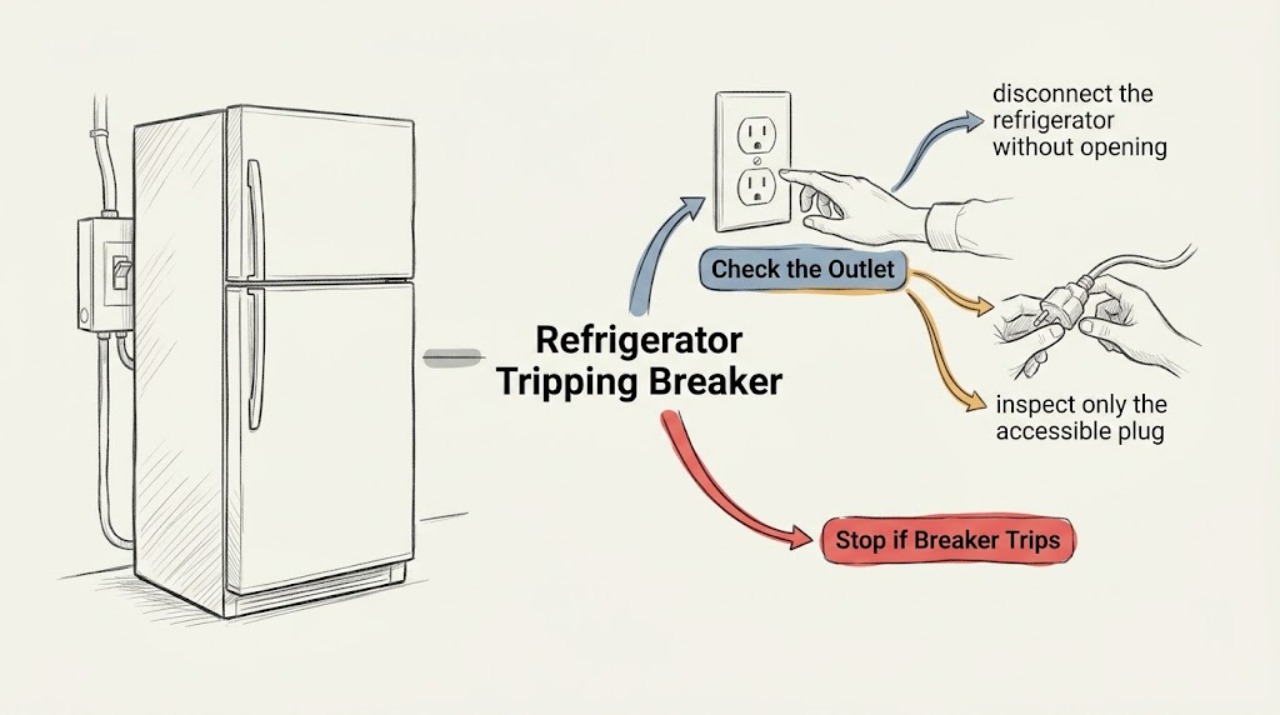
If a GE refrigerator trips a breaker, stop resetting it repeatedly. Note whether the trip happened as soon as the refrigerator was connected, when a motor started, or after it had been running, then look for a hot or discolored plug, damaged cord, buzzing, burning odor, water near the receptacle, or other visible damage without opening the appliance. If the breaker trips immediately even with the refrigerator unplugged, or the outlet, cord, or panel shows a hazard, leave the circuit off and call a qualified electrician. If the breaker holds with the refrigerator disconnected but trips when the refrigerator runs, leave the refrigerator unplugged and arrange qualified appliance service. GE says the refrigerator’s exact installation instructions control the required supply; its general guidance describes an individual, properly grounded circuit and notes that refrigerators can trip from a shorted heater, timer, loose wire, or failed component. Never install a larger breaker, use an extension cord, bypass a GFCI/AFCI, or perform a live electrical test.
Work through in order
Diagnostic checks
Use only checks that match the exact appliance or system and its official guide.
-
Check 1
Stop operating the refrigerator and identify what actually opened: a panel breaker, a GFCI/AFCI breaker, or a fuse. Do not repeatedly reset it. If the plug, cord, outlet, or nearby floor is wet, or you see scorching, melting, sparking, smoke, or smell burning, keep the circuit off and do not touch the appliance or receptacle.
Expected result: There is visible or odor evidence of overheating, water, arcing, or damage; or the protective device simply moved to an off or middle position without visible damage.
Next step: For any hazard sign, leave the circuit off and contact a qualified electrician; if the refrigerator itself is implicated, arrange appliance service as well. For a dry, undamaged situation, continue only with one controlled isolation check.
Why this matters
Why: Damage, moisture, or repeated protective-device operation is an immediate electrical or shock/fire risk. A normal-looking trip still does not identify the fault, so it should not be defeated or treated as a nuisance by default.
-
Check 2
When the plug and area are dry and accessible, disconnect the refrigerator without opening any cover. Turn off other appliances on the affected circuit, then reset the protective device once by the manufacturer's normal handle procedure. Do not force a handle that will not reset and do not substitute a higher-rated breaker.
Expected result: The breaker trips immediately while the refrigerator is unplugged, or it resets and remains on with the refrigerator disconnected.
Next step: Leave the breaker off and call an electrician for an unplugged trip or a questionable receptacle/panel. If it holds, keep the refrigerator disconnected and continue with external, non-invasive observations; do not reconnect it repeatedly to reproduce the trip.
Why this matters
Why: An immediate unplugged trip makes the house wiring, receptacle, breaker, or panel more likely. A breaker that holds with the refrigerator disconnected makes an appliance, cord, receptacle-under-load, or circuit-loading problem more likely, but does not prove which one.
-
Check 3
With power still isolated, inspect only the accessible plug and cord for cuts, crushed insulation, loose blades, discoloration, or heat damage, and inspect the receptacle face for looseness or scorching. Check whether other high-load appliances were operating on the same circuit, but do not move the refrigerator to an extension cord or use an adapter as a test.
Expected result: The cord or plug is damaged, the receptacle is loose or discolored, or several appliances share the circuit; or the external supply looks intact and the refrigerator was on the intended circuit.
Next step: Do not use a damaged cord, plug, or receptacle; have an electrician repair the supply and have appliance service assess the refrigerator. If the installation is shared or its rating is uncertain, provide the model and rating-plate information to an electrician rather than changing the breaker.
Why this matters
Why: External damage or a heavily loaded/shared circuit can cause a protective device to open. An intact exterior does not clear the refrigerator: internal wiring, a heater, timer, compressor-start component, or another failed component may still be involved.
-
Check 4
Record when the trip occurs without opening the appliance: immediately on connection, when a compressor or fan starts, after a period of cooling, during a defrost-related pause, or only when another appliance is used. Also record whether the refrigerator loses all lights and display or only the protective device opens.
Expected result: The trip follows connection or a refrigerator operating event, follows another appliance being turned on, or occurs even when the refrigerator is disconnected.
Next step: Keep the refrigerator unplugged if its operation triggers the trip and arrange qualified appliance service. Use an electrician when the trip is tied to the house circuit, another load, the receptacle, or an unplugged condition; do not perform continuity, voltage, compressor, heater, or insulation tests yourself.
Why this matters
Why: Timing helps separate a circuit load or house fault from an appliance fault, but it cannot identify a safe user-replaceable component. GE lists a shorted heater, timer, loose electrical wire, or failed component among possible appliance causes.
-
Check 5
Compare the installation with the exact GE Owner's Manual or Installation Instructions and rating plate: grounding arrangement, circuit type, protective-device rating, and whether the circuit is individual or shared. Check only visible, user-accessible information; do not remove an outlet or panel cover and do not rely on a generic rating when the model manual differs.
Expected result: The circuit does not match the model instructions, the refrigerator shares a circuit with significant loads, the protective device is GFCI/AFCI, or the installation information cannot be confirmed.
Next step: Have a qualified electrician verify or correct the circuit. Never install a larger breaker, bypass GFCI/AFCI protection, use a two-prong adapter, or add an extension cord; keep the refrigerator off until the supply is confirmed safe.
Why this matters
Why: An incorrect or overloaded supply can trip before an appliance fault is proven. GE says model-specific installation instructions control and recommends a dedicated circuit for refrigerator operation, while protective devices must remain functional.
-
Check 6
Before arranging service, record the refrigerator model, the protective device type, the exact trip timing, visible cord or receptacle condition, other loads on the circuit, and whether the breaker holds with the refrigerator disconnected. Do not remove rear covers, access the compressor or heater, bypass a relay, or make a live measurement.
Expected result: The trip pattern is repeatable only when the refrigerator is connected, or the pattern remains uncertain because the circuit itself is unsafe or cannot be isolated.
Next step: Leave the appliance and/or circuit in the safe off state and give the recorded observations to the appropriate qualified appliance technician or electrician. Keep doors closed and transfer perishable food if the outage will last.
Why this matters
Why: A repeatable appliance-linked trip supports appliance diagnosis, while an uncertain or unsafe pattern needs electrical diagnosis first. Neither pattern justifies ordering a generic internal part or continuing to reset the breaker.
Use your observations
Decision map
Find the observation that best matches what you see, then follow the next safe action.
-
PATH 01Next step
What you see
The breaker trips immediately when reset, even though the GE refrigerator is unplugged.
Do this next
Keep the circuit off and call a qualified electrician. Do not keep resetting the breaker or open the panel or receptacle yourself.
Why this path and its safety boundary
Why it matters: The house circuit, receptacle, breaker, or panel is more likely than an operating refrigerator fault, and the hazard signs raise the urgency.
-
PATH 02Next step
What you see
The breaker holds with the refrigerator disconnected but opens when the refrigerator is connected or starts operating.
Do this next
Leave the refrigerator unplugged and arrange qualified appliance service. Do not reconnect it repeatedly or attempt internal electrical tests.
Why this path and its safety boundary
Why it matters: An appliance fault or an appliance-linked supply problem is more likely. GE lists shorted heaters, timers, loose wires, and failed components as possible causes; the timing alone cannot name a part.
-
PATH 03Next step
What you see
The refrigerator shares a circuit, or the trip occurs when another high-load appliance is used.
Do this next
Stop using the affected combination and have an electrician verify the circuit, grounding, receptacle, and protective-device selection against the exact GE installation instructions.
Why this path and its safety boundary
Why it matters: Circuit loading, an installation mismatch, or a weak/defective protective device is more likely than a refrigerator component by itself. A larger breaker is not a safe remedy.
-
PATH 04Next step
What you see
There is a damaged cord or plug, moisture, burning odor, buzzing, scorching, or repeated trips.
Do this next
Leave the circuit off, keep people away from wet or damaged equipment, and contact a qualified electrician and appliance service as appropriate. Do not touch water near the receptacle or bypass the protective device.
Why this path and its safety boundary
Why it matters: The condition may involve shock, arc, overheating, or fire risk and is not suitable for a user repair or a nuisance-trip workaround.
Helpful context
Understand the symptom
Treat the trip as a protection event
A breaker is opening the circuit because it detected a condition that may be unsafe or beyond the circuit's capacity. A single trip can follow an overload or a fault, but a refrigerator that repeatedly trips must not be kept in service by repeated resets. Keep the refrigerator door closed and protect perishable food while power is off. If there is smoke, a burning smell, sparking, heat, water at the receptacle, or a damaged cord or plug, stop the inspection and leave the circuit off.
Separate the house circuit from the refrigerator
With the refrigerator disconnected only when the plug and surrounding area are dry and safely reachable, a single controlled breaker reset can show whether the protective device trips with the appliance absent. An immediate trip with the refrigerator unplugged points toward the house wiring, receptacle, breaker, or panel; a breaker that holds until the refrigerator is connected points toward the appliance, its cord, the receptacle under load, or a circuit-loading problem. This is a decision boundary, not permission to test with the cover removed or the refrigerator repeatedly reconnected.
Use the exact installation requirements
GE's general refrigerator guidance describes a properly grounded individual branch circuit and recommends a dedicated circuit, but the rating plate and the exact model installation instructions control. A refrigerator may share a kitchen circuit with other loads, or an AFCI/GFCI device may be the protective device that opens. Do not change the breaker rating, defeat a protective device, add an adapter, or run the refrigerator from an extension cord to make the symptom disappear; have an electrician verify the circuit when the installation is questionable.
When checks do not resolve it
Need a professional?
Call a qualified electrician if the breaker trips with the GE refrigerator unplugged, the receptacle or panel is hot, loose, discolored, wet, buzzing, or damaged, the installation does not match the exact model instructions, or the circuit is overloaded or otherwise uncertain. Arrange qualified appliance service if the breaker holds with the refrigerator disconnected but trips when the refrigerator is connected or operating, or if the cord, plug, compressor-start system, heater, timer, wiring, or another internal component may be involved. Keep the refrigerator unplugged when its operation triggers the trip. Do not repeatedly reset the breaker, install a larger breaker, use an extension cord or adapter, bypass a GFCI/AFCI, open electrical covers, or perform a live test. Keep doors closed and move perishable food to a safe cold location during a prolonged outage.
Common questions
FAQ
Why does my GE refrigerator keep tripping the breaker?
Possible causes include a house-circuit or receptacle problem, an overloaded/shared circuit, or an appliance fault. GE specifically lists a shorted heater, timer, loose electrical wire, or failed component among possible appliance causes. The useful first distinction is whether the breaker trips with the refrigerator unplugged or only when the refrigerator is connected; repeated resets are unsafe and do not identify the failed part.
Can I reset the breaker and plug the refrigerator back in?
Only a single normal reset is appropriate when the plug and area are dry, there is no visible damage, and the refrigerator is safely disconnected. If the breaker trips immediately while unplugged, leave it off and call an electrician. If it trips again when the refrigerator is connected or running, leave the refrigerator unplugged and arrange qualified service instead of repeating the test.
Does a GE refrigerator need its own circuit?
GE's general refrigerator guidance recommends an individual, properly grounded branch circuit and a dedicated circuit for best performance and to help prevent overloading. The exact protective-device requirement is model-specific, so use the refrigerator rating plate and its Owner's Manual or Installation Instructions. Do not change the breaker rating or use an extension cord to compensate for a questionable circuit.
Read the exact guide
Official sources
- Appliance Safety TipsElectrical Safety Foundation International · General consumer electrical safety when an appliance repeatedly trips a breaker or shows damage
- GE Appliance - Resetting Your Circuit BreakerGE Appliances · GE appliance breaker reset procedure and service boundary
- GE Appliance - Circuit Breaker TripsGE Appliances · GE appliance breaker and fuse trip isolation, including refrigerator fault and house-wiring boundaries
- Refrigerator - Electrical Requirements and Breaker SizeGE Appliances · GE refrigerator model-specific electrical supply, grounding, and circuit guidance
- Refrigerators, Freezers and Icemakers Troubleshooting and SupportGE Appliances · GE refrigerator model-specific support and routing to exact manuals and service
Community feedback
Share a repair observation
Share a plain-text repair observation. Accepted observations are published automatically; this page may take a moment to update.