
On this page
Start here
Quick answer
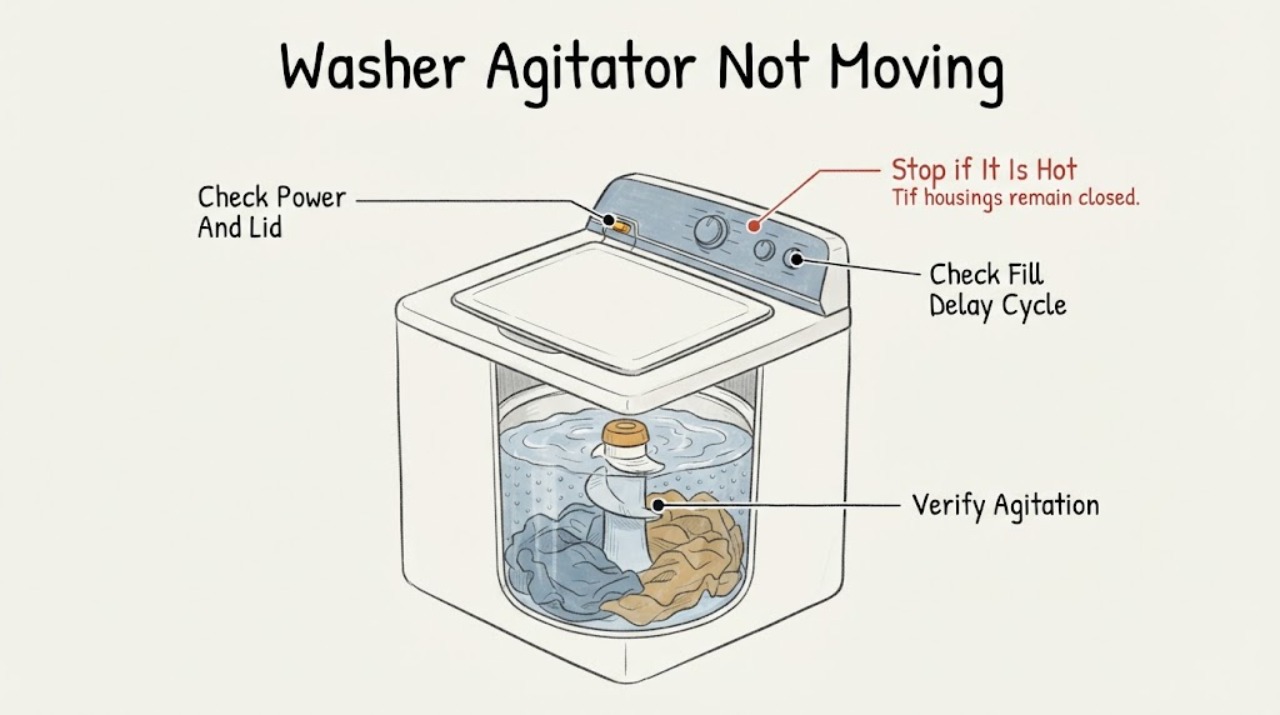
First confirm that this is a GE top-load washer with an agitator or infusor and that the load truly is not moving. GE says newer washers may agitate quietly, may wait about 20–30 seconds after filling to engage the drive, and will not agitate with the lid open. Check the dedicated outlet, a paused or soak cycle and the visible lid probe or magnet. A motor-reset sequence is only appropriate when the exact model is documented as a compatible HydroWave washer; GE limits that guidance to models with the HydroWave system, generally select models from 2011–2015. Do not remove or force the agitator: GE says agitator removal on 1995-and-newer top-load models requires a service technician. If the load still does not move after model-appropriate checks or the problem returns, arrange GE service.
Work through in order
Diagnostic checks
Use only checks that match the exact appliance or system and its official guide.
-
Check 1
On the empty or safely loaded top-load washer, open the lid, place a clean article of clothing where you can identify it, close the lid and observe a running wash for one to two minutes. Do not put hands into a moving tub.
Expected result: The clothing has moved around the tub, or it remains in the same position while the washer fills and the lid stays closed.
Next step: If there is no movement, continue with the fill-delay, cycle and lid checks. Stop the test if there is smoke, burning odor, exposed wiring, violent motion or a leaking electrical connection.
Why this matters
Why: Movement confirms that quiet or intermittent agitation was being mistaken for no agitation. No movement makes the cycle, lid, power, HydroWave-delay or drive branch relevant, but it does not identify an internal failed part.
-
Check 2
After the water stops filling, allow the model's normal sensing period to pass; GE describes about 20–30 seconds for HydroWave models. Confirm that Start/Stop or Pause was not selected, the timer knob is not pushed in, and the washer is not in a soak-only portion of the selected cycle.
Expected result: The agitator begins after the delay, or the washer remains full and still with the cycle paused, soaking or otherwise not at its main-wash agitation step.
Next step: Resume or select the model-appropriate wash cycle according to the owner's manual. Do not advance an unknown timer repeatedly or bypass a cycle interlock.
Why this matters
Why: A delay or selected pause/soak state can look like a failed agitator. A continuing no-motion condition after the cycle should be in agitation is not explained by the delay alone.
-
Check 3
Stop the washer and check that its plug is fully seated in its dedicated working outlet and that the house breaker or fuse has not tripped. With power off for a visual check, inspect the lid's visible probe or magnet for missing or obvious damage; do not defeat or bridge the lid switch.
Expected result: The outlet or breaker is not supplying power, the lid is not fully closed, the probe/magnet is missing or damaged, or the power and visible lid parts appear normal.
Next step: Restore only a safe external power condition and close the lid normally. If the probe/magnet is damaged, the lid will not latch, or the washer still will not agitate, stop troubleshooting and request service rather than bypassing the safety circuit.
Why this matters
Why: GE says a top-load washer will not agitate or spin with the lid open and that a missing or damaged lid probe/magnet can prevent agitation even when the lid appears closed. A normal visual check does not prove the switch or drive system is good.
-
Check 4
Record the complete model number from the washer label and confirm in the GE specifications or owner's manual whether the washer has the HydroWave wash system. Do not assume that a GE top-load washer or a similar-looking agitator uses the HydroWave reset sequence.
Expected result: The exact model is documented as HydroWave-compatible, or the model is not HydroWave/its system cannot be confirmed.
Next step: Use the reset action only in the confirmed HydroWave branch. Otherwise follow the exact manual's no-agitation procedure or arrange service; do not transfer the sequence from another GE family.
Why this matters
Why: GE limits its published six-lid-lift reset to top-load washers equipped with HydroWave and says the feature was generally on select 2011–2015 models. An unknown or different model needs its own instructions.
-
Check 5
Only if the exact model is confirmed as a compatible HydroWave top-load washer, unplug it for one minute, plug it back in, then lift and lower the lid six times within 12 seconds, starting within 30 seconds and raising the lid at least 2 inches each time. Close the lid fully on each movement.
Expected result: The washer accepts a small empty test cycle and begins agitation, or it still does not agitate or stops again after a few loads.
Next step: For a confirmed successful reset, follow the model manual before adding laundry. If it does not agitate, stops again or the model was not confirmed as HydroWave, stop repeating the reset and schedule GE service.
Why this matters
Why: GE presents this as a HydroWave motor reset after a power spike, surge, unbalanced load or power disruption; success does not identify or repair a failed motor or other internal component.
-
Check 6
With the washer unplugged, inspect only the visible agitator for a completely detached upper piece, a garment visibly caught beneath it, cracks, or an unusual separation. Do not pull the agitator, remove its fastener or reach under it unless the exact GE procedure expressly applies.
Expected result: The agitator is slightly loose but seated, is completely detached in the tub, or a garment is caught beneath it; no external agitator problem is visible.
Next step: Do not force, tighten or remove the agitator. Arrange qualified GE service for a detached/caught condition or persistent no-agitation, and provide the model number and observations.
Why this matters
Why: GE says slight agitator wobble on late-2015-and-newer models can be normal, while a completely detached agitator is not. GE also says removal on 1995-and-newer top-load models requires a service technician. A no-motion symptom with no visible issue does not prove a particular drive part.
Use your observations
Decision map
Find the observation that best matches what you see, then follow the next safe action.
-
PATH 01Next step
What you see
The marked clothing has moved after the lid was closed and the washer had time to sense the load.
Do this next
Use the washer according to the exact model manual and do not adjust or remove a slightly loose agitator solely because it wobbles.
Why this path and its safety boundary
Why it matters: The agitator is operating, possibly more quietly or with a normal delay than expected.
-
PATH 02Next step
What you see
The washer fills, the lid is closed, the cycle is actually in wash agitation, and the exact model is confirmed as HydroWave.
Do this next
Use the published six-lid-lift reset once, then run the supported small empty test. If it fails or the symptom returns, request service rather than repeating resets.
Why this path and its safety boundary
Why it matters: The GE HydroWave motor-reset branch may apply after a disruption, surge or unbalanced-load event.
-
PATH 03Next step
What you see
The washer is not HydroWave or the exact model/system cannot be confirmed, and it still fills without moving the load.
Do this next
Use the matching owner's manual or GE service path after checking the outlet, lid and cycle externally. Do not apply another model's reset sequence or open the drive system.
Why this path and its safety boundary
Why it matters: The HydroWave reset cannot be safely transferred to this model; the public general page does not identify a universal internal repair.
-
PATH 04Next step
What you see
The agitator is completely detached, a garment is caught underneath, the lid probe/magnet is damaged, or the washer has burning odor, smoke, exposed wiring or unsafe movement.
Do this next
Unplug and stop using the washer when safe, keep hands out of the tub, and arrange qualified GE service. Do not force the agitator, bypass the lid circuit or continue a cycle to reproduce the problem.
Why this path and its safety boundary
Why it matters: The issue has reached a service or safety boundary; a visual symptom does not authorize agitator removal or lid-switch bypass.
Helpful context
Understand the symptom
Confirm that agitation is actually absent
A top-load agitator may move gently and quietly, especially on HydroWave models. GE's supported observation is to note where a clean article of clothing sits, close the lid, let the washer run for a minute or two, and see whether the article has moved around the tub. Do not judge the cycle by noise or by a few seconds of stillness immediately after filling.
Keep model-specific reset steps conditional
GE publishes a six-lid-lift motor reset for HydroWave-equipped top-load washers, but the HydroWave page limits that system to compatible models and says the model specifications should be checked first. An unknown GE washer should not be given that sequence as a universal repair. Record the model number and use the matching owner's manual or GE support path.
Do not force the agitator or open the drive system
GE distinguishes a slightly loose late-2015-and-newer agitator from one that is completely detached. It also says a garment caught under an agitator on 1995-and-newer top-load models requires service removal. These observations do not authorize pulling an unknown agitator, tightening a fastener or diagnosing a transmission, motor or clutch from the symptom alone.
When checks do not resolve it
Need a professional?
Request qualified GE service when the washer still will not agitate after model-appropriate external checks and a confirmed HydroWave reset, when the symptom returns after a few loads, when the lid probe/magnet or agitator is damaged/detached, when a garment is caught beneath the agitator, or when there is smoke, burning odor, exposed wiring or unsafe movement. Do not select a motor, transmission, clutch, belt or agitator part from the symptom alone.
Common questions
FAQ
How can I tell whether my GE washer is agitating?
GE suggests marking the position of a clean article of clothing, closing the lid, letting the washer run for a minute or two, and checking whether the article moved around the tub. Newer and HydroWave washers can agitate more quietly than older machines.
How long should a GE HydroWave washer wait before agitation?
GE says a HydroWave machine may take about 20–30 seconds after filling stops to sense the load and engage the drive, and it may take about a minute after restarting before agitation begins. Check the exact manual for the model.
Can I use the six-lid-lift reset on any GE washer?
No. GE limits the published reset to top-load washers equipped with the HydroWave system and says to confirm the model specifications first. Do not transfer the sequence to an unknown or different GE washer.
Is a loose GE washer agitator always broken?
No. GE says agitators on late-2015-and-newer top-load models are designed to be slightly loose, while one completely detached and lying in the tub is not normal. Do not tighten or remove the agitator without exact model guidance.
Can I remove a garment caught under the GE agitator?
GE says top-load washer agitator removal on models made from 1995 to present requires a GE service technician. Unplug the washer, keep hands out of the tub and arrange service rather than forcing the agitator or improvising removal.
Read the exact guide
Official sources
- Top Load Washer - Agitator LooseGE Appliances Support · Official GE guidance limited to the loose-agitator symptom; late-2015-and-newer wording is not generalized to all GE designs.
- Top Load Washer - Hydrowave Motor ResetGE Appliances Support · Limited to GE top-load washers confirmed to have the HydroWave wash system; GE says the feature was generally on select models from 2011–2015.
- Top Load Washer - Fills But Will Not AgitateGE Appliances Support · Official general GE top-load guidance; the exact owner's manual controls model-specific features and procedures.
- Top Load Washer - Agitator Came OffGE Appliances Support · Limited to the specified two-piece agitator family; examples include models beginning GTW460, GTW485 and GTW585, and it is not generalized to unknown models.
- Top Load Washer - Agitator or Infusor Removal on 1995 to Present ModelsGE Appliances Support · Official GE guidance for top-load models made from 1995 to present; it directs agitator removal to a service technician.
- Washers - Will Not Agitate (HydroWave Models)GE Appliances Support · Official GE HydroWave-specific guidance; it is not generalized to an unidentified washer system.
Community feedback
Share a repair observation
Share a plain-text repair observation. Accepted observations are published automatically; this page may take a moment to update.