
On this page
Start here
Quick answer
A brief stop during agitation on the GE WCSE3100A1WW is not automatically a seized agitator. The model's owner manual describes the Delicates cycle as using periods of agitation and soak, and it changes agitator speed with the selected wash-speed setting. First record the cycle and whether the agitator resumes and moves the load. A short, repeatable pause only in a gentle or Delicates setting, with no grinding, smoke, burning odor, leak, or violent movement, can be a programmed operating pattern. A stop in every cycle, a pause that becomes longer, failure to move clothes after agitation should be underway, or a harsh hum or grind needs qualified service. Do not pull the agitator, open the cabinet, or choose a gearbox, motor, belt, or coupler from one brief symptom.
Work through in order
Diagnostic checks
Use only checks that match the exact appliance or system and its official guide.
-
Check 1
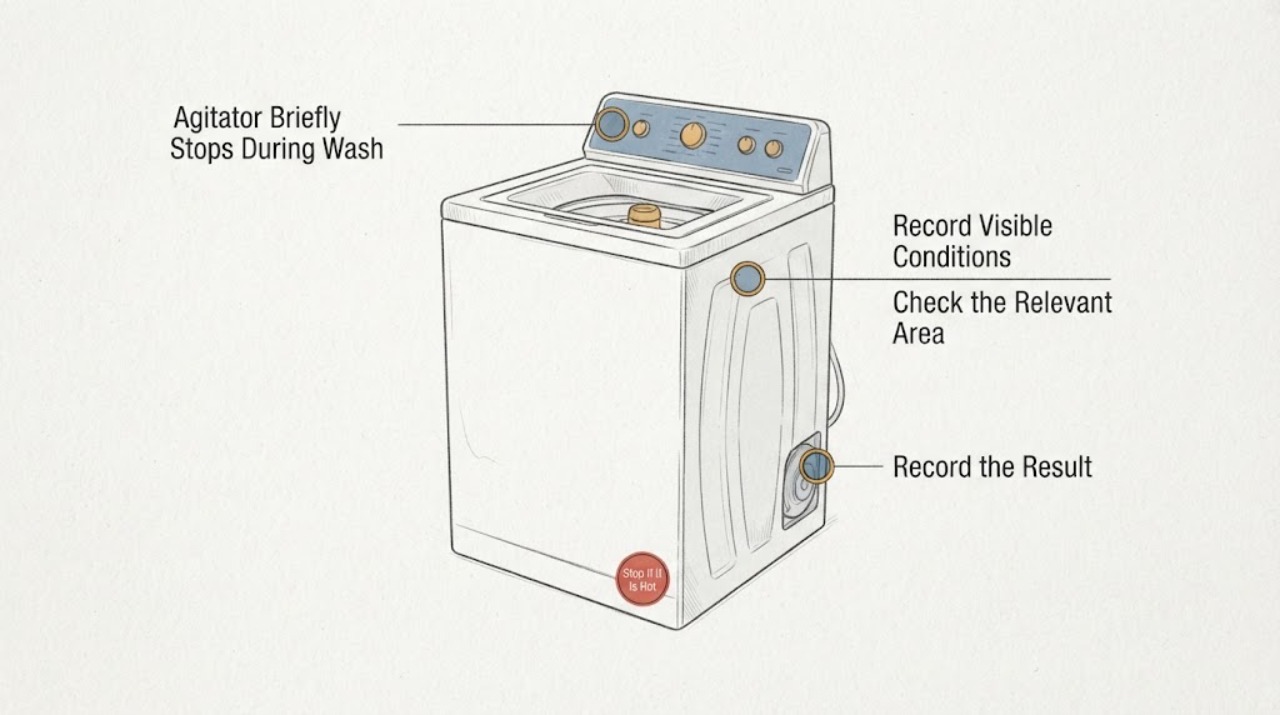
Stop or pause the washer using its normal control and keep the lid closed while the tub or agitator is moving. From a dry, safe position, record the selected cycle, wash-speed setting, stage, pause duration in ordinary terms, sound type, and whether there is water on the floor, smoke, burning or electrical odor, unusual heat, violent movement, or a tripped protection device. Do not restart solely to reproduce the noise.
Expected result: The agitator pauses briefly and resumes, the pause occurs only during Delicates or a gentle setting, the agitator remains still, a harsh hum or grind occurs, or a safety symptom accompanies the pause.
Next step: For smoke, burning odor, leak near electricity, violent movement, or a tub that will not stop, leave the washer off, isolate power only from a dry safe position if possible, and arrange qualified appliance or electrical service. If no hazard is present, continue with the stopped-cycle checks below.
Stop if: Do not reach into a moving basket, force the lid, repeatedly restart the cycle, or touch a hot, wet, or damaged cord or outlet.
Why this matters
Why: The model's documented Delicates pauses and speed changes can explain a short operating interruption, while a persistent stop, harsh mechanical sound, or safety symptom moves the case out of an ordinary cycle-setting check. The observation does not identify a gearbox, motor, belt, or coupler.
-
Check 2
After the washer is stopped, read the selector and record whether the event occurs only on Delicates, only with a gentle wash-speed setting, or also on the ordinary cottons or heavier cycle. Compare the selected setting with the WCSE3100A1WW owner manual; do not turn the selector while the washer is running.
Expected result: The pause appears only on Delicates or a gentle setting and agitation resumes, or the same stop occurs on every selected cycle regardless of wash speed.
Next step: If the pattern is limited to a documented gentle or Delicates behavior and there is no hazard, use that cycle only for its intended fabric load and monitor without deliberately repeating the event. If it occurs on all cycles or worsens, leave the washer off and arrange service.
Stop if: Do not change several settings and run repeated comparison cycles, and do not use a different cycle to conceal a grinding sound, leak, odor, or violent movement.
Why this matters
Why: The exact manual says Delicates includes periods of agitation and soak and that wash-speed settings change agitator motion. A setting-specific pause with resumed movement is therefore more consistent with programmed operation than a universal seized-drive condition. A cross-cycle stop is not explained by that one Delicates description.
-
Check 3
Once all motion has stopped, check whether the lid was fully closed and whether Start or Pause was pressed, the timer was moved, or the lid was raised immediately before the interruption. Record whether the controls resume normally after the documented pause without forcing the lid or lock.
Expected result: The event follows a lid opening, a Start/Pause input, a selector change, or a normal control pause, or it occurs with the lid closed and no control input.
Next step: Use the normal control sequence once and allow the cycle to proceed if there is no hazard. If the lid will not close safely, the controls remain stuck, or the agitator stops without a control event, stop use and request service rather than bypassing the lid safety system.
Stop if: Do not tape, defeat, short, or manually operate a lid switch, and do not open the cabinet to test the control or drive.
Why this matters
Why: The owner manual treats raising the lid or pressing Start again as a pause control, so a user control event can look like an intermittent agitation fault. A repeatable interruption with no control input requires a different branch; it is not proof that the lid switch or drive has failed.
-
Check 4
With the washer stopped and the lid open, inspect only the visible load and basket area. Note whether clothes are tightly packed, wrapped around the agitator, gathered to one side, or moving normally when the brief pause ends. Remove or redistribute items once only after the basket is completely still; do not pull on the agitator or reach below it.
Expected result: The load is tightly packed or tangled, the pause disappears after one safe redistribution, clothes still do not move, or a scrape or hard stop remains with a suitable load.
Next step: If a single obvious load issue resolves and no hazard is present, follow the manual's loading guidance and monitor an ordinary load without deliberately stressing the machine. If the symptom remains or returns, leave the washer off and arrange qualified service.
Stop if: Do not pull up the agitator column, use tools in the basket, run an overloaded test, or keep running a cycle that grinds, stalls, leaks, or smells hot.
Why this matters
Why: A load condition can change the resistance the washer sees, but a change after redistribution does not prove a healthy drive. Continued non-movement or a repeatable hard stop with a suitable load makes an internal or control issue more likely without selecting a particular part.
-
Check 5
Read and photograph the complete rating-plate model and serial information without moving the washer, then prepare a service record stating the cycle, speed, load, stage, pause pattern, sound, lid/control events, and any water or electrical symptom. Inspect the plug, receptacle, hoses, and floor only from a dry safe position; do not remove panels.
Expected result: The label confirms WCSE3100A1WW, the label differs or is incomplete, the pause repeats across cycles, or the record includes a harsh sound, no agitation, leak, odor, heat, or protection trip.
Next step: For a confirmed persistent fault or any safety symptom, keep the washer off and provide the full model, serial, cycle settings, timing, and observations to qualified GE or appliance service. If the label differs, stop using the WCSE3100A1WW instructions until the correct model manual is identified.
Stop if: Do not open the cabinet, test live voltage, remove the agitator, bypass a lid switch, or order a motor, belt, coupler, gearbox, or transmission from the symptom alone.
Why this matters
Why: GE's exact-model record links the applicable manual and parts diagrams, but a persistent symptom cannot be reduced to a part name from a user observation. Identity and timing let a technician distinguish a documented cycle behavior from an internal drive, control, lid, or installation issue.
Use your observations
Decision map
Find the observation that best matches what you see, then follow the next safe action.
-
PATH 01Next step
What you see
The pause is brief, occurs only in Delicates or a gentle wash-speed setting, the agitator resumes, clothes move, and there is no harsh sound, odor, leak, heat, or violent movement.
Do this next
Use the setting only for its intended load and monitor normally; do not pull the agitator or buy a drive part. If the pause starts occurring in other cycles, lasts longer, or the sound changes, leave the washer off and arrange service.
Why this path and its safety boundary
Why it matters: The exact owner manual's Delicates description—periods of agitation and soak—makes a programmed pause more plausible than a seized agitator in this pattern. A symptom match alone does not establish a component condition.
-
PATH 02Next step
What you see
The same stop occurs in every cycle, becomes longer or more frequent, the agitator does not resume, or clothes remain still after the wash stage should be operating.
Do this next
Stop ordinary use and arrange qualified GE or appliance service with the exact cycle and timing record. Do not keep running comparison loads or open the cabinet.
Why this path and its safety boundary
Why it matters: This is not explained by the Delicates-only pause description. A drive, control, lid-safety, or other internal condition becomes more plausible, but the observation does not distinguish a gearbox, motor, belt, or coupler.
-
PATH 03Next step
What you see
The interruption follows raising the lid, pressing Start/Pause, moving the selector, or another clear control event, and the washer resumes normally after the documented control sequence.
Do this next
Use the normal control sequence once and observe the cycle. If the lid cannot close safely, the controls remain stuck, or the stop happens without a control event, leave the machine off and request service.
Why this path and its safety boundary
Why it matters: A control pause can imitate a momentary mechanical stop. That pattern does not prove the lid switch or timer is defective, and it does not justify bypassing a safety interlock.
-
PATH 04Safety boundary
What you see
The event includes grinding, a hard mechanical stop, smoke, a burning or electrical odor, a hot or damaged cord, a leak near electricity, violent movement, repeated protection trips, or a tub that will not stop.
Do this next
Keep clear and stop the washer. Isolate power only from a dry, safe, accessible position when possible, shut off water only if safely reachable for a continuing leak, and arrange qualified appliance or electrical service.
Why this path and its safety boundary
Why it matters: The symptom has crossed the ordinary cycle-setting boundary and may involve an immediate mechanical, water, fire, or shock hazard. No individual part can be safely selected from this observation.
Safety stop: Do not restart, repeatedly reset protection, reach into motion, touch wet electrical equipment, or inspect inside the cabinet.
-
PATH 05Next step
What you see
The rating label does not exactly confirm WCSE3100A1WW or the owner manual, cycle controls, and machine do not match the assigned model.
Do this next
Keep the machine stopped if the symptom is persistent or harsh, photograph the full rating plate, and obtain the correct GE manual or qualified service assessment before further testing or part selection.
Why this path and its safety boundary
Why it matters: GE manuals and parts diagrams are model-specific. A nearby GE top-loader can use different cycle timing, lid behavior, and drive parts, so the WCSE3100A1WW interpretation cannot be carried over safely.
Helpful context
Understand the symptom
Why a momentary pause can be different from a seizure
The exact GE manual separates wash-cycle choice from wash and spin speed. It says the Delicates cycle provides periods of agitation and soak, while the wash-speed setting changes how the agitator moves. That makes the first question whether the pause follows a selected gentle or Delicates pattern and then resumes, not whether a particular internal part can be named from the sound. A brief pause that never becomes a loss of cleaning motion is a different decision from an agitator that stops and leaves the load still.
Use the symptom as a timing record
Record the cycle, wash-speed setting, water state, lid state, and whether the pause occurs at the same point. A single exact-model Reddit report is useful for matching the symptom, but it is not a repair result. Treat it as a reason to document the pattern, not as permission to pull the agitator or order a coupler, belt, motor, or transmission.
When the safe user check ends
Stop ordinary troubleshooting for smoke, a burning or electrical odor, a leak near the outlet or cord, violent movement, a damaged lid or cord, or a tub that will not stop. For a persistent pause or harsh mechanical sound, leave the washer off and give service the exact model and cycle observations. The model record matters because the owner manual and parts diagrams are tied to WCSE3100A1WW, not to every GE top-loader.
When checks do not resolve it
Need a professional?
Arrange qualified GE or appliance service when the pause occurs across cycles, becomes longer or more frequent, the agitator does not resume, a hard stop or harsh hum/grind occurs, the lid safety or controls do not behave normally, the model identity is uncertain, or any leak, smoke, burning/electrical odor, heat, violent movement, or protection trip is present. Use electrical service for a damaged or repeatedly tripping household connection.
Have this ready
- Provide the complete WCSE3100A1WW model and serial, cycle and wash-speed settings, load description, stage and pause timing, whether the agitator resumed and moved clothes, lid or Start/Pause events, sound description, water state, and any photos or recording made only after stopping safely.
Common questions
FAQ
Is a brief agitator stop on the GE WCSE3100A1WW automatically a bad gearbox or motor?
No. The owner manual describes periods of agitation and soak in Delicates and different agitator motion by wash-speed setting. A brief pause that resumes only in that context is not enough to identify a gearbox or motor. A stop across cycles, no resumed movement, or harsh noise needs service rather than a guessed part.
Should I pull the agitator to see whether it is seizing?
No. Do not pull the agitator column or open the cabinet as a first check. Record the cycle and pause pattern, inspect only the visible load after the basket stops, and arrange qualified service if the event persists or is accompanied by grinding, a hard stop, odor, leak, or heat.
Could the Delicates cycle intentionally pause during agitation?
The WCSE3100A1WW owner manual says Delicates provides periods of agitation and soak during wash and rinse. If the brief pause is limited to that setting, agitation resumes, and no hazard appears, that documented behavior is a plausible explanation. Do not use it to dismiss a pause that occurs in every cycle or becomes a harsh mechanical stop.
What should I tell a GE technician about the intermittent stop?
Give the complete WCSE3100A1WW model and serial, cycle and wash-speed setting, load, stage, approximate pause timing, whether clothes moved afterward, the sound description, any lid or Start/Pause event, and any leak, odor, heat, or protection-trip symptom. Do not order a coupler, belt, motor, or transmission until the technician confirms the diagnosis and fit.
Read the exact guide
Official sources
- Model Search | WCSE3100A1WWGE Appliances · Official GE Appliances parts and documentation page opened for the exact WCSE3100A1WW model.
- User Manual & Care for WCSE3100AWW | GE AppliancesGE Appliances · Official GE Owner Center support page for the WCSE3100AWW family record; used only to corroborate the Super Capacity Plus washer identity and model-specific documentation/service boundary, not to invent a different model.
- GE top loader Washing machine agitator seizes for a brief second at random?Reddit · Exact Reddit post opened for the assigned model and symptom; it is used only as an anecdotal symptom match and does not establish a component diagnosis.
- 49-90030v07GE Appliances · Official GE-hosted owner manual opened from the exact WCSE3100A1WW documentation link.
Community feedback
Share a repair observation
Share a plain-text repair observation. Accepted observations are published automatically; this page may take a moment to update.