
On this page
Start here
Quick answer
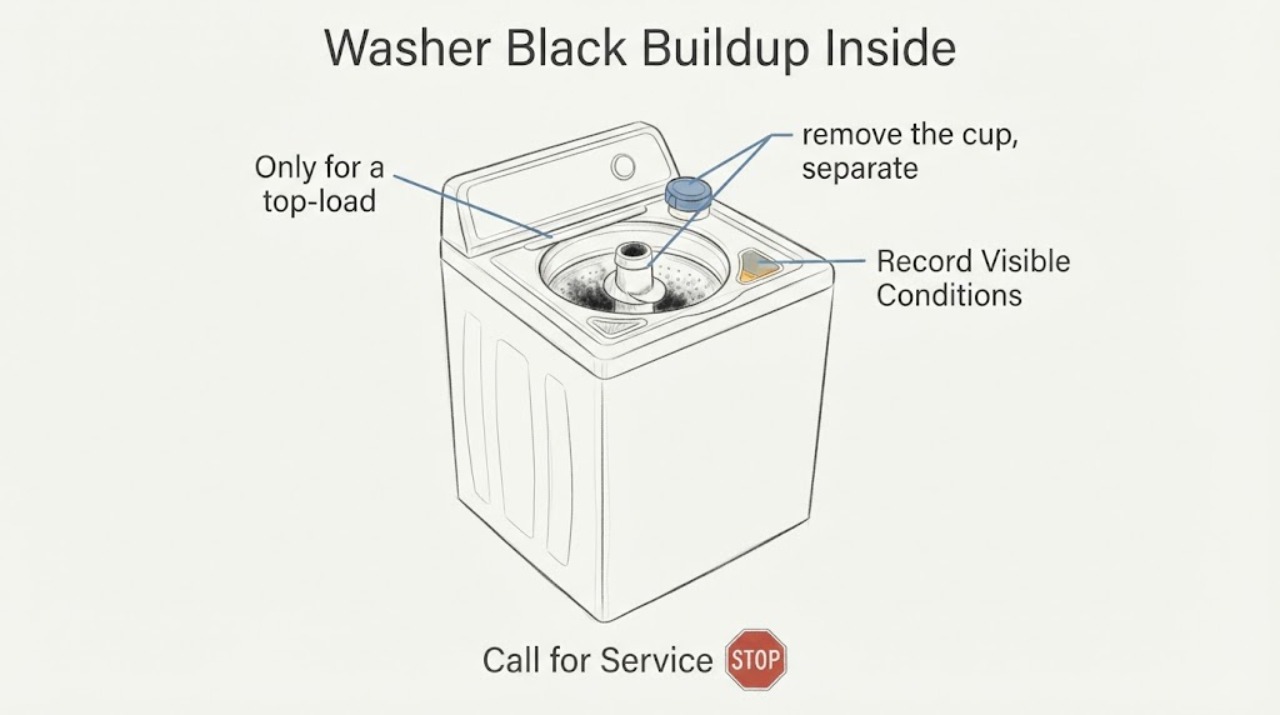
GE does not treat every agitator as removable or interchangeable. If your top-load GE washer has the top-mounted fabric-softener dispenser covered by GE's cleaning instructions, GE says to use the specified Colors/Normal, Super Fill or Deep Fill, Deep Rinse and Warm or Hot settings, add 1/4 cup detergent and 1 cup bleach to the wash basket, remove the dispenser, brush the agitator interior with a long soft brush during the wash phase, flush it with wash water, and let the cycle finish. Use that sequence only when the dispenser and controls match your exact washer manual. Clean a removable dispenser separately with warm water, detergent and bleach as GE specifies. GE says top-load agitators on models from 1995 onward require a Bodewell technician for removal, so do not pry off a cap or remove the agitator to reach black buildup underneath. If residue returns, leaves odor or stains clothes, or the washer needs an agitator or basket opened, stop at the external cleaning steps and arrange model-specific service.
Before you begin
Safety first
- Do not pry off a cap, remove a modern agitator, access the drive or basket, improvise a puller, mix cleaning products, or order a seal, agitator or other part from black color alone. Use only the exact model's supported cleaning instructions and GE service boundary.
Work through in order
Diagnostic checks
Use only checks that match the exact appliance or system and its official guide.
-
Check 1
With the washer stopped, inspect the top of the agitator without prying or pulling it. Determine whether there is a removable fabric-softener dispenser cup, a non-removable cap, or no agitator because the washer uses an infusor or pulsator; record the full GE model number before choosing a procedure.
Expected result: A top-mounted fabric-softener dispenser is present, the cap is non-removable, or the machine has an infusor/pulsator instead of an agitator.
Next step: Use the dispenser-specific path only when the exact model manual and controls match it. If the cap is non-removable, the part is an infusor/pulsator, or the configuration is unclear, do not disassemble it; use the owner manual or arrange GE service.
Stop if: Stop if identifying the configuration would require removing the cap, dispenser housing, agitator or basket.
Why this matters
Why: GE's inside-agitator cleaning sequence is conditional on a top-mounted dispenser, and its removal article distinguishes agitators from infusors/pulsators. A visual match is needed before applying the sequence.
-
Check 2
If the fabric-softener dispenser is removable and the exact model instructions match GE's dispenser article, remove the cup, separate the cup from its cover, soak both in the specified warm-water, detergent and bleach solution, loosen buildup with a soft cloth, rinse, reassemble and return the dispenser to the agitator.
Expected result: Residue is on the dispenser or cover and comes away during the supported soak, or buildup remains after rinsing.
Next step: Reinstall only a clean, correctly assembled dispenser. If it is cracked, will not seat or continues to collect residue, keep the model information and contact GE service; do not improvise a fit or pour undiluted softener into the agitator.
Why this matters
Why: GE treats the dispenser as a separately cleanable component and warns against a stiff brush that could scratch it. Remaining residue may require the exact model's service or replacement guidance rather than more force.
-
Check 3
Only for a GE top-load washer with the top-mounted fabric-softener dispenser covered by the inside-agitator article, select Colors/Normal, Super Fill or Deep Fill, Deep Rinse and Warm or Hot. Add the GE-specified 1/4 cup detergent and 1 cup bleach to the wash basket, remove the dispenser, let the washer agitate for about five minutes, then lift the lid and use a long, slender, soft brush to clean inside the agitator.
Expected result: Loosened soil is visible inside the agitator, or the residue is not reachable with the long soft brush and matching cycle.
Next step: Continue the GE sequence by flushing with wash water from outside the agitator, closing the lid before the 15-minute limit, allowing the cycle to finish and reinstalling the dispenser. If the exact configuration does not match, skip this procedure and use service guidance.
Stop if: Stop if the washer manual does not permit the listed settings or products, if the residue is below the agitator, or if cleaning would require reaching under or removing the agitator.
Why this matters
Why: GE says this sequence is for the top-mounted-dispenser configuration and that the loosened soils drain with the wash water and rinse during Deep Rinse. It is not a general instruction to pour chemicals into every agitator design.
-
Check 4
For the matching GE sequence, use a measuring cup to pour wash water from around the outside of the agitator into its interior, complete the cycle before the article's 15-minute limit, and reinstall the dispenser only after the cycle is complete. Afterward inspect the reachable area and note whether black material, odor or clothing marks recur.
Expected result: The reachable buildup is removed and does not recur, or black residue, odor or stains return after the supported cleaning.
Next step: Use the exact owner's manual for ongoing tub-cleaning frequency and detergent amount. If recurrence persists, preserve a photo/sample description and arrange model-specific service instead of escalating to agitator removal.
Why this matters
Why: A clean result supports removable soil or product residue as the immediate cleaning target, but recurrence does not prove a particular failed part. GE separately recommends regular tub cleaning for soil and detergent buildup.
-
Check 5
If residue is underneath the agitator, the cap will not come off as the manual describes, the agitator is loose or damaged, or the washer has an infusor/pulsator, leave the assembly in place and record the exact model. Do not use a puller, pry tool or improvised fastener removal.
Expected result: The buildup cannot be reached by the supported dispenser/inside-agitator cleaning path, or a mechanical problem is present.
Next step: Schedule GE/Bodewell service and provide the model, location and recurrence of the buildup, any odor or clothing staining, and photographs taken without disassembly.
Why this matters
Why: GE states that top-load washers made from 1995 to present require a Bodewell technician to remove the agitator. The residue location does not prove a drive, seal or basket failure.
Use your observations
Decision map
Find the observation that best matches what you see, then follow the next safe action.
-
PATH 01Next step
What you see
The washer has a top-mounted fabric-softener dispenser and the exact model manual matches GE's inside-agitator cleaning article.
Do this next
Follow the specified cycle, detergent/bleach amount, soft-brush and under-15-minute flush sequence, then complete the cycle and reinstall the dispenser.
Why this path and its safety boundary
Why it matters: The published GE cleaning sequence is scoped to this configuration and can address reachable soil inside the agitator without removing the agitator.
-
PATH 02Next step
What you see
The visible residue is on a removable fabric-softener cup or its cover.
Do this next
Soak, wipe with a soft cloth, rinse and reassemble it using GE's dispenser instructions. Contact service if it remains damaged or will not seat.
Why this path and its safety boundary
Why it matters: The dispenser is a separately cleanable part in GE's support instructions; a stiff brush or poor reassembly can damage or mis-seat it.
-
PATH 03Next step
What you see
The cap is non-removable, the residue is below the agitator, the machine uses an infusor/pulsator, or the model/configuration is unclear.
Do this next
Do not pry, pull or remove the assembly. Use the exact owner manual or schedule GE service with the model and residue location.
Why this path and its safety boundary
Why it matters: The supported inside-agitator cleaning path does not apply, and GE requires a Bodewell technician to remove modern top-load agitators.
-
PATH 04Next step
What you see
Black material, odor or clothing staining returns after the correct reachable cleaning cycle.
Do this next
Use the exact model's tub-cleaning guidance and detergent amount; if recurrence continues or the residue is inaccessible, arrange model-specific service rather than ordering a part from color alone.
Why this path and its safety boundary
Why it matters: GE acknowledges recurring soil, detergent and odor buildup in washer tubs, but recurrence alone does not identify a failed seal, bearing, drive or agitator.
Helpful context
Understand the symptom
Black color does not identify the source by itself
The task has no GE model number and the color of residue does not establish whether it is soil, detergent or fabric-softener buildup, a dispenser problem or material from a part. GE's public guidance supports cleaning the reachable agitator interior only for a specific top-mounted-dispenser configuration. It does not support diagnosing a failed agitator, seal or drive from black residue alone.
Match the cleaning path to the agitator design
Some GE agitators have a cap or cover that is not removed, while others have a fabric-softener dispenser cup. GE's dedicated cleaning article is conditional on the dispenser being at the top of the agitator. A removable dispenser can be cleaned separately, but the agitator itself should not be pulled out as a household cleaning step on modern top-load models.
Treat recurrence as a cleaning or service question, not a parts diagnosis
GE recommends monthly washer-tub cleaning to control soil and detergent buildup and says the proper detergent amount helps prevent residue. If black material returns after a matching cleaning cycle, transfers to clothes, causes odor, or sits below a non-removable agitator, document the model and arrange service rather than ordering an agitator or removing the basket yourself.
When checks do not resolve it
Need a professional?
Arrange GE/Bodewell service when buildup is below a non-removable agitator, the agitator or dispenser is damaged or loose, the supported cleaning does not remove or stop recurrence, clothing is stained, or the washer needs the agitator or basket opened.
Safety scope: Do not pry off a cap, remove a modern agitator, access the drive or basket, improvise a puller, mix cleaning products, or order a seal, agitator or other part from black color alone. Use only the exact model's supported cleaning instructions and GE service boundary.
Have this ready
- Provide the complete GE model number, agitator versus infusor/pulsator type, whether a top-mounted dispenser is present, where the black material sits, photos taken without disassembly, recurrence after cleaning, odor or clothing-stain details, detergent/softener amount and any unusual noise or movement.
Common questions
FAQ
What causes black buildup inside a GE washer agitator?
GE's public guidance does not identify black color alone as a failed part or a specific material. It does document soil, detergent and fabric-softener buildup in washers and provides a conditional inside-agitator cleaning path for top-load models with a top-mounted dispenser. Identify the configuration before choosing a cleaning method.
Can I remove the agitator to clean underneath it?
GE says top-load washers made from 1995 to present require a Bodewell technician to remove the agitator. Do not pry it off or use an improvised tool; give the service provider the complete model number and location of the buildup.
How do I clean inside a GE agitator?
Only when the washer has the top-mounted fabric-softener dispenser covered by GE's article: use the listed Colors/Normal, Super Fill or Deep Fill, Deep Rinse and Warm or Hot settings, add 1/4 cup detergent and 1 cup bleach to the basket, remove the dispenser, brush with a long soft brush during wash, flush with wash water and finish the cycle before the 15-minute limit. Follow the exact model manual if it differs.
How do I clean a GE fabric-softener dispenser?
For a removable dispenser, GE says to separate the cup and cover, soak both in warm water with the specified detergent and bleach, loosen buildup with a soft cloth, rinse, reassemble and reinstall. GE says not to use a stiff brush because it can scratch the dispenser.
What if the black residue comes back after cleaning?
GE recommends regular washer-tub cleaning and using the proper detergent amount to reduce soil and detergent buildup. If residue, odor or clothing stains return, or if the material is inaccessible below the agitator, arrange model-specific service rather than diagnosing or buying an internal part from the color alone.
Read the exact guide
Official sources
- Top Load Washer - Cleaning Inside AgitatorGE Appliances · Opened official GE support guidance. It is conditional on the top-load washer having the specified fabric-softener dispenser at the top of the agitator; it does not apply to every GE agitator, infusor or pulsator and does not authorize agitator removal.
- Top Load Washer - Agitator or Infusor Removal on 1995 to Present ModelsGE Appliances · Opened official GE guidance. It states that top-load washers made from 1995 to present require a GE Appliance Bodewell technician to remove the agitator and distinguishes infusors/pulsators; it is used to prevent unsupported disassembly, not to diagnose the black residue.
- Washer - Tide Washing Machine CleanerGE Appliances · Opened official GE support guidance. It states that soil, odor or detergent buildup can occur in washer tubs and recommends monthly tub cleaning; it is a general buildup-management source, not evidence of a particular internal component failure.
- Top Load Washer - Cleaning the Fabric Softener DispenserGE Appliances · Opened official GE support guidance for removable and non-removable fabric-softener dispensers. It supports dispenser cleaning and dilution/prevention steps only; it does not establish that a black mark is a failed dispenser or agitator.
Community feedback
Share a repair observation
Share a plain-text repair observation. Accepted observations are published automatically; this page may take a moment to update.