
On this page
Start here
Quick answer
A dirty-looking GE washer drum can be detergent or fabric-softener residue, soil, mineral or dye staining, or an odor-related buildup; the symptom alone does not prove a mold problem or a failed internal part. Empty the washer, inspect only accessible surfaces, clean the dispenser or gasket according to the matching GE model guidance, and run the model's BasketClean, Self Clean or other documented tub-cleaning cycle. GE recommends monthly tub cleaning for applicable models, but the exact manual controls the cycle and cleaner. If residue or odor returns after the documented cleaning, or there is standing water, a leak, burning smell or drain problem, stop using it and arrange service.
Before you begin
Safety first
- No cabinet opening, live electrical test, wash-basket removal, pump diagnosis or sealed/internal repair is included.
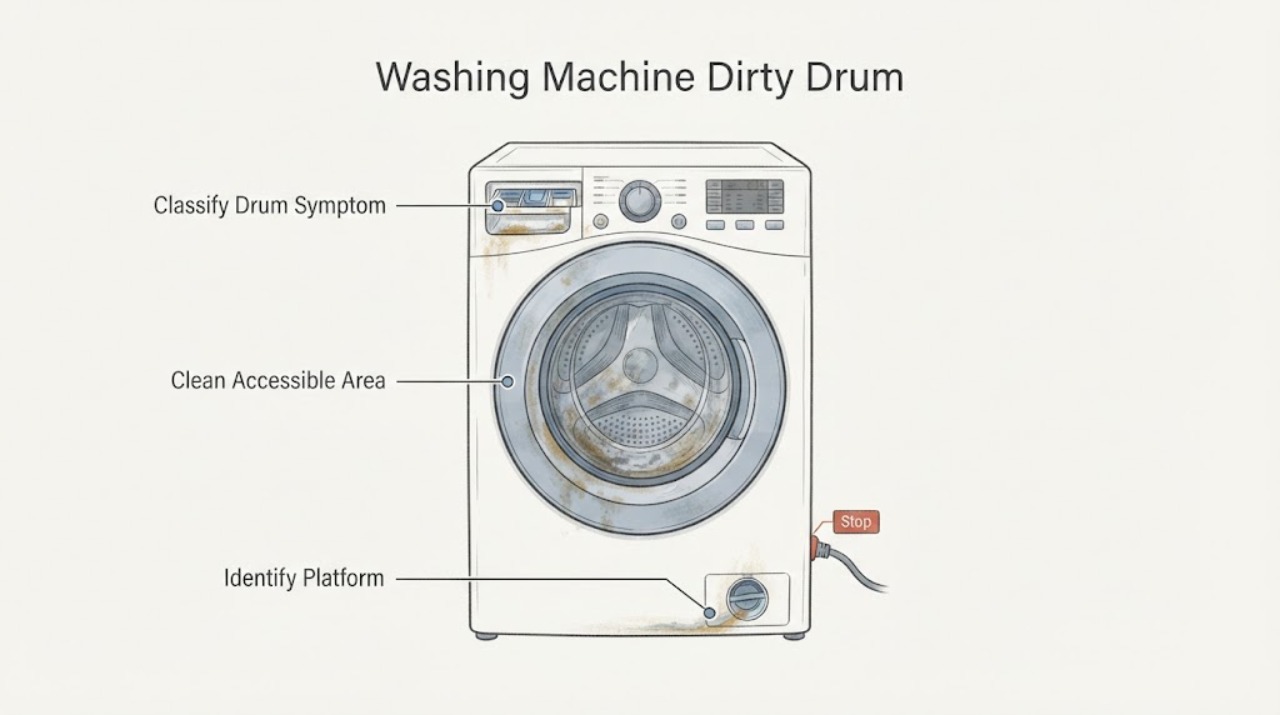
Work through in order
Diagnostic checks
Use only checks that match the exact appliance or system and its official guide.
-
Check 1
Record the complete GE model number and whether the washer is top load, front load or a GE Profile combo before selecting a cleaning cycle or cleaner.
Expected result: The model and washer form are known, or the identity is still incomplete.
Next step: Open the exact GE owner's manual and use its care-and-cleaning section. If the model cannot be identified, limit work to the visible checks below and do not guess a control sequence.
Why this matters
Why: GE publishes different tub-cleaning, dispenser, gasket and pump-filter instructions for different washer platforms; brand name alone does not select a button sequence.
-
Check 2
With the washer empty and stopped, use a light to record whether the problem is loose lint or debris, slimy/soap residue, a colored or mineral stain, black specks, or an odor without visible soil. Photograph the pattern for service if it returns.
Expected result: The residue or odor can be described, or the symptom remains unclear.
Next step: Use the matching maintenance path below and retain the model number and observation. Do not scrape, pry or remove the basket to investigate.
Why this matters
Why: GE distinguishes odor and detergent or softener buildup from dye, calcium or iron tub staining; an unclear appearance does not establish mold or an internal failure.
-
Check 3
After disconnecting power when the model instructions call for maintenance, wipe only accessible tub surfaces and the accessible door gasket; remove foreign objects from gasket folds without pulling the gasket out of its mount. For a top-load dispenser drawer, remove and rinse the drawer only if the exact GE instructions identify it as removable.
Expected result: Residue is visible in the gasket, dispenser drawer or other user-accessible area, or those areas are clear.
Next step: Rinse away cleaning solution and reinstall only parts the manual identifies as user-removable. If residue is behind a panel or returns immediately, stop disassembly and continue to the tub-cycle or service branch.
Why this matters
Why: GE says detergent or softener can build up in the dispenser and directs front-load owners to clean the gasket; top-load drawer cleaning does not mean the dispenser box should be removed.
-
Check 4
Remove all clothes and objects, then run the exact model's BasketClean, Self Clean or other tub-cleaning cycle as specified in the GE owner's manual. Where GE's opened guidance applies, it describes one empty-basket cycle with the specified cleaning product; do not substitute a different chemical or combine products.
Expected result: The washer has a documented tub-cleaning cycle, or the control panel/manual does not show one.
Next step: Complete the manual-directed cycle without laundry. If the exact manual supplies no safe user cycle, use only its stated alternative or arrange service rather than improvising a long hot cycle.
Why this matters
Why: GE's front-load guidance uses BasketClean or Self Clean when available and gives a different empty Heavy/Cotton path when it is not; a cycle name cannot be transferred from another model.
-
Check 5
If the remaining mark is a colored, chalky or mineral-looking stain, compare it with the exact GE tub-care instructions before choosing a treatment. GE lists bleach or a citric-acid treatment for some tub staining, with an additional rinse where specified.
Expected result: The stain matches a documented dye, calcium or iron buildup pattern, or it does not match / is unknown.
Next step: Use only the exact manual or GE treatment that matches the washer and substance. Do not mix bleach, vinegar, citric acid or other cleaners; if the stain is unknown or the tub surface is damaged, stop and ask service.
Why this matters
Why: A stain can be surface buildup rather than a washer failure, but the treatment and material compatibility are model and substance dependent.
-
Check 6
After the cleaning cycle, inspect only the visible drain-hose position and the accessible basket/gasket area for retained water, siphoning signs or debris. For a front loader, check the exact manual before cleaning an accessible pump filter; do not open a pump housing that the manual does not identify as user-accessible.
Expected result: Water remains, the drain hose is pushed too far into the standpipe, the visible filter path is restricted, or the drain area looks normal.
Next step: Correct only an obvious external hose-position issue and use the exact manual for any accessible filter. Arrange service for persistent standing water, repeated odor or a drain fault.
Why this matters
Why: GE says an incorrectly positioned drain hose can siphon water back and that a restricted accessible pump filter can contribute to odors on applicable front-load designs; these observations do not prove a failed pump.
-
Check 7
Stop using the washer and arrange qualified GE or appliance service if the drum remains dirty after the model-directed cleaning, residue returns quickly, water does not drain, there is a leak, a burning/electrical odor or visible wiring damage.
Expected result: The condition persists after safe external maintenance, or a water/electrical hazard is present.
Next step: Keep the washer off for a hazard and isolate power or water only from a safe, accessible control point. Give service the model, residue pattern, cleaning product/cycle, drain observations and photographs.
Why this matters
Why: A persistent dirty drum can require model-specific inspection, but the supplied symptom does not identify a pump, seal, bearing, heater, valve or control failure.
Use your observations
Decision map
Find the observation that best matches what you see, then follow the next safe action.
-
PATH 01Next step
What you see
The visible material is a thin soap or softener film, and the model has a documented BasketClean or Self Clean cycle.
Do this next
Clean accessible residue, then run the exact empty-basket cycle from the GE manual and allow the washer to dry as the manual directs.
Why this path and its safety boundary
Why it matters: This is consistent with the residue buildup GE describes and does not prove a failed washer part.
-
PATH 02Next step
What you see
A front-load gasket or dispenser area contains lint, foreign objects or residue.
Do this next
Power down when required, clean only the accessible area, rinse away cleaner and use the model manual for any pump-filter step.
Why this path and its safety boundary
Why it matters: The material is in a user-accessible maintenance area that GE directs owners to inspect and clean.
-
PATH 03Next step
What you see
The mark is colored or chalky and matches a possible dye, calcium or iron buildup, but the exact substance is uncertain.
Do this next
Do not mix products or scrub aggressively; use the exact model guidance or have service identify the residue.
Why this path and its safety boundary
Why it matters: GE documents separate tub-stain treatments, but an unknown mark cannot be safely classified from appearance alone.
-
PATH 04Next step
What you see
The dirty drum is accompanied by retained water, repeated odor, a leak, burning smell, electrical symptoms or visible wiring damage.
Do this next
Stop using the washer, isolate it safely without touching hazardous parts and contact qualified service.
Why this path and its safety boundary
Why it matters: The complaint has crossed routine cleaning into a drain, water or electrical safety boundary.
-
PATH 05Next step
What you see
Residue or odor returns after the correct model-directed cleaning and accessible maintenance.
Do this next
Record the model, cleaner/cycle, timing and residue pattern and arrange a service inspection; do not remove panels or the wash basket.
Why this path and its safety boundary
Why it matters: The symptom is persistent and cannot be narrowed to one internal component from the available evidence.
Helpful context
Understand the symptom
“Dirty drum” is an observation, not a component diagnosis. A visible film, dark flecks, a colored stain and a musty odor can have different causes. GE's opened care guidance separates monthly tub cleaning, dispenser or gasket residue and model-specific maintenance, so identify the washer platform before choosing a cycle or cleaner.
The task has no model number. Use the complete model from the rating label to open the correct GE owner's manual. The checks below stay at the user-accessible level; do not assume that a front-load BasketClean instruction, a top-load Basket Clean control or a pump-filter location applies to every GE washer.
Do not mix cleaning products, reach into a moving washer, remove cabinet panels or scrape the basket with a harsh or abrasive tool. Stop for a burning or electrical odor, a leak, exposed wiring or abnormal standing water and arrange qualified service.
When checks do not resolve it
Need a professional?
Arrange GE or qualified appliance service when the exact model-directed cleaning and accessible maintenance do not clear the dirty drum or the condition returns., Stop using the washer for a leak, persistent standing water, burning/electrical odor, exposed wiring, unusual noise or a breaker problem., Do not remove the cabinet, wash basket, pump housing or control panel, perform live electrical tests, or diagnose a pump, seal, bearing, heater, valve or control from residue alone.
Safety scope: No cabinet opening, live electrical test, wash-basket removal, pump diagnosis or sealed/internal repair is included.
Have this ready
- complete GE model number and washer form
- residue or stain appearance and where it was found
- cleaning cycle/product and whether it completed
- gasket, dispenser, drain-hose and retained-water observations
- photos and any leak, odor, noise or electrical symptom
Common questions
FAQ
Why does my GE washer drum look dirty?
GE identifies detergent or fabric-softener residue, soil and odor-related moisture buildup as possible maintenance issues, while dye, calcium or iron can create separate tub stains. Classify what you see, use the exact model's cleaning guidance and do not infer a failed part from appearance alone.
Can I run a GE BasketClean cycle on any GE washer?
No. GE's opened guidance distinguishes models with BasketClean or Self Clean from models without those cycles, and the owner's manual controls the product and procedure. Do not copy a button sequence from another GE model.
How do I clean residue from a GE washer dispenser or gasket?
Use the exact GE instructions for your washer. GE supports cleaning a front-load gasket and says top-load dispenser drawers can be removed and washed when designed for removal; it says not to remove the top-load dispenser box. Power down when the manual requires it and rinse away any cleaning solution.
When is a dirty GE washer drum a service issue?
Use service when the correct model-directed cleaning does not clear the residue or it quickly returns, and stop sooner for a leak, retained water, burning/electrical odor, exposed wiring or another safety symptom. A dirty drum alone does not identify which internal part would need repair.
Read the exact guide
Official sources
- Washing Machine Cleaning TipsGE Appliances · Opened official GE Appliances pressroom article. It supports the stated top-load Basket Clean and air-drying guidance; it is not used to assign controls to an unspecified model.
- Top Load Washer - Cleaning Dispenser DrawerGE Appliances · Opened official GE Appliances support article. It supports only the stated top-load drawer cleaning and explicitly says not to remove the dispenser box; exact model instructions control.
- Front Load Washer - Odor in TubGE Appliances · Opened official GE Appliances support article. It applies to front-load washers and is used only for the explicitly scoped front-load branches; the exact owner's manual remains controlling.
- Washers Permatuf Tub CareGE Appliances · Opened official GE Appliances support article. It is limited to GE washers with the stated Permatuf surface and is used only for the scoped tub-stain branch.
- Washers - Tub StainsGE Appliances · Opened official GE Appliances support article. It gives a limited stain-treatment path and is not used to diagnose an unspecified residue or internal fault.
- Front Load Washer - Cleaning the TubGE Appliances · Opened official GE Appliances support article. It documents model-dependent front-load tub-cleaning paths and directs owners to the exact manual.
Community feedback
Share a repair observation
Share a plain-text repair observation. Accepted observations are published automatically; this page may take a moment to update.