
On this page
Start here
Quick answer
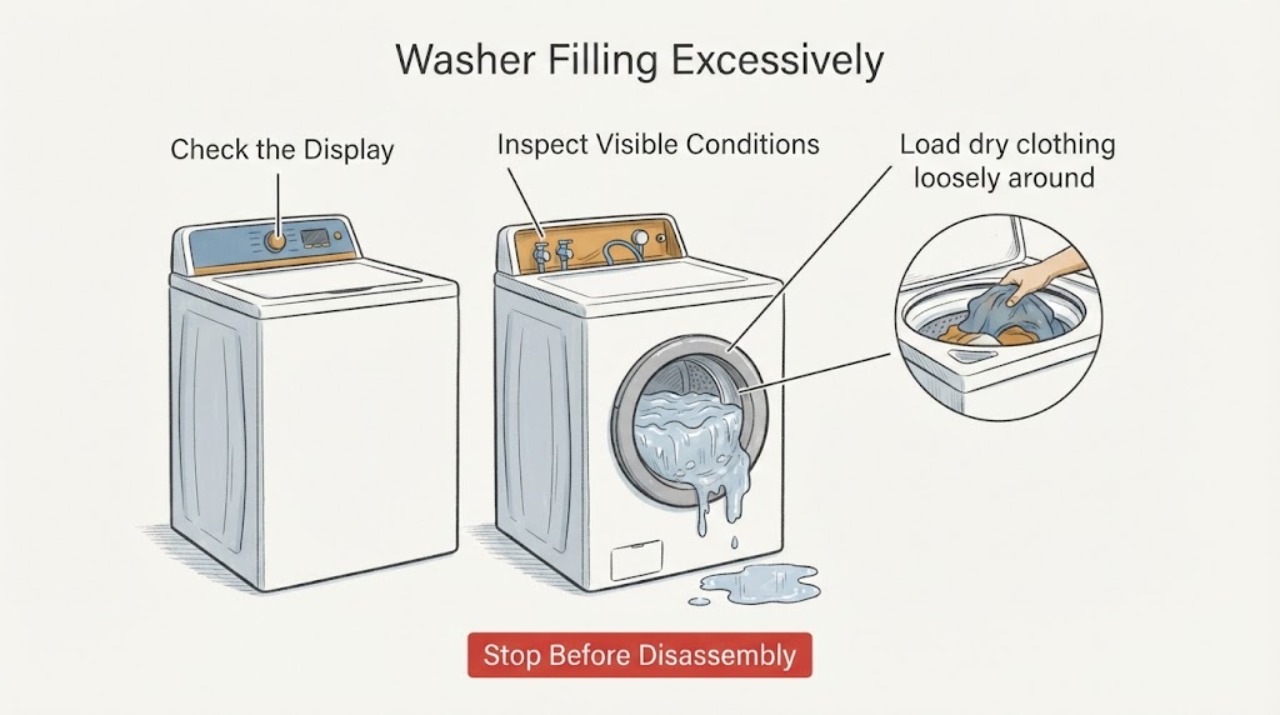
On the GE GTW720BSNWS, a tub that does not fill to the top is not automatically a fault: the model has Adaptive Fill and a Deep Fill option, and GE says load-sensing washers vary the water level with the cycle and load. First confirm the exact model and check whether Deep Fill or a larger Load Size/Water Level was intentionally selected. Load dry clothes loosely, keep the lid closed while sensing, and watch whether filling stops and washing begins. If the water stops below the clothes level, that can be normal for a high-efficiency load-sensing cycle. If water continues entering after the fill phase, rises to overflow, appears on the floor, or keeps flowing with the cycle stopped, press Start/Pause if the lid is locked, close the household hot and cold washer valves if safe, and arrange service. Do not bypass the water-level system or open the console.
Work through in order
Diagnostic checks
Use only checks that match the exact appliance or system and its official guide.
-
Check 1
Read the model label and open GE's GTW720BSNWS Owner Center; before starting, identify the selected cycle, Deep Fill light, and Load Size or Water Level control without changing multiple options at once.
Expected result: Deep Fill is illuminated or the selected load level is larger than intended, the controls show normal sensing, or the label does not exactly read GTW720BSNWS.
Next step: Use the exact GE manual for the confirmed model and make one documented baseline with Deep Fill off and the intended load level. If the identity is unclear, stop before changing settings or ordering parts.
Stop if: Do not remove the console or wiring to identify the model or water-level controls.
Why this matters
Why: This model has Adaptive Fill and Deep Fill, but the amount depends on the selected option and cycle. A near-model manual or an unfamiliar button state can make intended extra water look like overfilling.
-
Check 2
With the machine empty or carrying the ordinary load for the selected cycle, press Deep Fill only as the manual describes, then observe the indicator and whether filling stops before agitation begins; do not hold or press it repeatedly while the tub is filling.
Expected result: A Deep Fill selection adds a deliberate amount and then stops, or water continues rising after the selected fill should be complete.
Next step: For intended extra water, turn Deep Fill off for the next normal-load baseline. For continuous inflow or rising water, press Start/Pause if safe, close both household washer valves, and use the service branch.
Stop if: Do not reach into the tub, hold the lid open against the lock, or try to defeat a lid or water-level control.
Why this matters
Why: GE says Deep Fill adds additional water regardless of manual or load-sensing fill, and holding the button requests a maximum fill on applicable models. A stopped fill followed by washing supports an intentional option; continuous inflow or overflow does not.
-
Check 3
Load dry clothing loosely around the basket, avoid compacting or wrapping items around the infusor, close the lid, and let the washer perform its sensing portion before judging the water level.
Expected result: The basket turns or senses briefly and the level changes with the type and amount of clothing, or the load was tightly packed, placed across the infusor, or added while sensing.
Next step: Redistribute the dry load loosely and keep the lid closed during sensing. Compare one ordinary load with Deep Fill off; do not manually add water to chase a preferred visual level.
Stop if: Do not open the lid while the lid-lock indicator is lit or place hands near the moving basket.
Why this matters
Why: GE says Precise Fill senses the load during filling, while Adaptive Fill can assess weight and absorbency. Dense or incorrectly arranged items can change how much water appears necessary and can make a normal fill look excessive or ineffective.
-
Check 4
During one supervised baseline, note whether the inlet flow stops and agitation or washing begins, and inspect only the floor and visible hose connections for water; do not disconnect a hose or access the inlet valve.
Expected result: Filling stops and the wash phase begins with no water on the floor, the tub keeps filling after washing should begin, or a hose/valve connection is visibly leaking.
Next step: For a normal stopped fill, record the cycle and option for future loads. For continuing water or a leak, pause if safe, close the household valves, keep the washer off, and arrange service; do not name a valve or sensor as proven bad.
Stop if: Stop immediately for overflow, water near the receptacle or cord, a damaged hose, or a valve that will not close.
Why this matters
Why: A stopped fill with dry connections supports normal timed or load-sensed operation. Water that continues past the fill phase, or a visible supply leak, is different from a low-water or unfamiliar-operation concern and may involve the inlet path or control.
-
Check 5
Check the household setup from outside the washer: confirm both supply hoses are routed without sharp kinks, look for visible leaks, and note whether the washer drains water while it is supposed to be filling; do not measure pressure or remove inlet screens unless the exact manual explicitly makes that an owner step.
Expected result: The hoses and floor are dry, a hose is kinked or leaking, or water level falls while the washer fills because water is visibly leaving the machine.
Next step: Correct only a clearly visible routing issue without disconnecting a pressurized hose. If water is escaping, the drain arrangement is abnormal, or the fill remains uncontrolled, close the supply and arrange qualified service or installation help.
Stop if: Do not disconnect hoses, enter the console, bypass the water-level system, or continue a cycle with water on the floor.
Why this matters
Why: GE's fill guidance says fill behavior depends on regulated inlet flow and unobstructed plumbing, while a leak or simultaneous loss of water is a separate installation or drain-path issue. External observations cannot prove an internal valve or sensor failure.
-
Check 6
Run no further test if the washer has overflowed or keeps filling; with the area dry and safe, turn off the washer and close both household supply valves, then record the selected cycle, Deep Fill state, load, and exactly when water failed to stop for the technician.
Expected result: The water stops when the household valves are closed, the valves cannot be closed safely, or water continues despite the washer being turned off.
Next step: Keep the washer isolated and schedule GE or qualified appliance service. If the house valve or supply hose is the wet point, use a qualified plumbing professional; if the washer remains electrically wet, do not restore power yourself.
Stop if: Do not reset, bypass, or repeatedly run the washer to see whether an uncontrolled fill repeats.
Why this matters
Why: Stopping the supply limits a controllable overflow. A valve that will not close, water continuing from the house side, or water near electrical parts is beyond an operating tutorial and requires a broader safety response.
Use your observations
Decision map
Find the observation that best matches what you see, then follow the next safe action.
-
PATH 01Next step
What you see
Deep Fill or a larger Load Size/Water Level is selected, filling stops, and washing begins without water on the floor.
Do this next
Use Deep Fill only for loads that need it and make a normal-load baseline with the option off; follow the exact GTW720BSNWS manual for cycle behavior.
Why this path and its safety boundary
Why it matters: The selected option explains the additional water; it is not evidence of a failed level sensor.
-
PATH 02Next step
What you see
The washer senses briefly, water remains below or around the clothing level, and the level varies with load size or absorbency while the cycle proceeds normally.
Do this next
Keep the load loose, leave the lid closed during sensing, and do not manually add water. Escalate only if the machine overflows, never starts washing, or shows a persistent abnormal symptom.
Why this path and its safety boundary
Why it matters: GE describes this as load sensing or Adaptive Fill behavior. Modern high-efficiency washers are not expected to fill the entire basket for every cycle.
-
PATH 03Next step
What you see
Water continues entering after the fill phase, rises to the top or overflows, or keeps flowing after the washer is turned off.
Do this next
Close both household washer valves if safe, keep the machine off, protect nearby electrical areas, and arrange qualified appliance service. Do not bypass the level control or open the console.
Why this path and its safety boundary
Why it matters: Normal Deep Fill or load sensing does not explain uncontrolled inflow. An inlet valve, control, or related water-level fault is possible, but the external symptom does not identify the part.
-
PATH 04Next step
What you see
Water appears on the floor, a supply hose or valve leaks, the household shutoff will not close, or water is near the receptacle or power cord.
Do this next
Stop using the washer without touching wet electrical parts, close the supply only if safe, and contact qualified appliance or plumbing service as indicated by the wet point.
Why this path and its safety boundary
Why it matters: This is a water and electrical safety stop, not a setting question.
-
PATH 05Next step
What you see
The level concern disappears with Deep Fill off and a loose normal load, but the first user still cannot identify the selected controls or cycle behavior.
Do this next
Keep the exact model manual with the washer and document the normal option state; do not order a water-level part without a later, reproducible uncontrolled-fill symptom.
Why this path and its safety boundary
Why it matters: The issue was likely an operation or option misunderstanding rather than a proven component failure.
Helpful context
Understand the symptom
The GTW720BSNWS is a GE 4.8-cubic-foot top-load washer with Adaptive Fill and Deep Fill. GE describes load sensing as a way to determine water from load weight and absorbency, so a new owner may see less water than in an older washer or a different level on different loads.
Deep Fill is a deliberate water-level choice, not the same as a failed fill sensor. GE says a press of Deep Fill adds water and holding it can request a maximum fill on applicable models; the exact cycle and the illuminated option matter. Conversely, water that never stops, overflows, or continues with the cycle stopped is not explained by normal sensing.
Use the checks below to learn the machine's normal fill sequence without reaching into a moving basket. Stop at the first sign of overflow, a wet electrical area, or a control that will not stop the water.
When checks do not resolve it
Need a professional?
Give the technician the complete GTW720BSNWS model, cycle and Load Size/Water Level selected, whether Deep Fill was illuminated or held, how the load was arranged, whether the basket sensed, when the inlet flow should have stopped, whether the cycle began, and where any water appeared. Ask for diagnosis before accepting a valve, sensor, or control recommendation; the fill symptom alone does not prove a particular part.
Common questions
FAQ
Should the GE GTW720BSNWS fill the tub to the top?
Not for every cycle. GE says load-sensing and Adaptive Fill vary water with the cycle and load, and its loading guidance says water may be just under the clothes level. A full or deeper fill is an intentional Deep Fill choice, not the default requirement.
What does Deep Fill do on this GE washer?
The GTW720BSNWS product page lists Deep Fill. GE's Deep Fill guidance says the option adds water to either a manual or load-sensing fill, while holding the button requests a maximum fill on applicable models. Check the light and exact manual before calling normal selected extra water an overfill.
Why does the water level change from one load to another?
GE says Precise Fill and Adaptive Fill assess load weight and, in some operation, absorbency; clothing type and amount therefore change the level. Load items loosely and keep the lid closed during sensing.
When is extra water a real overfill problem?
Treat it as abnormal when water continues after the fill phase, rises to overflow, appears on the floor, or keeps flowing after the washer is turned off. Close the household supply valves if safe and arrange service; do not bypass the water-level control.
Read the exact guide
Official sources
- Top Load Washer - Loading the WasherGE Appliances · GE top-load washer loading around the basket, avoiding compacted loads or infusor obstruction, and lid-lock behavior when adding items.
- Troubleshooting for GTW720BSNWS | GE AppliancesGE Appliances · Exact GE GTW720BSNWS troubleshooting and service entry for model-specific escalation.
- GE® ENERGY STAR® 4.8 cu. ft. Capacity Washer with Sanitize w/Oxi and FlexDispense® - GTW720BSNWS - GE AppliancesGE Appliances · Exact GE GTW720BSNWS product identity and listed features including Adaptive Fill, Deep Fill, load balancing, and control options.
- User Manual & Care for GTW720BSNWS | GE AppliancesGE Appliances · Exact GE washer model GTW720BSNWS Owner Center, model-specific owner's manual, and service/support entry.
- Top Load Washer - Deep FillGE Appliances · GE top-load washers with Deep Fill, including how the option adds water to manual or load-sensing fills and how a press versus a hold changes the requested level.
- Top Load Washer - Precise Fill Automatic Load SensingGE Appliances · GE top-load washer Precise Fill or Auto Load Sensing, including loose loading and keeping the lid closed while the load is sensed.
- Top Load Washer - Fill FunctionGE Appliances · GE top-load washer fill algorithm, load-sensing or load-size input, regulated valve flow, and external supply restrictions that affect filling.
- Top Load Washer - Change Load Size / Water LevelGE Appliances · GE top-load washer Load Size/Water Level and Deep Fill behavior after the cycle starts.
- Washer - Adaptive FillGE Appliances · GE front- and top-load washer Adaptive Fill load sensing based on load weight and absorbency.
- Washer – Not Enough Water / Low Water LevelsGE Appliances · GE washer water-use context: modern load-sensing machines vary levels, do not fill the basket completely, and should not be manually filled.
Community feedback
Share a repair observation
Share a plain-text repair observation. Accepted observations are published automatically; this page may take a moment to update.