
On this page
Start here
Quick answer
Do not keep running a GE GTWN5050M that is grinding, leaking, and walking across the floor. First stop the cycle, shut off both water valves, and disconnect power only from a safe dry location; never hold the washer in place while it runs. Then identify the first wet point, inspect the visible hoses and standpipe with water off, and check the load and level without forcing the cabinet. GE's official records show GTWN5050MWS as a specific top-load washer variant and say model-specific manuals and parts matter, so the missing suffix must be confirmed before any repair part is chosen. A single unbalanced load or installation issue can cause movement, but recurring grinding, an empty-drum mechanical noise, an active leak, or severe movement needs qualified service. The repair-versus-replacement decision should wait for a written diagnosis and quote; the “do not buy a new model” opinion is not a technical finding.
Before you begin
Safety first
- Do not brace or press on the washer while it runs, reach beneath it, remove panels, operate it with a leak, loosen pressurized hose fittings, or select an internal part from the sound. Keep water valves closed and isolate power only from a safe dry location. Stop for flooding, exposed wiring, a hot or damaged cord, burning odor, sparks, or unsafe movement.
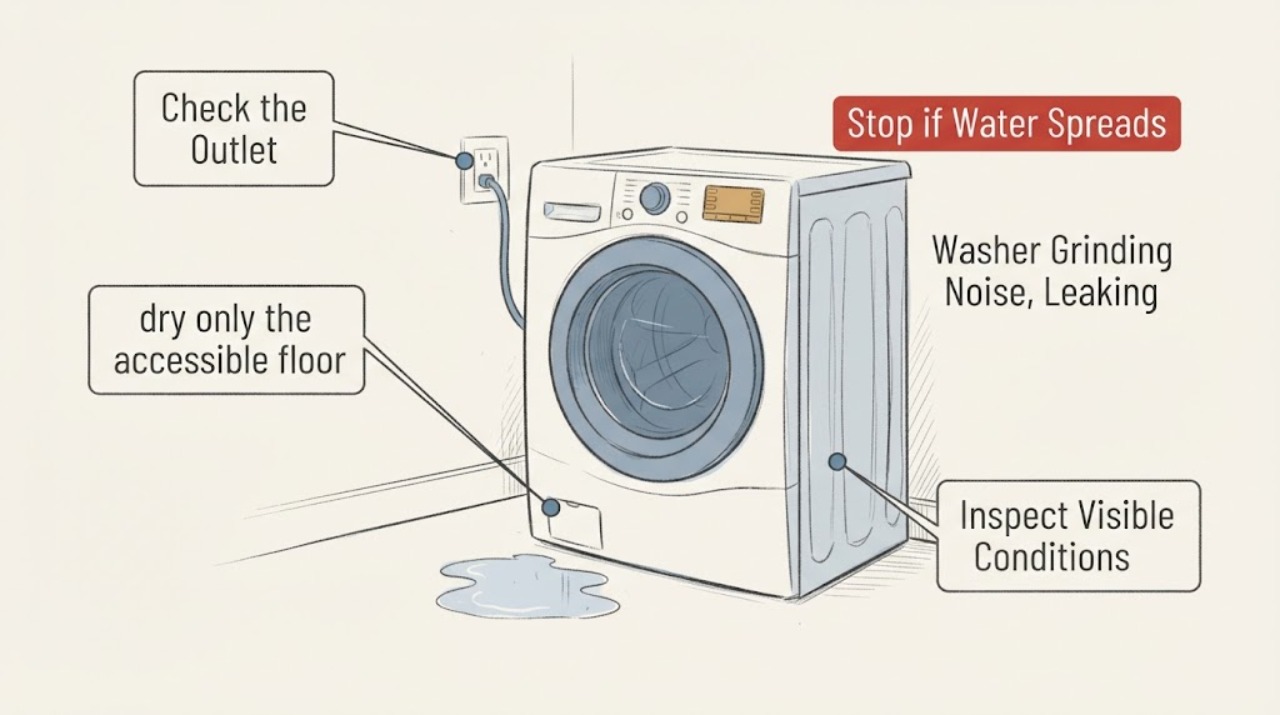
Work through in order
Diagnostic checks
Use only checks that match the exact appliance or system and its official guide.
-
Check 1
Stop the washer and do not restart it while the leak, grinding, or walking is unresolved. Close the hot and cold water valves. If water is near an outlet or you are standing in water, do not reach for the plug; isolate power only from a safe dry location or have a qualified person do it.
Expected result: The washer is stopped, water is still entering or pooling, the floor is wet near electrics, or the cabinet moved substantially.
Next step: Keep the water valves closed and protect the floor. Arrange service promptly for water near electrical parts, a strong burning smell, sparking, a damaged cord, or movement that could tip the washer.
Why this matters
Why: An active water leak and a moving appliance can create slip, water-damage, and electrical hazards. Repeated cycles would also erase the original leak and sound pattern without identifying the cause.
-
Check 2
After the washer is stopped and the area is safe, dry only the accessible floor and cabinet edges. Use a dry tissue or towel at separate visible points and watch where water first appears without pulling the washer out or reaching underneath it.
Expected result: The first wet point is at a rear fill hose, rear drain hose or standpipe, front/left overflow area, under the cabinet, or cannot be located.
Next step: Photograph the first wet point and keep the water supply off. Use the matching external hose or plumbing branch below; call appliance service when the source is hidden or recurring.
Why this matters
Why: GE says a rear leak is often related to installation, hoses, or plumbing, and that an uneven floor can make a rear leak appear at the front. A leak under the cabinet or with no visible source needs appliance diagnosis rather than a hose assumption.
-
Check 3
With power isolated and no cycle running, look at the floor, leveling feet, cabinet clearance, and visible shipping material or recent-move history. Do not press down on the washer, brace it, or put hands under it to test stability.
Expected result: The washer visibly rocks while idle, one foot is not firmly on the floor, the floor is soft or uneven, shipping material may remain, or the installation looks stable.
Next step: Follow the exact installation instructions for any safe leveling or shipping-material check; do not move a full or connected washer alone. If it is stable at rest but repeatedly walks or grinds, schedule service.
Why this matters
Why: GE identifies leveling, a solid floor, shipping material, and unbalanced loads as common contributors to walking and vibration. These observations do not explain a persistent grinding sound or an internal leak.
-
Check 4
Write down the cycle phase and load pattern from the event already observed: filling, agitation, draining, or spinning; one heavy item or mixed load; water level; and whether the noise and movement happened together. Do not run an empty or deliberately unbalanced cycle to reproduce it.
Expected result: The sound occurred only with one bulky load, during agitation, while draining, during spin, at every phase, or even when the basket was not being driven.
Next step: Give the timing and load history to the technician. Keep the washer out of service if the sound recurs, the basket movement is severe, or the noise is accompanied by a leak, odor, or scraping.
Why this matters
Why: GE documents that some top-load sounds can be normal during agitation or drain, while imbalance and leveling can cause rocking during spin. A persistent grinding pattern, especially with a leak or without a load-related trigger, cannot be assigned to one internal part by sound alone.
-
Check 5
With the water valves closed, inspect only the visible fill hoses, drain hose connection, retainer, and standpipe opening. Do not loosen a pressurized fitting, detach a hose while water is present, or reach behind the cabinet.
Expected result: A hose is cracked or wet, a visible washer or connection is damaged, the standpipe backs up or overflows, the drain hose is unsecured, or all visible connections are dry.
Next step: Leave the water off. Arrange plumbing service for standpipe backup or household drainage, and appliance service for a damaged hose connection, cabinet leak, or unresolved source. Do not substitute a hose repair for a grinding diagnosis.
Why this matters
Why: GE links rear leaks to hoses, drain installation, and household plumbing; standpipe overflow points to a plumbing issue, while a dry accessible path shifts concern to an internal leak or another location.
-
Check 6
Read the rating label in place and record the complete model suffix, serial information, and installation setting. Compare the label with GE's model-specific support and parts lookup before considering any component.
Expected result: The label reads GTWN5050MWS or another suffix, shows only GTWN5050M, or cannot be safely read.
Next step: Give the complete label and symptom record to service. Request a written diagnosis that separates load/leveling, hose/plumbing, drain, and internal mechanical causes before approving a part or deciding on replacement.
Why this matters
Why: GE's opened owner center identifies GTWN5050MWS as a 3.6 DOE top-load washer and provides its own manual route; GE also says most repair parts are model specific. A shortened model prefix cannot establish compatibility or a repair-versus-replacement conclusion.
Use your observations
Decision map
Find the observation that best matches what you see, then follow the next safe action.
-
PATH 01Next step
What you see
Water is actively entering, reaches electrical parts, or the washer is moving enough to threaten a person, cabinet, or hose.
Do this next
Keep the cycle stopped, close both water valves, isolate power only from a safe dry point, and arrange qualified appliance service; use plumbing service if the standpipe or household drain backs up.
Why this path and its safety boundary
Why it matters: Safety and water containment take priority over identifying the noise. Continuing to run the washer can worsen flooding or electrical risk.
-
PATH 02Next step
What you see
The first wet point is a visible fill hose, drain hose, retainer, or standpipe, and the cabinet remains dry.
Do this next
Leave the water off and correct only the documented external installation issue through the appropriate appliance or plumbing provider. Have the grinding and walking assessed before resuming normal use.
Why this path and its safety boundary
Why it matters: Installation, hose, or household plumbing is more likely than an internal drive fault, but it does not explain a separate persistent grinding noise.
-
PATH 03Next step
What you see
Walking occurs only with a bulky or one-sided load, while the washer is visibly level and there is no continuing leak or grinding when idle.
Do this next
Do not hold the washer during operation. Follow the exact manual's safe loading and leveling guidance; schedule service if movement persists with ordinary loads or the leak returns.
Why this path and its safety boundary
Why it matters: Load distribution or the installation surface is more likely than a confirmed transmission, suspension, or motor failure.
-
PATH 04Next step
What you see
Grinding recurs across loads, occurs when no load-related trigger is present, is accompanied by scraping or odor, or continues after the external leak path is dry.
Do this next
Keep the washer stopped and request model-specific diagnosis. Do not remove panels, reach under the machine, run a forced test, or order a transmission, pump, belt, bearing, or motor from the sound alone.
Why this path and its safety boundary
Why it matters: An internal mechanical, drain, drive, or other appliance fault remains possible. GE's sound descriptions cannot identify a part for this exact symptom combination.
-
PATH 05Next step
What you see
A repair person says not to buy a new model but provides no written diagnosis, exact model confirmation, or explanation of the leak and grinding path.
Do this next
Request the complete model-based findings and a written quote that identifies the confirmed fault and what the repair addresses. Decide on repair or replacement only after that information.
Why this path and its safety boundary
Why it matters: A purchase opinion is not evidence that this washer is safe, repairable, or uneconomic to repair. The missing suffix also prevents a reliable compatibility decision.
Helpful context
Understand the symptom
Why all three symptoms matter
Walking can come from an unbalanced load, shipping material, leveling, or the floor, while a leak can come from a hose, drain installation, standpipe, overflow, or an internal assembly. Grinding may be a normal cycle sound in some GE top-load designs or may be a mechanical fault when it is persistent or occurs with an empty machine. The combination should be triaged by location and timing rather than reduced to one guessed transmission, pump, or bearing.
Repair or replace
A repair person's opinion about newer models is not enough to decide. Get the exact label, the leak location and timing, the cycle phase and sound pattern, and a written diagnosis that states what was found and what the proposed repair would address. Do not authorize a component from the sound alone.
When checks do not resolve it
Need a professional?
Arrange qualified GE washer service for recurring grinding, walking with ordinary loads, a leak from the cabinet or an inaccessible area, a leak that returns after a visible hose/plumbing correction, or any need to inspect the drain, drive, suspension, motor, pump, or internal wiring. Use a qualified plumber for household standpipe backup.
Safety scope: Do not brace or press on the washer while it runs, reach beneath it, remove panels, operate it with a leak, loosen pressurized hose fittings, or select an internal part from the sound. Keep water valves closed and isolate power only from a safe dry location. Stop for flooding, exposed wiring, a hot or damaged cord, burning odor, sparks, or unsafe movement.
Have this ready
- Provide the complete model and serial label, including any suffix after GTWN5050M, the home installation setting, first wet point, valve and hose observations, cycle phase, load pattern, sound description, movement severity, floor/level observations, and photos.
Common questions
FAQ
Does “do not buy a new model” mean this GE washer should be repaired?
Not by itself. That is an opinion, not a diagnosis. Confirm the complete GTWN5050M suffix, locate the first wet point, document the cycle and sound pattern, and obtain a written diagnosis and quote before deciding.
Can I hold the washer down or run it empty to identify the grinding?
No. Do not brace a moving washer or run a deliberate test while it leaks or grinds. Keep water off, record what already happened, and have a qualified technician assess the machine if the problem recurs.
Read the exact guide
Official sources
- Top Load Washer - Noises Heard During AgitationGE Appliances · Official GE noise descriptions used to distinguish cycle-timed sounds from persistent noise; the page does not identify a specific internal part for GTWN5050M.
- Washer - Leaking in RearGE Appliances · Official GE washer leak guidance used for visible external checks with water supply off; it does not rule out an internal leak or explain a separate grinding fault.
- User Manual & Care for GTWN5050MWSGE Appliances · Official GE owner center for the GTWN5050MWS suffix variant; used to show why the shortened GTWN5050M identity must be confirmed before applying a manual or parts decision.
- Top Load Washer - Leaking Water in FrontGE Appliances · Official GE top-load front-leak guidance used to distinguish overflow and oversudsing patterns; it is not a diagnosis of an internal grinding or cabinet leak.
- Top Load Washer - Walking or VibratingGE Appliances · Official GE top-load guidance used for safe external checks; it is not a part diagnosis for the combined GTWN5050M grinding-and-leak symptom.
- Washer - Leaking TroubleshootingGE Appliances · Official GE index used to scope the external leak branches; it directs the user to the matching detailed article rather than naming an internal part.
- Support for GE Washers and DryersGE Appliances · Official GE washer support hub used for model lookup and qualified service routing; it does not establish a repair-versus-replacement outcome.
- GE Appliance - Finding Parts for Your ApplianceGE Appliances · Official GE parts guidance used to prevent selecting a transmission, pump, belt, bearing, or other part from the sound alone.
Community feedback
Share a repair observation
Share a plain-text repair observation. Accepted observations are published automatically; this page may take a moment to update.