
On this page
Start here
Quick answer
First establish where the oily material is: on the clothes, in the wash water or tub, or on the floor under the GE washer. GE says many oily clothing stains arrive on the garments, come from liquid fabric softener, or can be associated with the water supply; for washers made from 1995 onward, GE also says transmission oil cannot get into the washer and splatter clothing. GE treats oil leaking onto the floor differently and says it comes from the transmission and needs service. Do not dry affected clothes until the stain is gone, do not choose a transmission or seal part from a generic symptom, and arrange qualified service if oil is truly in the tub after a model-approved no-detergent check, returns repeatedly, or is found on the floor.
Before you begin
Safety first
- Do not remove panels, tip the washer, probe live wiring, bypass lid or door controls, or order a transmission, seal, pump, or hose from the symptom alone. Keep the washer off for oil on the floor, an oily film that returns in an empty tub, smoke, burning odor, electrical wetness, repeated breaker trips, severe vibration, or a spreading water leak.
Work through in order
Diagnostic checks
Use only checks that match the exact appliance or system and its official guide.
-
Check 1
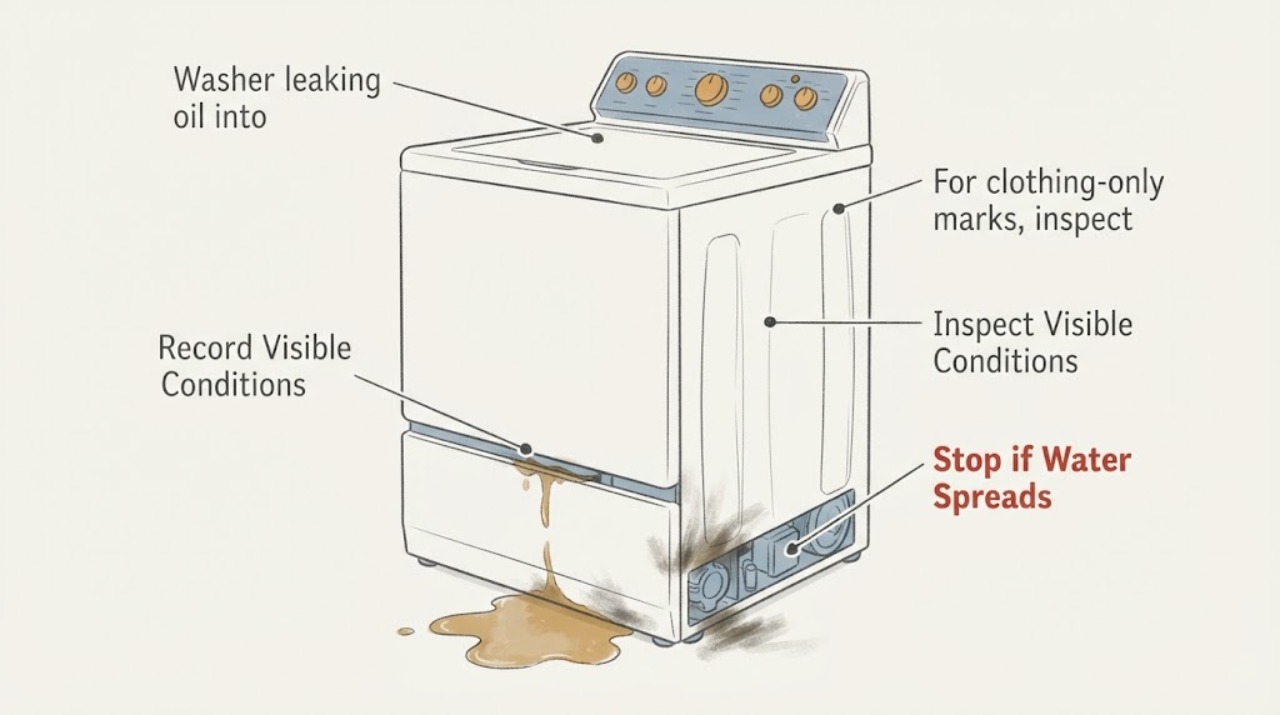
Stop the cycle from a dry, safe position and identify where the oil-like material is actually visible: on one or more garments, floating or coating the wash water or tub, or on the floor beneath the washer. Record the full model and approximate manufacture year if available, whether it is a top-load or front-load washer, and which cycle phase exposed the material.
Expected result: The marks are only on clothing, a film or droplets are visible in the tub with no clear source, oil is on the floor or cabinet underside, or the location is uncertain.
Next step: Photograph the material and keep the affected garments out of the dryer. If there is oil on the floor, a spreading leak, smoke, or an electrical hazard, keep the washer out of use and arrange qualified service; if the location is uncertain, do not dismantle the washer to find it.
Stop if: Do not reach into moving or hot water, touch a wet plug or outlet, tip the appliance, or continue cycles to make the symptom reappear.
Why this matters
Why: This is the key split for this symptom. GE says oily clothing stains can come in on the load, from liquid fabric softener, or from the water supply, while its separate floor-oil guidance attributes oil on the floor to the transmission. The 1995-and-newer clothing guidance is not a model-year finding for an unidentified washer.
-
Check 2
For clothing-only marks, inspect the affected garments and the accessible detergent or softener dispenser without removing panels. Note whether the marks were already present before washing, whether they are on one load or many, whether liquid softener was overdosed or contacted dry fabric directly, and whether any oil-like material is visible in the empty tub.
Expected result: Marks track a particular garment or load and the tub is clean, or the same film is visible in the tub or on many otherwise clean loads; a dispenser has visible buildup or misuse is documented.
Next step: For a load-specific stain, follow fabric-care instructions and GE's stain guidance: pretreat with undiluted detergent, wait the stated dwell time, rewash at a fabric-safe temperature, and do not use fabric softener until the cause is clear. If the tub itself is oily or the symptom repeats across loads, continue to the model-gated confirmation and service branch.
Stop if: Do not pour solvent, bleach, dish soap, or an unapproved cleaner into the washer, and do not put a garment with an unresolved oily or flammable contamination into the dryer.
Why this matters
Why: A load-specific pattern with no tub or floor oil is more consistent with incoming cooking or body oil, fabric softener, or another laundry input than a washer transmission leak. GE warns that softener should be measured, put in the dispenser when available, and kept from direct contact with clothing; a repeated tub film is not explained by a single garment.
-
Check 3
If the exact GE owner's manual permits a no-detergent Rinse and Drain, extra-rinse, or comparable empty check for that model, run only that documented check with no laundry or additives while remaining nearby; otherwise skip the test. Observe the discharged water and tub after the check rather than opening the cabinet.
Expected result: The model-approved empty check is clear and the oily appearance does not return, suds or residue appears without detergent, or an oily film or droplets return in the empty tub.
Next step: If residue or suds point to laundry-product buildup, follow the matching manual and GE detergent guidance before one supervised verification. If an oily film returns without laundry or detergent, stop using the washer, retain the photos and model information, and request qualified GE appliance service for diagnosis.
Stop if: Do not run a hot or loaded experiment, repeat cycles to force a leak, remove panels, bypass a lid or door interlock, or perform live electrical or mechanical tests.
Why this matters
Why: A clear result lowers the likelihood that the washer is continuously releasing oil but does not prove the source; GE notes that detergent buildup can be confirmed by seeing suds in a no-detergent wash and that some models provide Rinse and Drain. Returning oil-like material in an empty tub is a service signal, not proof of a specific bearing, seal, pump, or transmission part.
-
Check 4
From ordinary dry access, check the floor and visible cabinet edges for a separate oil puddle, black greasy trail, fresh water near the plug or outlet, burning odor, smoke, repeated breaker trips, grinding, or a loose or severely vibrating basket. Do not pull the washer forward or inspect underneath by tipping it.
Expected result: Oil is present on the floor or cabinet underside, or the oily symptom is accompanied by a burning smell, smoke, electrical wetness, severe noise, or unsafe vibration; or none of these signs is present.
Next step: For floor oil or any hazard, keep the washer out of use, isolate water and power only from a dry safe position, and arrange qualified service. If the floor is dry and the only symptom is a load-specific stain, use the clothing-care branch and monitor rather than ordering an internal part.
Stop if: Do not open the cabinet, attempt a transmission or seal repair, move an unstable machine, reset a tripping breaker, or operate with oil or water near electrical equipment.
Why this matters
Why: GE's oil-on-floor support page identifies floor oil as a transmission leak and says the existing transmission is not repaired; it must be replaced by service. Noise, vibration, smoke, or electrical wetness can add hazards but cannot identify a safe part from the outside.
Use your observations
Decision map
Find the observation that best matches what you see, then follow the next safe action.
-
PATH 01Next step
What you see
Oily spots appear on one load or on garments that may have been exposed to cooking or body oil, while an empty visible tub has no oil film and no oil is on the floor.
Do this next
Pretreat and rewash according to fabric care and GE's oil-stain guidance, air-dry until the stain is confirmed gone, and avoid direct or excessive fabric-softener contact. Escalate if the same residue appears in the tub or across unrelated loads.
Why this path and its safety boundary
Why it matters: GE describes these as often-invisible oily soils that become visible after washing; the pattern does not establish a washer fault or justify a transmission part.
-
PATH 02Next step
What you see
A model-approved no-detergent check shows suds or product residue but no persistent oily film, and the issue improves after correct detergent or softener use.
Do this next
Follow the exact model manual for cleaning and rinse options, then perform one supervised verification. Stop and request service if an oily film returns without laundry or additives.
Why this path and its safety boundary
Why it matters: The result is more consistent with detergent or softener buildup than transmission oil; GE says no-detergent washing can reveal detergent buildup and recommends correct dosing and available rinse options.
-
PATH 03Next step
What you see
An oily film or droplets return in an empty tub, the residue appears across unrelated loads, or oil is visibly present on the floor or cabinet underside.
Do this next
Keep the washer out of use, provide the technician with the model, approximate year, phase, photos, and whether the floor or tub was affected, and ask for confirmation of the source before any part is selected.
Why this path and its safety boundary
Why it matters: This is no longer a simple clothing-stain decision. GE specifically directs floor-oil cases to service and attributes them to the transmission; an oil-like film inside the tub still needs model-specific diagnosis rather than a guessed part.
-
PATH 04Next step
What you see
The oily marks are black or greasy and the home's water supply is extremely hot, at or above the temperature GE identifies as a possible hose-breakdown condition, or the washer has smoke, burning odor, electrical wetness, or repeated breaker trips.
Do this next
Stop using the washer and arrange qualified service to assess the water temperature, hoses, and appliance condition; use the exact owner's manual for any hose replacement decision. Do not continue operating until the hazard is resolved.
Why this path and its safety boundary
Why it matters: GE warns that water at 150 degrees Fahrenheit or higher can break down an inlet hose and cause black greasy stains. The accompanying electrical or heat symptoms require a safety stop, not another wash test.
When checks do not resolve it
Need a professional?
Arrange qualified GE appliance service when oil is on the floor, the source is in the tub after a model-approved no-detergent check, the symptom returns across unrelated loads, the model/year cannot be matched to the applicable GE guidance, or any electrical, heat, movement, or flooding hazard is present.
Safety scope: Do not remove panels, tip the washer, probe live wiring, bypass lid or door controls, or order a transmission, seal, pump, or hose from the symptom alone. Keep the washer off for oil on the floor, an oily film that returns in an empty tub, smoke, burning odor, electrical wetness, repeated breaker trips, severe vibration, or a spreading water leak.
Have this ready
- Provide the full model and serial information if available, approximate manufacture year, top-load or front-load design, cycle phase, photos of the garment marks, tub or floor residue, detergent and softener products and amounts, whether a dryer was used, and the result of any model-approved empty check.
Common questions
FAQ
Can a GE washer put transmission oil on clothes?
GE says the transmission design of washers made from 1995 onward makes that impossible, and its support guidance says most oily clothing stains come from the load, fabric softener, or another input. Because the model and year are not supplied here, confirm the exact appliance before applying that year-specific statement.
What if I see oil under my GE washer?
GE's separate oil-on-floor guidance says floor oil comes from the washer transmission, that the existing transmission is not repaired, and that service is needed. Keep the washer out of use and do not tip it or attempt a transmission repair.
Should I run another wash to see whether the oil comes back?
Do not repeat uncontrolled cycles. Only use a no-detergent Rinse and Drain or similar empty check if the exact GE manual documents it for your model; if an oily film returns, stop and arrange service. Keep affected clothing out of the dryer until the stain is gone.
Could fabric softener look like oil on GE washer clothing?
Yes. GE lists liquid fabric softener as a possible contributor to oily stains and advises measuring it, using the dispenser when available, and preventing direct contact with dry clothing.
Read the exact guide
Official sources
- Washers Greasy or Oily StainsGE Appliances · Directly applicable to GE washer clothing stains and laundry-additive checks; it does not identify a universal internal washer oil fault.
- Washer - Leaking Oil on FloorGE Appliances · Directly applicable when oil is found on the floor or beneath the washer; it is a service boundary, not proof of an oil-in-tub cause.
- Washer - Soap or White Residue in ClothesGE Appliances · Applicable only to distinguishing detergent or softener buildup from an oily appearance; model-specific options still control.
- Frequently Asked Questions About GE WashersGE Appliances · Applicable to GE's distinction between oil leaking from a washer and clothing stains, and to service escalation; it does not replace the exact model manual.
- Washer - Oil on Clothes After WashingGE Appliances · Directly applicable to GE's 1995-and-newer transmission statement, clothing-stain distinction, stain treatment, and high-temperature hose warning; exact model/year remains necessary.
- How to Get Oil Out of ClothesGE Appliances · Applicable to handling affected clothing, especially avoiding heat until an oily stain is confirmed gone; it is not a washer internal-failure diagnosis.
Community feedback
Share a repair observation
Share a plain-text repair observation. Accepted observations are published automatically; this page may take a moment to update.