
On this page
Start here
Quick answer
GE's cleaning guidance differs between front-load and top-load washers. For a front loader, inspect and wipe the accessible door-gasket folds, clean the dispenser area as the Owner's Manual allows, and run the model's BasketClean or Self Clean cycle with one approved cleaning product. For a top loader, leave the lid open between uses and use Basket Clean when available or the GE top-load odor guidance. Unplug before maintenance, use only one cleaning chemistry at a time, and never mix chlorine bleach with vinegar, ammonia or acids. Visible surface growth that returns, a blocked or inaccessible area, standing water, leaks or a damaged gasket needs the model manual and qualified service; do not remove panels or assume hidden mold can be cleaned by a generic disassembly.
Before you begin
Safety first
- Disconnect power before maintenance, never mix bleach with vinegar, ammonia or acids, do not remove panels or the basket to reach hidden growth, and stop for fumes, leaks, damaged cords or electrical concerns.
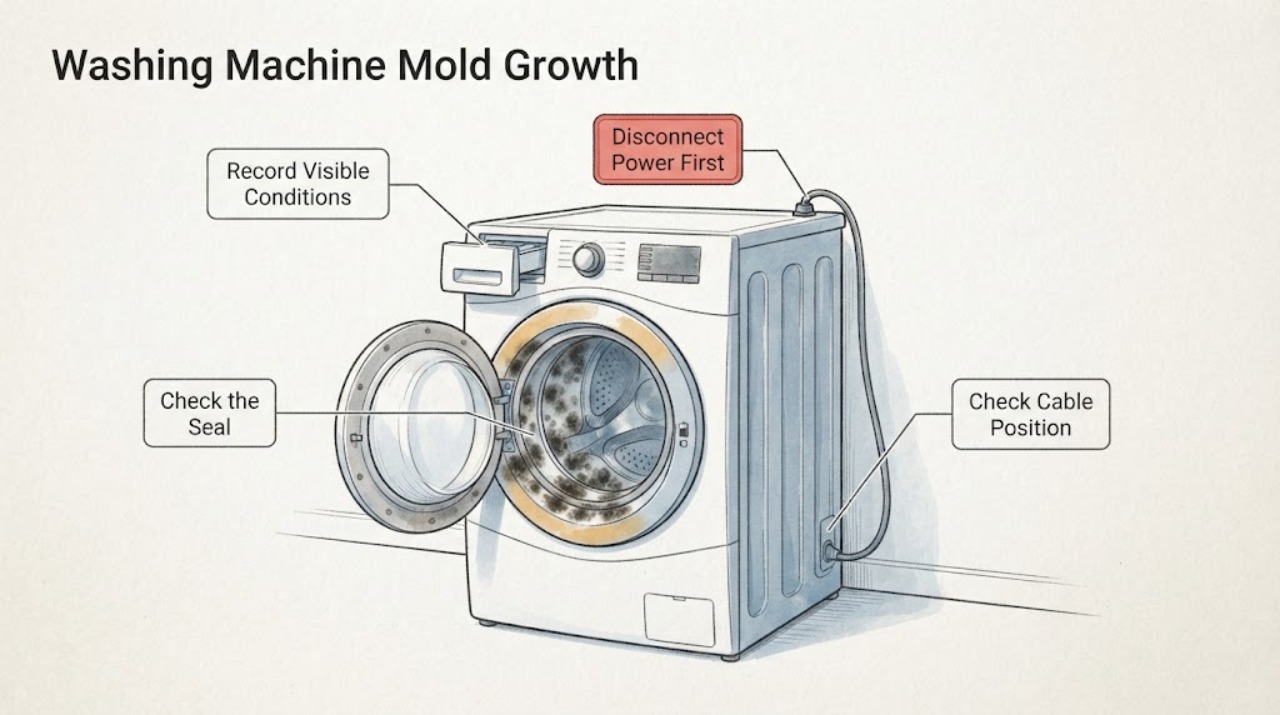
Work through in order
Diagnostic checks
Use only checks that match the exact appliance or system and its official guide.
-
Check 1
Record the washer model and identify whether growth or odor is at the front-load gasket, dispenser, tub/basket, top-load lid/tub, drain area or an inaccessible seam.
Expected result: The affected area is visible and user-accessible, or the report is only an odor with no visible growth or points to a hidden area.
Next step: Use the matching GE path for visible areas. If the area is hidden or the washer type/model is uncertain, stop before disassembly and use the Owner's Manual or service.
Why this matters
Why: GE provides separate front-load gasket/dispenser/tub guidance and top-load ventilation/tub guidance; a hidden area cannot be assigned a generic cleaning step.
-
Check 2
Before cleaning, stop the washer and disconnect power at the plug or household disconnect as directed by the model, then inspect only accessible gasket, dispenser, lid and tub surfaces.
Expected result: The washer is safely disconnected and the growth is on a reachable surface, or the surface cannot be reached without tools or panel removal.
Next step: Clean only the reachable surface using the model-appropriate instructions. Do not remove the cabinet, basket or gasket mounting to chase unseen growth.
Why this matters
Why: GE's safety guidance says to disconnect power before maintenance or cleaning; inaccessible buildup is outside a generic surface-cleaning step.
-
Check 3
Choose one approved cleaning product or solution for the applicable GE instruction and keep bleach, vinegar, ammonia, acids and other cleaners separate.
Expected result: Only one product is being used, or products have already been combined or residue from an earlier product remains.
Next step: Do not add another chemical. Ventilate and seek appropriate help if fumes are present; otherwise rinse/wipe only as the GE model guidance directs, then use a single-product cycle later if appropriate.
Why this matters
Why: GE warns that mixing chlorine bleach with ammonia or acids such as vinegar or rust remover can produce toxic gas; residue should be removed according to the model instructions before another product is considered.
-
Check 4
Run the exact model's empty Basket Clean, Self Clean or other GE-approved tub-clean cycle with one approved product and let it finish without laundry.
Expected result: The cycle completes and the visible growth or odor improves, or the cycle cannot be selected, is interrupted, or the problem returns.
Next step: If improved, follow the model's recurring maintenance interval. If not improved or the cycle cannot complete, stop repeating unverified chemicals and consult the manual or qualified service.
Why this matters
Why: GE uses these cycles to remove residue and reduce mold/mildew odors, but repeated or inaccessible growth may require model-specific maintenance or service.
-
Check 5
After cleaning, check moisture retention, detergent use, lid/door ventilation and visible drain-hose placement; arrange service for recurring growth, standing water, leaks or a damaged gasket.
Expected result: Growth returns despite the model-matched cleaning cycle, water remains, a gasket or hose is damaged, or the affected area is hidden.
Next step: Stop using the affected function if there is a leak or electrical hazard and provide the model, photos, cleaning products and cycle history to qualified service. Do not disassemble the washer.
Why this matters
Why: Recurring moisture, drainage or inaccessible buildup is not proven to be a surface-cleaning problem and may require a model-specific inspection.
Use your observations
Decision map
Find the observation that best matches what you see, then follow the next safe action.
-
PATH 01Next step
What you see
Growth is visible in a front-load gasket, dispenser area or other user-accessible surface, and there is no leak or electrical damage.
Do this next
Disconnect power before cleaning, use one approved solution, wipe away residue with warm water and follow the exact manual for the dispenser or pump filter.
Why this path and its safety boundary
Why it matters: GE's front-load guidance supports gasket/dispenser cleaning and a model-matched tub-clean cycle for residue and mildew odor.
-
PATH 02Next step
What you see
The washer is top-load and the concern is mildew odor or visible tub residue after the lid has stayed closed between uses.
Do this next
Leave the lid open between uses and run the applicable empty tub-clean cycle with one approved product; check the drain-hose position if odor persists.
Why this path and its safety boundary
Why it matters: GE identifies trapped moisture and poor air circulation as a common top-load odor contributor.
-
PATH 03Next step
What you see
Bleach has been mixed with vinegar, ammonia, rust remover or another acid, or fumes are present.
Do this next
Stop adding chemicals, leave the area and obtain appropriate help for fumes; do not run another cleaning cycle until the situation is safe and the product directions are clear.
Why this path and its safety boundary
Why it matters: GE warns that these combinations can produce toxic gas.
-
PATH 04Next step
What you see
Growth is behind the basket/cabinet, returns after model-matched cleaning, or is accompanied by standing water, leakage or a damaged gasket.
Do this next
Use the exact Owner's Manual and arrange qualified service; do not remove panels, pull the basket or use unverified chemical or disassembly steps.
Why this path and its safety boundary
Why it matters: The issue is not established as a removable surface deposit and may involve drainage, sealing or inaccessible buildup.
Helpful context
Understand the symptom
Mold or mildew growth is most useful to classify by location and washer design. GE's front-load guidance addresses the door gasket, dispenser drawer, tub and accessible pump filter, while its top-load guidance focuses on lid ventilation, tub cleaning and drain-hose installation. Those paths support safe cleaning of visible or user-accessible areas; they do not prove that unseen buildup behind the basket or cabinet can be removed without model-specific service.
Identify the washer type and where the growth is visible
Record the complete model number and whether the washer is front-load, top-load or a specialized UltraFresh model. Photograph the visible area: door-gasket fold, dispenser, basket/tub, lid area, drain opening or an inaccessible seam. GE's front-load article explicitly describes cleaning the gasket and dispenser; its top-load article attributes musty odor to moisture left in the tub when the lid stays closed. Do not call an odor alone proof of mold or use front-load access instructions on a top loader.
Clean accessible front-load surfaces
For a front loader, unplug before maintenance, open the door and inspect the accessible gasket folds and drain holes. Remove only loose foreign material that can be reached without tools, then wipe the gasket with the mild or diluted solution permitted by GE and wipe away all cleaning solution with warm water. Clean the dispenser drawer area according to the exact Owner's Manual. Do not pull the gasket out of its mounting, remove panels or combine cleaning products.
Run the model-matched tub-clean cycle
Use one empty-tub cleaning cycle that the model supports. GE describes Basket Clean for many top-load models and Self Clean for UltraFresh front-load models; other front-loaders may use the model's Heavy/Cotton cycle when no BasketClean function exists. Use one cup of the single approved product named by the applicable GE instructions, never a mixture, and allow the cycle to complete. If the cycle is interrupted, follow the model guidance before returning clothes to the washer.
Reduce moisture and recurring residue
Use the detergent amount and type specified for the washer; GE says excess detergent can leave residue in a front-load outer tub. Leave a top-load lid open between uses, or use the model's approved vent feature if equipped. Check that a drain hose is not pushed too far into the standpipe, since GE says siphoning can return water and create a musty odor. UltraFresh models have a model-specific vent and drain design, so do not retrofit or disable it.
When checks do not resolve it
Need a professional?
Use qualified GE service for recurring or hidden mold growth, standing water, a leaking or damaged gasket/hose, an inaccessible pump area, incomplete cleaning cycles or any chemical, electrical or water-safety concern. Do not disassemble the washer to chase unseen growth.
Safety scope: Disconnect power before maintenance, never mix bleach with vinegar, ammonia or acids, do not remove panels or the basket to reach hidden growth, and stop for fumes, leaks, damaged cords or electrical concerns.
Have this ready
- Full model number, washer type, photos and location of visible growth, odor history, cleaning product and cycle used, detergent amount, drain-hose position, standing-water or leak observations, and whether the gasket or dispenser is damaged.
Common questions
FAQ
Can I use bleach and vinegar together to clean GE washer mold?
No. GE warns not to mix chlorine bleach with ammonia or acids such as vinegar or rust remover because the combination can produce toxic gas. Use only one product or solution at a time and follow the applicable model instructions.
How do I clean mold from a GE front-load washer gasket?
Disconnect power, inspect the accessible gasket folds and drain holes, remove reachable foreign material, and wipe the gasket with the mild or diluted solution GE permits for the model. Wipe away all cleaning solution with warm water; do not remove the gasket from its mounting.
Why does a GE top-load washer smell musty after cleaning?
GE says a closed lid can trap moisture and create a musty odor, and a drain hose pushed too far into the standpipe can siphon water back into the washer. Leave the lid open between uses, run the applicable tub-clean cycle and check the hose placement.
Read the exact guide
Official sources
- Top Load Washer - Cleaning the TubGE Appliances · Opened the official GE Appliances top-load tub-clean page. It supports an empty Basket Clean cycle when available, a single approved cleaning product and completion of an interrupted cycle before normal use.
- GE Washer Owner's Manual Safety InformationGE Appliances · Opened the official GE-hosted washer manual PDF. It supports disconnecting power before maintenance, not mixing chlorine bleach with ammonia or acids such as vinegar/rust remover, and not attempting repairs outside understood published instructions. It is used for safety boundaries, not for a model-specific cleaning cycle.
- Top Load Washer - Odor in TubGE Appliances · Opened the official GE Appliances top-load support page. It identifies closed-lid moisture, provides a top-load cleaning route and supports checking drain-hose siphoning. It is not used for front-load procedures.
- UltraFresh Front-Load Washer - Self-Clean CycleGE Appliances · Opened the official GE Appliances UltraFresh page. It applies only to front-load washers with the UltraFresh Vent System with OdorBlock and supports the Self Clean cycle, single-product use, interruption handling and manual-specific gasket/pump-filter directions.
- Front Load Washer - Odor in TubGE Appliances · Opened the official GE Appliances support page. It applies to front-load washers and supports monthly tub cleaning, model-specific pump-filter/dispenser instructions, accessible gasket cleaning, detergent-residue control and drain-hose siphoning checks.
Community feedback
Share a repair observation
Share a plain-text repair observation. Accepted observations are published automatically; this page may take a moment to update.