
On this page
Start here
Quick answer
For a GE Hotpoint HTW240ASK2WS that fills, drains, and never reaches wash while showing 18 19 26 27, first determine whether water is being lost through the external drain setup or whether the tub completed draining and the washer then failed to advance. GE's public support says a drain hose that is too low, inserted too far, or sealed to the standpipe can siphon water as the washer fills; it also says the fill path needs open household valves, unobstructed hoses and screens, and adequate pressure. The public GE pages opened for this model family do not provide a complete consumer mapping for all four numeric codes, so do not borrow meanings or parts from another GE platform. If the hose and supply path look correct, the tub is empty, and the same sequence returns, stop using the washer and give service the exact model, complete display, cycle, and timing. Stop immediately for uncontrolled filling, a leak, water near electrical parts, smoke, burning odor, a damaged cord, or repeated breaker operation.
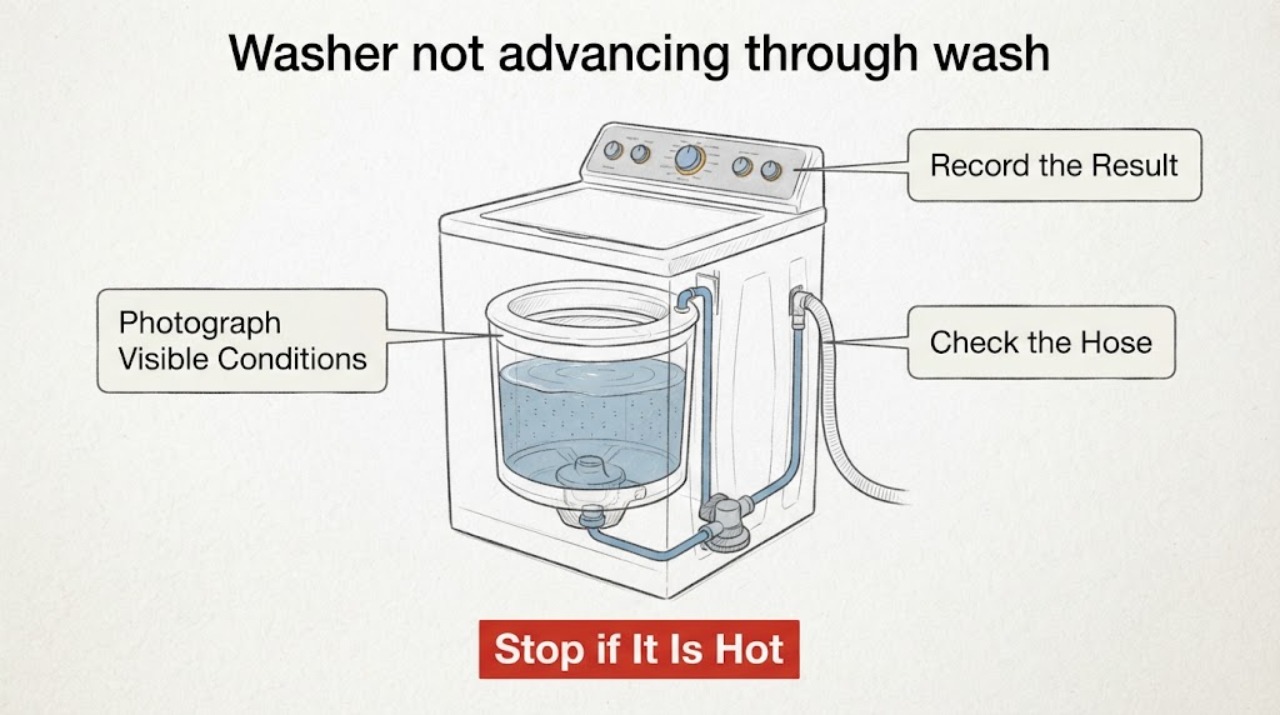
Work through in order
Diagnostic checks
Use only checks that match the exact appliance or system and its official guide.
-
Check 1
From a dry, safe position, photograph the entire display, note which cycle-status lights are on, write down the order of events from filling to draining, and confirm the rating-label model is HTW240ASK2WS rather than a visually similar Hotpoint or GE washer.
Expected result: The label and full display are clear, the washer is the assigned HTW240ASK2WS, or the model/code is partial, different, or unreadable.
Next step: Preserve the photo and sequence. If the identity is different or cannot be confirmed, use only that model's manual or arrange service; do not apply an unrelated GE code chart.
Stop if: Stop if the display accompanies smoke, a burning smell, a hot or damaged cord, a leak, uncontrolled filling, water near electrical parts, or repeated breaker operation.
Why this matters
Why: The exact model family has rotary-electronic cycle-status controls, but the public GE pages do not establish that 18, 19, 26, and 27 have the same meaning on every GE washer. An incomplete identity makes a code-specific reset or part choice unsafe.
-
Check 2
With the washer stopped, inspect only the visible drain hose and standpipe connection. Compare its routing with the HTW240ASK2WS installation instructions: look for a hose end sitting too low, pushed too far into the standpipe, sealed airtight, unsupported, kinked, or visibly damaged; do not pull the washer out or remove rear hardware for this check.
Expected result: Water was leaving while the tub was filling and the hose is low, deeply inserted, airtight, unsupported, kinked, or damaged, or the hose appears correctly routed and the tub only drains after filling.
Next step: Correct only an obvious external routing or support issue using the exact model instructions, then perform one supervised model-approved test. If the hose is damaged, the connection cannot be corrected safely, or the loop returns, request service.
Stop if: Do not seal the hose into the standpipe, reach behind a wet or unstable washer, open the cabinet, or continue a test when water is near electrical parts.
Why this matters
Why: GE says an incorrect drain-hose or standpipe arrangement can siphon water back out while the machine fills. A correctly routed visible hose makes siphoning less likely but does not identify a failed internal part.
-
Check 3
If the drain hose is visibly correct, check the accessible household water valves and inlet hoses from a dry position. Confirm the valves are open, the hoses are not kinked or crushed, and there is no obvious restriction at the accessible inlet path; do not disconnect a pressurized hose or probe the valve electrically.
Expected result: A valve is closed, a hose is kinked or damaged, the supply is unusually weak, or the visible supply path is open and unobstructed.
Next step: Correct only an accessible closed valve or hose kink, then retry once if the washer is dry and safe. If supply is confirmed and the fill-drain/no-wash sequence returns, leave the washer off and provide the evidence to service rather than choosing a part by code guesswork.
Stop if: Close the water supply and stop for a leaking or burst hose, flooding, water near electrical parts, or any connection that cannot be safely isolated.
Why this matters
Why: GE says the fill algorithm depends on the water valves and unobstructed inlet path, with sufficient household pressure. A sound visible supply path makes a simple fill restriction less likely, but it cannot prove that an internal valve, sensor, pump, or control is good.
-
Check 4
After any obvious external hose correction, observe one supervised cycle only from outside the washer. Note whether water level holds, whether the tub drains completely, whether the wash phase begins, and whether the same 18 19 26 27 display returns; do not enter service mode or repeatedly reset the controls.
Expected result: The washer now holds water and begins wash, it drains but remains stuck with an empty tub, or water remains or drains slowly.
Next step: For an empty tub with the same display, stop and request qualified GE/Hotpoint service with the exact model and timing. For remaining water or slow drainage, stop the cycle and report the water level and drain behavior rather than opening the pump area.
Stop if: Stop the test immediately for abnormal movement, loud grinding, smoke, burning odor, a leak, uncontrolled filling, a hot cord, or breaker operation.
Why this matters
Why: Recovery after correcting a visible drain installation supports siphoning as the first problem. An empty tub followed by no wash, or water remaining after the drain command, leaves an internal control, sensing, or drain-path fault unresolved; the numeric sequence alone does not select a safe part.
-
Check 5
If the washer continues filling when it should not, reaches an unsafe water level, or cannot be stopped normally, close the household washer water valves and isolate power only from a dry, safe position; do not restart it to reproduce the code.
Expected result: The water stops after the valves are closed and power can be isolated safely, or water continues, spills, reaches electrical equipment, or the supply cannot be reached safely.
Next step: Keep the washer out of service, protect the area, and give service the code photo and event sequence. Use local emergency procedures for active flooding, fire, or immediate danger.
Stop if: This is a hard stop: do not touch wet electrical equipment, pull a plug through water, open energized panels, bypass a lid or water safety device, or continue operating the washer.
Why this matters
Why: Continued filling is a flooding and electrical hazard rather than a routine code-reset situation. An unsafe isolation point requires qualified or emergency assistance, not cabinet access.
Use your observations
Decision map
Find the observation that best matches what you see, then follow the next safe action.
-
PATH 01Next step
What you see
The washer loses water while it is filling, and the visible drain hose is low, too deeply inserted, airtight at the standpipe, unsupported, kinked, or damaged.
Do this next
Correct only the visible hose arrangement with the exact model instructions and run one supervised check. If the hose is damaged or the loop remains, request service.
Why this path and its safety boundary
Why it matters: The drain installation is a stronger explanation for the apparent fill-then-drain loop than an immediately identified internal part; GE specifically warns that hose and standpipe setup can let water siphon away.
-
PATH 02Next step
What you see
The hose is correctly routed, the water supply path is visibly open, the tub is empty after draining, and the washer still never starts wash while 18 19 26 27 returns.
Do this next
Stop using the washer and arrange qualified GE/Hotpoint service. Give the technician the exact model, complete display, cycle, whether the tub was empty, and the timing from fill to drain.
Why this path and its safety boundary
Why it matters: Siphoning and an obvious inlet restriction are less likely, but the observation does not distinguish a pump, pressure-sensing, lid, drive, or electronic-control problem on this exact model.
-
PATH 03Next step
What you see
Water remains in the tub or drains slowly after the washer attempts to drain, regardless of whether the cycle advances.
Do this next
Stop the cycle, do not reach into the tub or pump area, and report the remaining water level and any abnormal pump sound to service.
Why this path and its safety boundary
Why it matters: A drain-path or pump-side problem remains possible, but GE's consumer pages do not support selecting a pump or other part from this numeric sequence alone.
-
PATH 04Next step
What you see
The washer is leaking, filling uncontrollably, smoking, emitting a burning odor, has a hot or damaged cord, or trips a breaker or safety device.
Do this next
Close the water valves and isolate power only if reachable from a dry position; keep clear and arrange qualified appliance or electrical help. Use local emergency procedures for active fire or immediate danger.
Why this path and its safety boundary
Why it matters: This is an immediate water, fire, or electrical safety boundary and is not a diagnostic opportunity for the 18 19 26 27 display.
Helpful context
Understand the symptom
This symptom has two different outside decisions. If water leaves while the washer is filling, inspect the visible drain-hose installation for siphoning. If the tub is empty after a normal drain but the washer never starts agitation, the hose and supply checks have not identified the internal cause and the exact display sequence should go to service. GE lists this Hotpoint family as a top-load washer with rotary-electronic controls and cycle-status lights, so record the complete model and every displayed digit before trying another cycle.
Do not treat 18, 19, 26, and 27 as a universal GE code chart. GE appliance platforms use model-specific controls and guidance, and the opened consumer pages do not define this complete numeric combination for HTW240ASK2WS. A safe result is a better installation or service decision, not a guessed pump, sensor, lid, or control-board replacement.
When checks do not resolve it
Need a professional?
Request qualified GE/Hotpoint service when the exact model and visible hose and supply checks do not restore the wash phase, when the tub remains full or drains slowly, when the same numeric sequence returns with a correctly routed hose, or whenever a leak, uncontrolled filling, smoke, burning odor, damaged cord, or repeated breaker operation occurs.
Have this ready
- Provide the complete HTW240ASK2WS model, a photo of the full display and status lights, cycle and load details, the order and approximate timing of fill and drain, whether the tub was empty, the visible hose route, and any water or electrical safety event.
Common questions
FAQ
What should I check first when my GE Hotpoint HTW240ASK2WS fills and then drains without washing?
First photograph the complete display and confirm the model, then determine whether water is escaping while the washer fills. Check only the visible drain-hose and standpipe routing for siphoning, followed by accessible water valves and inlet-hose restrictions. If the tub is empty but wash never begins, stop and provide the sequence to service.
What do GE Hotpoint washer codes 18 19 26 27 mean?
The opened public GE consumer pages do not provide a complete model-specific mapping for this exact four-code sequence. Preserve the complete display and exact model instead of applying a chart from another GE platform; use the fill, drain, and safety observations to decide whether the hose installation needs correction or the washer needs service.
Can I keep running the washer to see if it eventually reaches wash?
No. Run at most one supervised model-approved check after an obvious external hose correction. Stop for a repeated fill-drain loop, an empty tub that never advances, remaining water, a leak, uncontrolled filling, smoke, burning odor, or any electrical warning, and arrange service.
Does a correctly routed drain hose prove the washer's pump or control board has failed?
No. It only makes an obvious siphoning installation problem less likely. The same no-wash result can involve several internal systems, and the public pages do not support choosing a replacement part from 18 19 26 27 alone.
Read the exact guide
Official sources
- Top Load Washer - Fills and Drains at Same TimeGE Appliances · Official GE consumer support page opened for top-load washers; used for the visible siphoning and drain-installation branch, not for assigning the numeric codes.
- Top Load Washer - Fill FunctionGE Appliances · Official GE consumer support page opened for top-load washer filling; used for the accessible valve, hose, screen, and supply-pressure branch without authorizing live testing.
- HTW240ASKWS SupportGE Appliances · Official GE support page opened for the HTW240ASKWS family; used only for family support scope and the warning to match the model documentation.
- Washer - Won't Stop FillingGE Appliances · Official GE consumer support page opened for washer filling that does not progress; used for safe external water-level checks and service escalation.
- HTW240ASK2WS Hotpoint washer parts assemblyGE Appliances · Official GE Appliances parts and documentation page opened for the exact model HTW240ASK2WS.
Community feedback
Share a repair observation
Share a plain-text repair observation. Accepted observations are published automatically; this page may take a moment to update.