
On this page
Start here
Quick answer
For the assigned GE GTW220ACK5WW washer, a lid that is locked during load sensing or spin is not by itself proof that the washer has a drain failure. GE says current top-load models may lock during sensing and spin, and a paused lid can take up to about three minutes to unlock while the basket coasts to a stop. First record whether water is actually standing in the tub and whether the lid locks and releases in that expected sequence. If the lock behaves normally, use the matching GE Drain and Spin control sequence once and inspect only the visible drain hose and household drain. If the lid never engages when the cycle requires it, stays locked after a safe pause and reset, or the tub remains full and only hums, leave the washer off and arrange qualified service. The opened GE Owner Center page is labeled GTW220ACKWW rather than the full GTW220ACK5WW suffix, so verify the rating plate and exact manual before applying any model-specific setting.
Before you begin
Safety first
- Do not force, bypass, magnetize, or electrically test the lid lock; do not open the cabinet, test live wiring, disconnect wet plumbing, or keep cycling a full washer. Keep the washer off for a full tub that only hums, persistent abnormal locking, leaks, wet electrical areas, smoke, heat, repeated trips, or instability.
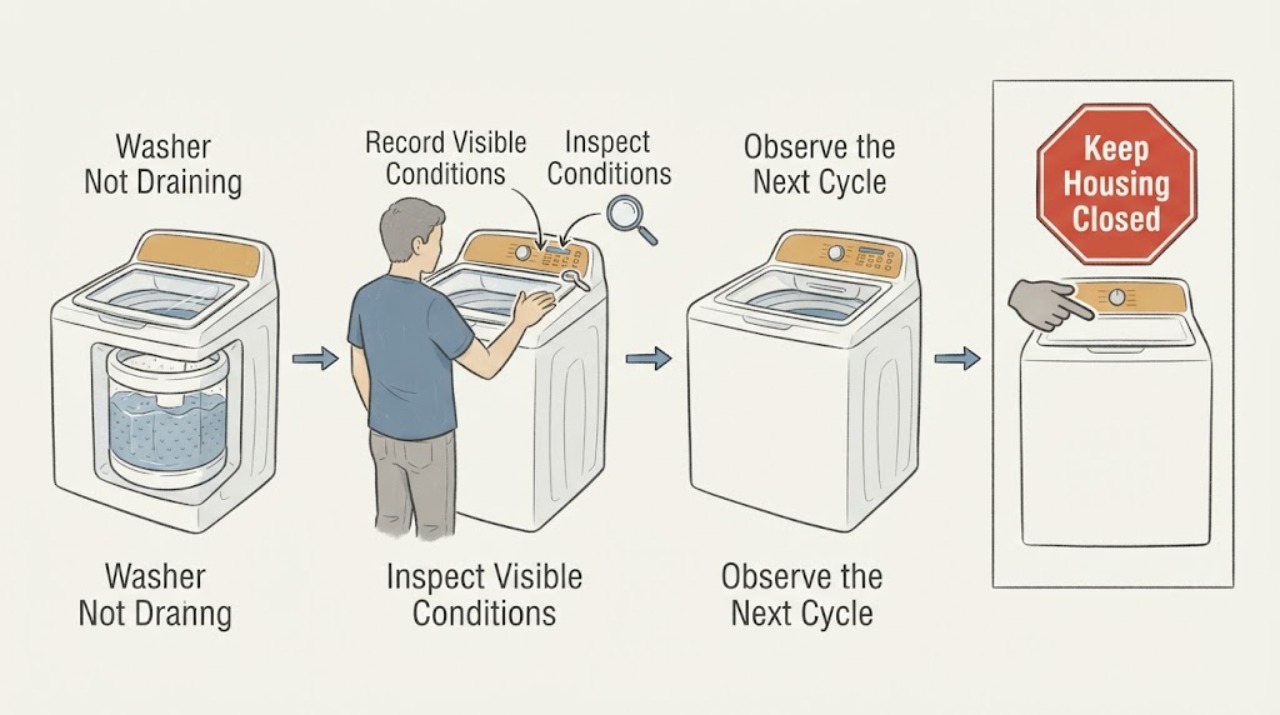
Work through in order
Diagnostic checks
Use only checks that match the exact appliance or system and its official guide.
-
Check 1
From a dry, safe position, confirm the rating-plate identity as GE GTW220ACK5WW and record the cycle stage, whether water is visibly standing in the basket, the lid-lock indicator or message, and whether the lid is currently locked, unlocked, or simply waiting for the basket to stop.
Expected result: The full suffix is confirmed and the basket contains water, or the suffix, cycle stage, water level, or lock state is uncertain.
Next step: Photograph only the rating plate and control display if needed, retrieve the exact GE manual using the full suffix, and continue only with the general external checks below. Do not order a lock or pump part from the symptom alone.
Stop if: Do not open the cabinet, reach into a moving basket, or try to defeat or hold the lid lock closed.
Why this matters
Why: The opened GE Owner Center page is for GTW220ACKWW, not the complete assigned suffix, and GE's support steps vary by top-load control design. A missing model match means that a model-specific setting or manual procedure has not yet been established.
-
Check 2
With the washer otherwise safe, observe one normal lock transition without forcing the lid: note whether the lock engages during load sensing or spin, and if you press Start/Pause, whether the basket stops and the lid releases within the GE-described coast-down period.
Expected result: The lid locks during a sensing or spin stage and releases after the basket stops, or it never engages when the cycle requires it, remains locked after the basket has stopped, or shows an abnormal lock indication.
Next step: If the sequence is normal, do not bypass the lock; continue to the Drain and Spin and visible drain-path checks. If it is abnormal, leave the washer off and arrange GE or qualified appliance service.
Stop if: Never pry, hold down, magnetize, bypass, or electrically test the lid-lock switch, and do not open a locked lid while the basket is moving.
Why this matters
Why: GE identifies locking during sensing/spin and a delay of up to about three minutes after a paused spin as normal behavior. A lock that never engages or remains locked after a safe pause is a separate lock/service branch, not evidence that the drain hose is clear or blocked.
-
Check 3
If the lid-lock sequence is normal and the area is dry, use the exact manual's control path once; GE's general electronic-control guidance uses Start/Pause followed by Drain and Spin and Start/Pause again. Record whether the pump-out begins and whether water leaves the basket.
Expected result: The washer drains after the documented Drain and Spin selection, or water remains and the washer reports a long-drain indicator or does not start the pump-out.
Next step: If it drains, monitor one normal load without bypassing controls. If it does not, stop repeated cycling and inspect only the visible hose and household drain; use the full-suffix manual for any model-specific indicator.
Stop if: Do not repeatedly reset a full washer, manually advance a dial through a pause, or start a cycle when water is spreading or the power area is wet.
Why this matters
Why: A successful permitted drain cycle makes a temporary control or cleared restriction more plausible; persistent water after the control sequence keeps the drain path or pump in question. GE describes a flashing RINSE light or scrolling "Po" on applicable newer top-load models as a long-pump-out symptom, not a lid-lock diagnosis.
-
Check 4
With power left off and the floor dry, inspect the visible drain hose and its entry into the standpipe, utility sink, or floor drain without dragging the washer or disconnecting a wet hose. Look for a kink, crush, crack, unusual insertion, backflow, or a household drain that cannot accept water independently.
Expected result: The hose is visibly restricted or damaged, the household drain backs up, or the external drain arrangement looks clear while water remains in the tub.
Next step: Correct only an obvious dry-access hose-position issue allowed by the exact installation instructions, or request plumbing service for a backed-up household drain. Leave the washer off and arrange appliance service for a damaged/inaccessible hose or persistent full tub.
Stop if: Do not disconnect plumbing beside standing water, use drain chemicals, probe the hose with a sharp object, move the washer across a wet floor, or open the cabinet.
Why this matters
Why: GE identifies a kinked or clogged hose and a restricted household drain as causes of failed draining. If those external paths are clear but water remains, the lid-lock observation has not cleared the pump, internal hose, or control path; that conclusion requires the exact model procedure or service rather than a guessed part.
-
Check 5
Before requesting service, record whether the tub is full and the machine only hums, whether the lid-lock fault returns, whether a code or RINSE/Po indication returns, and whether there is a leak, burning smell, hot plug, repeated trip, or severe movement.
Expected result: The tub is full and only hums, the lock remains abnormal, the no-drain condition persists after the safe external checks, or any electrical, leak, heat, or instability warning is present.
Next step: Leave the washer off, keep clear of wet electrical areas, and arrange GE or qualified appliance service; use plumbing or electrical help when the observed problem is outside the appliance.
Stop if: Do not open panels, test live wiring, bypass the lock, or continue cycling a full washer to force it to drain.
Why this matters
Why: GE directs service for a top-load tub that is full and only hums, and a persistent lock fault cannot be safely separated from the control, latch, wiring, or drive sequence by appearance alone. Hazards are stop-use conditions regardless of the drain result.
Use your observations
Decision map
Find the observation that best matches what you see, then follow the next safe action.
-
PATH 01Next step
What you see
The GTW220ACK5WW lid locks during a sensing or spin stage, the basket stops after Start/Pause, and the lid releases within the GE-described coast-down period, but water remains in the tub.
Do this next
Use the exact manual's Drain and Spin sequence once, then inspect the visible hose and household drain if water remains. Do not bypass a normal lock.
Why this path and its safety boundary
Why it matters: The lock behavior is consistent with GE's normal top-load sequence; it does not establish that the lock caused the no-drain symptom. The next decision is the drain-control and external drain path.
-
PATH 02Next step
What you see
The lid never engages when the cycle requires locking, remains locked after the basket has stopped and the safe pause/reset guidance has been followed, or the lock indication returns with an incomplete cycle.
Do this next
Leave the washer off and provide the technician the full model suffix, cycle stage, lock behavior, tub water level, and any displayed indication. Do not open the cabinet or bypass the lock.
Why this path and its safety boundary
Why it matters: This is a lid-lock or control-sequence service lead, not a safe invitation to force the lid or substitute a part. A lid-lock fault can also prevent a cycle from reaching its intended spin/drain completion on models that require the lock for that stage.
-
PATH 03Next step
What you see
The lock behaves normally, the tub is full, and the visible hose is kinked/damaged or the standpipe, sink, or floor drain backs up.
Do this next
Correct only an obvious dry-access hose-position issue, or arrange plumbing service for the household drain; arrange appliance service for a damaged or inaccessible hose.
Why this path and its safety boundary
Why it matters: The observed pattern makes an external drain restriction or installation issue more likely than a lid-lock fault. GE treats a blocked household drain as a plumbing path and a damaged hose as a service issue.
-
PATH 04Next step
What you see
The lock sequence is normal, the external drain path appears clear, and the tub remains full and only hums, or the symptom persists after the one permitted Drain and Spin attempt.
Do this next
Leave the washer off and arrange qualified GE appliance service. Ask the provider to verify the lid-lock sequence and then test the drain path before selecting a replacement part.
Why this path and its safety boundary
Why it matters: GE identifies a full tub with only a hum as a service condition. The remaining possibilities include the pump, internal hose, control, wiring, or another model-specific component, none of which can be confirmed from the lid indicator alone.
-
PATH 05Next step
What you see
Water is spreading, the plug/outlet or floor is wet, there is smoke, a burning smell, heat, a repeated circuit trip, severe movement, or the machine is unstable.
Do this next
Stop using the washer, keep away from wet electrical parts, and obtain qualified appliance, plumbing, or electrical help as appropriate. Do not continue diagnostic cycles.
Why this path and its safety boundary
Why it matters: The issue is a water or electrical safety stop regardless of whether the lid locks or the drain eventually runs.
Helpful context
Understand the symptom
Why the lid-lock observation changes the first decision
On GE top-load washers, the lid-lock indicator can describe a normal sensing or spin state rather than a blocked drain. That makes the first useful split different from simply assuming that a locked lid caused the water to remain: a normal lock sequence points back to the drain path, while a lock that never engages or will not release after the documented pause/reset needs service. GE also says not to force the lid; the basket must stop before a paused spin cycle unlocks.
Keep the exact suffix in view
GE's opened Owner Center entry is for the closely named GTW220ACKWW base family, while the assigned appliance is GTW220ACK5WW. Use the rating-plate suffix when looking up the manual and do not assume that a control sequence, indicator, or part listed for a different suffix is interchangeable.
Only after diagnosis
Potential parts
- lid-lock or latch component
Only consider this class if the exact model's lid never locks or remains locked after the documented safe pause/reset and a technician confirms the lock path is faulty.
Confirm the complete GTW220ACK5WW suffix and GE compatibility with the provider; no part fit is established by the no-drain symptom alone. - drain pump or internal drain-path component
Only consider this class after the lock sequence, permitted control step, visible hose, and household drain have been checked and the tub remains full or only hums.
Have GE or qualified service verify the failed component and exact model fit before ordering; do not infer a pump failure from a locked lid.
When checks do not resolve it
Need a professional?
Arrange GE or qualified appliance service when the lid-lock sequence is abnormal, the lid remains locked after the safe pause/reset guidance, the tub remains full and only hums, or no-drain persists after the exact manual's permitted control step and safe external hose/plumbing checks. Use plumbing service for a backed-up household drain and qualified electrical help for wet, hot, damaged, or repeatedly tripping power connections.
Safety scope: Do not force, bypass, magnetize, or electrically test the lid lock; do not open the cabinet, test live wiring, disconnect wet plumbing, or keep cycling a full washer. Keep the washer off for a full tub that only hums, persistent abnormal locking, leaks, wet electrical areas, smoke, heat, repeated trips, or instability.
Have this ready
- Provide the full GTW220ACK5WW rating-plate suffix, market, cycle stage, water level, lid-lock timing, displayed indication, Drain and Spin result, hose/plumbing observations, and any leak, odor, heat, noise, or circuit-trip details.
Common questions
FAQ
If the lid is locked, does that prove the GE washer cannot drain?
No. GE says current top-load washers can lock during load sensing or spin, so a normal lock indicator is not by itself a drain diagnosis. Record whether water is actually in the tub and whether the lock releases after the basket stops, then follow the exact model's drain path.
How long should I wait for the lid to unlock after pausing?
GE says a paused spin can take up to about three minutes while the basket coasts to a stop. Do not pry the lid open. If the basket has stopped and the lid still will not unlock after GE's safe pause/reset guidance, arrange service.
What should I do when the lid locks normally but the tub remains full?
Use the exact manual's Drain and Spin control sequence once if the area is safe, then inspect only the visible drain hose and household drain. A full tub that only hums or a persistent no-drain condition requires qualified service; do not guess a pump or lock part.
Why should I verify GTW220ACK5WW instead of using the GTW220ACKWW page?
The opened GE Owner Center page is labeled GTW220ACKWW, while the assigned appliance includes the GTW220ACK5WW suffix. Use the complete rating-plate model number to retrieve the matching manual before applying model-specific settings, indicators, or parts guidance.
Read the exact guide
Official sources
- GE Appliance - Download a Copy of Your Owner's Manual or Installation InstructionsGE Appliances · Supports using the complete rating-plate model number to retrieve the appropriate literature before applying model-specific controls or maintenance steps.
- Top Load Washer - Lid Lock FeatureGE Appliances · Applies to GE top-load washers covered by the support article; used for lock timing and the safe pause/reset/service boundary, not as proof of a part fit for GTW220ACK5WW.
- Top Load Washer - Will Not DrainGE Appliances · Applies at the GE top-load symptom level; model-specific indicators and procedures still require the assigned washer's exact manual.
- Top Load Washer - How to Drain and Spin a Wash Cycle on Electronic Control ModelsGE Appliances · Use only when the assigned washer's exact control layout and manual match the electronic-control path; it supports one controlled drain observation, not repeated resets or bypassing the lock.
- Top Load Washer - Display and Status / Feature LightsGE Appliances · Supports interpreting common GE top-load status and lock indicators; the exact assigned model's manual controls which indicators are present.
- User Manual & Care for GTW220ACKWW | GE AppliancesGE Appliances · Used only to show the closely named base-family Owner Center entry and the need to verify the full GTW220ACK5WW suffix; it is not treated as proof that every suffix has identical controls.
Community feedback
Share a repair observation
Share a plain-text repair observation. Accepted observations are published automatically; this page may take a moment to update.