
On this page
Start here
Quick answer
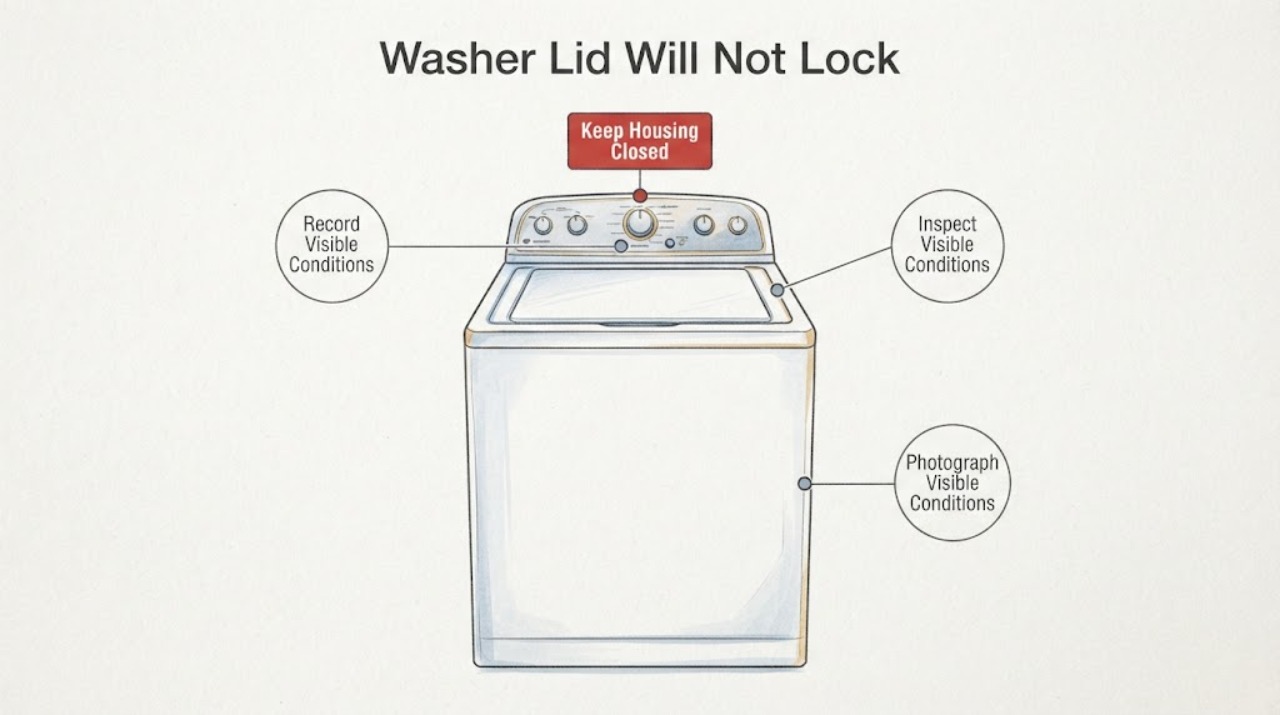
Do not force the lid or defeat the lid-lock safety system on a GE GTW330ASK0WW. First make sure the basket has stopped, keep the washer disconnected while inspecting, and record the exact Lid Locked light, display message, and cycle stage. GE's GTW330-series instructions describe the lid as locking during load sensing and spin, not necessarily for the entire wash cycle; a short unlocked period can therefore be normal. With power off, look only for clothing or an object preventing the lid from closing, a visibly damaged lid strike or opening, or a lid that sits out of alignment. A light or message that remains abnormal after one safe power reset, or a lock that will not engage when the cycle requires it, needs service. Do not press the lock, hold the switch closed, open the console, or run the washer with the lid bypassed.
Work through in order
Diagnostic checks
Use only checks that match the exact appliance or system and its official guide.
-
Check 1
Stop the cycle and wait until the basket is completely still. From a dry, safe position, note whether the lid is open, closed but unlocked, or locked, and record the exact stage light or display text: Fill, Soak, Wash, Rinse, Spin, Lid, Lid Locked, PAUSE, or another message.
Expected result: The lid is unlocked during ordinary wash/agitation, or the washer is in load sensing or spin and the Lid Locked indication does not engage; a Lid message or other light pattern may also appear.
Next step: Do not start, force, or repeatedly pause the washer. Keep the tub still and continue only with the power-off visible inspection below; arrange service if the required lock state does not occur.
Stop if: Stop immediately for a moving basket that will not stop, violent movement, smoke, burning odor, a leak near electrics, or a lid that can open during a required locked stage.
Why this matters
Why: GE describes the GTW330-series lid as locking during load sensing and spin and unlocking after those portions. An unlocked lid during ordinary wash may be expected, but failure during a stage that requires locking is not explained by normal timing alone.
-
Check 2
Unplug the washer or isolate its circuit from a dry, safe position, then inspect the lid edge, the lid-lock opening, and the visible lid strike area with ordinary lighting. Look for clothing, detergent buildup, a foreign object, a cracked or displaced strike, or a lid that is visibly sitting unevenly; do not push the lock or remove any cover.
Expected result: A visible item blocks closure, the strike or surrounding plastic is damaged or out of position, the lid closes evenly with a clear opening, or the lid cannot close without force.
Next step: Remove only a loose, accessible obstruction after the washer is disconnected. Leave the washer out of service for cracked parts, a displaced strike, a lid that needs force, or a clear opening with continued lock failure.
Stop if: Do not pry the lid, press the lock mechanism, bridge a switch, remove the console, or open the lock assembly.
Why this matters
Why: A visible obstruction or alignment problem can prevent the lid from reaching the lock position. A clear, evenly closing lid does not prove whether the lock, wiring, sensor, or control is defective, so the internal cause must not be guessed.
-
Check 3
While power remains isolated, photograph or write down every light and message exactly as shown, including whether a lock icon blinks, the Lid Locked light is off, or a Lid/PAUSE/status message is present. Do not infer a part from a light pattern.
Expected result: The display or status lights identify an open lid, pause, lock state, sensing, spin, or another exact message; alternatively, the panel is dark or gives no consistent indication.
Next step: Keep the record for GE service and do not run a diagnostic or service-mode sequence. If the panel is dark, erratic, or still shows a required-lock problem after the safe reset, leave the washer disconnected.
Stop if: Do not hold the lid switch closed, operate the machine with the lid open, or enter a service mode to force a lock test.
Why this matters
Why: GE uses status lights and messages to distinguish an open lid, normal sensing, pause, and locked portions of a cycle. An unlisted or inconsistent pattern needs model-specific service interpretation rather than a guessed lock or control replacement.
-
Check 4
If the basket is still, there is no leak or electrical hazard, and the washer is dry, perform one normal control reset by disconnecting power for the GE-recommended interval. Restore power once and observe the panel without forcing the lid or starting a cycle to reproduce the failure.
Expected result: The controls return to a normal display, the same lock indication returns immediately, the panel remains dark, or the lid still fails to lock when the recorded stage requires it.
Next step: If the required lock state remains abnormal, disconnect the washer and arrange qualified GE service with the model, serial, light pattern, stage, and reset result. Do not repeat resets or open the control area.
Stop if: Do not reset with a moving tub, water on the floor, burning odor, damaged cord, or any need to touch internal wiring.
Why this matters
Why: GE notes that a pause or interruption can leave electronic controls locked and describes a power reset; a recurring lock failure after that single reset is evidence that the underlying condition remains. A reset cannot verify or repair the lid switch, lock, wiring, or control.
Use your observations
Decision map
Find the observation that best matches what you see, then follow the next safe action.
-
PATH 01Next step
What you see
The lid is unlocked during ordinary wash/agitation but locks during load sensing or spin, and no damage or unsafe behavior is present.
Do this next
Do not try to make the lid stay locked for the entire wash. Monitor the documented lock stages and seek service if it fails to lock there.
Why this path and its safety boundary
Why it matters: That timing matches GE's GTW330-series description and does not by itself show a failed lock.
-
PATH 02Next step
What you see
A loose item is visibly blocking the lid edge or opening, and the lid closes evenly after the washer is disconnected and the item is removed.
Do this next
Leave the washer off if the original failure included repeated lock attempts, a damaged part, or an abnormal light. Have GE or qualified service confirm safe operation before regular use.
Why this path and its safety boundary
Why it matters: The obstruction can explain why the strike did not reach the lock position, but the lock has not been safely proven by a forced or repeated start.
-
PATH 03Next step
What you see
The lid or strike is cracked, displaced, misaligned, or requires force, or the washer can begin a required-lock stage with the lid unsecured.
Do this next
Keep the washer disconnected and arrange qualified service. Do not order or install a lock component from the symptom alone.
Why this path and its safety boundary
Why it matters: This is a failed or unsafe lid-interlock condition, not a normal pause or a user-adjustable setting.
-
PATH 04Next step
What you see
The lid closes normally and the visible path is clear, but the required Lid Locked indication is absent or returns after the single safe reset.
Do this next
Stop using the washer and provide GE service the full model/serial, exact light pattern, cycle stage, and reset result.
Why this path and its safety boundary
Why it matters: An internal lock, strike sensing, wiring, or control problem remains possible; the visible checks cannot select the failed part.
-
PATH 05Next step
What you see
Smoke, burning odor, arcing, a hot electrical connection, a water leak near electrical parts, violent movement, or a tub that will not stop is present.
Do this next
Keep clear, isolate power only if safe, and use qualified appliance or emergency help as appropriate. Do not attempt any lid or control inspection.
Why this path and its safety boundary
Why it matters: The safety hazard takes priority over lid diagnosis.
Helpful context
Understand the symptom
The GTW330ASK0WW is identified on GE's parts and support system as a 3.8-cu.-ft. top-load washer. The public owner manual is a GTW330-series manual, so use the full rating-label model and serial information when arranging service. The key distinction is timing: a lid that is not locked during ordinary agitation can be expected on this family, while failure to lock during load sensing or spin is a safety or control concern.
Keep checks observational. Disconnecting power is not a license to remove the control console or lid-lock assembly. The lid switch and lock are safety devices; a washer that can run with an unsafe lid condition should remain out of service.
When checks do not resolve it
Need a professional?
Arrange qualified GE service when the lid will not lock during load sensing or spin, the lock state returns after one safe reset, the lid strike or surrounding plastic is damaged or misaligned, the lid can open during a required-lock stage, the display is dark or erratic, or diagnosis would require the console, lock assembly, wiring, or a service mode. Do not bypass the lid safety system or choose a replacement part from the symptom alone.
Common questions
FAQ
Should the lid stay locked during the whole wash cycle?
Not necessarily. GE says the GTW330-series lid locks during load sensing and spin and can be unlocked during other portions. Judge the symptom by the cycle stage, not by expecting a continuously locked lid.
Can I press or hold the lid switch to make the washer run?
No. The lid switch is a safety device. Do not bypass it, hold it closed, run with the lid open, or open the console to test it.
What should I record before calling service?
Record the complete model and serial label, the cycle stage, the exact lights or message, whether the basket was moving, whether the lid closed evenly, any visible obstruction or damage, and the result of one safe power reset.
Read the exact guide
Official sources
- Top Load Washer - Display and Status / Feature LightsGE Appliances · Lid, Lid Locked, PAUSE, SEnSIng, and cycle-status messages
- Top Load Washer - Lid Lock FeatureGE Appliances · When top-load lid locks and safe pause/unlock behavior
- 49-3000255-2_LoRes.pdfGE Appliances · GTW330-series lid timing, lid lock indication, safety, and model/serial location
- Top Load Washer - Lid SwitchGE Appliances · Lid switch safety function and visible probe or magnet concepts
- Washer - Resetting the Electronic ControlsGE Appliances · One power interruption to clear controls locked after a pause or interruption
- Model Search | GTW330ASK0WWGE Appliances · Exact model identity and owner-manual routing
Community feedback
Share a repair observation
Share a plain-text repair observation. Accepted observations are published automatically; this page may take a moment to update.