
On this page
Start here
Quick answer
On a Kenmore 110.5142510, F5E1 and F5E2 together after replacing the lid lock mean the control is not receiving a trustworthy lid-switch/lock sequence; they do not prove that the aftermarket assembly alone is defective. Whirlpool's top-load guidance describes F5E1 as a door/lid-switch condition and F5E2 as a lid-lock engagement problem, with visible obstruction checks and a five-minute power disconnect as owner-level steps. With power disconnected and the lid fully open, compare the replacement's fit, visible connector seating, mounting position, lid strike, and any packaging or clothing interference without forcing anything. Do not enter diagnostics, jumper the lock, probe live wiring, or run a cycle with an unverified lock. If the codes return after one safe reset or the lock will not engage, stop using the washer and have a qualified technician verify the exact model documentation, replacement compatibility, strike alignment, wiring, and control-side sensing.
Before you begin
Safety first
- Owner checks stop at dry power isolation, complete model identification, visible lid/strike/lock-area obstruction removal, non-forced fit observation, and one exact-model-authorized five-minute reset. Do not enter diagnostics, apply power to the lock, measure live circuits, open the console or cabinet, splice wires, add shims, force the strike, or bypass the lid-lock safety system.
Work through in order
Diagnostic checks
Use only checks that match the exact appliance or system and its official guide.
-
Check 1
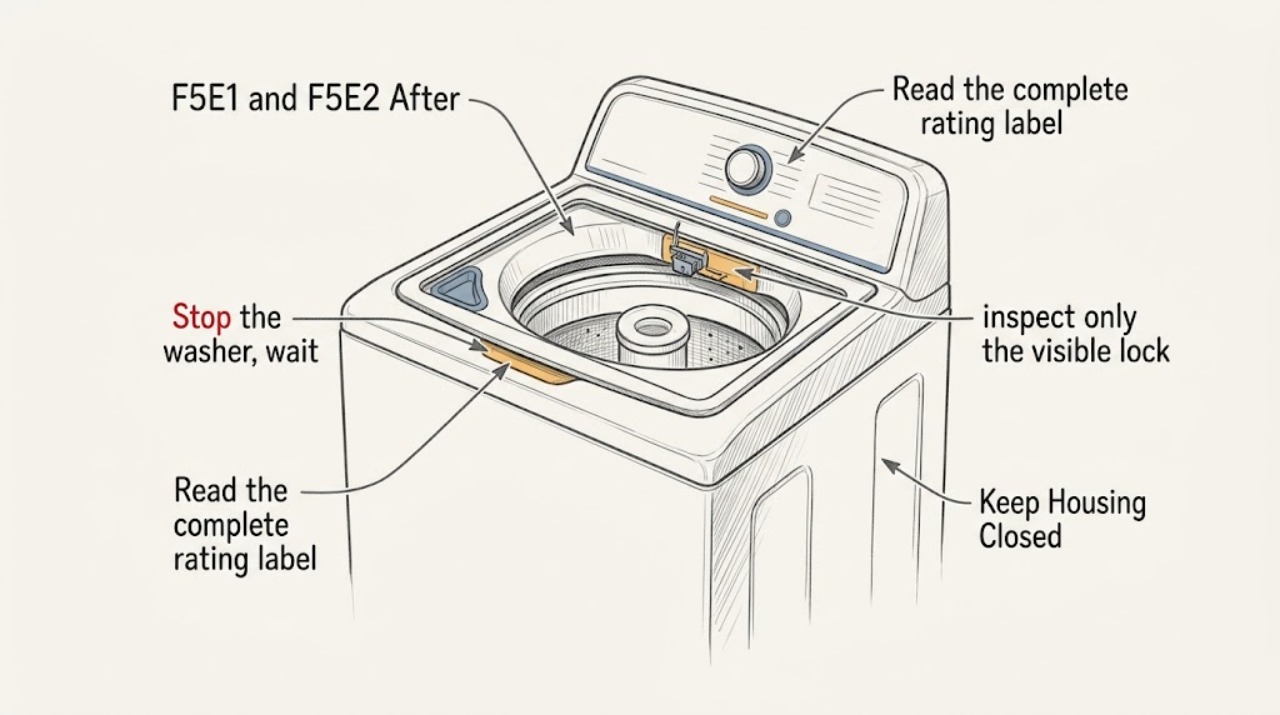
Stop the washer, wait for the basket to stop, and disconnect power from a dry, safe position before looking at the lid-lock area. Keep both hands and tools away from the lock opening and do not try to start a cycle while the lock is unresolved.
Expected result: The lid is open or closed, the lock is in an unknown position, water remains in the tub, or there is a damaged lid, strike, cord, outlet, smoke, burning odor, or water near electrical parts.
Next step: Keep the washer off; close the water supplies if water is present and arrange qualified appliance service for a damaged or inaccessible lock. Do not bypass, jumper, wedge, or manually defeat the lid lock.
Stop if: Stop immediately for exposed wiring, a damaged strike or lid, smoke, burning odor, sparks, a hot plug, water at electrical parts, or a basket that does not stop normally.
Why this matters
Why: A lid-lock fault is a safety interlock issue, and water or visible electrical damage adds a separate stop condition. A lock that is simply left in an unknown position after installation cannot be safely reset by forcing it.
-
Check 2
Read the complete rating label and compare it with the Kenmore manual lookup using the full model number 110.5142510. Confirm that the washer is the top-load platform represented by the exact report; do not substitute a visually similar Kenmore 110 model or a front-load procedure.
Expected result: The label matches 110.5142510, has a different digit or suffix, is unreadable, or the machine's lid and control layout differ from the exact-model report.
Next step: Photograph the label and use the exact model documentation or give it to qualified service. Until identity is confirmed, limit the diagnosis to safe power isolation and visible obstruction checks.
Stop if: Do not order another lock or copy a diagnostic key sequence from another Kenmore or Whirlpool model.
Why this matters
Why: Kenmore says the complete model number is needed to locate the correct manual. Similar 110-series washers can have different lock hardware, connectors, and controls, so a near match cannot establish fit or error meaning.
-
Check 3
With power disconnected and the lid fully open, inspect only the visible lock opening, lid strike, and surrounding rim. Remove loose clothing, packaging, lint, or detergent residue that is plainly obstructing the strike; wipe accessible exterior residue with a soft damp cloth only. Do not pry the lock or bend the strike.
Expected result: A loose object or residue blocks the strike, the strike enters the lock opening without force, the strike sits off-center or cannot enter, or the visible areas are clean and aligned.
Next step: Correct only the loose visible obstruction allowed by the exact manual. If the strike still cannot enter freely, leave the washer off and request model-specific service; do not force the lid or lock.
Stop if: Stop for a cracked lid, bent strike, broken plastic, loose housing, or any need to remove panels or the lock assembly.
Why this matters
Why: Whirlpool identifies objects, clothing, packaging, and buildup around the lock or strike as possible interference. A strike that cannot enter after an aftermarket replacement makes fit or alignment a stronger lead, but it does not distinguish the replacement, lid, cabinet, or mount by itself.
-
Check 4
Still with power disconnected, compare the new assembly with the old one using photographs or the parts documentation: visible housing shape, strike opening, mounting position, connector keying, and whether any shipping latch or protective material remains. Do not reconnect a part that does not seat naturally, and do not make a continuity or voltage measurement.
Expected result: The new housing or connector differs, the mounting holes or strike path do not line up, protective material is present, the connector is visibly loose, or the replacement appears to seat normally.
Next step: Document the replacement brand/markings and return to the exact model parts/manual route or a qualified technician for compatibility and installation verification. Do not add shims, alter plastic, splice wires, or buy a control board from the codes alone.
Stop if: Do not work on wiring with power connected, apply power directly to the lock, or alter any safety interlock.
Why this matters
Why: The exact report describes an aftermarket lock whose strike did not fit, and then F5E1/F5E2 appeared. A physical mismatch or visible loose connection raises an installation/compatibility question; a normal-looking fit does not prove the lock or control is good.
-
Check 5
After any plainly visible obstruction is removed and the lid can close without force, use one model-authorized control reset only: leave the washer disconnected for five minutes, then restore power from a dry position. Do not enter manual or automatic diagnostics and do not run a load just to reproduce the codes.
Expected result: The codes clear and the washer remains able to close and lock normally, or F5E1/F5E2 return, the lock does not engage, or the control remains unresponsive.
Next step: If the codes return or locking is not normal, stop using the washer and request qualified service with the exact model, replacement details, and the before/after timeline. If the washer remains normal, monitor without forcing or repeating tests.
Stop if: Do not repeatedly cycle power, clear codes through an unknown procedure, or operate with a lock that is not reliably detected.
Why this matters
Why: Whirlpool says a five-minute power disconnect can reset the control, but a returning code indicates the lock/switch sequence is still unresolved. A reset does not validate an aftermarket part, connector, strike, or control board.
-
Check 6
Prepare a service handoff from the existing evidence: record the complete model, original and replacement lock markings, whether the strike physically enters, whether any click or movement was heard before power was removed, both codes and their order, and whether the symptom began immediately after installation. Do not reopen the console or cabinet.
Expected result: The issue began immediately after the replacement, the replacement never fit, the lock fit but was not sensed, the codes appeared only after a reset, or the timeline is unknown.
Next step: Give the timeline and photographs to qualified Kenmore/Whirlpool-platform service and ask them to verify the exact lock, strike, wiring, and control sensing. Keep the washer out of service until the safety lock is confirmed.
Stop if: Do not request or perform a lid-lock bypass, live voltage test, diagnostic-mode actuation, or cabinet repair as an owner check.
Why this matters
Why: A post-installation onset makes fit, alignment, connector, and part-identity verification the most useful next decision, while a delayed or changing failure leaves the control-side sensing path open. Neither timeline identifies a component without model-specific testing by a technician.
Use your observations
Decision map
Find the observation that best matches what you see, then follow the next safe action.
-
PATH 01Next step
What you see
The strike and lock opening are clean, the replacement fits naturally, the lid closes without force, and one five-minute reset clears the codes without a recurrence.
Do this next
Do not run repeated tests; use the exact manual and stop if either code returns or the lock is not reliably detected.
Why this path and its safety boundary
Why it matters: A temporary control state or visible obstruction is more plausible than a proven failed component, but the reset does not establish aftermarket compatibility or long-term safety.
-
PATH 02Next step
What you see
The problem started immediately after the aftermarket replacement and the strike cannot enter, the housing or connector differs, or the lock does not seat naturally.
Do this next
Leave the washer disconnected and have a qualified technician or the exact model parts route verify the replacement and strike. Do not modify the lock, add a shim, splice wiring, or bypass the safety system.
Why this path and its safety boundary
Why it matters: The strongest independent lead is installation, alignment, or replacement identity—not proof that the new part or the main control is defective. The exact report records this same timing and physical-fit concern, but its community suggestions do not prove a remedy.
-
PATH 03Next step
What you see
The strike enters freely and no visible obstruction remains, but F5E1 and F5E2 return after the one safe reset or the controls cannot complete the lock sequence.
Do this next
Stop use and request qualified service with the exact model and replacement timeline; the provider should perform any internal or electrical diagnosis.
Why this path and its safety boundary
Why it matters: This narrows the issue to lock/switch sensing, the connector or harness, control-side detection, or another model-specific fault. It does not justify selecting a second lock or control board from the codes alone.
-
PATH 04Next step
What you see
The lid, strike, housing, cord, or outlet is damaged, the lock area is wet, the basket will not stop, or there is smoke, burning odor, sparks, or repeated breaker action.
Do this next
Keep the washer off, isolate water and power only from a safe dry position, and obtain qualified appliance or electrical service. Do not restore power to see whether the code clears.
Why this path and its safety boundary
Why it matters: This is an immediate mechanical or electrical safety stop beyond an owner-level code check.
Helpful context
Understand the symptom
The installation timeline matters. The assigned model is a top-load Kenmore 110.5142510, and the exact-model report says the new lock was aftermarket, the lid strike would not fit into the cabinet lock, and diagnostics showed both F5E1 and F5E2. That combination can reflect a mismatch or alignment problem, a connector or mounting issue, an obstruction, or a control-side sensing problem. It is not enough evidence to declare the replacement part bad or to tell the owner to defeat the lock.
The official Whirlpool pages are platform-level guidance rather than proof that every Kenmore control behaves identically. Kenmore's official manual page directs owners to enter the complete model number to obtain the correct manual. Keep the full label identity and use model-specific documentation for any button sequence, part fit, or service procedure.
When checks do not resolve it
Need a professional?
Request qualified appliance service for returning F5E1/F5E2, an aftermarket assembly that does not fit, a lock that cannot be reliably detected, a loose or mismatched connector, damaged lid/strike/housing, or any need to assess harness or control sensing. Request electrical service for a damaged household supply or recurring breaker.
Safety scope: Owner checks stop at dry power isolation, complete model identification, visible lid/strike/lock-area obstruction removal, non-forced fit observation, and one exact-model-authorized five-minute reset. Do not enter diagnostics, apply power to the lock, measure live circuits, open the console or cabinet, splice wires, add shims, force the strike, or bypass the lid-lock safety system.
Have this ready
- Provide Kenmore 110.5142510 and the complete rating-label identity, original and replacement lock markings, installation date, photographs of the strike and lock opening, whether the strike enters without force, both codes and their order, reset result, water/basket state, and any damage or electrical symptom.
Common questions
FAQ
What do F5E1 and F5E2 mean together on a Kenmore 110.5142510?
On the Whirlpool top-load guidance used for this platform family, F5E1 points to a lid/door-switch condition and F5E2 to a lid-lock engagement problem. Together after a lock replacement, they show that the control is not receiving a complete lock/switch sequence; they do not prove that the aftermarket lock, the strike, the connector, or the control is the failed part.
Should I force the lid strike into the replacement lock?
No. If the strike does not enter naturally, leave the washer disconnected and treat fit, alignment, or replacement identity as unresolved. Do not bend the strike, enlarge the opening, add a shim, or defeat the lock; have the exact model and replacement checked by qualified service.
Can I clear these codes by unplugging the washer?
Whirlpool's owner-level F5E1 and F5E2 pages describe disconnecting power for five minutes as a possible control reset. Use that only once after the washer is safe and any plainly visible obstruction is removed. If either code returns or the lock does not work normally, stop; a reset does not validate the replacement part and should not be repeated as a test.
Can I run diagnostics or jumper the lid lock to see whether the aftermarket part works?
No. The lid lock is a safety interlock. Do not enter service diagnostics, apply power directly, probe live wiring, jumper the lock, or operate the washer with the safety circuit defeated. Give the technician the exact model, part markings, physical-fit observations, and code timeline instead.
Read the exact guide
Official sources
- Lid Light FlashingWhirlpool Product Help · The opened top-load page explains that lock interference can involve the strike, packaging, clothing, detergent, or lint and that model-specific strike position varies. It supports visible, non-forced checks and the service boundary, not a bypass or live test.
- Stumped on washer lid lock replacement (with photos and error codes)Reddit / r/appliancerepair · Community evidence only. The opened post matches Kenmore 110.5142510, reports an aftermarket replacement, a strike that would not fit, and both F5E1 and F5E2. Its diagnostic-mode and continuity-testing details are not used as owner instructions.
- F5E2 - Error CodeWhirlpool Product Help · The opened top-load page identifies F5E2 as inability to engage the lid lock, advises checking the lock area and clothing obstruction, and describes a five-minute power disconnect. It does not prove that a Kenmore 110.5142510 aftermarket assembly is compatible or defective.
- Kenmore ManualsKenmore · Kenmore's opened manuals page instructs owners to enter the complete model number to locate the correct manual and explains that manuals cover installation, use, troubleshooting, and parts/accessory information. It does not expose the assigned model's exact document in the opened page.
- Error Codes or Flashing LightsWhirlpool Product Help · The opened top-load error index lists F5E1 and F5E2 as separate washer error-code pages. The linked pages provide the meanings and owner checks; the index does not establish that every Kenmore model has identical controls.
- F5E1 - Error CodeWhirlpool Product Help · The opened top-load page identifies F5E1 as a door/lid-switch condition, advises checking that the lid is fully closed and unobstructed, and describes a five-minute power disconnect. It is used as platform-level guidance and not as proof of a specific Kenmore control-board failure.
Community feedback
Share a repair observation
Share a plain-text repair observation. Accepted observations are published automatically; this page may take a moment to update.