
On this page
Start here
Quick answer
For the GE GFWN1100D0WW, a rinse-stage stop after moving without shipping bolts is not enough to identify a control board or spring. Confirm whether the display actually goes blank, whether water remains, and whether the washer is still waiting for cold-water fill, drain, door lock, or balance. This model's opened GE manual says prewash and rinse water are always cold, lists both supply faucets, drain routing, pump, load balance, leveling, and power among the checks, and says the tub should be held stationary with shipping bolts when the washer is moved. First keep the washer off for smoke, a hot or damaged cord, a leak near electrics, violent movement, or a loose object inside; otherwise make only dry external observations. Do not tip the cabinet, open the control area, reconnect internal springs or wires, run repeated cycles, or order a part from the move history. If the symptom began immediately after the move, tell GE or an appliance technician that the shipping hardware was not installed and provide the exact rinse-stage behavior.
Before you begin
Safety first
- Do not tip or lift the washer by its door or dispenser, open the cabinet or control area, reseat an internal spring or wire, bypass the door lock, disconnect a pressurized hose, open a wet pump filter, make live electrical measurements, or run repeated cycles after violent movement or a transport-related loose sound. Pressing Power does not disconnect the appliance; use a dry safe location and the appropriate breaker or service procedure only when needed for safety.
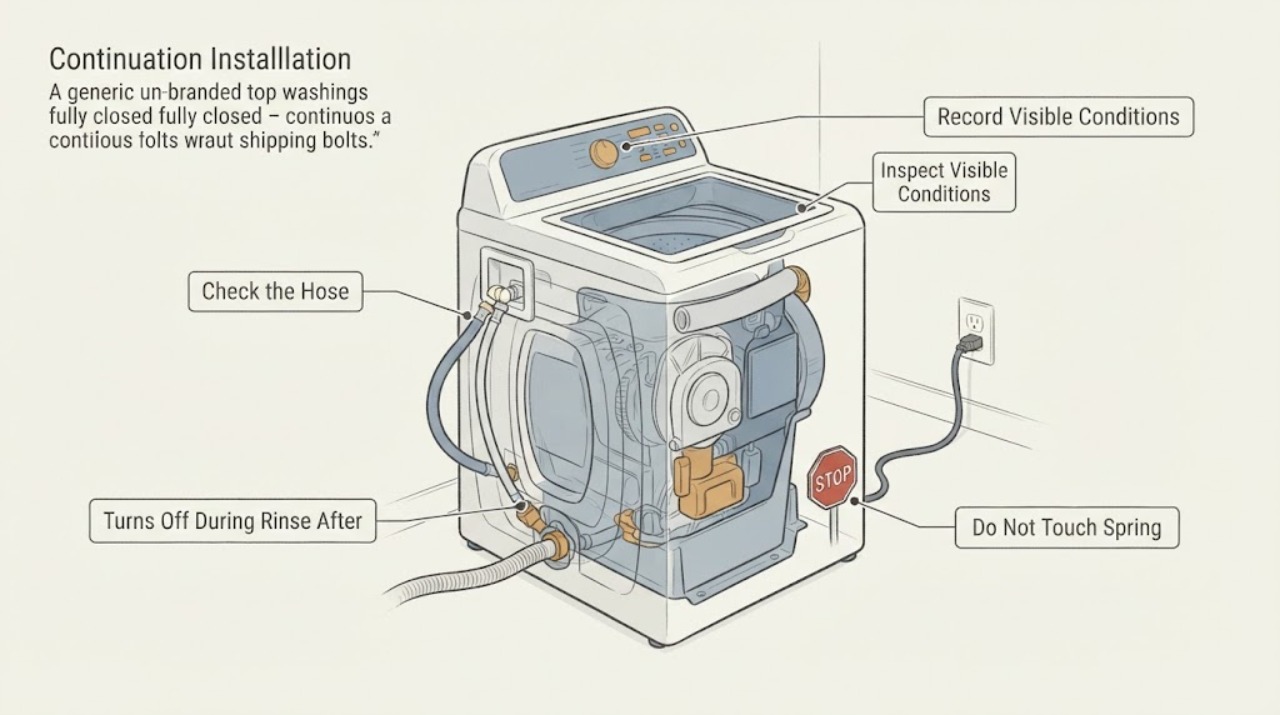
Work through in order
Diagnostic checks
Use only checks that match the exact appliance or system and its official guide.
-
Check 1
Without moving the washer, read the model and serial label and write down the exact point of failure: rinse fill, tumble, drain, spin, or a completely blank display. Record any code or light pattern, whether the door is locked, whether water remains, whether a breaker opened, and whether the stop started immediately after the move without shipping bolts.
Expected result: The display is blank, the display remains on but the timer stops or extends, water remains, the washer is waiting at a locked door, or there is no clear stage/code.
Next step: Keep the washer off for smoke, burning odor, a hot or damaged cord, a leak near electrical parts, violent movement, or a loose object inside. Otherwise continue only with dry external checks and give the technician the exact stage and model label.
Why this matters
Why: A blank display is a power-path observation; an active display points toward a paused/canceled cycle or a stage-specific fill, drain, lock, or balance condition. Water remaining separates a drain or flood-risk path from a purely electrical symptom. The move history changes the service context but does not select an internal part.
-
Check 2
From a dry, safe position, check that the grounded washer plug is fully seated, no extension cord or adapter is being used, and the relevant household breaker or fuse has not opened. Look at the cord and receptacle without removing covers or making a live electrical test; do not repeatedly reset a breaker that trips.
Expected result: The display and other controls are dead, the breaker has opened, the cord or receptacle is hot/damaged, or the washer still has a live display and no obvious external power issue.
Next step: If the cord/receptacle is hot, damaged, wet, smoking, or repeatedly trips, leave the washer disconnected from a dry safe location and use an electrician or appliance service. If the external supply is normal, do not open the control panel; continue to stage and water observations.
Why this matters
Why: The manual specifies a grounded 120-volt supply and says pressing Power does not disconnect the appliance. A dead display with a supply problem is not evidence of a rinse-specific component. A live display makes total power loss less likely and keeps the investigation at the fill, drain, door, balance, or control-state branch.
-
Check 3
Because rinse water is cold on this model family, inspect only the visible cold-water faucet and inlet hose for an open valve, kink, crush, leak, or hose pulled tight during the move. Do not loosen a pressurized hose, remove inlet screens, or open the cabinet.
Expected result: The cold valve is closed or partly closed, the hose is kinked/damaged/leaking, no cold-water sound occurs at the rinse-fill point, or the visible cold path appears normal.
Next step: Correct only an obvious dry, accessible valve setting and supervise one normal attempt if there is no hazard. For a leak, damaged hose, no-fill recurrence, or uncertain model plumbing, stop and arrange service rather than selecting a valve or board.
Why this matters
Why: A rinse-only fill failure can be consistent with a cold-water supply path even when earlier wash activity occurred. A normal visible path does not prove an inlet valve, sensor, or control failure; it only moves the issue to model-specific service diagnosis. The opened exact-model Reddit case raised the same cold-rinse comparison, but it did not document a confirmed repair.
-
Check 4
With the floor and hose connections dry, note whether water remains in the drum and inspect the visible drain hose for a kink, flattening, an unrestrained end, or an installation that has changed since the move. Do not pull the washer out, open the pump filter with standing water, or dismantle the drain pump.
Expected result: Water remains, the washer hums without visibly draining, the hose is kinked or routed too far into the drain, the household drain backs up, or the visible drain route is normal and the tub is empty.
Next step: Correct only a visible routing issue if it can be done without moving the cabinet or touching wet electrical areas, then make at most one supervised normal attempt. Stop for trapped water, a backup, a leak, or a returning stop and use appliance or plumbing service as appropriate.
Why this matters
Why: GE's manual lists a clogged pump, kinked or improperly connected hose, household drain restriction, and drain-hose siphoning as causes of incomplete cycles and non-draining. A tub that is already empty makes a drain blockage less likely, while a clear route with no pumping leaves an internal fault unconfirmed.
-
Check 5
After all motion has stopped, look from outside for rocking, a visibly damaged or extended leveling leg, the cabinet walking, unusual impact noise, or a new loose-object sound. Do not tip, lift by the door or dispenser, remove panels, or keep running full loads to reproduce violent movement.
Expected result: All four feet appear planted and the cabinet is stable, the load was gathered to one side, the washer shakes or walks, or a new noise/loose-object sound began after the unbolted move.
Next step: If safe and there is no transport-related noise or hazard, correct only an obvious load or visible leveling issue using the manual and try once with no load. If the washer walks, bangs, has a new loose sound, or the stop returns, leave it off and request an inspection that includes transport damage and installation, not a guessed part.
Why this matters
Why: The manual says the unit should be level with all four rubber legs firmly on the floor and that an unbalanced load can interrupt spin; it also notes that leveling-leg damage can increase vibration. GE's moving guidance makes the missing shipping hardware a separate potential transport-damage risk. A stable empty cabinet does not rule out an internal fault, and a new noise does not identify which part is affected.
-
Check 6
If the washer is stable, dry, free of electrical hazards, and the exact stage is known, perform no more than one model-approved normal test such as a small or empty rinse-and-spin observation; do not manually advance the timer or repeatedly power-cycle it. Stop immediately if movement becomes violent, water leaks, the display goes blank again, or the door will not safely unlock after the tub stops.
Expected result: The empty test completes, it fails at the same rinse point, it drains but will not continue, it loses the display, or the door remains locked with water present.
Next step: Keep the result, stage, water state, and move history for the provider. Do not repeat the test, enter an unverified service sequence, or open the machine; arrange qualified GE/appliance service, with plumbing service for a backed-up household drain.
Why this matters
Why: GE's manual uses a no-load rinse-and-spin result to distinguish a load imbalance from a machine-level problem, while its incomplete-cycle guidance separately lists pump/drain and power causes. Repetition at the same stage after visible checks supports service diagnosis, but it still does not prove a board, lock, pump, motor, or spring.
Use your observations
Decision map
Find the observation that best matches what you see, then follow the next safe action.
-
PATH 01Next step
What you see
The display goes completely blank at rinse, the external cord/receptacle or breaker is abnormal, or the washer repeatedly loses power without a water or movement clue.
Do this next
Leave the washer off for heat, damage, moisture, smoke, or a repeatedly tripping breaker and use an electrician or appliance service. Do not open the control area or make live measurements.
Why this path and its safety boundary
Why it matters: This is an external or internal power-symptom branch rather than proof that the rinse mechanism or control board failed. The exact manual requires a grounded supply and warns that Power is not a disconnect.
-
PATH 02Next step
What you see
The display remains active and the stop occurs when rinse should fill, with no water entering and the visible cold faucet or hose is closed, kinked, or otherwise disturbed by the move.
Do this next
Correct only an obvious dry external valve/hose issue and allow one normal attempt. If the washer still will not fill or the visible path is normal, stop and request model-specific service.
Why this path and its safety boundary
Why it matters: A cold-water supply or installation issue is more plausible than total power loss. Rinse is always cold in the opened GE manual family, but this observation does not identify an inlet valve or control component.
-
PATH 03Next step
What you see
Water remains at the rinse or drain transition, the hose or household drain backs up, or the pump only hums without removing water.
Do this next
Keep water away from electrical parts, correct only a visible safe hose-routing issue, and stop for trapped water, a leak, or a recurring failure. Use appliance service for the washer and plumbing service for a backed-up household drain.
Why this path and its safety boundary
Why it matters: The manual's drain branch includes pump restriction, hose routing, siphoning, and household plumbing. A trapped-water condition can prevent the washer from advancing and creates a flood risk; the move history does not prove a pump failure.
-
PATH 04Next step
What you see
The washer walks, bangs, has a new loose-object sound, or fails after the move without shipping bolts, even though the plug, visible hoses, and load appear normal.
Do this next
Stop running the washer, do not tip or open it, and request an inspection that explicitly includes leveling, suspension/transport damage, loose wiring, door-lock area, and safe post-move installation. Provide the exact model and the no-shipping-bolts history.
Why this path and its safety boundary
Why it matters: The transport and installation context now deserves priority. GE says shipping hardware should hold the tub stationary during moving, and the manual links damaged leveling legs or an unbalanced load to vibration. None of these observations identifies a specific internal part or proves that damage occurred.
-
PATH 05Next step
What you see
The washer is stable and dry, no-load rinse-and-spin completes, but a normal loaded cycle stops only with a gathered or unusually small load.
Do this next
Use mixed loads and correct only visible leveling according to the manual. If the stop occurs with an empty or balanced load, or returns after one correction, leave it off and arrange service.
Why this path and its safety boundary
Why it matters: That pattern is more consistent with load distribution or leveling than with a rinse-specific control diagnosis. The manual says to redistribute clothes and use a no-load rinse-and-spin comparison for an unbalanced load.
Helpful context
Understand the symptom
Why the missing shipping bolts matter without proving the cause
The opened GE manual covers the GFWN1100 front-load family and says that, when the washer is moved later, the tub should be kept stationary with the shipping bolts removed during installation. GE's moving guidance likewise says to reinstall the bolts, spacers, and clamps to prevent damage. That makes an unbolted move a reason to stop and disclose the transport history to a technician. It does not establish that a spring, wire, pump, door lock, motor, or control board was damaged. Do not open the cabinet or try to reseat an internal part based only on a sound or the rinse-stage symptom.
Rinse is a different observation than wash
For this GE manual family, prewash and rinse water are always cold. If the washer tumbles or completes wash but stops when rinse should fill, record whether the cold faucet is open, the cold hose is kinked, and whether the display remains active. That observation can put the visible cold-water path ahead of a control-board theory. If water is already in the tub, the relevant next branch is drain or door-lock behavior rather than assuming that the missing shipping bolts caused the stop.
When checks do not resolve it
Need a professional?
Give the provider the complete model/serial label, the exact rinse-stage display state, whether water remains, cold-water and drain observations, any code or breaker behavior, whether a no-load test completed, the final floor/leveling observations, and the fact that the washer was moved from the second floor to the first without shipping bolts. Ask for an evidence-based diagnosis before any part is selected.
Safety scope: Do not tip or lift the washer by its door or dispenser, open the cabinet or control area, reseat an internal spring or wire, bypass the door lock, disconnect a pressurized hose, open a wet pump filter, make live electrical measurements, or run repeated cycles after violent movement or a transport-related loose sound. Pressing Power does not disconnect the appliance; use a dry safe location and the appropriate breaker or service procedure only when needed for safety.
Have this ready
- Provide the model GFWN1100D0WW, move date and direction, whether shipping bolts/spacers/clamps were installed, the first symptom after the move, any new noise or loose-object sound, display/timer behavior, water state, cold faucet and drain-hose status, and whether the washer walks or completes an empty rinse-and-spin.
Common questions
FAQ
Did moving the GE GFWN1100D0WW without shipping bolts definitely damage the control board?
No. GE says shipping hardware should hold the tub stationary during transport, so the omission is important history and a reason to request an inspection. It does not distinguish a board from a spring, wiring, door lock, drain, cold-water, or installation issue.
Why check the cold-water supply when the washer only stops in rinse?
The opened GFWN1100-series manual says prewash and rinse water are always cold. If the display stays on and the washer stops where rinse should fill, the cold faucet and visible hose path are a relevant first observation. A normal hose does not prove which internal component is at fault.
Can I run the washer again to see whether the move caused damage?
Do not repeat full cycles after violent movement, a new loose-object sound, a leak, smoke, a hot cord, or another hazard. If the washer is stable and dry, a single model-appropriate no-load observation may help distinguish load imbalance, but a repeated rinse stop should go to service rather than repeated testing.
Should I buy a spring, pump, door lock, or control board first?
No. The symptom does not identify a part, and the exact model manual lists several visible supply, drain, balance, leveling, and power paths before internal diagnosis. Give the service provider the full model, stage, water state, and transport history and have the failing path confirmed first.
Read the exact guide
Official sources
- Front Load Washer - Moving InstructionsGE Appliances · Opened GE support article for front-load washers. It directly supports reinstalling shipping bolts, spacers, and clamps before moving a front-load washer to prevent damage; it does not diagnose a post-move rinse stop or identify a failed part.
- GE Frontload washer turns off while in rinse mode.Reddit r/appliancerepair · Opened exact Reddit permalink. The post identifies GE GFWN1100D0WW and the same second-floor-to-first-floor move without shipping bolts, but reports no confirmed repair; comments are treated only as hypotheses and observation prompts, not as part diagnosis.
- User Manual & Care for GFWN1100DWW | GE AppliancesGE Appliances · Opened GE support page identifies the GFWN1100 front-load washer family and links the owner manual. The support page displays GFWN1100DWW while the assigned appliance label is GFWN1100D0WW; the manual's GFWN1100 family designation and exact label must be reconciled before model-specific service work.
- GE Washers Owner's Manual & Installation Instructions 49-90454-3GE Appliances · Opened GE-hosted PDF whose model list includes GFWN1100 and whose operating, installation, rinse-temperature, drainage, balance, power, and moving guidance is used here. The complete label remains required for any repair procedure or part selection.
Community feedback
Share a repair observation
Share a plain-text repair observation. Accepted observations are published automatically; this page may take a moment to update.