
On this page
Start here
Quick answer
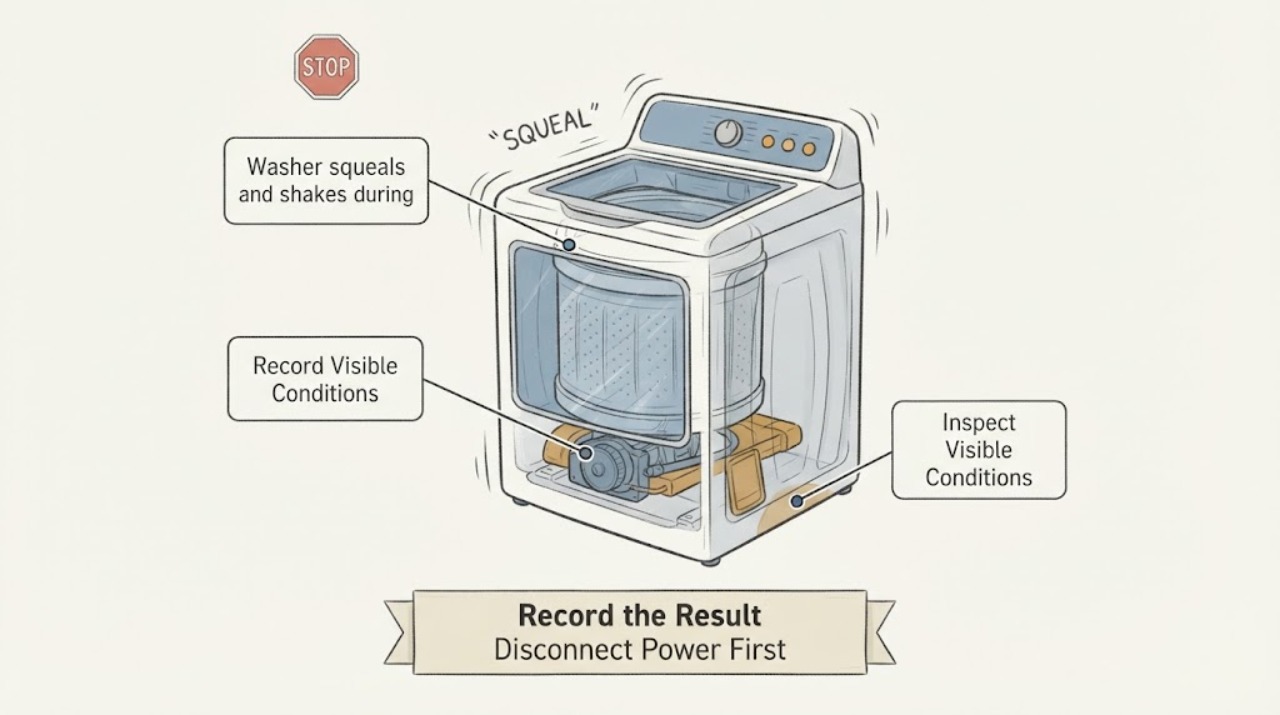
GE identifies WWSE5240G2WW as a 3.2 cu. ft. top-load washer. Its owner manual describes some agitation sounds—metallic clicking from the shifter, a back-and-forth swoosh or light clicking from the motor reversing, and short strokes that redistribute clothing—but it does not identify a loud squeal as a normal sound. Because the washer is used and the report includes shaking, do not run it again just to make a recording, approach it while it is moving, tilt it, or turn the basket by force. Disconnect power from a dry, safe position, wait for all motion to stop, and inspect only visible load, level, floor, cabinet-contact, hose, and leak conditions. A plain load or leveling issue may be corrected only as the installation instructions allow; persistent squealing, actual walking, metal debris, water, burning odor, or any damaged/missing part calls for qualified service rather than a guessed belt, bearing, clutch, motor, or transmission diagnosis.
Before you begin
Safety first
- Do not reach into a moving washer, run it to reproduce a severe noise, tilt it, remove panels, probe wiring, turn the basket by force, bypass the lid safety feature, or operate it when damaged, malfunctioning, partially disassembled, or missing/broken parts. Disconnect power before any maintenance only from a dry, safe position.
Work through in order
Diagnostic checks
Use only checks that match the exact appliance or system and its official guide.
-
Check 1
Confirm the rating label reads GE WWSE5240G2WW and write down that the noise was heard during agitation, whether it also occurred during drain or spin, whether the cabinet actually moved, and whether the machine was recently transported. Do not start another cycle solely to verify the report.
Expected result: The label matches and the squeal is limited to the reported agitation stage, or the label/stage is uncertain or the sound also occurs in other stages.
Next step: If identity or timing is uncertain, photograph the rating label and give the observed timeline to service. If it matches, continue only with the unplugged visible checks below.
Stop if: Do not approach a moving tub, open the cabinet, enter a service mode, or run an empty cycle to create a new recording.
Why this matters
Why: The exact model and stage are needed because GE documents different sounds for agitation, draining, and spin. A used-machine history or a video description cannot identify an internal part, and a different model may have different sound and installation guidance.
-
Check 2
From a dry, safe position, disconnect the washer from power and wait until every movement has stopped. Using the sound already observed, compare it only with the manual's listed light metallic click, back-and-forth swoosh/light clicking, or brief end-of-agitation redistribution strokes; do not listen live from beside the washer or touch it while running.
Expected result: The report matches only one of GE's described light sounds and there was no violent movement, leak, odor, or visible damage, or it was a loud/high-pitched squeal, scraping/grinding noise, or accompanied by shaking.
Next step: Treat a quiet, non-shaking documented sound as a reason to avoid unnecessary testing and monitor only under normal safe use; arrange service before further use when the sound was a loud squeal, scraping/grinding, or paired with shaking.
Stop if: Stop using the washer immediately for violent movement, a tub that does not stop, smoke, burning odor, hot electrical parts, water near electrics, or a damaged/missing part.
Why this matters
Why: A listed light sound can be part of the documented drive sequence, but the manual does not use that list to clear a loud squeal or shaking. A noise outside the documented examples needs a mechanical assessment rather than a part guess.
-
Check 3
With power disconnected and the basket stationary, inspect the visible installation: confirm the cabinet sits squarely on the floor, is not visibly touching a wall or the dryer/stand, and has no obvious hose, cord, loose object, or flooring contact that could transmit vibration. Look for an obviously unlevel cabinet and, only if the exact installation instructions can be followed without tilting or opening the washer, correct the visible leveling condition.
Expected result: The cabinet is visibly unlevel or contacting something, the floor is unstable, a hose/cord/object is contacting the cabinet, or the visible installation is clear and stable.
Next step: Correct only the plainly visible installation issue using the model-matched instructions, then have service assess any persistent noise or movement. Do not move a heavy used washer alone or tilt it to reach the underside.
Stop if: Do not remove panels, reach below the cabinet, loosen pressurized hoses, or perform a live or running test after the visual check.
Why this matters
Why: An installation or contact condition can explain shaking without proving an internal drive failure. A stable, correctly positioned cabinet with a persistent agitation squeal leaves the cause unresolved; the manual does not authorize identifying a belt, bearing, clutch, or motor from sound alone.
-
Check 4
Still unplugged, inspect only what is visible through the open lid and around the floor: note clothing or a hard object caught at the opening, water, metal fragments, scorch marks, a damaged cord or plug, missing parts, or signs that the cabinet has walked. Do not reach beneath the agitator or basket, force anything free, or turn the basket by hand to reproduce the noise.
Expected result: There is a visible foreign object or loading issue but no damage, or there is water, metal debris, scorching, a damaged/missing part, actual displacement, or no visible cause.
Next step: Remove only an object that is loose and reachable without force, then leave the washer off if the symptom was severe or returns. For any damage, hazard sign, actual walking, or unexplained squeal, arrange qualified GE/appliance service and provide the exact model and observations.
Stop if: Do not operate a washer that is damaged, malfunctioning, partially disassembled, or missing/broken parts; do not improvise a repair or bypass a lid safety feature.
Why this matters
Why: A plainly visible object or loading issue may explain a contact noise, but water, metal, scorching, displacement, or damaged/missing parts crosses the owner's safe check boundary. No visible cause does not distinguish among internal drive, support, tub, or control possibilities.
Use your observations
Decision map
Find the observation that best matches what you see, then follow the next safe action.
-
PATH 01Next step
What you see
The historical sound was only the light metallic clicking, back-and-forth swoosh/light clicking, or brief redistribution strokes described by GE, and there was no shaking, movement, leak, odor, or visible damage.
Do this next
Do not disassemble or replace a part based on the sound alone. If shaking or the loud squeal returns, leave the washer off and arrange service.
Why this path and its safety boundary
Why it matters: The report is compatible with a documented operating sound, but that does not certify the used washer or explain a separate shaking complaint.
-
PATH 02Next step
What you see
The cabinet is visibly unlevel, contacting a wall or nearby equipment, or has a plainly visible hose/cord/floor contact, and there are no hazard signs.
Do this next
With power disconnected, correct only the visible condition using the GE installation instructions and do not tilt or move the washer alone. Have service assess any continuing squeal or movement.
Why this path and its safety boundary
Why it matters: The installation condition is a plausible contributor to shaking, but correcting it does not prove that an internal mechanism is healthy.
-
PATH 03Next step
What you see
The squeal is loud or scraping/grinding, the cabinet walks or moves violently, or the symptom persists with a stable visible installation and no reachable foreign object.
Do this next
Keep the washer unplugged and arrange qualified service. Do not choose a belt, bearing, clutch, motor, or transmission from the sound or used history.
Why this path and its safety boundary
Why it matters: The manual's normal-sound descriptions do not identify this pattern, and observation alone cannot separate a drive, tub-support, basket, or other internal fault.
-
PATH 04Next step
What you see
Water, metal debris, scorch marks, burning odor, a hot or damaged plug/cord, a missing or broken part, repeated breaker operation, or a tub that will not stop is present.
Do this next
Stay clear, keep power disconnected only if it is safe to do so, shut off water if a hose is actively leaking, and contact qualified appliance service; use an electrician or emergency help for a building-side electrical hazard.
Why this path and its safety boundary
Why it matters: This is a safety or damage condition, not a normal noise check. Continued operation could worsen mechanical, water, or electrical risk.
Helpful context
Understand the symptom
What GE does and does not call a normal agitation sound
The model-matched GE manual gives examples of sounds that can occur during normal operation: a metallic click as the shifter engages or disengages, a back-and-forth swoosh or light clicking as the motor reverses for agitation, and short agitation strokes at the end of agitation to redistribute the load. Those descriptions do not establish that a loud squeal, scraping sound, or shaking cabinet is normal. Use the timing already observed—agitation only, drain-to-spin transition, or all movement—as evidence for the service provider; do not reproduce the noise by standing near or touching a running machine.
A used appliance needs an installation check before a part theory
Second-hand history is useful timeline information, not proof of a worn bearing, belt, clutch, transmission, or motor. GE's installation sheet requires the washer to be level and warns that improper leveling can damage it. Check the visible floor, cabinet position, and obvious contact points only after power is disconnected. Do not pull the washer out alone, tilt it, remove a cover, or attempt to make the agitator or basket turn by hand.
When checks do not resolve it
Need a professional?
Arrange qualified GE or appliance service for a loud squeal or scraping/grinding sound that is not one of the manual's listed light agitation sounds, persistent shaking, actual cabinet movement, a noise that returns after a plainly visible installation correction, or any water, metal, odor, scorch, cord, breaker, or missing-part warning.
Safety scope: Do not reach into a moving washer, run it to reproduce a severe noise, tilt it, remove panels, probe wiring, turn the basket by force, bypass the lid safety feature, or operate it when damaged, malfunctioning, partially disassembled, or missing/broken parts. Disconnect power before any maintenance only from a dry, safe position.
Have this ready
- Provide the complete model WWSE5240G2WW, used-machine and transport history, the exact stage when the sound occurred, whether the basket was moving, whether the cabinet walked, load and visible-level observations, any water or debris, and whether the power was disconnected.
Common questions
FAQ
Is a squeal during agitation normal on the GE WWSE5240G2WW?
GE's manual lists metallic clicking, a back-and-forth swoosh or light clicking, and brief redistribution strokes as possible agitation sounds. It does not define a loud squeal or shaking as normal, so do not diagnose or replace a part from sound alone.
Can I run an empty cycle to see where the noise comes from?
Not when the reported symptom includes a loud squeal or shaking. GE says not to reach into a moving washer and not to operate a damaged or malfunctioning appliance. Disconnect power and provide the observed stage and visible findings to service instead.
Could the fact that the washer is used prove a worn bearing or belt?
No. Used history is a timeline clue, not a component diagnosis. Confirm the model and visible installation conditions, then have a qualified provider assess persistent noise or movement without guessing a part from the symptom.
Read the exact guide
Official sources
- Installation Instruction - Quick Reference GuideGE Appliances · Installation sheet linked from GE's exact-model support path; used only for visible leveling, floor, transport-rod, grounding, and supply requirements, not for disassembly.
- Owner's Manual 49-90295-1 - GE WashersGE Appliances · Model-matched manual linked from the exact WWSE5240G2WW page; sound descriptions and safety rules are used without extending them into an internal part diagnosis.
- Model Search | WWSE5240G2WWGE Appliances Parts · Direct exact-model GE parts/support page; it identifies WWSE5240G2WW as a GE 3.2 cu. ft. Super Plus Capacity Washer and links the owner's manual and installation instructions.
Community feedback
Share a repair observation
Share a plain-text repair observation. Accepted observations are published automatically; this page may take a moment to update.