
On this page
Start here
Quick answer
Stop using a GE Profile PFW950SPT2DS washer after a breaker trip, especially when the appliance is only about a month old. From a dry, safe position, leave the washer disconnected; close its water valves if there is a leak or unwanted filling. Do not keep resetting the breaker, fit a larger breaker, use an extension cord, or open the cabinet. Record whether the trip happened on plug-in, at Start, during filling, or during drain or spin. If the breaker trips while the washer is unplugged, the household circuit or breaker needs a qualified electrician. If it holds with the washer unplugged but trips when the washer is connected or a cycle begins, leave the washer out of service and use the GE warranty route. A trip does not identify a heater, pump, motor, control, or wiring part by itself.
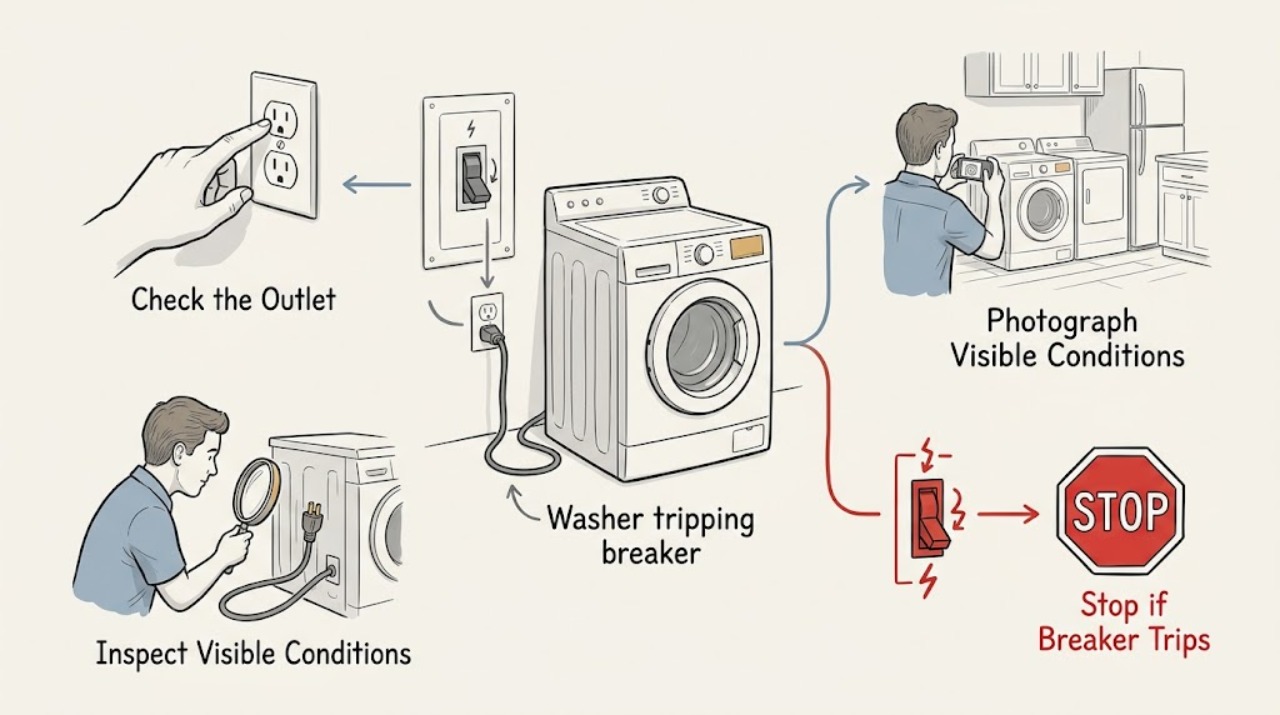
Work through in order
Diagnostic checks
Use only checks that match the exact appliance or system and its official guide.
-
Check 1
Stop the washer immediately. From a dry, safe position, turn it off and disconnect the plug only if the plug and receptacle are dry, cool and accessible without reaching through water. If there is standing water, a wet plug or outlet, smoke, a spark, a burning smell, a hot or damaged cord, or water entering the washer, keep clear; close the washer's water valves only from a safe dry position and isolate the circuit only if that can be done safely.
Expected result: The area and electrical hardware are dry and intact, or there is water, smoke, sparking, electrical odor, abnormal heat, damaged wiring or a damaged cord.
Next step: For any hazard, leave the washer out of service and arrange qualified electrical or appliance help; protect the area from flooding and do not touch wet equipment.
Stop if: Do not reset the breaker repeatedly, pull the washer across water, use an extension cord, or open the washer cabinet.
Why this matters
Why: A water or electrical hazard takes priority over diagnosing the trip. A dry appliance with no visible hazard can proceed only to limited external observation; a hazard cannot be safely reproduced by another wash cycle.
-
Check 2
Without moving or opening the washer, photograph the rating label and record the complete model and serial numbers, purchase date, country, and the installation paperwork available for the machine. Check whether the label really reads PFW950SPT2DS and whether the supplied manual matches that full identifier; do not assume that the closely named PFW950SPTDS support page is the exact suffix.
Expected result: The label clearly shows PFW950SPT2DS with a matching manual, the label shows another suffix, or the identifier and manual cannot be matched.
Next step: Use the matching installation instructions and rating plate for the electrical review. If the identity cannot be matched, give the label photo to GE service and an electrician rather than borrowing setup details from another washer.
Stop if: Do not pull out a built-in washer, remove covers, enter a service mode, or change wiring to make the model or supply fit a guessed procedure.
Why this matters
Why: GE's owner support and model-locator pages route owners by the exact model and serial information. A suffix difference can change installation details, controls or service documentation, so a generic 120-volt or breaker statement cannot replace the matching instructions.
-
Check 3
From a dry, stationary position, inspect only the visible plug, cord, receptacle face and breaker position. Look for looseness, scorching, discoloration, heat, moisture, a damaged cord, an extension cord, a shared laundry circuit, or a breaker arrangement that does not match the exact installation instructions. Do not remove the receptacle or open the electrical panel; ask an electrician to verify any local GFCI or AFCI requirement rather than guessing from a generic article.
Expected result: The plug or outlet is hot, wet, loose, scorched or damaged; the circuit is shared or questionable; the breaker is mislabeled or will not remain on; or the visible supply path looks normal.
Next step: Keep the washer disconnected and have a qualified electrician evaluate a questionable receptacle, breaker, branch circuit or required protection. If the visible supply path is normal, continue only with the trip history and warranty record.
Stop if: Do not touch hot or wet electrical hardware, substitute a larger breaker or fuse, use an extension cord, or work inside the panel.
Why this matters
Why: A household supply problem can trip before the washer itself is proven defective. GE describes its normal washer supply as an individual grounded branch circuit protected by a 15- or 20-amp breaker or time-delay fuse, with the exact installation instructions controlling model-specific details.
-
Check 4
Only if the washer remains unplugged, the area is dry and there is no odor, smoke, spark, damage or leak, use the household breaker's ordinary off-then-on operation once. Leave the washer disconnected while observing the breaker; do not plug the washer back in to see whether it trips again.
Expected result: The breaker holds with the washer unplugged, trips immediately while the washer remains unplugged, or will not reset normally.
Next step: If the unplugged breaker trips or will not hold, leave it off and call a qualified electrician. If it holds, keep the washer unplugged and request GE warranty or qualified appliance service instead of reconnecting it.
Stop if: Do not repeat the reset, reconnect the washer, run an empty cycle, or use another outlet as a test.
Why this matters
Why: A breaker that fails with the appliance disconnected points first to the household wiring, receptacle or breaker box. A breaker that holds without the washer does not clear the washer; it only makes the appliance side the next qualified-service question.
-
Check 5
Write down the event exactly as it occurred without reproducing it: cycle and load, whether the trip happened on plug-in, Power or Start, filling, wash or tumble, drain or spin, and whether there was a leak, water near the appliance, unusual noise, odor or display message. Preserve the receipt, installation paperwork and the external photographs for the service request.
Expected result: The trip was immediate on connection, happened only after a cycle began, followed filling or a leak, occurred during drain or spin, or its timing is unknown.
Next step: Give GE warranty service and, when relevant, the electrician the exact model and serial, purchase date, trip timing, breaker behavior, supply observations and photographs. Ask for a documented diagnosis before authorizing any part.
Stop if: Do not perform live measurements, remove panels, bypass an interlock, repeatedly reset power or run another load merely to improve the timestamp.
Why this matters
Why: Timing can separate a supply/input event from an operating-stage event, but GE lists several possible appliance-side causes and the timing does not select a heater, pump, motor, control or wire for replacement.
Use your observations
Decision map
Find the observation that best matches what you see, then follow the next safe action.
-
PATH 01Next step
What you see
There is water near the washer or electrical hardware, smoke, a spark, a burning smell, abnormal heat, damaged wiring or a second trip.
Do this next
Keep clear, isolate power and water only from a safe dry position, and arrange qualified electrical/appliance help. Do not restore power to reproduce the event.
Why this path and its safety boundary
Why it matters: This is a safety incident with possible shock, fire or flooding risk, not a user-level component diagnosis.
-
PATH 02Next step
What you see
The washer remains unplugged but the breaker trips immediately or will not hold, or the receptacle/circuit is visibly damaged or incorrectly supplied.
Do this next
Leave the washer disconnected and have a qualified electrician evaluate the circuit against the exact installation instructions and local code.
Why this path and its safety boundary
Why it matters: The household branch circuit, receptacle or breaker is the first fault domain; the washer has not been proven to be the cause.
-
PATH 03Next step
What you see
The breaker holds with the washer unplugged, but the trip occurred when the washer was connected or a cycle began, with no external water or supply hazard visible.
Do this next
Keep the washer out of service and request GE warranty or qualified appliance diagnosis using the exact model, cycle stage and event record. Do not reconnect it for another test.
Why this path and its safety boundary
Why it matters: An appliance-side fault is possible, but the event could involve several internal or installation paths and does not identify a safe replacement part.
-
PATH 04Next step
What you see
The breaker holds after one safe unplugged check and the external supply looks normal, but a one-month-old washer has already tripped once.
Do this next
Preserve the receipt and installation record, keep the washer disconnected until GE evaluates it under the written warranty, and provide the trip timing rather than repeatedly testing it.
Why this path and its safety boundary
Why it matters: A single event may not reveal whether the cause is supply-side or appliance-side; normal breaker behavior while unplugged does not make repeated operation a safe diagnostic.
Helpful context
Understand the symptom
This is an electrical-safety and warranty case, not a normal reset problem. GE's public PFW950SPTDS support page identifies the closely named PFW950SPTDS GE Profile front-load family and links its manual and service path, but the opened page does not show the task's extra 2 suffix. Confirm the rating label before relying on any model-specific installation detail. The exact installation instructions and local electrical code take priority over a generic washer chart.
GE's general washer guidance describes an individual grounded branch circuit and its breaker-trip guidance separates a breaker that fails with the washer unplugged from a trip that occurs only when the appliance is connected or operating. That split helps decide whether to call an electrician, GE warranty service, or both; it does not prove which internal part failed.
When checks do not resolve it
Need a professional?
Arrange qualified electrical help for a breaker that trips while the washer is unplugged, a hot or damaged receptacle, questionable branch circuit, or any smoke, spark, burning odor or water near electrical equipment. Arrange GE warranty or qualified appliance service for a trip that occurs only when this washer is connected or operating, a recurring trip, or an unexplained trip on a washer reported to be about one month old. Do not open the cabinet or replace a part from the symptom alone.
Common questions
FAQ
Does a breaker trip prove that the GE washer's heater or pump is bad?
No. GE lists several possible appliance-side causes, including a shorted heater, timer, loose electrical wires or another failed component. The trip timing helps a technician plan the diagnosis but does not select a part for replacement.
Should I try a larger breaker or a different outlet?
No. Keep the washer disconnected and have the exact installation requirements and household circuit checked by qualified professionals. Do not substitute a larger breaker, use an extension cord or move the appliance across a questionable circuit as a test.
What should I give GE when requesting warranty service?
Provide the complete model and serial label, purchase date, matching installation information, the cycle stage when the breaker tripped, whether the breaker held with the washer unplugged, and photographs of any safe external observations. Keep the washer out of service until GE advises the next step.
Read the exact guide
Official sources
- GE Profile 5.3 cu. ft. Smart Front Load Steam Washer - PFW950SPTDSGE Appliances · Opened official product page for the PFW950SPTDS base family; use the exact PFW950SPT2DS label and written warranty for suffix-specific decisions.
- User Manual & Care for PFW950SPTDSGE Appliances · Opened official Owner Center for the closely named PFW950SPTDS base family. It identifies the 5.3 cu. ft. front-load GE Profile washer and links owner manual and service; the task's extra 2 suffix must still be confirmed.
- GE Appliance - Circuit Breaker TripsGE Appliances · Opened official GE guidance for refrigerators, dishwashers, washers and dryers; it provides a supply-versus-appliance triage but does not diagnose a specific PFW950SPT2DS component.
- Washer - Electrical Requirements and Breaker SizeGE Appliances · Opened GE's official washer electrical guidance; it is a general GE washer reference and explicitly defers model-specific details to the exact Installation Instructions.
- Find Your GE Model & Serial NumbersGE Appliances · Opened official GE model-locator page to support recording the exact label before selecting manuals or service paths.
Community feedback
Share a repair observation
Share a plain-text repair observation. Accepted observations are published automatically; this page may take a moment to update.