
On this page
Start here
Quick answer
“T style” is not enough to identify one GE washer, so do not pull a shipping rod, remove packing material, adjust legs, or select a cycle from another model until the full model label and its installation instructions are confirmed. Once the tub is completely still, record whether the shaking happens with one bulky or small load, every load, an empty basket, or only after a recent move. GE's top-load guidance points first to an unbalanced load, an unlevel washer, an unsuitable or unstable floor, or shipping material left in place. Redistribute or reduce the load once when safe, and make only the model-documented external leveling correction. If the washer still walks, bangs, leaks, or vibrates severely with a balanced load and correct installation, stop using it and arrange qualified service; do not open the tub or guess at a suspension or damper part.
Before you begin
Safety first
- Do not reach into a moving basket, tilt or drag the connected washer, open the tub, remove unidentified transport material, bypass a lid lock, test live circuits, or guess a suspension, damper, drive, or bearing part. Keep power and water off for wet electrical areas, smoke, burning odor, damaged wiring, uncontrolled movement, or a leak.
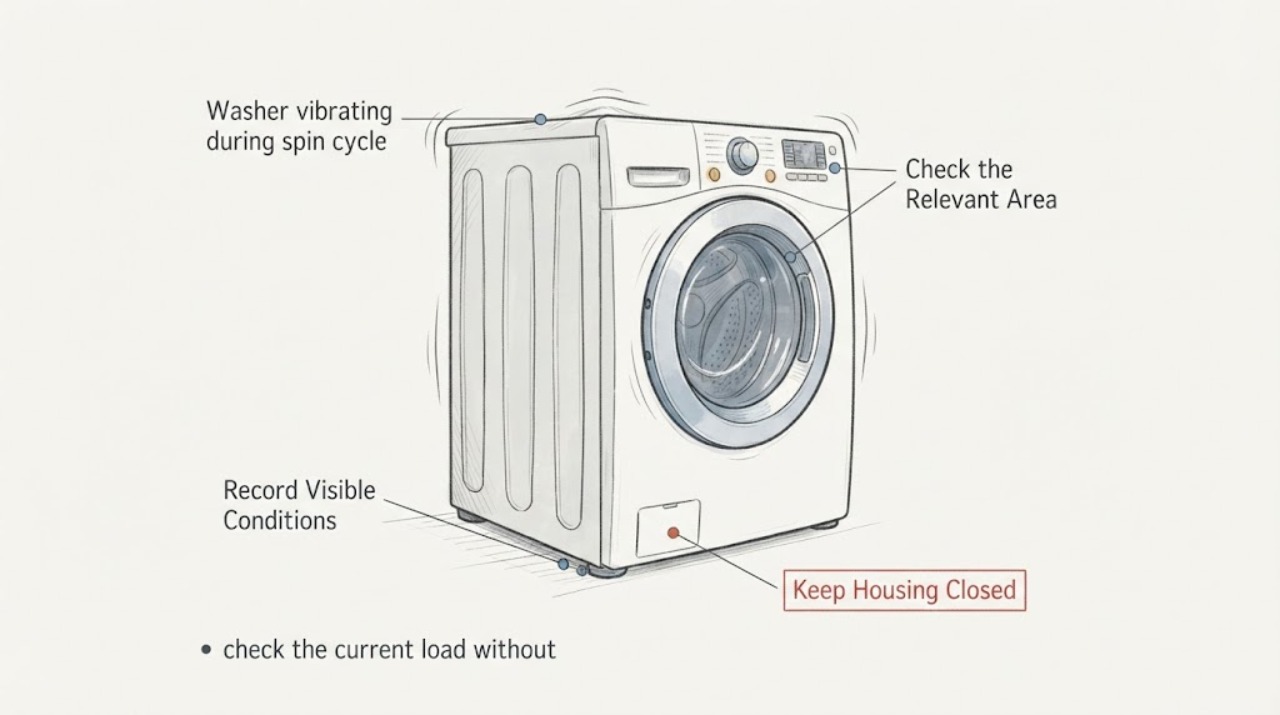
Work through in order
Diagnostic checks
Use only checks that match the exact appliance or system and its official guide.
-
Check 1
Stop or pause only as the controls and the model instructions permit, wait until the basket has fully stopped, and record when the vibration starts: during ramp-up, at full spin, as it slows, or after a recent installation or move. Note whether the cabinet walks, the lid area bangs, water leaks, or the washer shows a warning.
Expected result: The movement occurs only with one load, with every load, with an empty basket, immediately after a move, or with a leak, damaged cord, burning odor, or violent uncontrolled movement.
Next step: Keep clear while the tub moves. If there is a leak near electrics, smoke, burning odor, damaged wiring, or uncontrolled movement, unplug or switch off power only from a dry safe location and arrange service. Otherwise continue after the basket stops.
Stop if: Do not reach into the basket, hold the cabinet, or keep running a washer that is leaking or moving violently.
Why this matters
Why: A load-specific pattern supports balance as the first check; an empty-basket or all-load pattern makes installation or an internal fault more likely. A leak, electrical symptom, or violent movement is a safety boundary rather than a normal spin observation.
-
Check 2
Find and record the complete GE model number from the washer label, then use that exact number to open the GE installation instructions. Treat “T style” only as the supplied description until the full identifier is verified.
Expected result: A full model number is legible and its installation document is available, or only “T style” is known or the model cannot be located.
Next step: Use the exact document to confirm the washer type, shipping-material procedure, floor requirements, and leveling steps. If the model remains unknown, limit the check to load distribution and external observations and give the label to a technician.
Stop if: Do not pull a transport rod, remove packing, tilt the cabinet, or adjust a hidden component based only on the phrase “T style.”
Why this matters
Why: GE says shipping-material removal and leveling must follow the installation instructions for the specific model. Without the full model, it is not safe to assume the washer has a rod, foam, cardboard, or a particular leg-adjustment method.
-
Check 3
When the basket is still and the lid is closed, check the current load without reaching under the tub. If garments are gathered to one side or the load is one bulky item, remove excess material or redistribute the items evenly once, then close the lid and use the model-approved cycle.
Expected result: The load is bunched or unusually small or bulky, the load is evenly distributed, the vibration improves after redistribution, or the vibration returns immediately.
Next step: Monitor one subsequent spin with a normal balanced load. If the washer still walks or bangs, stop repeating load experiments and continue with the stationary installation checks.
Stop if: Do not open the lid while the basket is moving or keep adding/removing items during spin.
Why this matters
Why: GE identifies unbalanced loads as a cause of increased top-load vibration and walking. Improvement after one redistribution supports a load-balance cause; recurrence with a suitable load shifts attention to leveling, floor, installation material, or service.
-
Check 4
With power off and the washer stationary, check from outside whether the cabinet rocks on the floor and whether all visible feet contact a firm, solid surface. Compare the cabinet left-to-right and front-to-back, and use only the exact installation instructions for any leg adjustment.
Expected result: The cabinet rocks while idle, a foot is not firmly planted, the floor flexes or is uneven, or the washer is stable when idle but vibrates during spin.
Next step: Correct only an obvious, model-documented external leveling issue without tipping or moving the washer. If the floor is unstable, the legs cannot be adjusted safely, or movement remains after leveling, arrange service or a qualified installation check.
Stop if: Do not lift, tilt, drag, or place improvised supports under the washer while it is connected.
Why this matters
Why: GE says a top-load washer needs to be level and on a good, solid floor; its leveling guidance says a correctly leveled washer should not rock when it is not running. Idle rocking supports an installation or floor issue, while a stable idle cabinet with severe spin movement needs further diagnosis.
-
Check 5
If the vibration began after delivery, installation, or a move, compare the exact model's installation instructions with the visible exterior for the specified shipping material. Look only where the instructions identify an accessible item; do not remove a rod, foam, or cardboard piece unless the full model document explicitly identifies it and the washer is safe and stationary.
Expected result: The washer was recently moved, the documented transport material may still be present, the material was removed as instructed, or the model document does not match the machine.
Next step: Follow the exact model's installation procedure or arrange a qualified installation check. If the washer ran briefly with the wrong material in place, stop and provide the model and timing to service rather than opening the tub.
Stop if: Do not remove unidentified packing, pull a rod blindly, dismantle the cabinet, or continue operation when the transport setup is uncertain.
Why this matters
Why: GE says top-load washers can use different transport-retention materials and that material left in place can make the machine vibrate and become noisy. Because “T style” does not identify which design is present, an unverified removal attempt could damage the installation or suspension.
-
Check 6
After one documented load correction or external installation correction, make at most one supervised spin observation from a safe distance with the lid closed. Record whether movement is normal for the confirmed model, whether the cabinet walks, whether banging repeats with a balanced load, and whether any leak or warning appears.
Expected result: The washer completes a balanced spin, vibration remains severe, the motor runs without stable basket motion, the washer walks, or a leak or warning returns.
Next step: Stop using the washer for repeated severe movement, walking, banging, leaks, or warnings. Give service the full model number, load type, move history, idle-rock result, installation-material result, and the exact spin behavior.
Stop if: Do not open the tub, remove suspension or damping components, bypass a lid lock, test live circuits, or order a guessed part.
Why this matters
Why: Recovery after redistribution or correct installation supports that external condition. Severe repeat movement with a balanced load and stable installation cannot be assigned to a particular internal part from outside; a motor or basket symptom, leak, or warning needs qualified diagnosis.
Use your observations
Decision map
Find the observation that best matches what you see, then follow the next safe action.
-
PATH 01Safety boundary
What you see
The washer vibrates mainly with one bulky, very small, or visibly bunched load and settles after the items are redistributed once.
Do this next
Use a suitable balanced load and monitor the next completed spin. If the same movement returns with ordinary loads, proceed to the installation and service branches.
Why this path and its safety boundary
Why it matters: The load balance is the best-supported explanation, not evidence of a failed suspension part.
Safety stop: Do not keep running the washer if it walks into cabinets, bangs violently, or leaks.
-
PATH 02Safety boundary
What you see
The washer rocks while idle, a foot is not firmly planted, the floor flexes, or the cabinet was recently installed or moved and the exact transport procedure has not been confirmed.
Do this next
Keep the washer off while a qualified person follows the exact GE model installation instructions for leveling and transport material. Do not tilt or dismantle the washer to find a rod, foam, or cardboard piece.
Why this path and its safety boundary
Why it matters: Leveling, floor support, or unidentified shipping material is more likely than a proven internal mechanical failure. The phrase “T style” does not select a transport-material procedure.
Safety stop: Stop for a damaged connection, leak, uncontrolled movement, or any need to move the washer while it remains connected.
-
PATH 03Safety boundary
What you see
The cabinet is stable while idle, the load is balanced, the exact installation material is correct, but severe vibration or walking repeats, including with a suitable load.
Do this next
Leave the washer off and arrange qualified GE or appliance service. Provide the full model, when the symptom began, whether it follows the load, and any banging, scraping, leak, or warning.
Why this path and its safety boundary
Why it matters: An internal suspension, basket, drive, bearing, or structural issue remains possible, but external checks cannot identify which component is at fault.
Safety stop: Do not open the tub, guess a damper or suspension part, bypass the lid lock, or perform live electrical tests.
-
PATH 04Safety boundary
What you see
Vibration is accompanied by a leak, damaged cord, burning odor, smoke, a hot electrical connection, or violent uncontrolled movement.
Do this next
From a dry safe location, switch off power and water only if the controls or valves can be reached without touching wet equipment. Keep people clear and arrange prompt qualified service.
Why this path and its safety boundary
Why it matters: The symptom has crossed the ordinary owner-check boundary and continued operation could cause injury, water damage, or electrical damage.
Safety stop: Do not touch wet electrical equipment, restart the washer, drag it, open the cabinet, or reach into a moving basket.
Helpful context
Understand the symptom
Treat “T style” as a description, not a model
GE's support material repeatedly directs owners to the installation instructions for the specific model. Its top-load shipping guidance lists more than one transport-retention design, including a rod, Styrofoam, or cardboard packaging, so a generic “T style” label cannot tell you which piece—if any—should be removed. Photograph or transcribe the full model label before changing installation settings.
When movement is more than a load problem
A load that gathers to one side can make a top-loader shake, and an uneven cabinet or floor can make spin movement worse. If those external conditions are correct but severe movement repeats with a balanced load, the result is a service boundary; it is not a basis for naming a suspension, drive, or damper component.
When checks do not resolve it
Need a professional?
Arrange qualified GE or appliance service when the full model cannot be identified for an installation check, severe vibration or walking repeats with a balanced load and stable cabinet, transport setup is uncertain, or a leak, warning, banging, scraping, electrical symptom, or motor/basket problem appears.
Safety scope: Do not reach into a moving basket, tilt or drag the connected washer, open the tub, remove unidentified transport material, bypass a lid lock, test live circuits, or guess a suspension, damper, drive, or bearing part. Keep power and water off for wet electrical areas, smoke, burning odor, damaged wiring, uncontrolled movement, or a leak.
Common questions
FAQ
Is “T style” a sufficient GE model number for diagnosing spin vibration?
No. It is a description rather than a complete model identity. GE directs owners to the installation instructions for the specific model, and top-load machines can use different shipping materials and leveling procedures.
What should I check first when a GE top-loader shakes during spin?
Wait for the basket to stop, record whether the symptom follows one load or every load, then redistribute a bunched or bulky load once. With power off and the machine stationary, check whether the cabinet rocks or a foot is not firmly on a solid floor.
Should I replace a suspension or damper part if the washer still vibrates?
Not from this symptom alone. If balanced loads, model-correct shipping setup, and external leveling do not resolve severe movement, a qualified technician should identify the internal cause. Do not open the tub or order a guessed part.
Read the exact guide
Official sources
- Top Load Washer - Noises Heard During AgitationGE Appliances · GE's noise guide separates model-dependent normal sounds from installation-related thumps and rocking; model-specific instructions are required for the assigned “T style” washer.
- FAQs | WashersGE Appliances · GE's washer FAQ supports the distinction between a balance-related spin stop and a model-specific washer issue without selecting a component for “T style.”
- Top Load Washer - Shipping RodGE Appliances · GE lists multiple top-load transport-retention designs and directs owners to the specific model installation instructions; it does not establish which design the assigned “T style” washer uses.
- Washer - Leveling the LegsGE Appliances · GE leveling principles support an external check for the assigned top-load washer; the exact “T style” model controls any adjustment or tilt procedure.
- Top Load Washer - Walking or VibratingGE Appliances · GE's general top-load guidance applies to the assigned GE “T style” description while requiring the full model's installation instructions for exact procedures.
Community feedback
Share a repair observation
Share a plain-text repair observation. Accepted observations are published automatically; this page may take a moment to update.