
On this page
Start here
Quick answer
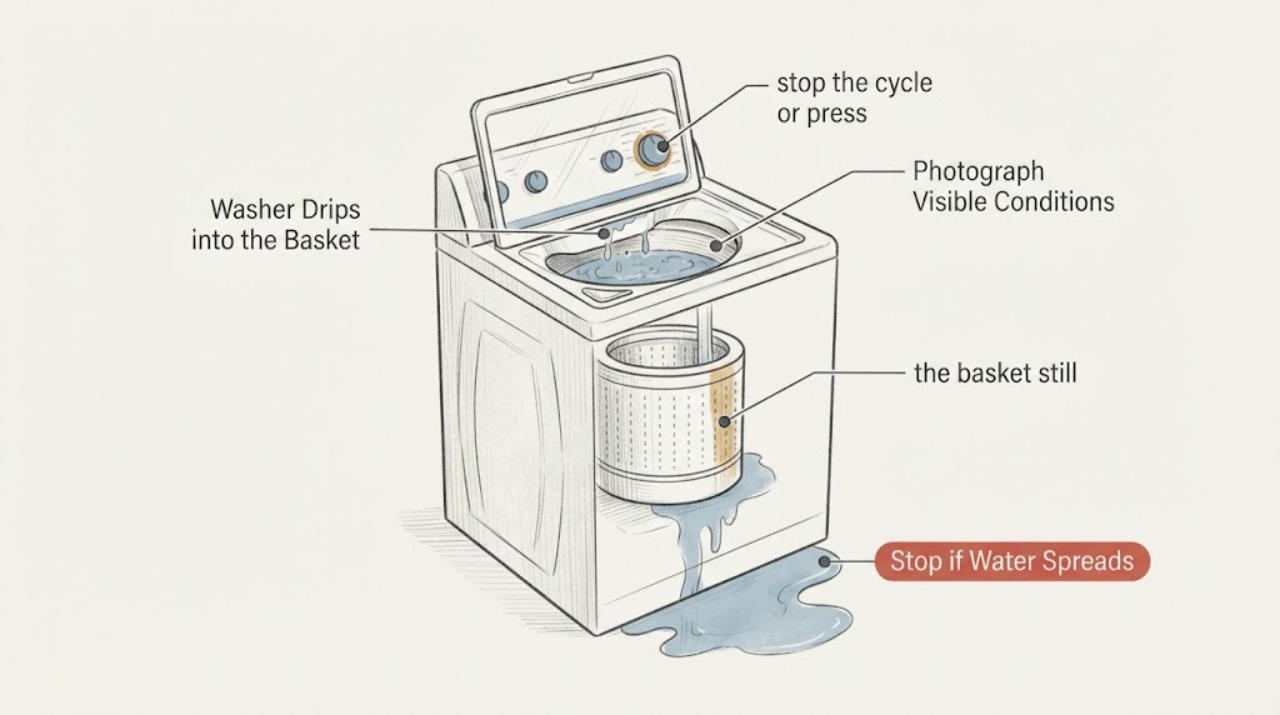
First verify the model from the rating label under the lid: GE's official Owner Center uses the spelling GTW750CSLWS, while the reported GTW750CSLOWS has an extra O that may be a transcription error. Do not use a button sequence or part lookup until the label is confirmed. On the GTW750 top-load platform, a few delayed drops into the empty basket can be normal: GE says water trapped in the fill nozzle may release after the fill stops, even hours later, and a small amount of water (typically no more than 1/2 cup) at the bottom of the basket is considered normal. Water that keeps entering, forms a steady stream, raises the level while the washer is idle, or exceeds that amount is different: from a dry position stop the washer, close both household water valves, and disconnect power only when doing so is safe and dry. Do not keep running Whites or Deep Rinse, remove the inlet valve or dispenser, or infer a failed part from dripping alone.
Work through in order
Diagnostic checks
Use only checks that match the exact appliance or system and its official guide.
-
Check 1
From a dry position, photograph the rating label under the lid and record the complete model, serial information, market, selected Whites cycle, Deep Rinse setting, time the cycle ended, and when the first drop appeared. Do not start another cycle just to reproduce it.
Expected result: The label reads GTW750CSLWS or another complete GTW750 variant, the extra O is confirmed, or the label cannot be read clearly.
Next step: Use the complete label in GE's Owner Center and keep the washer out of code- or part-specific experimentation until the identity is confirmed. If the label remains uncertain, provide the photo to GE service.
Stop if: Do not remove covers, enter a service mode, or disconnect a valve or dispenser while the identity is uncertain.
Why this matters
Why: GE's official support page uses GTW750CSLWS, while the reported string contains an additional O. Full model identity controls the matching manual, dispenser arrangement, and any permitted procedure; a near match is not proof that every control or part is identical.
-
Check 2
With the cycle finished, the basket still, and the washer safe to approach, estimate the water amount at the bottom of the empty basket and note whether it arrived as one delayed spurt, occasional drops, a thin continuous stream, or a rising level. Use a clean measuring cup only outside the appliance if needed; do not reach into a moving basket.
Expected result: There is a small amount at or below about 1/2 cup with only delayed drops, or there is more than about 1/2 cup, a steady stream, repeated accumulation, or water spreading outside the basket.
Next step: For the small delayed pattern, leave the lid open to let the basket dry and monitor without replacing a part. For a larger or ongoing pattern, stop the washer and continue with the dry-area supply check.
Stop if: Stop immediately for flooding, water near the receptacle or cord, a wet control area, or any electrical odor or spark.
Why this matters
Why: GE describes about 1/2 cup or less and delayed release from the fill nozzle as normal residual water. A larger amount, ongoing inflow, or a rising level is outside that published normality and needs a supply-isolation decision rather than repeated cycle testing.
-
Check 3
If water is still entering while the washer is idle, stop the cycle or press Power from a dry position, then close both household hot and cold supply valves if they can be reached without stepping into water. Disconnect the plug or circuit only from a dry, safe position; never unplug while standing in water.
Expected result: Dripping stops after the supply valves are closed, continues despite closed valves, or the floor, outlet, cord, or cabinet is wet or damaged.
Next step: Leave the washer out of use with the valves closed and arrange qualified GE appliance service. If the water source, hose connection, or household plumbing is the visible source, use plumbing help as appropriate.
Stop if: Do not touch a wet plug or outlet, reset a tripping breaker, loosen a pressurized hose, or open the console or valve assembly.
Why this matters
Why: GE specifically recommends closing the water valves when a washer drips or fills while off; a washer water valve may be involved, but the symptom alone does not prove which valve, control, or hose has failed. Continued water with the valves closed points away from a simple active supply-inlet path and requires service/plumbing assessment.
-
Check 4
With water off and power safely isolated, inspect only the visible basket, top fill nozzle, softener/conditioner drawer, and surrounding lid area for clean residual water, detergent or softener residue, an overflowing dispenser, or a damaged/misaligned external piece. Do not remove the dispenser box or insert tools into the nozzle.
Expected result: Only the dispenser has a small amount of water, the basket receives one clean delayed drop from above, residue or overflow is visible, or water appears from an unseen cabinet area.
Next step: Wipe accessible spills and clean only the drawer components the exact manual permits, then keep the machine off if water entered the cabinet or continues. Request service for a hidden source, overflow, or recurrence.
Stop if: Do not remove the non-removable dispenser box, dismantle the fill nozzle, scrape buildup into the basket, or run the machine with water near electrical parts.
Why this matters
Why: GE's GTW750 manual says a small amount of water remaining in the dispenser after a cycle is normal, and its cleanout instructions distinguish the GTW750 detergent tank from other model families. A clean delayed drop from the fill nozzle fits the residual-water explanation; residue, overflow, or an unseen leak is not evidence for a specific valve or dispenser part.
-
Check 5
Compare the timing with the manual's documented GTW750 sequence without starting a new test: note whether the lid was opened, the controls were left paused, Water Station was used, or the cycle knob was moved after dispensing. Record whether the water is clean and appears from above or is dirty water returning from the drain path.
Expected result: The water appears only after a documented pause/lid or Water Station state, is a small clean delayed amount from above, or returns as dirty water or continues independently of those states.
Next step: Document the state and use only the exact manual's normal completion behavior once the machine is dry and safe. Keep supply valves closed and arrange service for ongoing inflow, backflow, or unexplained water.
Stop if: Do not repeatedly pause, change cycles, or run Whites/Deep Rinse to force a comparison; do not reach into the tub or drain path.
Why this matters
Why: GE documents automatic draining after a lid is open with water present for more than 15 minutes, after a closed-lid pause over 24 hours, and after Water Station use when the knob changes. Those cycle states can change when water moves, but they do not explain a steady idle fill. Dirty return water or independent ongoing inflow needs a drain/plumbing or appliance-service branch.
-
Check 6
If the water was only a small delayed amount and no hazard is present, leave the lid open, allow the basket and accessible surfaces to dry, and monitor the next normal period without adding detergent or changing parts. If a second observation shows active filling, measure the amount again only from outside the tub.
Expected result: No further water appears, the same small delayed amount recurs, or the basket gains water while idle or after the supply is reopened.
Next step: Keep the supply valves closed for an idle rise or stream and request GE service with the model photo, amount, timing, water appearance, and valve-closed result. Do not order a water valve from the symptom alone.
Stop if: End owner checks for overflow, water near electricity, damaged hoses, a wet cabinet, or any need to open the appliance.
Why this matters
Why: A one-off small residual amount is consistent with GE's normal fill-nozzle explanation. Recurrence as an idle rise or stream is materially different and increases the risk of overflow; it should not be labeled normal because the previous amount was small.
Use your observations
Decision map
Find the observation that best matches what you see, then follow the next safe action.
-
PATH 01Next step
What you see
The complete label is the GTW750 family, the water is clean, the amount is about 1/2 cup or less, and it arrives as a delayed spurt or occasional drops from the upper fill area after the cycle.
Do this next
Leave the lid open to dry and monitor. Do not replace a part unless a later observation changes to continuous inflow, a larger amount, or another leak path.
Why this path and its safety boundary
Why it matters: This matches GE's published normal residual-water behavior from water trapped in the fill nozzle; Deep Rinse or Whites selection does not by itself prove an inlet-valve failure.
-
PATH 02Next step
What you see
The basket gains more than about 1/2 cup, a steady stream continues after the cycle, or the water level rises while the washer is idle.
Do this next
From a dry position stop use, close both supply valves, isolate power only when safe, and arrange qualified GE appliance service. Protect the floor and keep the washer out of use until the source is resolved.
Why this path and its safety boundary
Why it matters: The symptom is outside GE's described small residual amount and is consistent with an unresolved supply/inlet, control, hose, or other water-path issue; the observation does not identify a specific component.
-
PATH 03Next step
What you see
Only the softener/conditioner dispenser retains a small amount of water, while the basket stays dry and there is no cabinet or floor leak.
Do this next
Clean only the accessible drawer parts using the exact manual, refit any permitted siphon components correctly, and request service if the drawer overflows or water reaches the cabinet.
Why this path and its safety boundary
Why it matters: GE's GTW750 manual treats a small amount of residual dispenser water after a cycle as normal; it is not the same as water entering the basket.
-
PATH 04Next step
What you see
Water is dirty or returns from the drain path, appears with an unrecognized paused/Water Station state, or continues after supply valves are closed.
Do this next
Keep the washer off with water isolated, photograph the source and timing, and use qualified appliance or plumbing service. Do not disassemble the pump, valve, dispenser, or cabinet to identify it yourself.
Why this path and its safety boundary
Why it matters: The pattern is not explained by a simple clean fill-nozzle residual drop; drain/plumbing backflow, an internal water path, or an unverified cycle state remains possible.
Helpful context
Understand the symptom
Confirm the O/0 model transcription first
The reported model is GTW750CSLOWS, but GE's opened Owner Center page uses GTW750CSLWS, without the extra O. The same manual covers the GTW750 family, and GE places the model and serial information under the lid. Photograph the complete label and market before using a model-specific control or dispenser procedure. Until that is done, use only the safe top-load residual-water distinction below.
A few delayed drops are not the same as continuous filling
GE says a small amount of water in a top-load basket after a cycle is typically normal. Water can remain in the fill nozzle above the basket and release later when its water tension breaks, even a few hours after filling stops. GE's published threshold is about 1/2 cup or less at the bottom of the basket. This applies to a small residual amount, not a rising water level or a steady stream.
When checks do not resolve it
Need a professional?
Arrange qualified GE appliance service when the basket receives more than about 1/2 cup, water enters as a steady stream, the level rises while idle, the symptom returns after supply valves are closed and the washer remains unused, the source is inside the cabinet, or the model identity cannot be matched to the correct manual. Use plumbing service for a visible household drain or supply problem. Stop immediately and keep clear for flooding near electrical parts, a wet or damaged cord or outlet, smoke, burning smell, sparks, repeated electrical trips, or structural water damage. Do not unplug while standing in water, remove the inlet valve or dispenser, open panels, use a service mode, or keep running cycles to reproduce the drip.
Common questions
FAQ
Is one or two drops of water in a GE GTW750 basket after a cycle normal?
It can be. GE says water trapped in the top fill nozzle may release later, and a small amount at the bottom of a top-load basket—typically about 1/2 cup or less—is considered normal. A steady stream, rising level, or larger amount is not the same pattern.
What if the GE washer keeps filling when it is turned off?
From a dry position, close both household water valves and keep the washer out of use. GE says a washer that drips or fills while off may have a water-valve problem, but the symptom alone does not identify a safe part to order; arrange qualified service.
Can Whites with Deep Rinse cause water to drip into the basket?
Those are documented GTW750-family selections, but the option names alone do not prove a fault. Judge the result by amount and timing: a small delayed clean drop can match GE's fill-nozzle explanation; ongoing filling or a rising level requires the supply-isolation branch.
Why does the model label look like GTW750CSLOWS instead of GTW750CSLWS?
GE's opened Owner Center uses GTW750CSLWS, without the extra O. Read the complete label under the lid and use that exact spelling in GE's manual and service lookup; do not assume the extra character is interchangeable for a part or button procedure.
Read the exact guide
Official sources
- Washer - Drips or Fills When Not Turned OnGE Appliances · GE washer ongoing idle water-entry safety and service guidance
- Top Load Washer - Water Sprays Suddenly or Water Leaking into TubGE Appliances · GE top-load basket residual-water normality and quantity boundary
- Does My Appliance Have WiFi Capability?GE Appliances · GE guidance for locating the GTW750CSLOWS model when an appliance model contains an extra character
- User Manual & Care for GTW750CSLWSGE Appliances · GE GTW750 top-load washer model identity and owner-manual routing
- GTW755/GTW750/GTW685/GTW680 Owner's Manual & Installation InstructionsGE Appliances · GE GTW750 family cycles, Deep Rinse, fill/drain sequence, dispenser, water and safety guidance
- Top Load Washer - Water in Dispenser AreaGE Appliances · GE top-load dispenser residual-water normality
- Top Load Washer - Start-Up and Automatic Draining SequencesGE Appliances · GE GTW750-family startup and automatic-drain timing
Community feedback
Share a repair observation
Share a plain-text repair observation. Accepted observations are published automatically; this page may take a moment to update.