
On this page
Start here
Quick answer
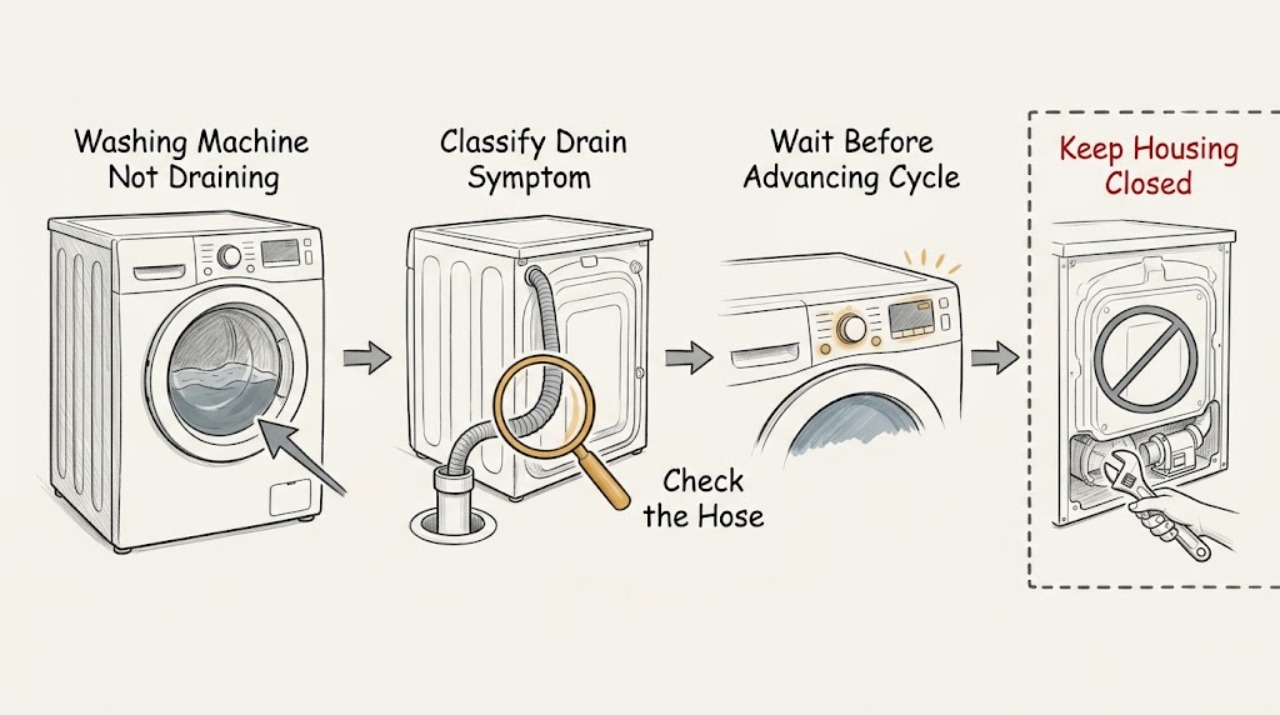
Wait through the model's normal pause before changing a timer or control. Then identify the washer style and check the visible drain hose for kinks, crushing, clogging, excessive height, or incorrect standpipe routing. Check the household drain separately. On a front-load model with a user-accessible pump-filter door, unplug the washer, protect the floor, drain slowly, and clean the filter only as the exact manual describes; not every model has an accessible filter. A top-load washer may show a flashing rinse light or Po when pump-out takes too long. If the tub is full and the washer only hums, water is flooding, the hose or pump is inaccessible, or the problem returns after one safe correction, stop and arrange qualified service. Never reach into moving parts or open an energized washer.
Before you begin
Safety first
- User checks are limited to waiting through a normal pause, inspecting accessible hose and plumbing routing, redistributing a stopped load, and cleaning a user-accessible pump filter only as the exact model manual directs. Do not disconnect pressurized hoses, reach into a moving or locked basket, open an energized cabinet, force a filter, bypass a lid lock, or operate through flooding or electrical hazards.
Work through in order
Diagnostic checks
Use only checks that match the exact appliance or system and its official guide.
-
Check 1
From a dry, safe position, note the washer style, whether water is visible, how high the water is, whether the pump hums or is silent, which cycle stage stopped, and any display or flashing light such as a rinse indicator or Po.
Expected result: The tub is empty but sounds slosh, water drains slowly, the tub is full and silent, the tub is full and hums, or a model-specific message appears.
Next step: Wait through the model's pause, photograph the display, and follow the matching pause, hose, plumbing, filter, load, or service check.
Stop if: Stop for flooding, water near electrical parts, smoke, burning odor, exposed wiring, violent movement, or a hot cord or outlet.
Why this matters
Why: A normal balance-ring sound is different from retained water. A slow drain points to hose, plumbing, filter, or pump restriction; a full tub that only hums is a service boundary in GE's guidance.
-
Check 2
If the washer has just finished agitation or shows a pause, wait several minutes for the model's pump-out period; on a mechanical timer, do not manually advance the dial while it is pausing.
Expected result: The pump starts and water drains after the pause, or the expected pause passes with water still present and no pump-out.
Next step: If draining begins, observe one complete pump-out. If not, stop the cycle safely and continue to the hose and plumbing check rather than repeatedly advancing or restarting.
Stop if: Do not reach into the basket, bypass a lid lock, or continue a cycle that is leaking or electrically unsafe.
Why this matters
Why: GE says pauses of up to a few minutes can be normal and manually advancing a timer can skip pump-out. A persistent full tub after the pause is not explained by the normal timing delay.
-
Check 3
With the washer stopped and unplugged if the hose must be touched, inspect the visible drain hose for a kink, crush point, clog, loose connection, or routing that exceeds the model's permitted pump height; do not disconnect a hose while water is pressing against it without a safe drainage plan.
Expected result: The hose is visibly kinked, crushed, blocked, disconnected, routed too high, or appears clear and correctly routed.
Next step: Correct only an accessible kink or routing issue according to the exact installation instructions, then run one supervised Drain & Spin or equivalent test.
Stop if: Stop for a burst hose, uncontrolled water, flooding, water near electrical parts, or a connection that cannot be safely isolated.
Why this matters
Why: GE identifies hose restrictions and excessive height as common drain causes. A clear external hose shifts suspicion to the household drain, accessible filter, pump, or control.
-
Check 4
If it is safe to remove only the drain hose end from the household standpipe or sink, place it securely so it cannot spray or fall, then check whether the household drain accepts water according to the model installation guidance; do not work in a flooded area.
Expected result: The household standpipe, sink, or drain accepts water normally, or water backs up and drains slowly outside the washer.
Next step: Arrange a plumber for a blocked household drain. If plumbing is clear, restore the hose as specified and continue only with a model-provided filter check or service.
Stop if: Do not pour into a blocked or overflowing drain, create a sealed hose connection, or handle sewage-contaminated water without appropriate protection.
Why this matters
Why: A blocked household drain can mimic a washer failure. If the household drain is clear but the washer still cannot pump out, the restriction or fault is inside the washer's drain path.
-
Check 5
Only on a front-load model with a bottom-front pump-filter access door described in its Owner's Manual, unplug the washer, place towels and a shallow pan, open the cover, control the water flow, remove the filter slowly, and clear debris without forcing the cap.
Expected result: Debris or lint is present and the filter can be cleaned and reseated securely, or the washer has no user-accessible filter door, the filter is seized, or water will not drain safely.
Next step: Replace and tighten the filter exactly as the manual directs, close the access door, and run one supervised drain test. If the problem returns, stop and request service.
Stop if: Do not open a filter while energized, remove a cabinet panel, force a cap, put hands into a moving pump, or release water onto an electrical area.
Why this matters
Why: GE says the pump filter captures lost items and can clog drainage on models designed for user access. No access door or an unsafe filter condition is a service path, not permission to remove panels.
-
Check 6
If the washer drains only after an interrupted or unbalanced spin, wait for the basket to stop, redistribute the load evenly, and select the model's documented Drain & Spin or Spin cycle; do not add or remove items through a locked or moving basket.
Expected result: The load is clumped, the washer is level and the load balanced, or the machine repeatedly stops before pump-out with a suitable load.
Next step: Run one supervised Drain & Spin after safe redistribution. If water remains or the machine repeatedly stops, preserve the sequence and arrange service.
Stop if: Stop for cabinet strikes, walking, severe vibration, leaks, or a lid-lock problem.
Why this matters
Why: GE explains that an out-of-balance condition can trigger redistribution and leave clothes wet or end a cycle early. A balanced load that still cannot drain points toward the drain path or service.
-
Check 7
After the external checks and any permitted filter cleaning, run one model-appropriate supervised drain test and listen from outside the cabinet for pump operation; record whether the display returns a drain-time message, the tub empties, or the pump only hums.
Expected result: Water drains normally, drains slowly, remains with a hum, remains silently, or the same message returns.
Next step: Stop after one failed retest and provide the technician with the exact sound, water level, message, and checks performed; do not keep cycling a full tub.
Stop if: Do not open energized panels, test live components, bypass a lid lock, or continue with a leak, smoke, burning odor, or electrical trip.
Why this matters
Why: A successful test supports a cleared restriction. Slow or failed pump-out after a clear hose and plumbing, especially a full tub with only humming, supports pump, wiring, control, or internal obstruction diagnosis.
-
Check 8
Stop user troubleshooting and arrange qualified service when the tub remains full after the pause, hose and household drain checks, and any permitted filter cleaning, or when the washer only hums, the pump access is not user-serviceable, or water is leaking.
Expected result: The no-drain symptom is repeatable, the washer cannot safely be emptied, or one safe correction restores normal draining without recurrence.
Next step: Leave the washer off, protect the area, and provide the technician with the model, washer style, water level, message, pause duration, hose and plumbing results, filter state, and pump sound.
Stop if: This is a hard stop for flooding, water near electrical equipment, smoke, sparking, hot electrical parts, or an inaccessible shutoff; obtain appropriate qualified or emergency help.
Why this matters
Why: Persistent no-drain can involve an internal obstruction, pump, hose inside the cabinet, wiring, control, lid or door sensing, or a model-specific protection state. The symptom does not identify a compatible replacement part.
Use your observations
Decision map
Find the observation that best matches what you see, then follow the next safe action.
-
PATH 01Safety boundary
What you see
The washer is between agitation, pump-out, and spin and water begins draining after the model's normal short pause.
Do this next
Let the cycle continue and do not manually advance a mechanical timer.
Why this path and its safety boundary
Why it matters: The pause may be normal timing rather than a failed drain.
Safety stop: Stop for water leakage, abnormal noise, smoke, electrical odor, or water that remains after the expected pump-out.
-
PATH 02Safety boundary
What you see
The visible drain hose is kinked, crushed, clogged, disconnected, or routed too high.
Do this next
Correct the accessible routing or obstruction according to the model installation instructions and test once.
Why this path and its safety boundary
Why it matters: The external drain path can restrict the pump or prevent the washer from reaching the drain.
Safety stop: Stop for a leaking or pressurized connection, flooding, or water near electrical parts.
-
PATH 03Safety boundary
What you see
Water will not flow freely through the standpipe, sink, or household drain when checked safely.
Do this next
Arrange plumbing service and do not operate the washer into an overflowing drain.
Why this path and its safety boundary
Why it matters: A plumbing blockage can prevent an otherwise functional washer from emptying.
Safety stop: Stop for sewage backup, flooding, or unsafe contaminated water.
-
PATH 04Safety boundary
What you see
A front-load model has the manual-described pump-filter access door and debris is found in the filter.
Do this next
Clean and reseat the filter slowly with power removed, then run one supervised drain test.
Why this path and its safety boundary
Why it matters: Captured items or lint may restrict pump-out.
Safety stop: Do not force the filter, release uncontrolled water, or create access where the model provides none.
-
PATH 05Safety boundary
What you see
The load is clumped, the washer redistributes, or spin ends early with wet clothes.
Do this next
Redistribute a stopped load and run the documented Drain & Spin once; service a repeat failure.
Why this path and its safety boundary
Why it matters: An out-of-balance condition can interrupt the sequence and leave water in clothing or the tub.
Safety stop: Stop for violent vibration, cabinet strikes, walking, or a leak.
-
PATH 06Safety boundary
What you see
The tub is full of water and the washer only hums or remains silent after the expected pause.
Do this next
Leave the washer off and arrange qualified diagnosis of the pump and internal drain path.
Why this path and its safety boundary
Why it matters: GE treats this combination as requiring service after safe external checks, rather than a reason to keep restarting.
Safety stop: Stop immediately for flooding, water near electrical parts, smoke, sparking, or a hot cord or outlet.
Helpful context
Understand the symptom
A short pause may be normal; a full tub is not
Many GE washers pause between agitation, pump-out, and spin. Give the washer the time specified by its model before touching a timer. If water remains after the expected pause, classify the symptom: a slow drain, a completely full tub, a hose or household drain problem, a pump that hums, or a front-load filter issue. The washer style and exact model determine which checks are safe.
Check the path outside the cabinet first
A drain hose can be kinked, clogged, routed too high, pushed too deeply into a standpipe, or installed against a blocked household drain. Those conditions can look like a failed pump. Disconnecting hoses or opening a filter can release water, so unplug first, protect the floor, and follow the model manual. Do not seal a standpipe connection or reach into a wet, energized machine.
A filter is only user-cleanable on some models
GE describes a bottom-front pump-filter procedure for front-load models with an access cover, including a shallow pan, towels, slow removal, debris removal, and secure replacement. If there is no model-provided access door, do not improvise one or remove a cabinet panel. A full tub that only hums or a repeated no-drain condition belongs with qualified service.
When checks do not resolve it
Need a professional?
Safety scope: User checks are limited to waiting through a normal pause, inspecting accessible hose and plumbing routing, redistributing a stopped load, and cleaning a user-accessible pump filter only as the exact model manual directs. Do not disconnect pressurized hoses, reach into a moving or locked basket, open an energized cabinet, force a filter, bypass a lid lock, or operate through flooding or electrical hazards.
Common questions
FAQ
Why is my GE washing machine not draining?
Wait through the normal pause, then check the visible drain hose and household drain for kinks, clogs, incorrect height, or siphoning. On an eligible front-load model, clean the accessible pump filter as the manual directs. A full tub that only hums or a repeat failure needs service.
Can a GE washer pause before it drains?
Yes. GE says many models pause between cycles before pump-out. Do not manually advance a mechanical timer during that pause because you may skip the drain portion. If water remains after the model's expected pause, investigate the drain path.
How do I clean the pump filter on a GE front-load washer?
Only do this if the exact model has a bottom-front access door and its manual permits user cleaning. Unplug the washer, place towels and a shallow pan, open the cover, drain slowly, remove debris, and reseat the filter securely. Do not create access by removing a panel.
Why does my GE washer only hum with water inside?
After safe hose, plumbing, and model-permitted filter checks, a full tub that only hums can indicate a pump or internal drain-path fault. GE directs service for this symptom. Do not keep restarting a full washer or open energized panels.
Can an unbalanced load stop a GE washer from draining?
An out-of-balance load can interrupt redistribution, spin, and the end of the cycle, leaving clothes wet. Wait for the basket to stop, redistribute the load, and run one documented Drain & Spin test. A repeat with a balanced load needs diagnosis.
Read the exact guide
Official sources
- Front Load Washer - Will Not Drain or Drains SlowlyGE Appliances · GE front-load guidance; exact drain height and filter access depend on the model.
- Top Load Washer - Will Not DrainGE Appliances · GE full-size top-load guidance; compact, portable, unitized, and model-specific procedures vary.
- Front Load Washer - Cleaning a Pump FilterGE Appliances · Only front-load models with the described bottom-front access cover; the exact Owner's Manual controls whether a model has user-cleanable access.
Community feedback
Share a repair observation
Share a plain-text repair observation. Accepted observations are published automatically; this page may take a moment to update.