
On this page
Start here
Quick answer
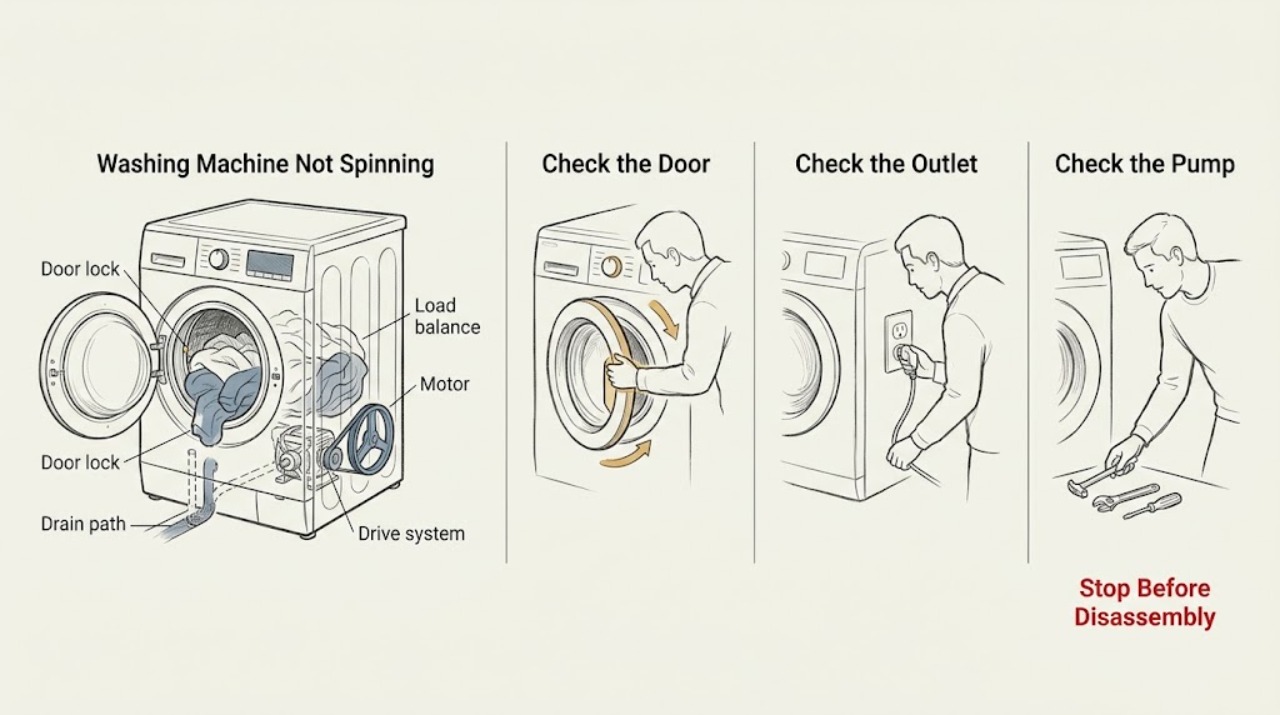
A GE washer may pause before pumping out and spinning, so do not manually advance a timer immediately. If it remains stuck, check that the washer has power, the lid or loading door and any dispenser drawer are fully closed, and the drain hose and household drain are clear. Then redistribute an uneven load or adjust the load size and run the model's Drain & Spin or Spin cycle. A pump filter may be owner-cleanable on some front-load models, but the owner's manual controls access. Stop if water remains in the tub, the washer hums without spinning, a lid or door lock is damaged, the machine moves violently, or the fault persists after these checks; arrange qualified service.
Work through in order
Diagnostic checks
Use only checks that match the exact appliance or system and its official guide.
-
Check 1
Watch the washer through the pause after agitation or washing without manually advancing the timer; listen for the pump-out stage and see whether the cycle eventually enters spin.
Expected result: A short pause followed by draining and spin is normal on supported models. A pause that never drains, a full tub, or a timer that advances without spin indicates a different fault path.
Next step: If the washer does not proceed, continue with the power, closure, drain, and load checks. Do not keep restarting a full or noisy tub.
Why this matters
Why: GE explains that some washers pause between stages and may pump out before spinning. Advancing a manual timer during that pause can skip the pump-out portion.
-
Check 2
Check the washer's power safely: confirm the cord is seated, inspect for a tripped breaker or fuse, and test the dry outlet with a known working small appliance without opening the outlet or touching wet equipment.
Expected result: A dark control panel or an outlet that does not power another safe appliance points to household power; a powered control with no spin points toward the washer's cycle, drain, balance, or internal fault.
Next step: Do not repeatedly reset a breaker or use a damaged cord. Leave the washer disconnected and call qualified electrical or appliance service for heat, scorch marks, wetness, or repeated trips.
Why this matters
Why: GE lists the wall outlet, household fuses, and circuit breakers as causes of a washer failing to spin.
-
Check 3
Confirm the model-specific closure path: lower the top-load lid or close the front-load door fully, check that the door or lid lock can engage, and close the dispenser drawer completely where the model uses one.
Expected result: A lid or door warning, an unlit lock indicator, a drawer left open, or a lid that sits unevenly can prevent spin even when the washer fills or tumbles.
Next step: Remove only an accessible obstruction and follow the owner's manual for a normal closure check. Do not bypass a lid or door switch, force a lock, or insert tools into the latch.
Why this matters
Why: GE states that top-load washers will not spin with the lid up, front-load washers may not spin with the dispenser drawer open, and unitized models require a properly connecting lid-lock path.
-
Check 4
Check drainage from the outside: inspect the drain hose for kinks or crushing, confirm it is installed as the model instructions specify, and check whether the standpipe or household drain is backing up.
Expected result: Standing water, slow pump-out, a kinked hose, an obstructed standpipe, or a hose pushed too far into the drain explains why the washer may not reach spin; free drainage shifts attention to balance or drive.
Next step: Correct only an obvious external hose position or plumbing blockage. If the household drain will not accept water, call a plumber; if the pump filter is accessible, use the owner's manual before opening it and contain the water.
Why this matters
Why: GE connects drain-hose, household-plumbing, siphoning, and pump-filter problems with washers that do not drain or spin.
-
Check 5
Pause the washer and redistribute the load: untangle clothing, remove excess items from an overloaded tub, or add similar items to a very small load, then select the model's Drain & Spin or Spin cycle.
Expected result: A washer that spins normally after redistribution had a load-balance issue. Repeated banging, a balancing message, or a wet load despite reasonable distribution indicates that imbalance is not the only cause.
Next step: Keep the washer on a solid, level floor and stop if it walks or shakes violently. Arrange service when different balanced loads produce the same no-spin result.
Why this matters
Why: GE says out-of-balance loads can stop or limit spin and recommends redistributing items or adjusting load size; unitized and top-load models may also require a level installation.
-
Check 6
Run one model-supported empty or small test cycle after the safe checks and observe whether it drains, locks, and ramps into spin; do not reach into a moving tub or remove panels.
Expected result: A successful test supports a temporary pause, closure, drain, or balance condition. A full tub that only hums, a motor that runs while the tub does not spin, recurring error behavior, or a repeat no-spin result indicates a service fault.
Next step: Stop using the washer and contact qualified appliance service for a motor, belt, pump, transmission, control, or lock diagnosis. Do not bypass safety devices or dismantle the washer.
Why this matters
Why: GE directs service when the motor runs but the tub does not spin, when water remains and the machine only hums, or when the listed checks do not resolve the issue.
Use your observations
Decision map
Find the observation that best matches what you see, then follow the next safe action.
-
PATH 01Next step
What you see
The washer is paused after washing or agitation but is not showing an error and has not yet pumped out.
Do this next
Allow the normal pause and pump-out sequence to finish; do not manually advance a timer. Escalate if it never drains or spins.
-
PATH 02Next step
What you see
The controls are dark, the outlet is dead, or a breaker trips again.
Do this next
Leave the washer disconnected and obtain qualified electrical or appliance service. Do not keep resetting the circuit or test wet equipment.
-
PATH 03Next step
What you see
A lid, door, or dispenser warning appears, or the lock does not engage.
Do this next
Close the lid, door, or drawer and remove only an accessible obstruction using the owner's manual. Never bypass or force the lock; arrange service if closure remains defective.
-
PATH 04Next step
What you see
Water remains in the tub, the drain hose or household drain is blocked, or the pump only hums.
Do this next
Disconnect power, correct only an obvious external hose or plumbing issue, and use the model manual for any accessible pump-filter check. Call a plumber for household drainage or a servicer for a pump fault.
-
PATH 05Next step
What you see
The washer repeatedly becomes unbalanced, walks, bangs, or will not spin with different reasonable loads.
Do this next
Stop the cycle and arrange service to check leveling, suspension, drive, or control components. Do not continue running a violently moving washer.
Helpful context
Understand the symptom
Not spinning can mean the washer is still in a normal pause, cannot drain, cannot confirm a closed lid or door, has an unbalanced load, or has a mechanical fault. Start by watching what the washer does with water and the controls rather than assuming the motor failed.
GE top-load, front-load, and unitized laundry-center models use different controls and access points. Use the exact owner's manual for the model before cleaning a pump filter, resetting a motor, or changing a setting.
Safety boundary
Stop conditions
- Stop if the cord, outlet, controls, floor, or washer is wet, hot, scorched, or electrically damaged, or if a breaker trips again.
- Stop if the tub is full and only hums, the lid or door lock is damaged, the tub is jammed, or the washer moves violently or bangs repeatedly.
- Do not reach into a moving tub, bypass a lid or door switch, remove panels, or work on the motor, belt, wiring, pump, or transmission as a routine user check.
- Arrange qualified service when drainage, closure, power, and load-balance checks do not restore spin, or when the same no-spin symptom returns.
Only after diagnosis
Potential parts
- washer lid or door lock
Consider this only after the model-specific diagnosis confirms that the lid or door closes but the lock fails to confirm a safe closed state.
Confirm the exact GE model and manufacturer fit information before ordering or installing any lock part. - washer drain pump or pump filter component
Consider this only when a documented drain check and qualified diagnosis confirm a pump or filter fault rather than a hose or household-plumbing blockage.
Pump and filter designs vary by model; use the owner's manual and service diagnosis to confirm fit and access. - washer drive component
Consider this only after service diagnosis confirms a drive, motor, belt, or suspension fault; a no-spin symptom alone does not identify the failed part.
Drive components require exact model verification and qualified installation.
When checks do not resolve it
Need a professional?
Call qualified GE appliance service when the washer still will not spin after the model-specific pause, power, lid or door, drain, and load checks; when the motor runs but the tub does not spin; when the tub remains full and hums; or when a lock, pump, drive, suspension, or control fault is suspected.
Common questions
FAQ
Why is my GE washer not spinning but still has power?
Check whether the washer is in a normal pause, whether the lid or door and dispenser are closed, whether water drained, and whether the load is balanced. If the motor runs but the tub does not spin, or water remains and the washer hums, service is required.
Can an unbalanced load stop a GE washer from spinning?
Yes. GE says an out-of-balance load can stop or limit spin. Redistribute clothing or adjust the load size, then run the model's Spin or Drain & Spin cycle; repeated imbalance with reasonable loads needs service.
Should I clean the pump filter on a GE washer?
Only if the exact model has an owner-accessible pump filter and its manual provides the procedure. Disconnect power, contain the water, and stop if access is not clearly provided or the washer still will not drain.
Read the exact guide
Official sources
- Front Load Washer - Does Not SpinGE Appliances · GE front-load washer pauses, power, dispenser closure, load size, and service guidance
- Front Load Washer - Will Not Drain or Drains SlowlyGE Appliances · GE washer drain restrictions, pump filter, load balance, humming, and service escalation
- Top Load Washer - Does Not SpinGE Appliances · GE top-load washer pauses, lid, balance, power, options, and service guidance
- Unitized Spacemaker Washer - Washer Will Not Start / Lid Not LockedGE Appliances · GE unitized washer-dryer lid lock and spin-cycle behavior
- Front Load Washer - TroubleshootingGE Appliances · GE front-load drain hose, household plumbing, pump filter, and load-balance checks
- Top Load Washer - Walking or VibratingGE Appliances · GE top-load washer leveling, load balance, movement, and service boundary
Community feedback
Share a repair observation
Share a plain-text repair observation. Accepted observations are published automatically; this page may take a moment to update.