
On this page
Start here
Quick answer
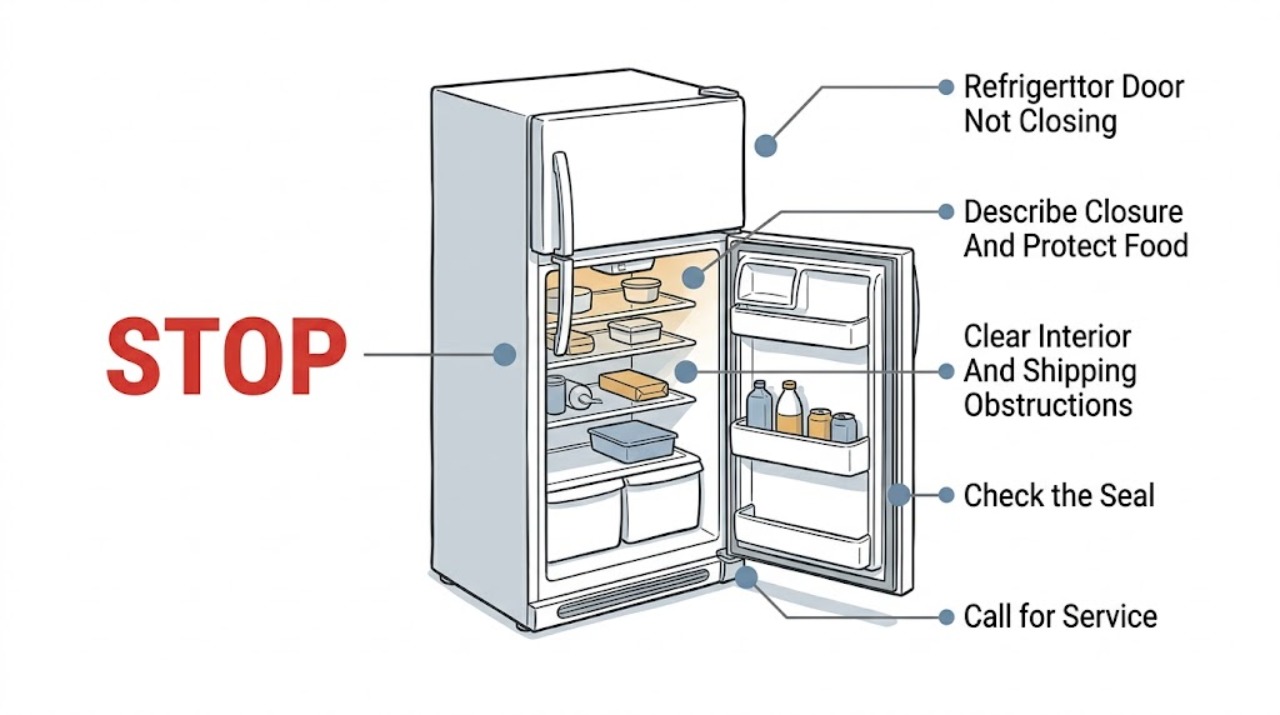
Start with the refrigerator door itself: remove any package, bottle, shelf, bin, crisper cover, or remaining shipping material that projects into the closing path, then check that the gasket is clean and contacts the cabinet all the way around. Gladiator's current all-refrigerator manual lists blocked food packages, incorrectly positioned removable parts, dirty gaskets, and an unstable refrigerator as the first checks; it also says to use the model instructions for installation and adjustment. Check stability and level without removing the door or hinge hardware. A door that remains open can cause temperature fluctuation, frost, moisture, or a door switch that does not actuate. If the gasket is torn or permanently distorted, the door or hinge is sagging, the cabinet is damaged, or the door still will not close after accessible checks, stop relying on the seal and arrange qualified service. Do not force the door, remove hinge hardware, or defeat a door switch.
Before you begin
Safety first
- The owner may rearrange accessible items, reseat removable storage parts, inspect and clean an intact gasket as the manual allows, and observe cabinet stability. Door removal, hinge alignment, damaged hardware, electrical door-switch diagnosis, and any work requiring lifting or internal access belong to qualified service.
Work through in order
Diagnostic checks
Use only checks that match the exact appliance or system and its official guide.
-
Check 1
Close the door gently once and observe the closing pattern without slamming or holding it shut: identify whether it stops before the cabinet, bounces back, sags at one corner, or reaches the frame but leaves a visible gap. Note any frost, moisture, warm food, or a door-open warning. Keep perishable food protected if the door cannot seal.
Expected result: The door is physically stopped, rebounds from the frame, is uneven or sagging, or appears closed but has a continuous gap or temperature/moisture symptom.
Next step: Use the pattern to choose the next external check: clear the closing path for a hard stop, inspect the gasket for a gap, and use the exact manual or service for sagging or hardware symptoms. Do not keep the door propped or force it closed as a permanent workaround.
Stop if: Do not operate the refrigerator indefinitely with a visible seal gap, and do not defeat a door switch or warning to hide the condition.
Why this matters
Why: A hard stop points first toward an obstruction; rebound or sag suggests alignment, level, hinge, or closure geometry; a continuous gap points toward the gasket or door alignment. A door that does not seal can cause temperature fluctuation, frost, moisture, or incorrect door-switch contact.
-
Check 2
With the door open, move packages and bottles away from the door edge and check that shelves, bins, crisper covers, and baskets are fully seated in their intended positions. Look around the door perimeter for leftover packaging, debris, or an item on top of or beside the cabinet that interferes with travel. Remove only accessible items; do not pry a mis-seated part into place.
Expected result: The door closes after an item is moved, a shelf/bin/cover was out of position, packaging is present, or the closing path is clear but the door still stops or rebounds.
Next step: Rearrange the storage so the door can close without pressure and reseat only the removable part described by the model manual. If the path is clear and the symptom remains, do not remove the door; inspect the gasket and cabinet stability next.
Stop if: Do not force shelves, drawers, or bins, cut packaging near the gasket, or use the door as a clamp for oversized items.
Why this matters
Why: The Gladiator manual specifically lists packages, removable parts, and stability for a door that will not close. If clearing the path restores closure, the cause was an obstruction rather than a failed hinge or gasket; if not, continue to the seal and cabinet checks.
-
Check 3
Inspect the gasket and the cabinet surface it touches all the way around. Look for food residue, sticky areas, a gasket folded out of its channel, tears, hardening, warping, or a section that never contacts the cabinet. If it is only dirty, clean the accessible gasket with the mild cleaning method in the Gladiator manual, then dry it and close the door gently.
Expected result: The gasket is dirty or sticky but intact, is displaced or folded, has a tear or permanent distortion, or contacts evenly after cleaning.
Next step: Clean and reseat only as the model instructions allow. If the gasket is torn, distorted, or will not contact evenly, record the model and arrange a model-confirmed gasket or qualified service rather than stretching or gluing it.
Stop if: Do not use petroleum products, harsh tools, heat, adhesive, or a replacement gasket that is not confirmed for the exact model.
Why this matters
Why: Dirt can add closing resistance and a damaged or displaced gasket can leave a leak even when the door reaches the frame. An intact gasket that contacts evenly makes a cabinet-level or hinge/alignment issue more likely if the door still will not stay shut.
-
Check 4
From a stable position, check whether the refrigerator rocks, rolls, or sits noticeably out of level from side to side or front to back. Note whether the problem began after moving or installing the unit and whether the door gap is larger at one side. Use a level and the exact Gladiator installation instructions; do not loosen hinges or lift the cabinet as an improvised adjustment.
Expected result: The cabinet rocks or is visibly out of level, the floor is uneven, the door is misaligned after installation or a move, or the cabinet is stable and level.
Next step: If the manual provides an owner-leveling procedure, follow only that procedure and recheck closure; otherwise arrange installation or appliance service. If the cabinet is stable and level but the door remains uneven, stop before hinge or door removal and request service.
Stop if: Do not drag a loaded refrigerator, place improvised supports under a caster, or adjust hinge bolts without the exact model procedure and safe door support.
Why this matters
Why: The Gladiator manual says stability is a door-closing check, and manufacturer support explains that an unlevel refrigerator can prevent the door from closing or sealing. A recent move or door-swing reversal also raises the possibility of model-specific installation or alignment error.
-
Check 5
After one round of accessible corrections, close the door gently and verify that it stays shut, the gasket contacts all around, and no door-open, frost, moisture, or temperature symptom continues. Record the exact Gladiator model, the gap location, obstruction and gasket findings, any recent installation or move, and whether the door or hinge appears damaged.
Expected result: The door now seals; it closes but leaves a gap; it still rebounds or sags; the gasket or hinge is damaged; or the interior has warmed after the door was open.
Next step: Keep the door closed as much as possible and arrange qualified Gladiator/Whirlpool-family appliance service for persistent gap, sag, damaged hardware, or temperature symptoms. Provide the observation record instead of repeatedly testing the door.
Stop if: Do not remove the door, hinge, door stop, or inner liner, and do not continue using the appliance if the door cannot maintain a safe seal or food temperature.
Why this matters
Why: A restored, even seal supports monitoring. A persistent gap or damaged gasket needs a model-confirmed repair. Rebound, sag, cabinet damage, or a door that cannot be held safely points beyond routine owner checks; temperature or frost symptoms show that the open-door condition has already affected operation.
Use your observations
Decision map
Find the observation that best matches what you see, then follow the next safe action.
-
PATH 01Safety boundary
What you see
The door stops at the same point and a bottle, package, shelf, bin, crisper cover, basket, or shipping remnant projects into the closing path.
Do this next
Move the item or reseat the removable part according to the Gladiator manual, then recheck the seal gently.
Why this path and its safety boundary
Why it matters: An accessible obstruction is more likely than a failed gasket or hinge.
Safety stop: Do not force the door or cut, pry, or permanently modify the storage part.
-
PATH 02Safety boundary
What you see
The closing path is clear, but the gasket is dirty, sticky, folded, torn, warped, or leaves a continuous gap against the cabinet.
Do this next
Clean and reseat an intact gasket using the manual's safe cleaning method. Arrange model-confirmed gasket service for damage or persistent gaps.
Why this path and its safety boundary
Why it matters: The seal is adding resistance or failing to contain the cold air; continued use can lead to frost, moisture, temperature fluctuation, and extra runtime.
Safety stop: Do not glue, heat, stretch, oil, or substitute a gasket without exact model fitment.
-
PATH 03Safety boundary
What you see
The cabinet rocks or is out of level, the door gap is uneven, or the symptom began after a move or installation.
Do this next
Use only the exact Gladiator leveling instructions if they identify an owner-safe adjustment; otherwise use installation or appliance service before changing hardware.
Why this path and its safety boundary
Why it matters: Cabinet stability and leveling can prevent the door from aligning with and sealing against the gasket.
Safety stop: Do not lift or drag a loaded refrigerator or loosen hinges without model instructions and door support.
-
PATH 04Safety boundary
What you see
The refrigerator is stable, storage is clear, and the gasket is clean, but the door is visibly sagging, the hinge area is loose or damaged, or a reversed door was not installed correctly.
Do this next
Stop owner adjustment and provide the model, installation history, photos of the gap, and hardware condition to qualified appliance service.
Why this path and its safety boundary
Why it matters: A hinge, door-stop, alignment, or installation issue is more likely; the exact Gladiator model determines the safe repair procedure.
Safety stop: Do not remove the door, alter hinge geometry, or rely on the magnet or a prop to keep an incorrectly aligned door closed.
-
PATH 05Safety boundary
What you see
The door still will not close or seal after accessible checks, or frost, moisture, temperature fluctuation, warm food, or a door-open warning continues.
Do this next
Keep the door closed as much as possible, protect perishable food, and arrange qualified service. Do not keep cycling the door or open the cabinet to locate the fault.
Why this path and its safety boundary
Why it matters: The issue has exceeded routine obstruction and cleaning checks; an inaccessible door, gasket, switch, hinge, or cabinet fault may remain.
Safety stop: Stop using the refrigerator if the door cannot maintain a safe seal or food temperature, and do not bypass the door switch or warning.
Helpful context
Understand the symptom
A door that looks closed may still be leaking air
Separate a door that is physically blocked from one that reaches the cabinet but leaves a gap. A gap around the gasket can allow warm air in even when the door seems nearly closed. The practical first record is where the gap is, whether it changes when the door is empty, and whether frost, moisture, or temperature fluctuation has appeared.
Gladiator door hardware is not one universal adjustment
Gladiator sells more than one refrigerator configuration, including garage-ready models with different installation and support documents. The published Gladiator manual used here gives the common obstruction, gasket, and stability checks; it does not make a hinge adjustment or door-removal procedure universal. Use the model and serial label to retrieve the correct instructions before any hardware work.
Safety boundary
Stop conditions
- Stop relying on the refrigerator when the door cannot maintain a seal, food is warming, frost or moisture is building up, or a door-open warning remains active.
- Do not force, slam, prop, or tape the door shut; do not bypass a door switch or warning to conceal a closure problem.
- Do not remove doors or hinges, alter the door swing, lift or drag a loaded refrigerator, or adjust hardware without the exact Gladiator model instructions and safe door support.
- Do not use heat, petroleum products, harsh tools, adhesive, or an unconfirmed replacement gasket on the door seal.
Only after diagnosis
Potential parts
- door gasket
Consider only if the exact model's gasket is torn, permanently warped, or fails to contact the cabinet after accessible cleaning and seating.
Door gaskets are model-specific. Do not order by appearance alone or stretch, glue, heat, or install a part without model confirmation. - door hinge, door-stop, or alignment hardware
Consider only after qualified diagnosis finds sagging, loose or damaged hinge hardware, incorrect door-swing installation, or a closure component fault.
The door arrangement and hardware vary by Gladiator model. Door and hinge work can require support and safe handling; do not use a generic adjustment or part.
When checks do not resolve it
Need a professional?
Arrange qualified appliance service when the door remains misaligned after the closing path, gasket, and stability checks; when the gasket is torn or permanently distorted; when a hinge, door stop, cabinet, or door was damaged or removed during installation; or when an open door has caused persistent frost, moisture, temperature fluctuation, or warm food. Use the exact Gladiator model and serial number when requesting the manual or service.
Safety scope: The owner may rearrange accessible items, reseat removable storage parts, inspect and clean an intact gasket as the manual allows, and observe cabinet stability. Door removal, hinge alignment, damaged hardware, electrical door-switch diagnosis, and any work requiring lifting or internal access belong to qualified service.
Common questions
FAQ
Why does my Gladiator refrigerator door pop back open?
First check for packages, bins, shelves, crisper covers, or packaging in the closing path, then check that the gasket is clean and the refrigerator is stable. If those checks pass, a model-specific alignment or hinge issue may need service.
Can I adjust the Gladiator refrigerator door myself?
Only if the exact Gladiator Owner's Manual provides an owner-safe leveling or alignment procedure. Do not remove or loosen hinge hardware, lift the door, or alter the door swing based on a generic refrigerator guide.
What happens if the refrigerator door does not seal?
A persistent gap can admit warm air and lead to frost, moisture, temperature fluctuation, and a door switch that does not actuate correctly. Arrange service if cleaning, clearing the closing path, and model-permitted stability checks do not restore an even seal.
Read the exact guide
Official sources
- Unable to Level - Refrigerator - Product HelpWhirlpool Product Help · Supports the need to check side-to-side and front-to-back level before alignment; use the Gladiator model instructions for any actual adjustment.
- Doors Not Sealing - Refrigerator - Product HelpWhirlpool Product Help · Supports general door-seal reasoning for a Gladiator refrigerator; exact leveling and installation details remain model-specific.
- Garage Refrigerator | 17.8 Cu. Ft. Garage-Ready FridgeGladiator · Establishes a real Gladiator refrigerator product family and its product-literature path; it is not a universal specification for every Gladiator model.
- Door Not Closing - Refrigerator - Product HelpWhirlpool Product Help · General Whirlpool-family guidance only; French-door vertical-seal details apply only if the exact Gladiator model has that architecture.
- Gladiator All Refrigerator and Upright Freezer Use and Care Guide (W11527800B)Gladiator / Whirlpool Corporation · Directly supports the published Gladiator model family's checks for closure, gasket, stability, storage position, cleaning, and model-specific procedures; confirm the exact model before applying a step.
Community feedback
Share a repair observation
Share a plain-text repair observation. Accepted observations are published automatically; this page may take a moment to update.