
On this page
Start here
Quick answer
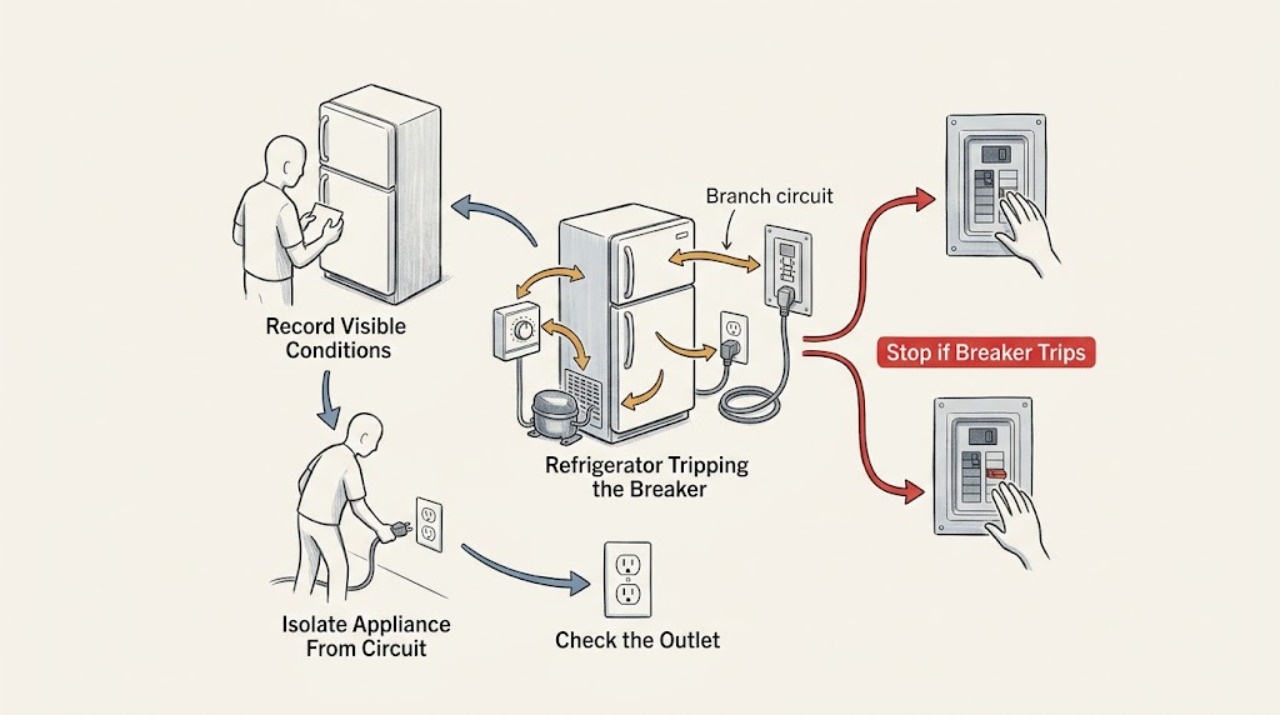
Stop repeatedly resetting the breaker and do not substitute a larger fuse or breaker. From a dry, safe position, note whether the Gladiator refrigerator trips immediately when plugged in, only when the compressor or fan starts, after it has run, or only when other garage loads are operating. Gladiator's owner manual calls for a grounded 115 V, 60 Hz, 15 A or 20 A supply, recommends a separate circuit serving only the refrigerator, and says not to use an adapter or extension cord. If safe and accessible, leave the refrigerator unplugged, inspect the cord and plug for visible damage or heat, and verify the outlet with a small lamp rather than moving the refrigerator or using a different high-load circuit. If the breaker trips with the refrigerator disconnected, the outlet/circuit needs an electrician; if it trips only when this refrigerator is connected, leave it unplugged and arrange qualified appliance service. Any smoke, burning smell, arcing, melted plastic, wet electrical parts, repeated GFCI trips, or damaged cord is an immediate stop-use condition. Do not open the cabinet, bypass protection, replace a breaker with a larger rating, or live-test the compressor, defrost heater, fan, or wiring.
Before you begin
Safety first
- Keep the refrigerator unplugged after a repeat or appliance-linked trip. Do not use extension cords or adapters, change breaker/fuse rating, bypass GFCI/AFCI protection, open the cabinet, or perform live electrical tests. Disconnect or reset only from a dry, safe, accessible point.
Work through in order
Diagnostic checks
Use only checks that match the exact appliance or system and its official guide.
-
Check 1
From a dry, safe position, record the complete Gladiator model, whether the device is a standard breaker or GFCI, and when the trip occurs: as the plug is inserted, at startup, after cooling begins, during a later cycle, or only when other equipment is running. Do not reconnect the refrigerator solely to reproduce the trip.
Expected result: The breaker trips immediately on connection, only after the compressor/fan starts, after the unit has run, only during a suspected defrost period, or only when other loads share the circuit.
Next step: Keep the refrigerator unplugged and follow the corresponding branch. Provide the exact model and timing to the electrician or appliance technician.
Stop if: Stop observing if there is smoke, odor, arcing, heat, water, melted plastic, or any exposed/damaged electrical part.
Why this matters
Why: Immediate or appliance-linked trips raise concern about the cord, plug, moisture, or an internal fault. A trip with other loads points more toward circuit loading. A delayed trip can still be an appliance or wiring fault; timing narrows the path but does not prove a component.
-
Check 2
If the refrigerator can be unplugged without moving it through water or touching a damaged connection, leave it disconnected. From the panel, reset the breaker only once after other loads are off and the area is safe; do not keep resetting a trip with the refrigerator connected. If it is hardwired or inaccessible, do not pull the unit forward or remove a cover.
Expected result: The breaker holds with the refrigerator disconnected, trips even with it disconnected, or cannot be safely reset/isolated.
Next step: For a circuit-side trip, call a qualified electrician. For a refrigerator-linked trip, leave the refrigerator unplugged and arrange appliance service; do not reconnect it to another circuit as a test.
Stop if: Do not reset repeatedly, use a larger breaker/fuse, bypass GFCI/AFCI protection, or reach into a wet panel or outlet.
Why this matters
Why: A breaker that holds without the refrigerator makes an appliance-linked fault or overload more likely. A breaker that trips with the refrigerator disconnected points toward the circuit, GFCI, outlet, or fixed wiring. Inability to isolate safely is itself a reason for professional help.
-
Check 3
With the refrigerator still disconnected and the area dry, look at the accessible cord, plug, and receptacle without opening anything. Check for cuts, crushed insulation, discoloration, looseness, water, heat, or a burning smell. If the outlet is dry and safe, verify it with a small lamp or other low-risk item; do not use an extension cord or adapter and do not move the refrigerator to a different high-load outlet.
Expected result: The cord/plug/outlet is damaged, hot, wet, loose, discolored, or dead; the lamp works and the connection looks normal; or the outlet cannot be reached safely.
Next step: Leave the equipment disconnected and call an electrician for the outlet/circuit or cord condition. If the supply looks safe but the refrigerator caused the trip, arrange qualified appliance service rather than reconnecting it repeatedly.
Stop if: Do not touch a wet or hot receptacle, repair a cord, remove the ground pin, use an adapter, or test with a larger appliance.
Why this matters
Why: A visible or thermal connection defect can trip protection and create shock or fire risk. A working, undamaged outlet does not clear the refrigerator; it only makes a simple dead-outlet explanation less likely.
-
Check 4
From the electrical panel and room, identify whether lights, chargers, tools, heaters, freezers, or other appliances share the refrigerator's circuit. Do not change wiring or install a new circuit yourself. Compare the installation with Gladiator's requirement for a grounded supply and its recommendation for a separate circuit serving only the refrigerator.
Expected result: The refrigerator shares a circuit with several loads and the breaker trips when they operate together; the circuit is dedicated but still trips with the refrigerator; or the circuit arrangement is unknown.
Next step: Stop using the affected branch until a qualified electrician verifies the circuit capacity and installation. If the branch is sound and the trip follows the refrigerator, arrange appliance diagnosis.
Stop if: Do not unplug or relocate equipment in a wet area, add an extension cord, change breaker size, or perform panel rewiring.
Why this matters
Why: A combined-load trip makes an overloaded branch more likely, while a dedicated branch that trips with this refrigerator keeps an appliance, outlet, or wiring fault in view. A dedicated circuit recommendation is not permission to alter the panel or breaker rating without an electrician.
-
Check 5
Without reconnecting a refrigerator that has tripped protection, note any safe visible context: whether the temperature control had been turned off, whether the trip followed a power interruption, whether the unit was in a normal defrost interval, and whether any water or condensation reached the lower rear area. Do not remove the rear cover or touch the compressor, fan, defrost heater, or wiring.
Expected result: The control was off, the event followed an outage or restart, the trip occurred after a long run/defrost, moisture is visible, or no context is available.
Next step: Give the technician the state and timing; keep the refrigerator disconnected until the circuit and appliance are assessed. Protect food separately if safe, without restoring power to test.
Stop if: Do not remove covers, scrape frost near wiring, use a heat source, or perform a live test of a defrost or compressor circuit.
Why this matters
Why: The Gladiator manual distinguishes cooling control and automatic defrost behavior, but these observations cannot clear an electrical fault after a breaker trip. Moisture or a repeated event increases the need for service rather than a DIY part diagnosis.
-
Check 6
After the single safe isolation and external observation, classify the remaining result: the breaker holds with the refrigerator disconnected, the breaker still trips without it, or a hazard is present. Do not reconnect the refrigerator to reproduce the event.
Expected result: The trip follows the refrigerator; the trip remains with it disconnected; or there is smoke, burning odor, arcing, heat, water, melted plastic, a damaged cord, or repeated protective-device operation.
Next step: Keep power off or the refrigerator unplugged as safely possible, keep people away, and call the appropriate qualified electrician or appliance technician. Tell them the model, circuit type, trip timing, outlet result, shared-load result, and visible hazard history.
Stop if: Do not bypass protection, change fuse/breaker rating, open the unit, or restore power to a wet, smoking, sparking, or damaged appliance.
Why this matters
Why: An appliance-linked trip needs qualified appliance diagnosis; a trip with the refrigerator removed needs electrical diagnosis. Any visible hazard overrides further fault isolation and may involve both services.
Use your observations
Decision map
Find the observation that best matches what you see, then follow the next safe action.
-
PATH 01Safety boundary
What you see
The refrigerator is safely disconnected and the breaker or GFCI still trips or will not hold.
Do this next
Leave the branch off and arrange qualified electrical diagnosis. Do not reconnect the refrigerator or keep resetting the device.
Why this path and its safety boundary
Why it matters: The house branch, receptacle, protective device, or fixed wiring is more likely than a refrigerator component.
Safety stop: Do not install a larger protective device, open the panel beyond normal safe operation, or touch a wet/hot/discolored outlet.
-
PATH 02Safety boundary
What you see
The circuit holds without the refrigerator, but trips immediately when the refrigerator is connected or switched on.
Do this next
Leave the refrigerator unplugged and arrange qualified appliance service; have an electrician assess the outlet if any connection damage is visible.
Why this path and its safety boundary
Why it matters: A cord/plug defect, moisture, or an internal short/ground fault is more likely than a shared-load overload.
Safety stop: Do not move the appliance to another outlet as a test, bypass the breaker/GFCI, or open the rear cover.
-
PATH 03Safety boundary
What you see
The refrigerator works or remains connected without a trip until tools, chargers, heaters, or another appliance operate on the same branch.
Do this next
Stop using the affected branch and have an electrician verify the circuit. Do not solve the load by using an extension cord or changing the breaker rating.
Why this path and its safety boundary
Why it matters: An overloaded or incorrectly arranged branch is more likely, although the refrigerator still needs service if it later trips by itself.
Safety stop: Do not continue operating multiple high-load devices on a branch that trips.
-
PATH 04Safety boundary
What you see
The breaker trips only after the refrigerator has run for a while or around a suspected defrost interval, while the outlet and circuit appear otherwise normal.
Do this next
Keep the refrigerator disconnected and arrange appliance diagnosis. Provide the elapsed time and any visible moisture, sound, odor, or heat without removing covers.
Why this path and its safety boundary
Why it matters: A heat-, moisture-, compressor-, fan-, defrost-, or wiring-related appliance fault remains possible; timing alone does not identify the part.
Safety stop: Do not scrape frost near wiring, force a defrost, or live-test the compressor/heater.
-
PATH 05Safety boundary
What you see
There is smoke, burning smell, arcing/crackling, melted plastic, a hot or damaged cord/plug, water near electrical parts, or repeated GFCI/breaker operation.
Do this next
Keep clear, disconnect power only if the point is dry and safely accessible, and call qualified electrical or appliance help. Use emergency services for an active fire or dangerous smoke condition.
Why this path and its safety boundary
Why it matters: This is an immediate electrical/fire/shock hazard and is not a safe troubleshooting state.
Safety stop: Do not touch wet equipment, operate the switch repeatedly, reconnect the refrigerator, or attempt a DIY repair.
Helpful context
Understand the symptom
The timing of the trip is the first useful clue
A breaker that trips with the refrigerator disconnected points toward the circuit, receptacle, or wiring. A trip that follows the refrigerator when it is connected points toward the appliance, its cord, moisture, or the installation. A trip immediately at connection is a different risk from one that occurs only after cooling or defrost has begun. Record the model and timing without repeatedly powering the unit.
Garage-ready does not mean any circuit is acceptable
Gladiator markets garage-ready refrigeration, but its owner manual still calls for a grounded supply and recommends a separate circuit. A garage circuit may also serve lights, tools, chargers, or other loads. Sharing a circuit can create an overload, but moving the refrigerator to an extension cord or bypassing a protective device creates a different hazard and is not a repair.
Do not guess which internal part is at fault
A compressor, fan, defrost component, control, cord, or wiring fault can require model-specific testing, but a breaker trip does not identify one of those parts. The Gladiator manual's user-level table stops at outlet, control, defrost, and breaker checks and directs continued electrical problems to an electrician. Keep appliance service and house-circuit diagnosis separate.
Water, heat, and arcing mean stop now
Leave the refrigerator unplugged for smoke, a burning odor, crackling or arcing, melted plastic, a hot or damaged cord/plug, a wet outlet, repeated GFCI operation, or a breaker that trips again. Do not reach into water, remove covers, bypass the breaker/GFCI, install a larger protective device, or test live appliance wiring. A qualified electrician should assess the circuit; a qualified appliance technician should assess a refrigerator-linked trip.
Only after diagnosis
Potential parts
Only after an electrician or appliance technician confirms a damaged cord/plug and identifies the exact Gladiator model.
Only after qualified diagnosis confirms the appliance-linked trip and the exact model part fit.
When checks do not resolve it
Need a professional?
Call a qualified electrician if the breaker/GFCI trips with the refrigerator disconnected, the outlet is dead, hot, loose, wet, discolored, or damaged, or the branch arrangement is uncertain. Call qualified appliance service when the trip follows the Gladiator refrigerator, occurs at startup or during operation, or persists on a verified safe circuit. Stop immediately for smoke, burning odor, arcing, melted plastic, damaged cord, water near electrical parts, or repeated protective trips.
Safety scope: Keep the refrigerator unplugged after a repeat or appliance-linked trip. Do not use extension cords or adapters, change breaker/fuse rating, bypass GFCI/AFCI protection, open the cabinet, or perform live electrical tests. Disconnect or reset only from a dry, safe, accessible point.
Have this ready
- Provide the complete model and serial information, breaker/GFCI type, exact trip timing, whether the device holds with the refrigerator unplugged, outlet/cord observations, shared garage loads, temperature-control or defrost context, and any water, heat, odor, smoke, arcing, or melted-plastic history.
Common questions
FAQ
Why does my Gladiator refrigerator keep tripping the breaker?
First determine whether the breaker trips with the refrigerator safely disconnected. If it does, the circuit, outlet, protective device, or wiring needs an electrician. If it holds until the refrigerator is connected, leave the refrigerator unplugged and arrange appliance service; a breaker trip does not identify a safe DIY part replacement.
Can I put a Gladiator refrigerator on an extension cord after it trips?
No. Gladiator's owner manual says to use a grounded three-prong supply and not an extension cord or adapter. Keep the unit disconnected and have the circuit and appliance assessed instead of moving the fault to another connection.
Should a Gladiator refrigerator have its own circuit?
Gladiator's manual recommends a separate circuit serving only the refrigerator or freezer and specifies a grounded 115 V, 60 Hz, 15 A or 20 A supply. Have a qualified electrician verify the installation; do not change the breaker size or rewire the panel yourself.
What if the breaker trips as soon as I plug in the Gladiator refrigerator?
Do not plug it in again. From a dry, safe position, note any visible cord, plug, outlet, water, heat, or discoloration. An immediate appliance-linked trip can involve the connection or an internal fault, so leave it unplugged and arrange qualified appliance and, if needed, electrical service.
What does it mean if the Gladiator refrigerator trips after running for a while?
Delayed timing can make a heat-, compressor-, fan-, defrost-, moisture-, or wiring-related appliance fault possible, but it does not identify the part. Keep the refrigerator disconnected, do not remove the rear cover or live-test it, and give the technician the elapsed time and any safe visible symptoms.
Read the exact guide
Official sources
- Tripping Breaker - RefrigeratorWhirlpool Corporation · General Whirlpool product-help guidance, not a Gladiator model manual; used only for general electrical isolation principles that are consistent with the Gladiator manual.
- Fuse and Breaker BreakdownElectrical Safety Foundation International · General electrical safety guidance, not Gladiator-specific; used for the repeated-trip and no-oversized-protection safety boundary.
- Owners ManualGladiator GarageWorks / Whirlpool Canada · Official Gladiator owner manual hosted by Gladiator GarageWorks; exact controls and model coverage must be checked against the appliance label.
- Appliances - Garage Refrigerators & FreezersGladiator GarageWorks · Official Gladiator appliance catalog; used to establish product identity and model lookup rather than electrical fault diagnosis.
Community feedback
Share a repair observation
Share a plain-text repair observation. Accepted observations are published automatically; this page may take a moment to update.