
On this page
Start here
Quick answer
Pause the Gorenje washing machine and classify the noise before running another cycle. A thump or walking during spin is commonly associated with an uneven load, too little laundry, an unlevel machine, loose lock nuts, or transport bolts left in after installation. A hum or grinding that occurs only while draining points toward the drain filter, filter housing, or pump area. A repeated scrape, metallic knock, drum rubbing, or noise that remains with an empty drum is not a load-balancing problem and needs qualified service. From a safe position, stop immediately for violent movement, a sharp metal impact, smoke, burning smell, leaking water, exposed wiring, or a breaker trip. Do not reach into a moving drum, remove transport hardware while the machine is installed, open the cabinet, or test live parts.
Before you begin
Safety first
- Stop and keep the washer off for violent movement, metallic impact, grinding that persists empty, active leaking, smoke, burning smell, sparks, exposed wiring, hot outlets, repeated breaker trips, or unsafe access. Do not reach into a moving drum, open the cabinet, bypass safety devices, dismantle the pump, or work in pooled water.
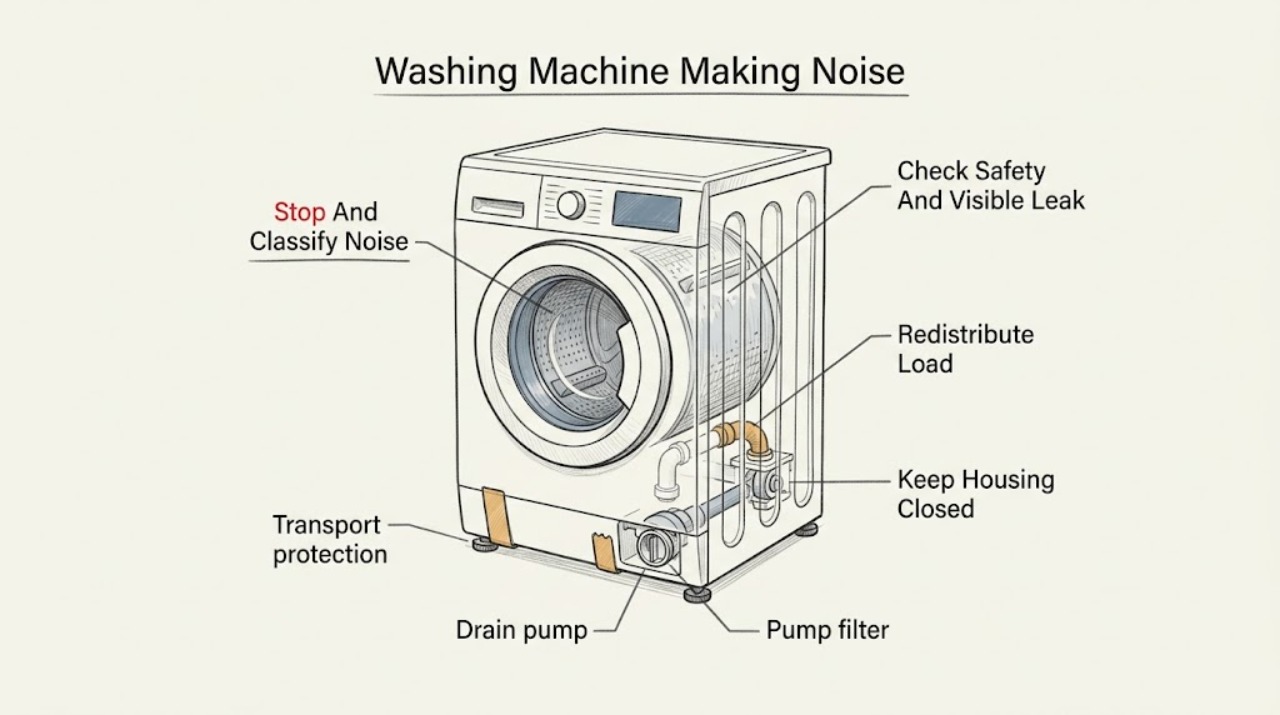
Work through in order
Diagnostic checks
Use only checks that match the exact appliance or system and its official guide.
-
Check 1
Pause or switch the washer off and wait for the drum to stop. From outside the appliance, note whether the noise is a thump, rattle, hum, scrape, grinding sound, or single impact, and whether it occurs during fill, wash, spin, drain, or the whole cycle.
Expected result: The machine moves violently, the sound is a load-dependent thump, the sound occurs only during drain, a metallic scrape follows drum speed, or a safety symptom is present.
Next step: Keep the machine off for any safety symptom. Otherwise continue only with the matching stopped-machine inspection and do not deliberately reproduce a violent or metallic noise.
Stop if: Do not reach into a moving drum, hold the cabinet while it spins, cross pooled water to unplug it, or reset a tripping breaker repeatedly.
Why this matters
Why: The noise timing selects the next safe branch: load and installation for spin movement, filter and pump for drain-only noise, and professional mechanical diagnosis for persistent empty-drum noise. Violent movement, leaking, smoke, burning, sparks, or electrical symptoms override all routine checks.
-
Check 2
From a dry position, check for water on the floor, a damaged cord, a hot outlet, smoke, burning smell, sparks, exposed wiring, or a breaker trip. Do not move the appliance to look behind it if the floor is wet or the unit is stacked or built in.
Expected result: No hazard is visible, a leak is present, an electrical or heat hazard is present, or the machine cannot be safely approached.
Next step: For smoke or fire, leave and contact emergency help. Otherwise keep water and power off as safely possible and call qualified appliance, electrical, or plumbing service. If dry and safe, continue with the symptom-specific checks.
Stop if: Do not touch wet cords or outlets, open panels, pull a stacked unit forward, or operate the machine with a damaged hose or power cord.
Why this matters
Why: A noise together with water or electrical/heat symptoms can create shock, fire, or further damage risk. An inaccessible or unstable appliance cannot be safely diagnosed by pushing or pulling it.
-
Check 3
When the drum has stopped and the appliance is dry, open the door and check whether a small load or one large item has formed a tight lump. Loosen and redistribute the laundry; use the model's documented Drain or Spinning program only if there was no safety symptom and the door and machine are safe to operate.
Expected result: The load is clumped or very small, the load is evenly distributed, the machine moved only during spin, or the drum is empty and still noisy.
Next step: For a clumped load, redistribute and use an appropriate load. If the problem persists with a balanced load or empty drum, stop and follow the installation or service branch.
Stop if: Do not add weight to a machine that is violently moving, run repeated high-speed tests, or reach under the cabinet while it operates.
Why this matters
Why: Gorenje says unevenly distributed laundry or too little laundry can cause vibration and noisy operation and may activate the stability system. An empty-drum noise or noise that does not change with load position is not explained by balancing.
-
Check 4
With the washer off, empty, and stable, check whether it rocks on a solid, dry floor and whether the adjustable feet are visibly seated. If the model instructions permit adjustment, level it in both directions and tighten each foot's lock nut firmly; do not push or tilt a stacked or built-in appliance.
Expected result: The cabinet rocks, a foot is not seated, a lock nut is loose, the floor is unstable, or the machine is level and stable.
Next step: Correct only an accessible adjustment allowed by the exact manual, then verify stability without a high-speed test. If the floor or installation cannot be corrected safely, call an installer or authorized service technician.
Stop if: Do not compensate for an unstable floor with loose blocks, violently rock the cabinet, or adjust feet while the machine is connected or supported unsafely.
Why this matters
Why: Gorenje states that incorrect levelling can cause vibration, sliding, and loud operation. A stable empty machine shifts attention away from basic levelling toward the load, pump, foreign object, suspension, bearing, or another fault.
-
Check 5
If the noise began immediately after installation or a move, compare the visible rear transport-protection hardware with the exact Gorenje installation instructions. Perform this check only when the rear is safely accessible and the appliance does not need to be moved or tilted.
Expected result: Transport bolts or blocking rods appear to remain installed, the hardware was removed as instructed, the appliance was recently moved, or the rear cannot be safely inspected.
Next step: Have an installer or qualified technician correct transport protection when access is unsafe, the unit is stacked, or the installation history is uncertain. Do not run another spin cycle to prove the cause.
Stop if: Do not remove transport hardware from an unstable, stacked, or built-in appliance, and do not transport the machine without the protection required by the manual.
Why this matters
Why: Transport protection is intended to block the drum during movement, so leaving it installed can produce severe vibration. Hardware that was correctly removed shifts the diagnosis toward levelling, load balance, pump, or mechanical service.
-
Check 6
If the noise is limited to draining, use the exact Gorenje manual to identify whether the pump filter is user-accessible. With power disconnected from a dry position and a suitable pan ready, clear only the documented filter and filter-housing area; stop if water is uncontrolled, the filter is stuck, or the pump cannot be safely accessed.
Expected result: The filter or housing contains lint or a small object, the impeller area is obstructed, the filter is clean, the household drain backs up, or the noise continues after the documented cleaning.
Next step: Reinstall the filter fully only after the manual's procedure and a dry inspection. If the noise persists or there is a leak, keep the washer off and call qualified service.
Stop if: Do not reach into a pump, dismantle it, remove hoses under pressure, work in pooled water, or run the machine with the filter or access cover unsecured.
Why this matters
Why: Gorenje associates a loud drain pump with a clogged filter, filter housing, or pump impeller. A clean path with continued noise, a backing-up household drain, or a seized filter needs appliance or plumbing diagnosis rather than repeated cleaning.
-
Check 7
After the drum is stopped and empty, inspect the door seal, drum holes, and visible gap for a loose fastener, coin, wire, or other foreign object. Turn the drum gently only as permitted by the manual and note any repeating scrape, rough spot, side-to-side play, or metal-on-metal contact.
Expected result: A loose object is visible, the drum turns smoothly and quietly, the scrape repeats at one position, the drum has abnormal play, or the sound is a hard impact during spin.
Next step: Remove only a loose object that is plainly accessible without tools and without reaching into hidden parts. For any rubbing, play, impact, or unresolved noise, stop using the machine and arrange authorized service.
Stop if: Do not remove the seal, drum, belt, pulley, motor, suspension, or bearing; do not use tools through drum holes or run the machine to locate an object.
Why this matters
Why: A visible object may explain a rattle, but a repeating scrape, play, impact, or noise with an empty drum can involve suspension, a belt or pulley, bearing, or another internal component. These symptoms cannot be safely confirmed by sound alone.
-
Check 8
Keep the washer off when noise is violent, persistent with an empty drum, accompanied by a leak or electrical symptom, or not resolved by a clearly permitted load or installation correction. Record the model and serial details, cycle stage, load, sound description, movement, filter result, and any display message for service.
Expected result: The noise returns after a balanced load and level check, remains when empty, worsens with speed, or is accompanied by leaking, scraping, impact, smoke, burning, sparks, or a breaker trip.
Next step: Arrange qualified appliance service and do not order a part from the sound alone. Restore operation only after the cause is corrected and the technician or exact manual establishes that the appliance is safe.
Stop if: Do not keep testing, bypass safety devices, open the cabinet, or energize a wet or electrically damaged machine.
Why this matters
Why: A repeat or unloaded noise can require inspection of the pump, suspension, drive, drum, bearing, wiring, or installation. Gorenje advises contacting an authorized service technician when the advised checks do not resolve the problem.
Use your observations
Decision map
Find the observation that best matches what you see, then follow the next safe action.
-
PATH 01Safety boundary
What you see
The washer walks, rocks violently, bangs hard, or threatens to strike nearby fixtures during spin.
Do this next
Pause and wait for the drum to stop. From a dry position, keep people away and check only load distribution and accessible stability; call service if it repeats or access is unsafe.
Why this path and its safety boundary
Why it matters: Stop before damage or injury; an unbalanced load, levelling or installation problem, transport protection, or mechanical fault may be involved.
Safety stop: Do not hold the machine, add improvised weights, or run another high-speed test.
-
PATH 02Safety boundary
What you see
The noise appears during spin with a small or tightly clumped load and improves when laundry is redistributed.
Do this next
Loosen and redistribute the load and use an appropriate program or load size; if the symptom repeats with balanced loads, check levelling and installation.
Why this path and its safety boundary
Why it matters: Gorenje identifies unevenly distributed laundry or too little laundry as a cause of vibration and noisy operation.
Safety stop: Do not continue if movement is violent, water leaks, or an electrical or burning symptom appears.
-
PATH 03Safety boundary
What you see
Noise began after installation or moving, or the cabinet rocks while empty.
Do this next
Compare the accessible installation with the exact Gorenje manual and have an installer correct unsafe or inaccessible work.
Why this path and its safety boundary
Why it matters: Unlevel feet, loose lock nuts, an unstable floor, or transport protection left installed can create loud vibration.
Safety stop: Do not tilt, pull, stack, or remove rear hardware from an unstable appliance.
-
PATH 04Safety boundary
What you see
The noise occurs only while draining and resembles a hum, rattle, or loud pump sound.
Do this next
Use the exact manual's safe filter procedure if the filter is user-accessible; call service for a clean filter with continued noise, a leak, or a backed-up household drain.
Why this path and its safety boundary
Why it matters: A clogged drain-pump filter, filter housing, or pump impeller is a Gorenje-documented possibility.
Safety stop: Do not dismantle the pump or work in pooled water.
-
PATH 05Safety boundary
What you see
A rattle or scrape is linked to one drum position and a visible coin, wire, fastener, or other object is found.
Do this next
Remove only a plainly accessible object without tools; otherwise keep the washer off and have service retrieve it.
Why this path and its safety boundary
Why it matters: The accessible object may be the noise source, but a hidden object can damage the drum or pump.
Safety stop: Do not probe through drum holes, remove the seal, or run the washer to move the object.
-
PATH 06Safety boundary
What you see
Grinding, scraping, side-to-side play, repeated impact, or loud noise remains with an empty drum or increases with drum speed.
Do this next
Stop using the machine and arrange authorized appliance service; provide a recording only if it can be made from a safe, dry position.
Why this path and its safety boundary
Why it matters: Load balance is excluded; suspension, bearing, drive, pulley, belt, foreign object, or another internal fault may require diagnosis.
Safety stop: Do not open the cabinet or replace a mechanical part based only on sound.
-
PATH 07Safety boundary
What you see
Noise accompanies smoke, burning smell, sparks, exposed wiring, repeated breaker trips, a hot outlet, active leaking, or unsafe access.
Do this next
Leave smoke or fire areas and contact emergency help. Otherwise keep the appliance off and call qualified electrical, plumbing, or appliance service as indicated.
Why this path and its safety boundary
Why it matters: The immediate risk is fire, shock, water damage, or injury rather than ordinary noise.
Safety stop: Do not cross water to unplug, reset a tripping breaker, touch wet electrics, or restart the appliance.
Helpful context
Understand the symptom
The timing and character of the noise matter
Listen only from outside the machine and note whether the sound occurs while filling, agitating, accelerating, spinning, draining, or after the cycle stops. A rhythmic thump that changes with load position is different from a high-pitched scrape that follows drum speed. A hum or rattle limited to draining sends the investigation toward the filter and pump. A hard impact, grinding, or rubbing with an empty drum points away from laundry balance and toward a mechanical fault that should not be tested repeatedly.
Start with a safe stop and a dry inspection
Pause or switch the washer off at its controls. If there is water on the floor, smoke, a burning smell, a hot outlet, sparking, or a repeated breaker trip, do not cross water to unplug it or touch wet electrical parts. Keep the door closed until the drum stops. Once the machine is cool and the floor is dry, record the noise, display message, load type, and point in the cycle. This record helps separate a temporary unbalanced load from an installation or internal fault.
Balance and levelling are separate checks
Gorenje explains that a small load or laundry that clumps together can trigger its stability system, causing redistribution attempts, reduced spin speed, or a skipped spin. This is different from a machine that rocks when empty or a cabinet that walks because its feet are not level. With the machine stopped, redistribute the load and check stability without pushing the cabinet violently. If the machine was recently installed or moved, verify that the installation instructions were followed and that the adjustable-foot lock nuts are tight.
Transport bolts are an installation issue
Transport protection locks the drum for moving the appliance and must be removed before normal use according to the model's installation instructions. If the noise began on the first cycle after installation, or the machine vibrates severely from the start, stop and inspect the rear only from a safe accessible position. Do not loosen or remove hardware if the appliance is stacked, built in, unstable, or difficult to access; an installer or technician should correct it. Transport hardware must be reinstalled for a later move, not left in place for washing.
A drain-pump sound follows the water path
If the sound appears only as water leaves the tub, Gorenje's troubleshooting guidance points to a clogged drain-pump filter, filter housing, or pump impeller. Do not assume every Gorenje model exposes the same filter or access route. Use the exact manual, disconnect power only from a dry position, drain residual water as instructed, and stop if the filter is seized, the area leaks, or the pump is inaccessible. A coin, fastener, or other object can produce a rattle, but reaching into the pump or dismantling it is not a low-risk adjustment.
Empty-drum scraping and repeated impact need service
After the drum is completely stopped, rotate it only as far as the model instructions permit and observe whether there is a repeating scrape, rough spot, side-to-side looseness, or metal-on-metal sound. Do not use force and do not remove the drum, pulley, belt, motor, shock absorber, or cabinet. Noise that remains with no laundry, becomes louder with speed, is accompanied by a leak, or includes a violent impact may involve suspension, a foreign object, a pulley or belt, a bearing, or another model-specific component. The sound alone cannot identify which part is failed.
When checks do not resolve it
Need a professional?
Safety scope: Stop and keep the washer off for violent movement, metallic impact, grinding that persists empty, active leaking, smoke, burning smell, sparks, exposed wiring, hot outlets, repeated breaker trips, or unsafe access. Do not reach into a moving drum, open the cabinet, bypass safety devices, dismantle the pump, or work in pooled water.
Common questions
FAQ
Why does my Gorenje washer bang only during spin?
A small or clumped load, incorrect levelling, loose foot lock nuts, or transport protection left after installation can cause spin vibration. Redistribute a safe load and check stable levelling from a stopped, dry machine; repeated or violent banging needs service.
Why is the Gorenje washer loud only when draining?
Gorenje associates a loud drain pump with a clogged pump filter, filter housing, or pump impeller. Use the exact model's filter procedure only when the area is dry and safe; a clean filter, leak, or backed-up drain needs service.
Could transport bolts cause noise after installation?
Yes. Transport protection is used to secure the drum during movement and should be removed according to the installation instructions before washing. If access is unsafe or the washer is stacked or built in, have an installer correct it.
How do I tell an unbalanced load from a bearing or drum problem?
An unbalanced load usually changes when laundry is redistributed and is most noticeable during spin. Grinding, scraping, side-to-side play, repeated impact, or noise that remains with an empty drum is not explained by load balance and should be professionally diagnosed.
Can I keep using the washer if it is noisy but still completes cycles?
Do not keep using it if the noise is violent, metallic, worsening, persists empty, or comes with leaking, smoke, burning smell, sparks, a hot outlet, or a breaker trip. A minor load or levelling issue may be corrected by the manual, but unresolved noise can cause further damage.
Should I remove a foreign object from the drum myself?
Only remove an object that is plainly visible and accessible without tools after the drum has stopped and power is safely disconnected. Do not probe through drum holes, remove the seal or cabinet, or dismantle the pump; call service for a hidden object.
Read the exact guide
Official sources
- User ManualGorenje · Gorenje washing-machine manual content; model-specific instructions control.
- User ManualGorenje · Gorenje washing-machine troubleshooting examples; model-specific instructions control.
- USER MANUALGorenje · Gorenje washing-machine installation and connection guidance; exact model instructions control.
Community feedback
Share a repair observation
Share a plain-text repair observation. Accepted observations are published automatically; this page may take a moment to update.