
On this page
Start here
Quick answer
First identify whether the Haier dryer is vented or a condenser/heat-pump model. A vented Haier dryer exhausts warm air through an external duct and may not have a condensate tank or drain hose; a condenser or heat-pump model can collect water in a tank or send it through a supplied drain hose. Do not connect or reroute a hose until the exact model manual confirms that design. For a confirmed tank or hose model, check only the accessible tank, rear hose connection, and sink/sewer end; persistent leakage, a full tank that returns, or an uncertain model needs Haier or qualified service.
Work through in order
Diagnostic checks
Use only checks that match the exact appliance or system and its official guide.
-
Check 1
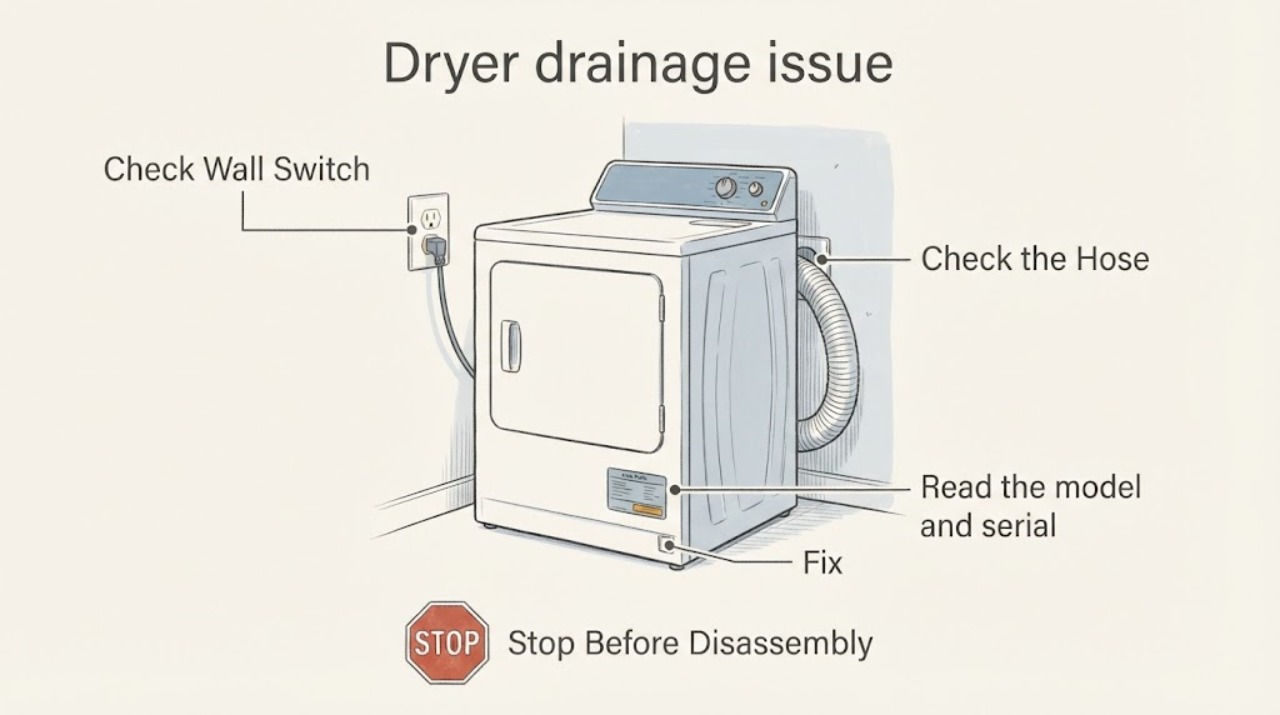
Read the model and serial label and confirm the drying system in the exact Haier manual before looking for a drain fault.
Expected result: The manual or product page identifies a vented dryer with an exhaust duct, or a condenser/heat-pump dryer with a water tank or drain-hose option.
Next step: Follow the matching branch below. If the model or drying system cannot be confirmed, stop before moving hoses or opening panels and obtain the exact manual or service support.
Why this matters
Why: A vented design routes moist air through an exhaust path; a condenser or heat-pump design turns moisture into collected water. The same “drainage” wording cannot be applied to both designs.
-
Check 2
For a confirmed condenser or heat-pump dryer with a water tank, switch the dryer off, let accessible hot surfaces cool, remove only the user-removable tank described by the exact manual, and empty it.
Expected result: The tank is full, partially full, dry, difficult to remove, or does not seat correctly when returned to its housing.
Next step: Reinstall the tank exactly as the model manual shows and keep the water away from drinking or food use. If the tank repeatedly fills abnormally, leaks, or will not seat, stop using the dryer and arrange model-specific service.
Why this matters
Why: Haier says condensed water is collected in the tank and should be emptied after each drying cycle; a tank that cannot be removed or reseated is not a reason to pry into the cabinet.
-
Check 3
For a confirmed model with a supplied direct-drain option, inspect only the accessible hose connection at the rear and the hose end placed in the sink or sewer.
Expected result: The rear hose is disconnected from the supplied drainage hose, the outlet end is not in the intended sink/sewer, or water is visible outside the intended receptacle.
Next step: With the dryer off, restore only the model-approved hose connection and secure outlet placement. Do not substitute a hose, drill a drain, or remove a rear panel without exact model instructions.
Why this matters
Why: Haier's heater-pump instructions use a rear connection and place the supplied hose end in a sink or sewer. This check verifies the external water path but does not prove an internal pump or condenser fault.
-
Check 4
Check the floor and the area around the tank housing or hose outlet for fresh water after the dryer is cool and idle.
Expected result: Water is under the appliance, around the tank housing, at the rear connection, or absent even though the dryer reports or appears to have a drainage problem.
Next step: Dry the area, keep the dryer out of service if water can reach electrical parts, and give the exact location and model to Haier service. Do not tip the dryer or probe internal passages.
Why this matters
Why: The location separates a visible external tank/hose issue from a symptom that cannot be identified from outside. No visible water does not prove that a pump or condenser is working.
-
Check 5
Compare the symptom with the dryer design: a vented unit should be assessed at its approved exhaust route, while a tank or hose model should be assessed at its water collection path.
Expected result: The dryer has an exhaust duct but no water tank/hose, or it has a water tank/hose and the expected water path is not working.
Next step: For a vented model, use the exact manual's exhaust and lint guidance rather than adding a water drain. For a tank/hose model, use only its manual-specific water-path instructions; escalate if the model does not match the available guide.
Why this matters
Why: A vented model can be incorrectly labeled as a drainage problem, while a condenser/heat-pump model can have a tank or direct-drain issue. The design identity must be resolved before parts or cleaning instructions are selected.
-
Check 6
Record the model, region, drying system, tank status, hose connection, and where any water appeared before requesting service.
Expected result: The model information and external evidence clearly match a tank/hose dryer, or the information conflicts with the suspected drainage setup.
Next step: Keep the dryer off if water is leaking or the water path is uncertain and provide the records/photos to Haier or a qualified appliance technician. Do not order a pump, hose, tank, or filter from a generic listing.
Why this matters
Why: Haier's published examples are model- and region-specific. A conflict can indicate a vented dryer, a different product family, or an installation that does not match the manual.
Use your observations
Decision map
Find the observation that best matches what you see, then follow the next safe action.
-
PATH 01Next step
What you see
The exact Haier product is vented and has an exhaust duct but no tank or approved condensate hose.
Do this next
Do not add a water hose or search for a tank. Follow the exact vented-dryer manual and arrange service if the dryer is leaking, not drying, or the approved exhaust path is abnormal.
Why this path and its safety boundary
Why it matters: The task's drainage wording is not enough to create a water-drain procedure for this dryer; the moisture path is the exhaust system shown by the model documentation.
-
PATH 02Next step
What you see
The exact Haier product is a condenser or heat-pump dryer with a removable tank, and the tank is full or not seated.
Do this next
Turn the dryer off, cool it, empty and reseat the tank as the exact manual shows, and arrange service if the problem returns or the tank leaks.
Why this path and its safety boundary
Why it matters: The accessible collection tank is the first water-path branch supported by Haier's guidance.
-
PATH 03Next step
What you see
The exact Haier product supports a supplied direct-drain hose, but the rear connection or sink/sewer end is disconnected or misplaced.
Do this next
Restore only the supplied, model-approved connection and outlet placement with the dryer off; keep the unit out of service if leaking persists.
Why this path and its safety boundary
Why it matters: The visible external hose path can account for water not reaching the intended outlet, but it does not identify an internal fault.
-
PATH 04Next step
What you see
Water reaches the floor, electrical area, or an inaccessible internal area, or the tank/hose path appears correct but drainage still fails.
Do this next
Stop using the dryer, keep power isolated if water is near electrical components and it is safe to do so, and arrange model-specific service. Do not open the cabinet or tip the appliance.
Why this path and its safety boundary
Why it matters: The external checks do not establish a safe user repair and an internal water-handling issue remains possible.
-
PATH 05Next step
What you see
The model number, region, and drying system cannot be confirmed.
Do this next
Obtain the exact manual or request Haier support before moving hoses, removing a tank, cleaning an internal filter, or selecting a part.
Why this path and its safety boundary
Why it matters: Haier's vented and condenser/heat-pump families have different water and air paths, so generic drainage instructions could be wrong.
Helpful context
Understand the symptom
“Drainage issue” is not enough to assume that every Haier dryer has a drain hose. Haier sells vented dryers as well as condenser and heat-pump designs. Start with the model label and manual, then follow only the water path that the exact product actually has.
The checks below stay outside the cabinet. They cover an accessible tank, a supplied rear drain hose, and the external outlet. They do not diagnose an internal pump, float, condenser, sensor, or blocked internal passage, and they do not turn a vented dryer into a drainable model.
When checks do not resolve it
Need a professional?
Arrange Haier or qualified service when water leaks onto the floor or near electrical components, a tank repeatedly fills or will not reseat, a supplied hose is correctly connected but drainage still fails, the dryer has no user-accessible water path matching the complaint, or the model cannot be identified. Do not open the cabinet, tip the dryer, clean an internal pump or condenser path, or choose a hose, tank, pump, or filter from a generic listing.
Common questions
FAQ
Do all Haier dryers need a drain hose?
No. Haier's official product pages show vented models as well as condenser or heat-pump models with a tank or drain-hose option. Confirm the exact model before connecting or rerouting anything.
What should I do if the Haier dryer water tank is full?
For a confirmed tank-equipped model, turn the dryer off, cool it, empty the removable tank, and reinstall it as the exact manual shows. Haier says not to use the collected water for drinking or food processing. A tank that fills abnormally, leaks, or will not seat needs service.
Can I use a generic hose or clean the pump to fix the drainage issue?
Not from this information. Haier's published hose guidance refers to the supplied hose and a specific heater-pump family. Without the exact model manual, do not substitute a hose, open the cabinet, or clean an internal pump or passage.
Read the exact guide
Official sources
- Haier HDV70E1 Vented DryerHaier Thailand · Official model page for HDV70E1 only; used to demonstrate why a model check is necessary, not to classify the unspecified dryer.
- Haier JZ-K90A Heat-Pump DryerHaier Japan · Official model page for JZ-K90A only; it is a second model-specific example of tank/hose variation and does not establish the user's model.
- How to empty the water tank of Tumble DryerHaier South Africa · Official Haier tumble-dryer water-tank guidance; tank location and controls vary by model.
- How to connect the drain hose of Heater Pump DryerHaier Saudi Arabia · Official Haier heater-pump dryer guidance; applies to the covered heater-pump family and is not a universal instruction for every Haier dryer.
- Haier GDNE9-636 Condenser DryerHaier · Official model page for GDNE9-636 only; used to demonstrate the condenser-family water path, not to assign this model to the task.
Community feedback
Share a repair observation
Share a plain-text repair observation. Accepted observations are published automatically; this page may take a moment to update.